
Table of Contents
Table of Contents
When someone searches for audit ready retention policy kafka, they are usually past the tutorial stage. The pressure is coming from a review, a procurement checklist, a regulator, or an incident where the team must explain why some data remained available, why other data expired, and who had authority to change that behavior.
That is where Kafka retention becomes more than a topic setting. A retention policy is a promise about data availability, deletion timing, replay scope, cost exposure, and operational recovery. Audit readiness means the platform team can prove that the promise in the policy matches the behavior of the running system. If that proof depends on a senior engineer remembering a cluster exception from two years ago, the system is not audit-ready, even if every topic has a valid configuration value.
The useful framing is stricter: an audit-ready Kafka retention policy needs a control path, a data path, and an evidence path. The control path says who can define or change the policy. The data path shows where retained records, metadata, copies, and downstream exports live. The evidence path records what changed, when it changed, and how the team verified that production behavior still matches the policy.
1Why teams search for audit ready retention policy kafka
Kafka is often the system of record for operational time, even when it is not the legal system of record for business data. Payment events, identity updates, fraud decisions, observability data, model features, order flows, and customer activity streams may all pass through Kafka before landing in databases, lakes, warehouses, search indexes, or AI pipelines. The retained log becomes the place teams return to when they need replay, reconciliation, backfill, incident analysis, or forensic review.
That makes retention policy a cross-functional decision. Data governance teams care about classification, deletion, and evidence. Security teams care about access, encryption, network paths, and change history. Platform teams care about broker capacity, consumer lag, partition count, and recovery behavior. None of those groups can evaluate the policy in isolation because the risk appears where their concerns intersect.
The most common mistake is treating retention as a single duration. A topic with seven-day retention may be low risk if it contains operational telemetry, has a clear owner, and is exported to a governed store. The same setting can be high risk if the topic contains sensitive identifiers, feeds unmanaged consumers, and has no evidence of who can reset offsets or extend retention.
Audit readiness starts by separating five questions:
- Retention objective: Is the policy designed for replay, compliance, debugging, downstream recovery, or cost control?
- Scope: Does the policy apply to the topic only, or also to connectors, exported objects, compacted topics, snapshots, backups, and derived tables?
- Authority: Who can create, extend, reduce, or override the policy, and how is that approval recorded?
- Runtime proof: Which metrics show retained bytes, topic configuration, consumer lag, offset movement, and deletion behavior?
- Recovery proof: Can the team replay or roll back within the stated window without violating access or residency requirements?
2The production constraint behind the problem
Apache Kafka exposes retention through topic and broker configuration, including time-based and size-based controls such as retention.ms and retention.bytes. That surface area is clear for individual topics. The production constraint comes from the way traditional Kafka stores retained log segments: brokers own local storage, partitions are placed across brokers, and replication keeps copies available for durability and availability.
In a Shared Nothing architecture, longer retention is not only a policy change. It becomes a capacity planning decision for broker-local disks, replica placement, failure recovery, and reassignment windows. If a topic's retention window expands, retained bytes must fit somewhere. If a broker fails or a cluster scales, the system may need to restore or move partition data. Tiered Storage can move older data to remote storage, but hot data and broker operations still need sizing and validation.
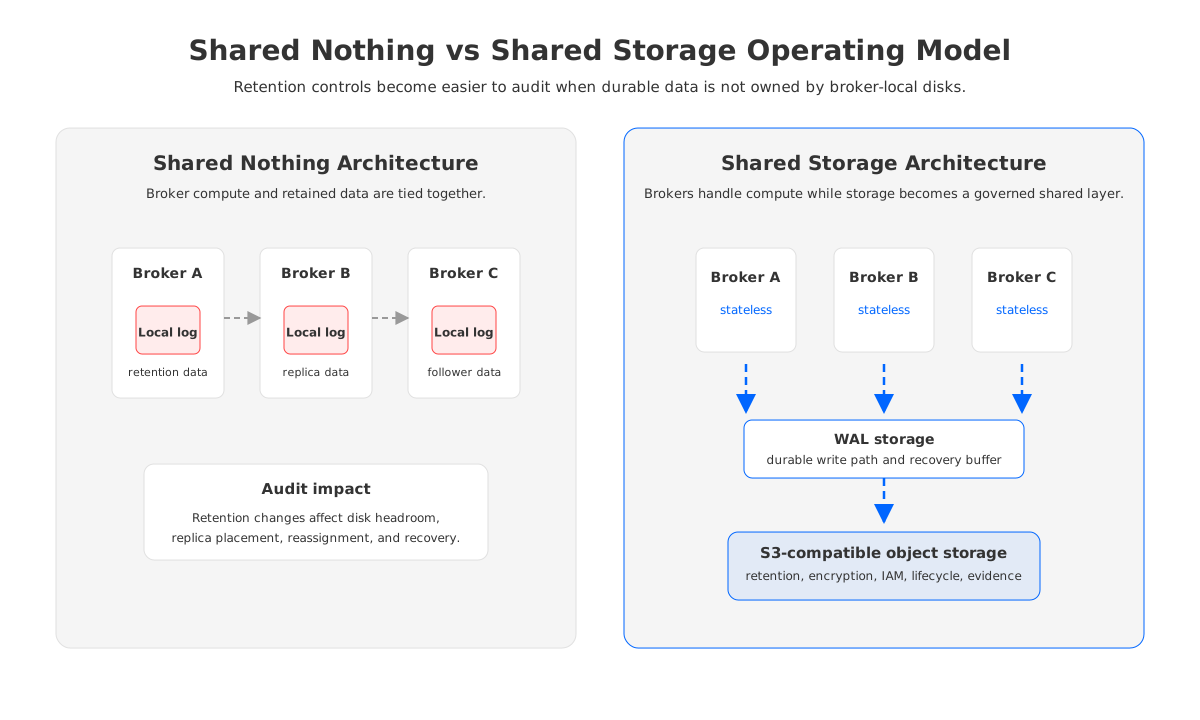
This is not a criticism of Kafka's design. Kafka's log abstraction is the reason teams depend on it for replay and durable streaming. The issue is that audit-ready retention requires a stable map from policy to physical behavior. Broker-local storage makes that map harder to maintain because operational actions can change where data is copied, how long recovery takes, and which capacity constraint dominates the next incident.
The audit concern is not limited to data payloads. Topic names can reveal business processes, Consumer group names can reveal application topology, offset resets can reveal replay decisions, and connector state can reveal downstream movement. A policy that only describes the main topic misses the metadata and operational actions that make it enforceable.
Platform teams should document retention in two layers. The Kafka layer covers topic configuration, compaction mode, partition count, replication settings, consumer groups, offset reset permissions, and owner metadata. The infrastructure layer covers storage location, encryption keys, identity boundary, network path, lifecycle rule, observability export, and evidence repository. Together they explain both intent and implementation.
3Architecture options and trade-offs
There are several defensible ways to make Kafka retention more audit-ready. The right option depends on workload, compliance boundary, operating model, and migration tolerance.
| Option | Where it helps | What to test before relying on it |
|---|---|---|
| Tighten topic governance on the existing Kafka estate | Good first step when drift, stale topics, or missing owners are the main problem | Topic inventory completeness, owner review cadence, ACL hygiene, offset reset workflow, and evidence export |
| Add Tiered Storage | Useful when long historical retention pressures local storage | Hot set sizing, remote fetch behavior, lifecycle policy, recovery behavior, and compatibility with operational tooling |
| Move retained data to a downstream governed store | Useful when Kafka should be a transport and replay layer, not the long-term evidence store | Connector reliability, schema evolution, exactly-once or idempotent writes, deletion propagation, and query access controls |
| Adopt a Kafka-compatible Shared Storage architecture | Useful when broker-local storage is the dominant scaling, recovery, or retention constraint | Kafka client compatibility, WAL choice, object storage governance, migration plan, rollback path, and observability model |
The table matters because audit readiness should not be a shortcut for replacing platforms. Many retention problems are governance problems. If the team cannot name topic owners, explain why retention differs by topic class, or show who can change ACLs, an architecture change will not fix the control gap. Start with inventory and ownership because those controls travel with you.
At the same time, governance cannot erase architectural friction. If every retention decision creates broker disk pressure, every scaling decision risks data movement, and every migration plan must preserve offsets while traffic continues, platform teams are not only managing policy. They are managing the physical consequences of the policy. That is where architecture becomes part of the audit discussion.
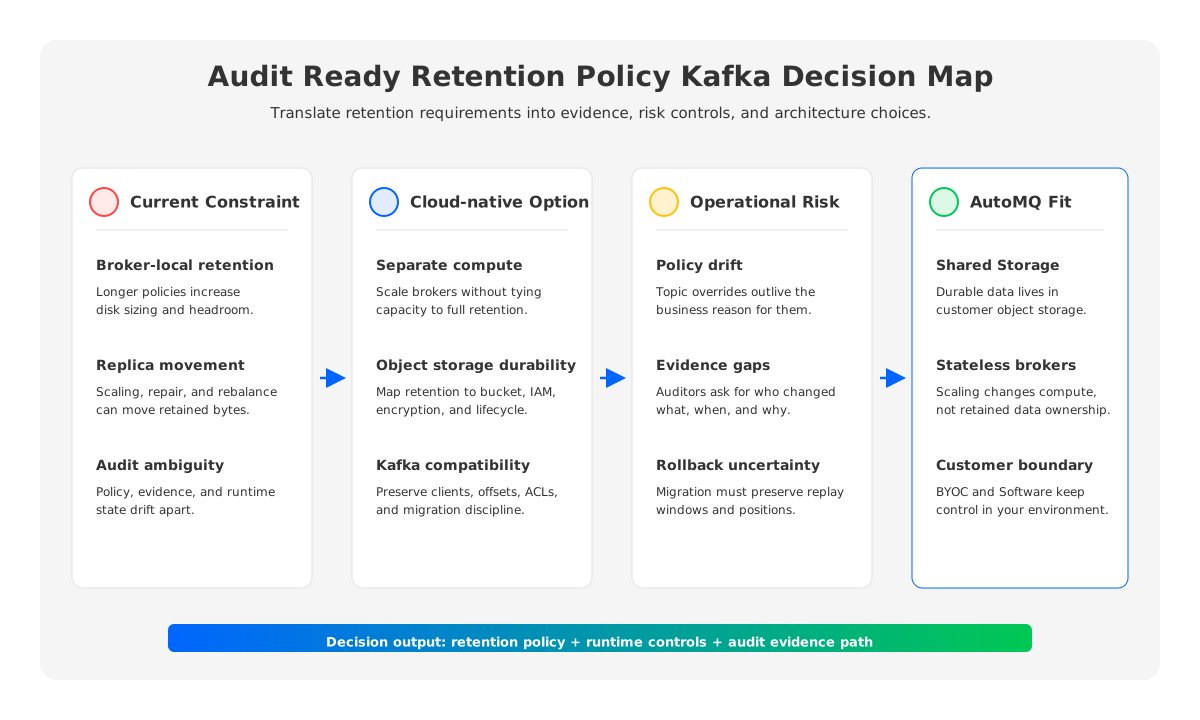
A neutral evaluation should ask whether the platform can keep four things aligned: Kafka semantics, storage control, operational elasticity, and evidence generation. Kafka semantics matter because producers, consumers, offsets, transactions, and Kafka Connect integrations are embedded in application behavior. Storage control covers encryption, residency, lifecycle, and access boundaries. Operational elasticity matters because audit windows do not pause during scale-out, broker replacement, or incident recovery. Evidence generation matters because a control that cannot be demonstrated under pressure is weak.
4Evaluation checklist for platform teams
The checklist below is a readiness review rather than a product comparison. It helps teams decide whether their current Kafka deployment, an improved Kafka design, or a Kafka-compatible alternative can support audit-ready retention policies.
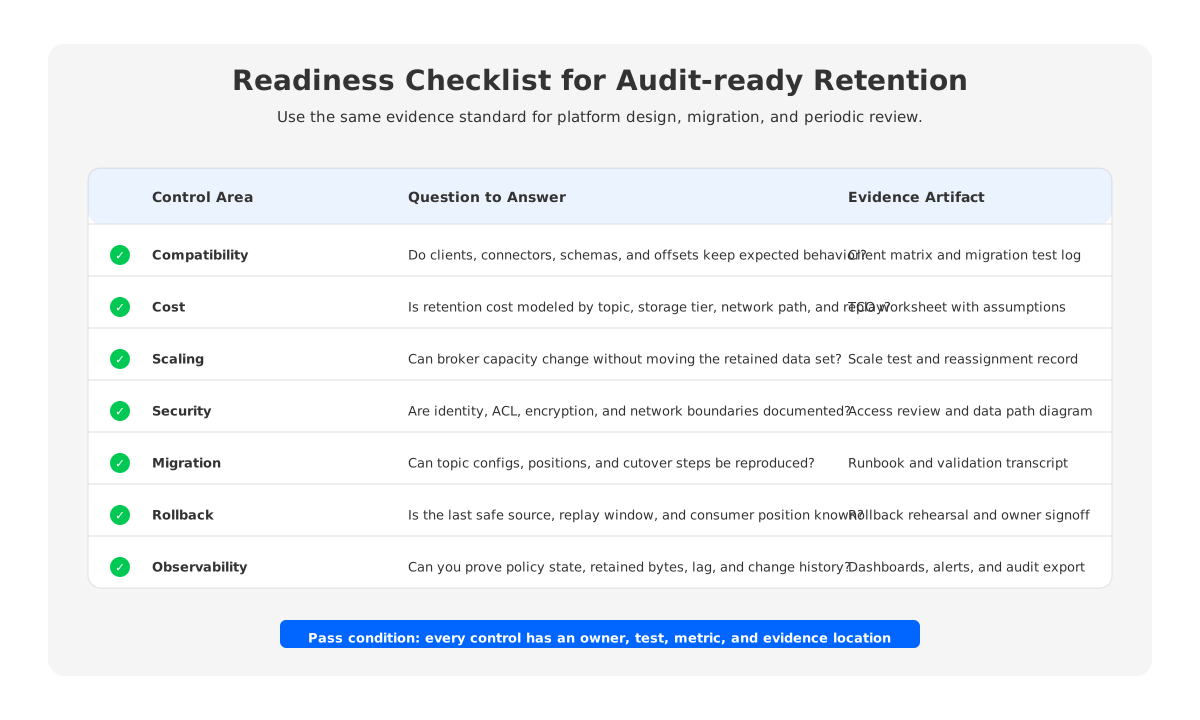
Start with compatibility. List the client libraries, Kafka protocol versions, producer settings, Consumer group behavior, Kafka Connect tasks, schema rules, transactional workloads, and admin operations that matter. A platform can look strong on paper and still fail the audit if migration changes offsets, breaks a connector, or weakens consumer resume behavior.
Then model cost and capacity using the same retention assumptions that appear in the policy. Do not stop at stored bytes. Include replication, hot set size, remote reads, object storage operations, cross-zone or cross-region traffic, migration overlap, monitoring retention, and review labor. Precise dollar figures should come from the cloud provider's current pricing page for the target region.
Security review should trace both the data path and the control path. The data path covers producers, brokers, WAL or log storage, object storage, consumers, connectors, and downstream exports. The control path covers who can create topics, alter configs, reset offsets, change ACLs, deploy connectors, access buckets, or approve exceptions. These paths need to be explicit.
Migration and rollback deserve their own evidence. For retention-sensitive topics, a migration plan should say which offsets move, which Consumer groups switch, how writes are cut over, and what condition triggers rollback. The rollback plan should identify the last safe source, the replay window, the approver, and the validation metric.
5How a Shared Storage architecture changes the operating model
After that evaluation, AutoMQ becomes relevant as a Kafka-compatible cloud-native streaming platform built around Shared Storage architecture. It keeps the Kafka protocol and ecosystem interface while changing the storage model underneath: durable data is stored in S3-compatible object storage through S3Stream, while AutoMQ Brokers focus on request handling, leadership, caching, and scheduling rather than owning broker-local persistent logs.
That distinction changes the retention conversation. In a broker-local model, a longer retention window tends to expand the broker storage problem. In AutoMQ's Shared Storage architecture, retention policy maps to object storage governance: bucket ownership, encryption, IAM, lifecycle, observability, and data residency. Brokers can be treated more like stateless compute nodes, while the durable retention layer sits in customer-controlled storage.
The benefit for audit readiness is not that architecture replaces governance. It gives governance a clearer boundary. AutoMQ BYOC runs the control plane and data plane in the customer's cloud account and VPC, and AutoMQ Software is designed for customer-managed private environments. Those deployment models are relevant when compliance teams need to know where Kafka records, operational metadata, control services, metrics, and access permissions live.
AutoMQ's migration tooling also matters because the hardest migration problem is often preserving replay semantics, not byte movement. Kafka Linking is designed to copy topic data while preserving offsets and synchronizing Consumer group progress, which gives teams a more testable path for cutover and rollback planning. The migration still needs a runbook, ownership, test traffic, and validation.
There are still trade-offs to test. WAL storage choice affects latency and deployment behavior. Object storage governance must match the organization's security model. Long-retention workloads should test catch-up reads and replay patterns, not only steady writes. A proof of concept should include client compatibility, topic configuration, ACLs, schema flows, consumer lag, offset resets, observability, and failure drills.
The practical outcome is a different operating model: retention policy is no longer forced to share the same capacity boundary as broker-local disks. Platform teams can separate compute scaling from durable data governance, while audit teams get a clearer path from written policy to runtime evidence.
6A readiness scorecard you can use
Use this scorecard before a platform review, migration plan, or procurement discussion. Score each row from 1 to 5, where 1 means "undocumented" and 5 means "documented, automated, tested, and owned."
| Control | Score | Evidence to collect |
|---|---|---|
| Topic inventory | Owner, purpose, classification, retention, compaction, partitions, schemas, and downstream systems | |
| Access control | ACLs, RBAC roles, service accounts, storage IAM, emergency access, and review history | |
| Retention enforcement | Topic configs, lifecycle rules, retained bytes, deletion behavior, and exception approvals | |
| Replay safety | Consumer group positions, offset reset policy, replay runbooks, and backfill validation | |
| Migration readiness | Compatibility matrix, cutover plan, rollback condition, and test transcript | |
| Observability | Dashboards for policy state, retained bytes, lag, storage health, and change history | |
| Data boundary | VPC, storage account, encryption keys, network path, and export destinations |
The score is less important than the empty cells. Empty evidence cells show where audit risk hides. They also show whether the next step is governance cleanup, Kafka tuning, downstream data management, or an architectural evaluation.
An audit-ready retention policy is not a longer retention window with a nicer name. It is a system of controls that lets the team prove what data exists, where it lives, who can change it, how long it remains available, and how replay behaves during failure or migration. If your current Kafka architecture makes that proof depend on local disk state and manual reconstruction, it is time to evaluate whether a Shared Storage architecture belongs in the design review. To compare AutoMQ against your own retention, governance, and migration requirements, start with the AutoMQ architecture overview or open an evaluation through AutoMQ Cloud.
7FAQ
7.1Is Kafka retention policy enough for compliance?
No. Kafka retention settings help define how long records remain in Kafka, but compliance depends on data classification, access control, encryption, deletion workflow, downstream exports, operational evidence, legal requirements, and reviewed procedures. Treat Kafka retention as one control in a broader governance system.
7.2Should audit logs stay in Kafka forever?
Usually no. Kafka is strong for durable streaming, replay, and event distribution. Long-term audit evidence often belongs in a governed object store, table format, warehouse, or archive with query, lifecycle, and access controls. Kafka can feed that system while preserving a shorter operational replay window.
7.3Does Tiered Storage make Kafka audit-ready?
Tiered Storage can reduce local storage pressure by moving older log segments to remote storage, but audit readiness still requires ownership, access control, evidence, observability, migration planning, and deletion review. It is a storage lever, not a complete governance model.
7.4What should be tested before migrating retention-sensitive Kafka workloads?
Test producer and consumer compatibility, topic configuration parity, schema behavior, ACLs, connector state, offset preservation, Consumer group progress, replay windows, rollback conditions, observability, and failure recovery. A migration that preserves data but loses replay semantics is not ready for regulated workloads.


