
Table of Contents
Table of Contents
Teams search for incident audit trail kafka when the incident channel has already become messy. Security wants to know which identity changed a permission. SREs want to know which consumers fell behind and which replay window is safe. Governance wants proof that sensitive records followed policy after the first alert. Kafka sits in the middle because the incident often touches records, offsets, schemas, connectors, and downstream systems at the same time.
An incident audit trail is not only an admin log. It lets a team reconstruct what happened while the platform was under stress. That trail has to connect producers, Topics, Partitions, Offsets, Consumer groups, schema decisions, connector delivery, configuration changes, access grants, storage health, and operator actions. If those facts live in separate systems with different clocks and no replay plan, the audit trail becomes manual reconstruction.
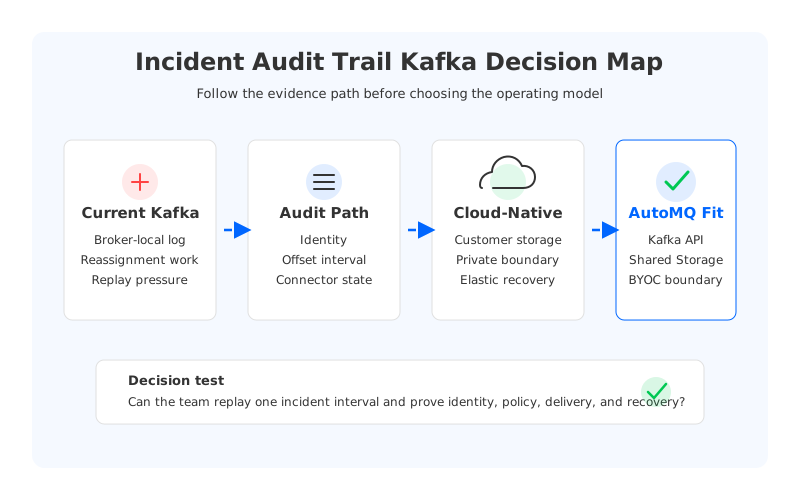
The stronger design goal is a streaming evidence path. Kafka can carry ordered events, give consumers independent positions, and replay a known interval. The hard part is deciding which controls belong in the event path, which controls belong in the platform boundary, and which controls prove that recovery did not create a second failure.
1Why teams search for incident audit trail kafka
The search usually starts with a practical question: can Kafka become the shared timeline for incident response? Kafka already gives platform teams a time-ordered log, durable topics, offset-based replay, and independent Consumer groups. Apache Kafka also has an ecosystem around Kafka Connect, security configuration, transactions, stream processing, and monitoring, so many organizations can move evidence into security, analytics, and archive systems.
The difficulty is that incident evidence is not a single stream. A useful timeline may need the event that triggered an alert, the schema version that accepted it, the identity policy that allowed it, the connector that exported it, the Consumer group that processed it, and the operator action during recovery. Each item can be valid alone and still fail as evidence if the team cannot connect it to the same incident interval.
That is why the platform review should start with the incident question rather than the logging question. Logging asks whether an action was recorded. Incident audit asks whether the team can reconstruct a chain of custody under pressure: what entered the stream, who touched it, which consumers observed it, where it moved next, and whether recovery changed the record.
2The production constraint behind the problem
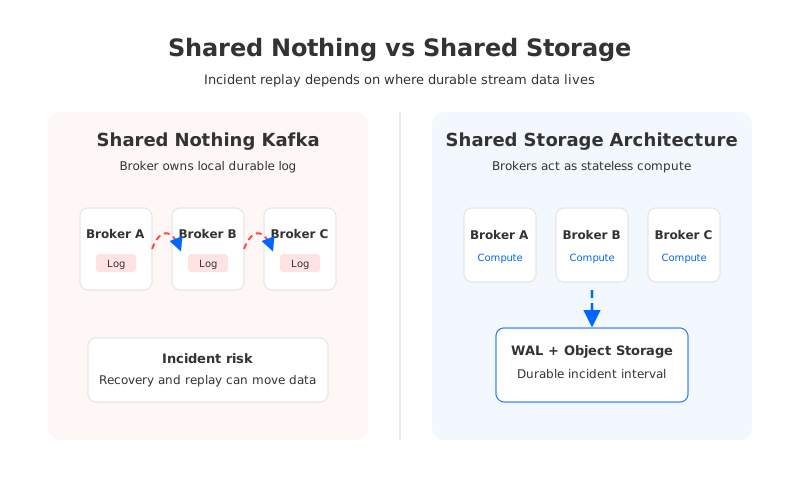
Traditional Kafka can support incident audit workloads, but its Shared Nothing architecture ties durable log data to broker-local storage. Each broker owns local partitions, and replication keeps copies across brokers for availability. That model works for many clusters, yet it turns retention, replay, scaling, broker replacement, and reassignment into storage work that may happen during the investigation window.
Incident audit trails make this coupling visible. An investigation often needs longer retention for a narrow topic set, catch-up reads for a specific interval, and reliable consumer progress while live traffic continues. If a broker is unhealthy, a partition is reassigned, or a cluster is scaled, the audit path has to explain both application behavior and recovery behavior. The risk is not only data loss. The risk is an evidence gap that forces responders to guess.
Tiered Storage can help when historical segments pressure local disks. It is useful when older data can move to remote storage while the active log remains sized and operated through Kafka brokers. It does not make brokers stateless, and it does not remove the need to validate local-log behavior, metadata, leadership changes, remote reads, and recovery procedures. For incident audit trails, the platform has to prove availability and explainability at the same time.
The production constraint is broader than storage. The audit trail also depends on identity, network boundaries, schema ownership, connector state, cloud IAM, object storage permissions, observability data, and support access. Topic names, Consumer group names, Offset resets, and connector failures can reveal business behavior or recovery decisions. A good audit design treats these facts as part of the control surface, not as background noise.
3Architecture options and trade-offs
A neutral review should separate the audit trail into four layers: capture, correlation, retention, and recovery. Capture records incident facts near the source. Correlation connects those facts across Kafka and surrounding systems. Retention keeps the interval available. Recovery proves that replay, rollback, and repair did not alter the evidence path.
| Option | Where it helps | What can still fail |
|---|---|---|
| Application audit logs | Closest to business intent and domain context | Uneven implementation across teams, weak offset correlation, and missing platform state |
| Central security log pipeline | Good for enterprise review, SIEM intake, and long-term archive | Delayed ingestion, weak ordering, and limited replay semantics |
| Kafka-native incident evidence topics | Strong fit for ordered event history, replay, fan-out, and multiple responders | Requires schemas, ownership, retention policy, and operational monitoring |
| Kafka-compatible Shared Storage architecture | Reduces dependence on broker-local disks for retained stream data | Requires validation of compatibility, WAL behavior, object storage controls, and migration plan |
This table keeps the conversation grounded. Some organizations need better application instrumentation before they need a different streaming platform. Others have strong governance but still struggle because every retention or replay decision becomes a broker capacity question. The answer depends on where the evidence gap appears.
The decision map is usually clearest when teams score each layer against the same controls:
- Compatibility: Existing producers, consumers, Kafka Connect workers, serializers, transactions, ACL workflows, and monitoring tools should continue to behave as expected.
- Cost and capacity: Retention, replay, storage media, object requests, cross-Availability Zone (AZ) traffic, observability retention, and migration overlap should be modeled as part of the audit workload.
- Governance: Topic ownership, schema or data contract rules, identity mapping, encryption, access review, object storage policy, and exception handling should have named owners.
- Recovery: Broker failure, controller failover, connector failure, bad schema release, offset reset, and rollback should be tested against a known incident interval.
- Boundary control: The review should name where the control plane, data plane, storage, logs, metrics, support access, and downstream exports live.
The most useful test is concrete: choose an incident interval and ask whether the team can follow it from producer identity to Topic, Offset, Consumer group progress, connector delivery, archive state, platform changes, and recovery action. If that path requires spreadsheets, it is not ready for incident audit pressure.
4Evaluation checklist for platform teams
Start with the incident taxonomy. Decide which events must be part of the audit trail and which can remain in surrounding systems. Access grants, ACL changes, service-account creation, schema decisions, contract violations, topic configuration changes, connector deployments, key-policy changes, offset resets, and recovery actions are strong candidates because order and replay matter. Static approvals can stay outside Kafka unless they participate in runtime decisions.
Then define the event contract. An incident audit event should carry the actor, resource, action, policy result, timestamp source, correlation identifier, affected topic or partition, and evidence class. For Kafka-specific events, include Offset intervals, Consumer group names, connector task identifiers, schema versions, and retry outcomes where they apply. The goal is joinable evidence without giving every responder direct access to every raw system.
Security review should trace data path and control path separately. The data path covers producers, brokers, WAL or log storage, object storage, consumers, connectors, and downstream systems. The control path covers who can create topics, change configs, reset offsets, alter ACLs, deploy connectors, access buckets, rotate keys, or approve emergency support access. Mixing those paths hides risk.
Replay design is the next gate. The team should know how to select the incident interval, pause consumers, rewind Consumer groups, replay into a safe target, deduplicate downstream effects, and prove completion. A vague statement like "we can replay from Kafka" is not enough. The runbook should identify the Offset boundary, downstream write mode, rollback condition, and completion metric.
Negative evidence deserves the same attention as successful events. A mature incident audit path records denied access attempts, rejected schema changes, dead-letter records, delayed consumers, failed connector tasks, missing producer heartbeats, retention-policy exceptions, and failed recovery steps. These records show what happened, what the platform blocked, and what failed to complete.
5How AutoMQ changes the operating model
After that neutral review, AutoMQ becomes relevant for teams that need Kafka-compatible behavior and clearer separation between incident evidence and broker-local storage operations. AutoMQ is a Kafka-compatible cloud-native streaming platform built around Shared Storage architecture. It keeps Kafka protocol semantics and ecosystem compatibility while replacing Kafka's broker-local log storage with S3Stream, WAL (Write-Ahead Log) storage, and S3-compatible object storage.
That shift changes the incident audit model. In a Shared Nothing cluster, broker replacement or scaling can involve local data placement and replication work. In AutoMQ's Shared Storage architecture, durable stream data is stored in shared object storage, while AutoMQ Brokers act as stateless compute nodes for protocol handling, leadership, caching, and scheduling. The platform team can evaluate incident intervals against object storage policy, WAL health, metadata correctness, cache behavior, and access boundaries rather than only broker disk state.
This does not make incident governance automatic. It changes what the team has to prove. The review can focus on whether the WAL path is durable, object storage permissions match policy, consumers recover from known Offsets, observability catches gaps, and the control boundary satisfies the security model.
Deployment boundary is part of that proof. AutoMQ BYOC runs the control plane and data plane inside the customer's cloud account and VPC. AutoMQ Software is designed for customer-managed private environments. For incident audit trails, those models let reviewers inspect private network paths, cloud IAM, object storage ownership, encryption keys, logs, metrics, support procedures, and the runtime data path.
AutoMQ can also fit into a migration and governance program. Kafka Linking can be evaluated when teams need topic data movement with offset continuity. Self-Balancing can be evaluated when traffic shape changes during backfill or incident replay. Table Topic can be evaluated when selected streams should land in Apache Iceberg tables for analytical review. The useful claim is narrow: Shared Storage architecture can reduce incident audit work tied to broker-local data placement.
6A readiness scorecard for incident audit trails
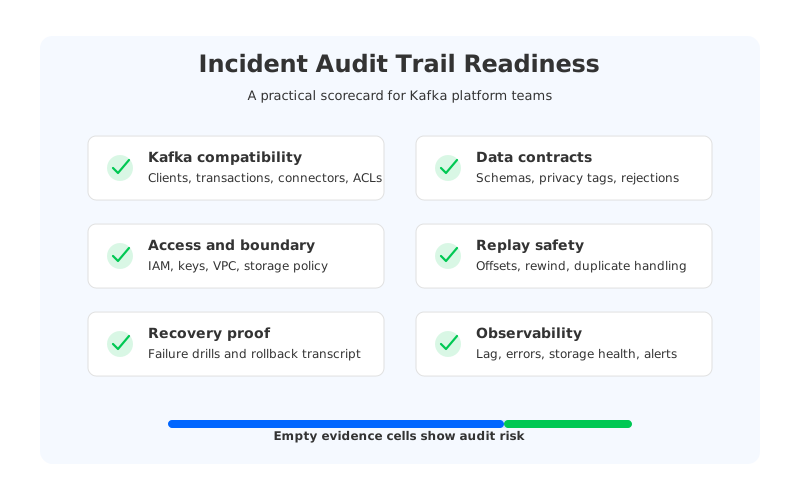
Use the scorecard before a platform review, procurement discussion, or migration plan. Score each row from 1 to 5, where 1 means "not documented" and 5 means "documented, tested, and owned."
| Control | Score | Evidence to collect |
|---|---|---|
| Incident taxonomy | Event classes, owners, severity mapping, and correlation identifiers | |
| Kafka compatibility | Client versions, transactions, serializers, Consumer groups, connectors, ACLs, and admin workflows | |
| Data contracts | Schema rules, required fields, privacy tags, rejection handling, and exception approvals | |
| Access and boundary | IAM, ACLs, key ownership, VPC path, object storage policy, support access, and audit export | |
| Replay safety | Offset intervals, consumer rewind procedure, duplicate handling, replay target, and completion metric | |
| Recovery proof | Broker failure drill, connector failure drill, bad schema release test, rollback condition, and timeline transcript | |
| Observability | Lag, produce errors, connector state, storage health, policy events, and alert history |
The score matters less than the empty cells. Empty cells show where the next incident will become a reconstruction exercise. They also show whether the next step is better instrumentation, stronger data contracts, Kafka tuning, retention redesign, or Shared Storage architecture evaluation.
An incident audit trail should leave responders with a concrete timeline, not a pile of related logs. The search that began as incident audit trail kafka should end with a practical test: pick a real incident interval, replay it, prove who touched it, show where it moved, and confirm that recovery preserved the evidence path. If your team is evaluating a Kafka-compatible Shared Storage architecture for governed incident response, run the scorecard against your own topics and recovery drills, then compare the operating model with AutoMQ BYOC or AutoMQ Software: start an AutoMQ evaluation.
7FAQ
7.1What is an incident audit trail in Kafka?
An incident audit trail in Kafka is a structured record that helps teams reconstruct what happened across producers, topics, offsets, Consumer groups, schemas, connectors, access controls, and platform operations during an incident. It is broader than an admin log because it connects application evidence with runtime platform behavior.
7.2Is Kafka a good fit for incident audit trails?
Kafka can be a strong fit when the audit trail needs ordered events, durable topics, independent consumers, replay, and integration with downstream systems. Teams still need data contracts, access control, retention policy, observability, recovery runbooks, and deployment-boundary review.
7.3How do data contracts relate to incident audit trails?
Data contracts define what an event must contain, who owns it, how it can evolve, and which policy checks apply. During an incident, contract decisions become evidence: accepted records, rejected records, schema changes, privacy tags, and exception approvals help explain why the platform behaved the way it did.
7.4Does Shared Storage architecture replace Tiered Storage for audit workloads?
No. Tiered Storage moves older log segments to remote storage while brokers still manage active local logs. Shared Storage architecture moves durable stream data away from broker-local disks and makes brokers stateless compute nodes. For audit workloads, that changes how teams reason about retention, scaling, replay, and recovery.
7.5What should be tested before migrating incident audit topics?
Test producer and consumer compatibility, schema behavior, ACLs, connector delivery, offset preservation, Consumer group progress, replay windows, rollback conditions, observability, storage controls, and failure recovery. A migration that moves records but loses timeline continuity is not ready for incident response.
8References
- Apache Kafka documentation
- Apache Kafka consumer configuration reference
- Apache Kafka transactions
- Apache Kafka Connect documentation
- Apache Kafka KRaft documentation
- Apache Kafka Tiered Storage
- AutoMQ compatibility with Apache Kafka
- AutoMQ Shared Storage architecture overview
- AutoMQ WAL storage
- AutoMQ migration overview
- AutoMQ Table Topic overview


