
Table of Contents
Table of Contents
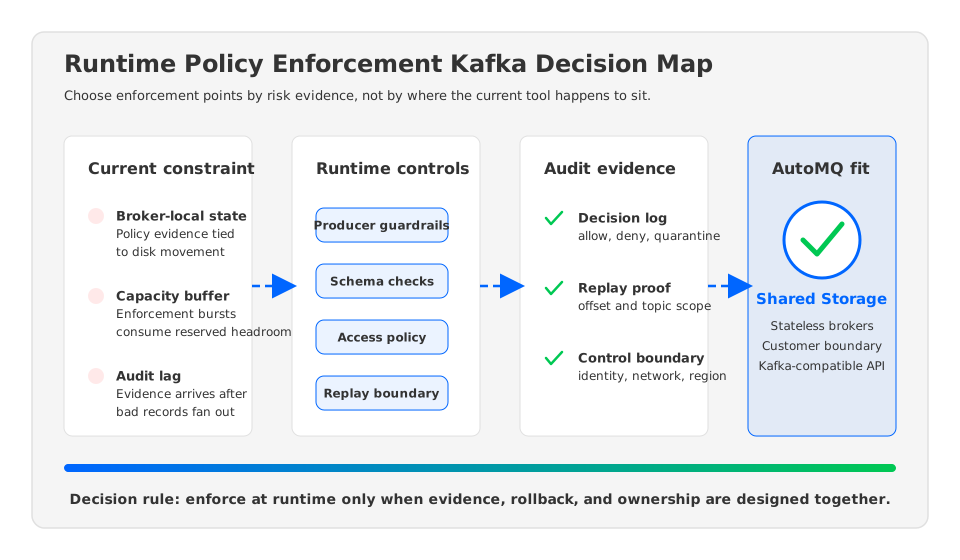
Teams rarely search for runtime policy enforcement kafka because they want a cleaner diagram. They search for it after a real control has become hard to prove: a producer can publish data that violates a contract, a consumer can replay sensitive records outside the expected boundary, or an auditor asks who allowed a record to cross from one system into another. At that point, Kafka is no longer only a durable event log. It is part of the control surface for security, governance, and operational risk.
The hard part is that runtime policy enforcement sits in the path of live traffic. If the policy is too weak, bad events fan out before the platform team can react. If the policy is too aggressive, legitimate producers stall, consumer lag climbs, and business workflows miss their recovery targets. The architecture question is not "Where can we add a policy engine?" The better question is: can the platform enforce a decision, preserve enough evidence to explain it, and still recover when the decision or the input data is wrong?
1Why Teams Search for runtime policy enforcement kafka
Kafka already gives platform teams several control primitives. Authentication defines who connects. Authorization limits which principals can read, write, or administer resources. Consumer groups coordinate processing across members, offsets record progress, and transactions help applications make atomic writes across partitions. Kafka Connect adds a standardized runtime for source and sink integrations, which often become the places where sensitive fields enter or leave the streaming estate.
Those primitives matter, but they do not automatically create a runtime governance program. A schema can prove that a record is decodable while still allowing a field that should have been masked. An ACL can prove that a service account may write to a topic while saying nothing about payload intent. Retention can make replay possible while leaving the team unable to prove which policy version accepted a record.
The pressure usually arrives from four directions:
- Data contracts move from documentation into production. Teams want a contract to reject, quarantine, or route records before downstream systems depend on them.
- Security teams need explainable enforcement. It is not enough to say that access control exists; the platform must show which identity, topic, policy version, and runtime decision were involved.
- Compliance teams care about residency and replay. A Kafka deployment can cross Availability Zones, accounts, regions, or private network boundaries, and each path changes the audit story.
- SRE teams inherit the failure mode. Runtime checks consume CPU, network, storage, and operator attention. When enforcement spikes, the streaming platform absorbs the blast radius.
Runtime policy enforcement is a platform operating model. The enforcement point, storage layer, migration plan, and evidence path all have to line up.
2The Production Constraint Behind the Problem
Traditional Kafka uses a Shared Nothing architecture: each broker owns local storage for its partitions, and durability is achieved by replication across brokers. That design makes the broker a clear unit of ownership. It becomes awkward when governance policies require frequent replay, quarantine topics, long audit windows, or rapid redistribution after a policy change.
The reason is mechanical. Broker-local storage couples compute capacity, durable data placement, and recovery scope. If enforcement increases write amplification, creates filtered streams, or requires replay, the work lands on brokers already carrying production reads and writes. If the cluster needs to rebalance, the platform moves partition data as part of changing ownership. Isolating a risky workload may require more local disk, more replica traffic, or more reserved headroom before the policy reaches production.
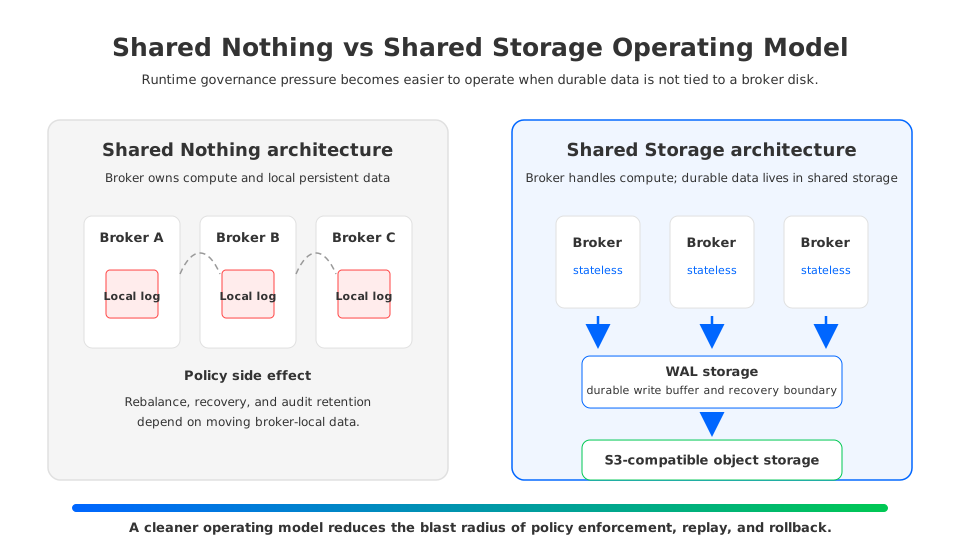
Shared Nothing is not wrong, but policy design must respect the storage model. A cluster with broker-local persistence needs explicit answers for where rejected records go, how long evidence is retained, how replay is throttled, and whether policy changes trigger data movement or cross-zone traffic.
This is also where teams confuse "audit log" with "audit path." An audit log records events. An audit path reconstructs a decision from identity, topic, contract version, offset range, policy result, storage boundary, and downstream state. A log line that says "denied" is useful; a replayable chain that shows what was denied, why, and how consumers were protected is stronger.
3Architecture Options and Trade-Offs
Most Kafka teams have more than one place to enforce runtime policy. The right answer depends on whether the control is about identity, payload shape, semantic correctness, residency, or recovery. Authentication and authorization belong near the broker access path. Schema compatibility belongs near producers and contract registries. Payload inspection may belong in a stream processing job, connector boundary, or producer library. Replay and quarantine often need topic-level and storage-level design.
Use the following matrix to avoid mixing those concerns:
| Enforcement option | Strong fit | Risk to plan for |
|---|---|---|
| Producer-side validation | Contract checks before bad records enter Kafka | Inconsistent adoption across teams and languages |
| Broker access controls | Identity, topic permissions, administrative boundaries | Payload semantics are outside basic ACL decisions |
| Connector or pipeline enforcement | Source/sink filtering, masking, routing, and integration policy | Connector runtime becomes part of the compliance boundary |
| Stream processor policy jobs | Stateful checks, enrichment, quarantine, and remediation | Lag, replay cost, and failure recovery need explicit limits |
| Platform storage and retention design | Audit windows, replay, rollback, and evidence preservation | Cost and data residency depend on storage architecture |
The table shows a pattern: runtime policy enforcement is strongest when controls are layered. Producer checks prevent obvious bad writes. Broker controls protect access paths. Connector and stream processing layers apply context-rich decisions. Storage and retention make the decision explainable later. A team that relies on one layer for everything usually gets weak enforcement or fragile operations.
Migration deserves the same discipline. If the organization is moving between Kafka-compatible platforms, policy enforcement should not be redesigned without a rollback plan. Offsets, consumer groups, connector configuration, authentication modes, topic naming, and producer retry behavior all affect continuity. A clean migration plan preserves enforcement evidence before, during, and after cutover.
4Evaluation Checklist for Platform Teams
Before comparing products, write down the decisions that must be explainable. A useful policy design starts with a few audit questions: who wrote this record, which contract applied, which decision was made, where was the record stored, who consumed it, and how can the team replay or quarantine it without widening access? Those questions are concrete enough for security, governance, and SRE teams to review together.
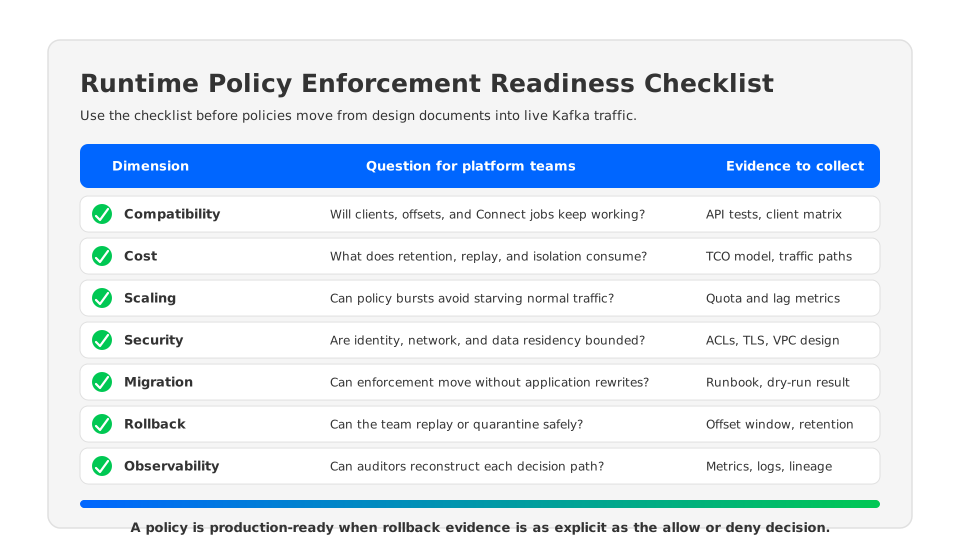
The checklist below turns that review into an architecture exercise:
- Compatibility: Existing Kafka clients, connectors, consumer groups, offsets, and transaction patterns should survive the enforcement design. A control that forces widespread application rewrites creates a migration project, not only a governance project.
- Cost: Runtime checks change the cost profile through extra topics, longer retention, replay reads, connector processing, network paths, and operational headroom. Estimate these costs before policy traffic reaches production.
- Elasticity: Policy bursts are common during schema rollouts, incident replay, and backfill. The platform needs a way to add processing capacity without turning every burst into a partition movement event.
- Security boundary: Identity, encryption, private network paths, region choice, and data residency must be clear enough that auditors can see where customer data and operational metadata live.
- Rollback: A policy can be wrong. The platform needs a safe path to pause, replay, quarantine, or bypass a control under approved conditions.
- Observability: Metrics and logs should explain both the data path and the control path. Lag, rejects, policy version, producer identity, connector state, and storage health are all part of the runtime picture.
None of these questions asks whether a vendor has a checkbox named "policy enforcement." If the platform cannot retain evidence, scale policy work, and isolate failures, the policy layer will be bypassed or blamed for incidents.
5How AutoMQ Changes the Operating Model
Once the evaluation reaches replay, retention, elasticity, and deployment boundaries, AutoMQ becomes relevant as a Kafka-compatible, cloud-native streaming platform built around Shared Storage architecture. AutoMQ keeps Kafka protocol compatibility while replacing broker-local durable log storage with S3Stream, backed by S3-compatible object storage and WAL storage. Storage architecture does not enforce business policy by itself. It changes the operating model around the policy.
In AutoMQ, brokers are stateless from the perspective of durable stream data. They process Kafka traffic, manage leadership, serve reads and writes, and use WAL storage as a durable write buffer before data is organized in object storage. Because durable data is not tied to broker-local disks, scaling and reassignment depend less on moving large partition data. That matters for governance workloads: quarantines, replays, catch-up reads, connector bursts, and backfills rarely arrive in a perfectly balanced shape.
The deployment boundary matters as much as the storage boundary. AutoMQ BYOC runs the control plane and data plane in the customer's cloud account and VPC, while AutoMQ Software is designed for customer-operated private environments. For security and compliance teams, that means the platform can be evaluated against customer-controlled networking, identity, storage, and regional requirements rather than a generic external service boundary. Runtime policy enforcement still needs a contract registry, access model, logging convention, and incident runbook, but those controls can be mapped to infrastructure the customer owns.
AutoMQ also fits the migration side of the problem. Kafka compatibility reduces the need to rewrite clients that depend on Kafka APIs. AutoMQ Kafka Linking is designed for migration from Kafka-compatible sources with byte-to-byte replication, offset consistency, and consumer progress synchronization in supported scenarios. Those details matter because evidence continuity is easier to preserve when topic data and consumption progress map cleanly across cutover.
The practical way to think about AutoMQ is not "policy engine inside Kafka." A better framing is: Kafka-compatible streaming with a storage model that makes policy operations less entangled with broker-local persistence. That distinction keeps the architecture honest. You still design producer contracts, ACLs, connector policy, audit logs, and remediation workflows. AutoMQ gives those workflows a platform foundation that is more elastic and easier to align with customer-controlled deployment boundaries.
6A Readiness Scorecard for Runtime Enforcement
Use this scorecard before moving a runtime policy from design to production. Give each row a green, yellow, or red rating, and do not average the result away. One red item can be enough to block rollout if it affects rollback or audit evidence.
| Area | Green signal | Red signal |
|---|---|---|
| Enforcement point | The control is placed where the decision has enough context | The control is placed where the team happened to have tooling |
| Evidence path | Identity, offset, policy version, and outcome can be reconstructed | The team can only show aggregate rejects or dashboard counts |
| Runtime isolation | Policy bursts have capacity limits and scaling behavior | Policy work competes blindly with production traffic |
| Data boundary | Storage, network, and region controls match compliance needs | The enforcement path crosses unreviewed accounts or regions |
| Migration plan | Clients, offsets, and rollback are tested before cutover | Policy redesign and platform migration happen in one untested step |
| Ownership | Security, data governance, SRE, and app teams know their roles | Every incident falls back to the Kafka platform team |
The strongest scorecards make enforcement decisions predictable, evidence available, and rollback rehearsed. They also clarify which controls belong in Kafka, application or connector code, and the storage and deployment model.
Runtime policy enforcement in Kafka is not a single switch. It is the discipline of making live decisions without losing throughput, recovery, or proof. If your current Kafka architecture makes every added control feel like a storage migration, a capacity reservation, or an audit scramble, the platform is carrying too much state in the wrong place.
To evaluate a Kafka-compatible architecture that separates compute from storage while preserving customer-controlled deployment boundaries, start with the AutoMQ Cloud entry point. Bring one real policy, one replay scenario, and one audit question; those three inputs will reveal whether the operating model is ready.
7FAQ
7.1Is runtime policy enforcement the same as Kafka authorization?
No. Kafka authorization controls whether a principal can perform an operation such as reading from or writing to a topic. Runtime policy enforcement can include authorization, but it also covers payload contracts, masking, routing, quarantine, replay, evidence retention, and operational rollback.
7.2Where should runtime policy enforcement happen in Kafka?
Use multiple enforcement points. Put identity and topic permissions near the broker access path, schema and contract checks near producers, integration policy near connectors, and remediation or quarantine logic in stream processing or platform workflows. The right design depends on the decision context and the evidence you need later.
7.3Do Kafka data contracts require changing the streaming platform?
Not always. Many teams can begin with producer validation, schema compatibility rules, connector governance, and better observability. A platform change becomes relevant when retention, replay, scaling, data residency, or migration risk makes the current architecture hard to operate.
7.4How does Shared Storage architecture help audit paths?
Shared Storage architecture does not create audit policy by itself. It helps by reducing the tight coupling between broker-local disks and durable stream data, which can make replay, scaling, partition reassignment, and recovery easier to reason about during governance-heavy operations.
7.5What should a production readiness review include?
Review client compatibility, policy evidence, reject handling, replay windows, retention cost, identity boundaries, network paths, observability, and rollback. The review should involve security, data governance, SRE, and application owners because each group owns part of the runtime decision path.


