
Table of Contents
Table of Contents
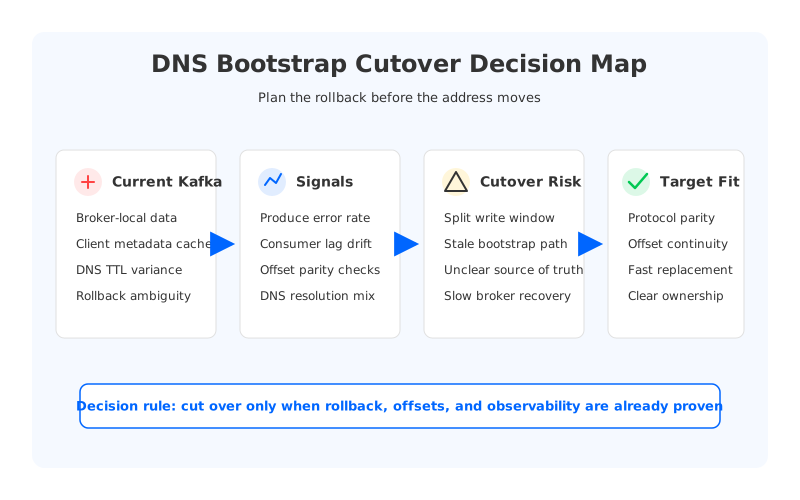
Teams searching for dns bootstrap cutover kafka are asking a production question: when Kafka clients move between bootstrap addresses, how do you know the move is working, and how do you reverse it before duplicate writes, offset drift, or stale client metadata turns a migration into an incident? The address change looks small on a ticket, but it sits where application release cadence, Kafka client behavior, network routing, consumer group state, and platform ownership all meet.
The hard part is that a Kafka bootstrap endpoint is not a normal service endpoint. In Apache Kafka, bootstrap.servers gives clients an initial host and port list so they can discover broker metadata; the list does not need every broker because clients maintain cluster metadata after bootstrapping. DNS adds timing: a shorter Time to Live (TTL) can make changes propagate faster, while a longer TTL lets recursive resolvers cache answers for longer.
Rollback planning belongs in the design, not in the war room. Treat DNS as the visible switch and Kafka state as the real control surface.
1Why teams search for dns bootstrap cutover kafka
The search starts after the migration design already looks reasonable. The target Kafka-compatible platform is provisioned. Topics, ACLs, certificates, and network paths have been mapped. What remains is moving producers and consumers from the source bootstrap endpoint to the target without making every application team coordinate a release.
DNS is attractive because it promises a single control point. Keep application configuration stable, update the record behind the bootstrap hostname, watch clients reconnect, and roll back by pointing the name back to the source cluster. Production systems are less tidy. Some clients keep long-lived connections, some resolve DNS through sidecars or JVM caches, and some sit idle long enough that the broker set can change before their next metadata refresh.
The operational question is whether the platform team can prove five things during the move:
- The target cluster is accepting writes for the intended topics and principals.
- Consumers can resume from the expected offsets, not from a default reset policy.
- Source and target client populations are visible as separate cohorts.
- The source cluster remains a valid rollback target until the decision gate closes.
- Every alert has an owner who can decide whether to hold, continue, or reverse.
Without those proofs, DNS becomes a blindfold. You may know that the name changed, but not which applications followed it or which consumer groups crossed the point where rollback becomes reconciliation.
2The production constraint behind the problem
Traditional Kafka runs as a Shared Nothing architecture. Each broker owns local storage for its assigned partition replicas, and reliability depends on broker-level replication through ISR (In-Sync Replicas). That architecture is durable and familiar, but it makes operational state sticky. Broker replacement, partition reassignment, and target catch-up all require attention to data movement, replica lag, leader placement, and local disk capacity.
This storage model shapes cutover risk in a way DNS cannot hide. If migration depends on copying records into another cluster, the rollback boundary is tied to replication completeness and offset consistency. If the source cluster keeps receiving writes while the target receives a partial set, the team must define which cluster is authoritative for each topic and time window.
Kafka clients do not treat the bootstrap address as the entire topology. After initial connection, they discover brokers and continue operating against the metadata they receive. Producer success, consumer lag, group rebalances, and offset commits can therefore tell different stories during the same interval. A DNS record might point to the target while some clients still write through old connections.
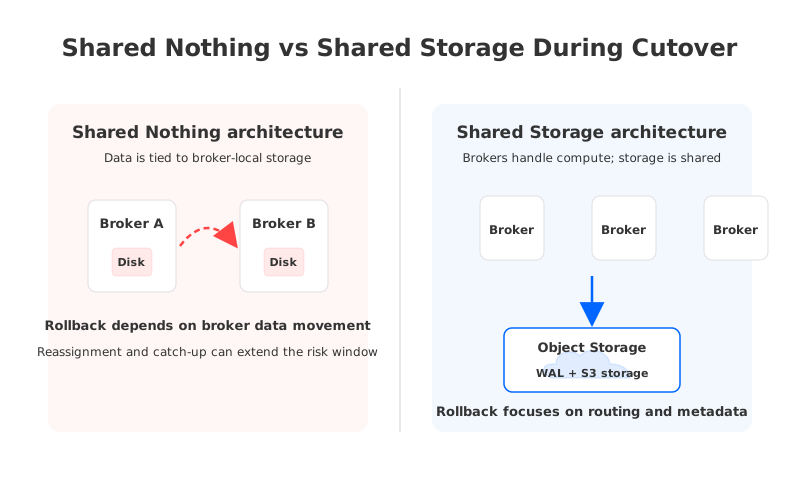
Rollback planning starts by treating the source cluster as an active control surface. Declare write authority, offset authority, and observation authority for each phase. If target produce traffic rises but consumer offsets do not advance, hold. If producer errors spike for a known client cohort, route that cohort back. If offset parity breaks for a critical group, stop the cutover before DNS propagation completes.
3Architecture options and trade-offs
There are several ways to approach DNS bootstrap cutover. The right answer depends on application coordination and how much migration state the platform can preserve.
| Option | What changes | Operational benefit | Main risk |
|---|---|---|---|
| Application config rollout | Each service changes bootstrap.servers directly | Clear ownership by application team | Slow coordination and uneven release discipline |
| DNS record switch | One hostname points from source to target | Centralized control and fast reversal at the name layer | DNS and client metadata caches may create mixed traffic |
| Proxy or gateway path | Clients connect through an intermediate routing layer | Better traffic cohorting and rollback control | Additional component to secure, scale, and observe |
| Topic-by-topic migration | Move selected topics or application groups | Smaller blast radius | Longer dual-running period and more state tracking |
The decision should not be driven by convenience alone. A DNS switch is useful when the target is proven, client behavior is understood, and rollback is rehearsed. It is fragile when migration depends on last-minute offset assumptions or when the platform team cannot distinguish stale clients from healthy clients.
Reliable plans combine a routing mechanism with a state contract. The routing mechanism says how clients move. The state contract says what must remain consistent.
For Kafka, that state contract should include compatibility, offsets, idempotence or transaction requirements, security principals, topic configuration, and observability. A consumer group using Kafka-based offset management needs its group.id and committed offsets treated as migration state. A client relying on auto.offset.reset=latest needs careful review because a missing offset can start consumption at the end of a topic.
4Evaluation checklist for platform teams
A readiness review should be short enough to run before every batch, but specific enough to stop a risky cutover. Its purpose is to prove rollback remains possible after real clients start moving.
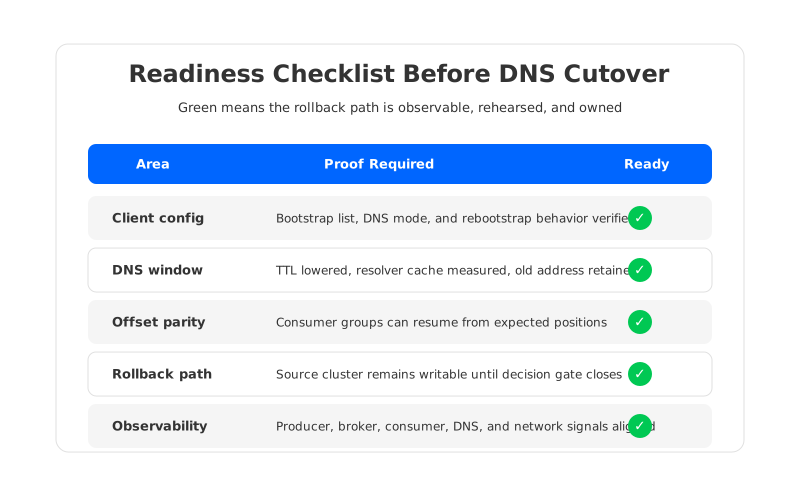
Use this checklist as a gate, not as a retrospective:
- Client behavior: Document client versions, DNS lookup behavior, connection idle settings, metadata refresh behavior, and retry policies.
- DNS window: Lower TTL before the cutover window, measure resolver behavior, and retain the old address long enough to support rollback.
- Offset continuity: Compare source and target positions for critical consumer groups. Monitor committed offsets, lag, and reset events after the switch.
- Write authority: Define whether producers may write to both clusters, one cluster, or a proxy path.
- Security and governance: Verify certificates, SASL mechanisms, ACLs, network policies, audit logs, and ownership boundaries.
- Observability: Separate source and target traffic. Include producer errors, latency, broker connections, consumer lag, rebalances, DNS samples, and network errors.
- Rollback trigger: Write the rollback rule in operational terms, with a clear owner and threshold.
The checklist should also include a freeze condition. Freeze means you stop moving additional clients while you investigate. Rollback means you actively restore the previous routing state.
5How AutoMQ changes the operating model
After the neutral evaluation, the architecture question becomes concrete: can the target platform reduce broker-bound state while preserving Kafka protocol behavior? AutoMQ approaches that problem as a Kafka-compatible streaming platform with Shared Storage architecture. It keeps Kafka APIs and ecosystem semantics, while moving durable storage away from broker-local disks and into S3-compatible object storage through S3Stream and WAL (Write-Ahead Log) storage.
That shift does not remove the need for careful cutover planning. DNS, client metadata, offsets, ACLs, and application behavior still matter. What changes is the recovery and scaling model. With stateless brokers, broker replacement and capacity adjustment are less coupled to local partition data movement.
For migration planning, AutoMQ Linking is the relevant operational tool. It is designed for migrations from Apache Kafka or other Kafka distributions to AutoMQ without application changes, and its documented goals include byte-to-byte copy, synchronized consumption progress, and producer proxy capabilities. Those properties map to the cutover contract: preserve offset continuity, reduce split-write ambiguity, and control producer movement.
This is where Shared Storage architecture and rollback design meet. In AutoMQ's model, durable data is not anchored to a single broker's local disk, so remediation can focus more on broker replacement, traffic routing, and scaling. The migration still needs validation, but the operational surface is narrower.
The deployment boundary matters too. AutoMQ BYOC runs the control plane and data plane in the customer's cloud account, while AutoMQ Software runs in customer-managed private environments. That keeps data paths, network controls, IAM boundaries, audit logs, and observability inside the environment the team owns.
6Observability design for the cutover window
Observability for bootstrap cutover should be built around questions, not metric inventory. Did clients move? DNS query logs, resolver samples, broker connection counts, and source-versus-target request rates answer that. Are moved clients healthy? Producer retries, request latency, authorization failures, and disconnect rates answer that. Is stream position coherent? Consumer lag, committed offsets, reset events, and application checkpoints answer that.
Show those signals by cohort. A global error rate is too blunt while source and target paths coexist. Segment by application, environment, topic, principal, client version, and network source where possible.
A useful dashboard has a small number of decision panels:
| Panel | What it answers | Rollback relevance |
|---|---|---|
| Client movement | Which clients still connect to the source path? | Prevents premature source shutdown |
| Produce health | Are writes succeeding on the intended target? | Detects authorization, metadata, and broker issues |
| Consumer progress | Are critical groups advancing from expected offsets? | Catches offset drift and reset mistakes |
| DNS propagation | Which resolver paths still return old answers? | Explains mixed client behavior |
| Recovery capacity | Can the target absorb load or replace brokers? | Determines whether to hold or scale |
Test the dashboard before the final switch. Rehearsal reveals failures that matter: a missing metric tag, a dashboard that hides the source and target split, a DNS sample from the wrong network, or an alert that pages the wrong team.
7A migration scorecard that decides when to move
The cleanest cutover plans end with a scorecard. It should fit on one page and produce a decision: proceed, freeze, or roll back. Teams can disagree about implementation details, but not about the meaning of a red gate during the cutover.
Use four categories. Compatibility verifies client versions, authentication, topic configuration, and API behavior. State checks replication, offsets, and consumer group progress. Operations covers dashboards, alerts, escalation paths, and rollback commands. Architecture confirms the target can replace failed compute, absorb expected traffic, and preserve governance boundaries.
The decision rule is direct: move traffic only when rollback is still possible. Once the source cluster is decommissioned, writes are no longer mirrored, or offsets have advanced beyond a recoverable boundary, you are operating the target as production. That should be a declared transition, not a surprise discovered during an incident.
If your team is evaluating a Kafka-compatible platform where offset continuity, rollback control, and cloud-native operations matter, run a small proof with the exact client patterns you plan to cut over. Reduce cutover risk by testing rollback before the main hostname moves: start with AutoMQ.
8FAQ
8.1Is DNS cutover safe for Kafka clients?
It can be safe when the team accounts for Kafka client metadata, DNS caching, offset continuity, and rollback ownership. DNS changes the address clients use for bootstrap, but Kafka clients also cache broker metadata and maintain long-lived connections. Treat DNS as one part of the migration control plane, not the whole plan.
8.2Should producers and consumers move at the same time?
Not always. Producers, consumers, stream processors, and connectors have different failure modes. Many teams move a small producer cohort first, validate writes, then move consumers or processing jobs once offset behavior is proven. Critical workflows should have a batch-specific plan.
8.3What should trigger rollback?
Use objective triggers: sustained producer failures, unexpected authorization errors, consumer offset resets, unexplained lag growth for critical groups, DNS behavior outside the planned window, or target cluster health degradation. The trigger should include an owner and an action.
8.4How does Shared Storage architecture help?
Shared Storage architecture reduces the coupling between broker compute and durable data. During migration, this can make scaling and broker replacement less dependent on local partition data movement. It does not remove the need for client, DNS, and offset validation.
8.5Where does AutoMQ fit in the migration plan?
AutoMQ fits after the team has defined the neutral migration contract: compatibility, state continuity, observability, rollback, and governance. Its Kafka-compatible API, Shared Storage architecture, stateless brokers, and Kafka Linking capabilities are relevant when those requirements are central to the cutover.
9References
- Apache Kafka producer configuration:
bootstrap.servers, DNS lookup, and metadata recovery - Apache Kafka consumer configuration: consumer groups, offsets, DNS lookup, and metadata recovery
- Amazon Route 53 documentation: TTL behavior for DNS records
- AutoMQ documentation: Apache Kafka compatibility
- AutoMQ documentation: migration overview and Kafka Linking
- AutoMQ documentation: observability overview


