
Table of Contents
Table of Contents
Teams searching for rollback safe replication kafka are usually close to a cutover decision. They have a source cluster, a target Kafka-compatible platform, a replication path, and a migration window that cannot turn into a one-way door. The question is no longer whether records can be copied. The question is whether the team can move Producers, Consumers, offsets, connectors, and security rules forward while still knowing exactly how to move back.
Rollback gets hard because Kafka migration changes more than storage location. A Record carries order, key distribution, timestamp, headers, and Offset position inside a Partition. Consumers add committed progress and downstream side effects. Connectors add external systems that may not be idempotent. By the time the target cluster receives replicated data, the migration has already become a distributed contract problem.
The practical rule is this: rollback-safe replication is not a replication tool choice. It is an operating model that defines the last reversible step, the first reconciliation step, and the evidence required at each gate. Once those gates are explicit, Kafka-compatible platform choices can be evaluated with less guesswork and fewer late-night arguments.
1Why rollback-safe replication becomes a production problem
Cross-cluster replication looks clean in diagrams. Records flow from source to target, Consumers validate reads, and the team promotes the target endpoint when lag reaches an acceptable threshold. That picture is useful, but it hides the moment where rollback changes meaning. Before Producers write to the target, rollback usually means routing traffic back to the source. After target writes become authoritative, rollback means deciding which event history is true.
The difference matters because Kafka is often upstream of stateful systems. A Consumer might write to a database, update a search index, trigger a payment workflow, or feed a feature store. Those side effects are not undone by switching bootstrap servers. If a target-side Consumer processes records and commits progress, the Kafka layer may still look healthy while downstream state has already moved past the reversible boundary.
That is why migration teams need to label the rollback state before they label the replication technology. A safe plan names the source of truth, the write owner, the Consumer progress boundary, the connector side effects, and the conditions that force the team to stop rather than continue. The tool can then be judged by how well it supports that plan.
2The workload risk behind the migration window
A migration window is not a quiet maintenance event. The source cluster is serving production traffic while replication reads from it. The target cluster is accepting copied records while validation Consumers, canary Producers, and observability jobs add load. Platform teams often increase retention for rollback and replay. Application teams ask for more time to validate downstream behavior. Each request is reasonable, but together they create a workload profile that does not look like steady state.
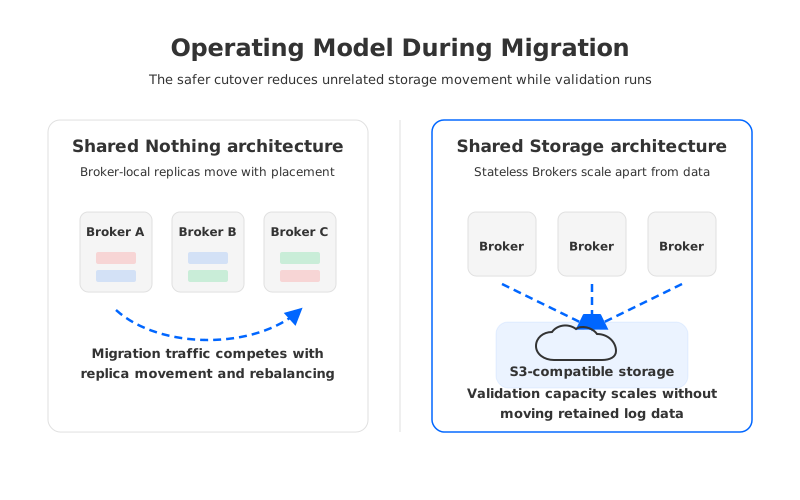
Traditional Kafka makes that profile harder to reason about because Broker-local storage is part of the risk. In the Shared Nothing architecture, each Broker owns local replica data for assigned Partitions. Replication factor and ISR protect durability, but they also bind capacity planning to disk placement and inter-Broker data movement. If the team adds Brokers, replaces a node, changes Partition placement, or increases retention during the migration, the cluster may need to move data at the same time it is serving migration traffic.
This is where rollback planning and infrastructure planning collide. Consumer lag can come from an application bug, a schema issue, target-side throttling, connector backpressure, or Broker storage pressure. If the platform is also reassigning Partitions, operators have to separate migration symptoms from cluster mechanics under time pressure. The safer plan reduces unrelated movement during the cutover, so the signals from the migration are easier to interpret.
3Four replication states every rollback plan should name
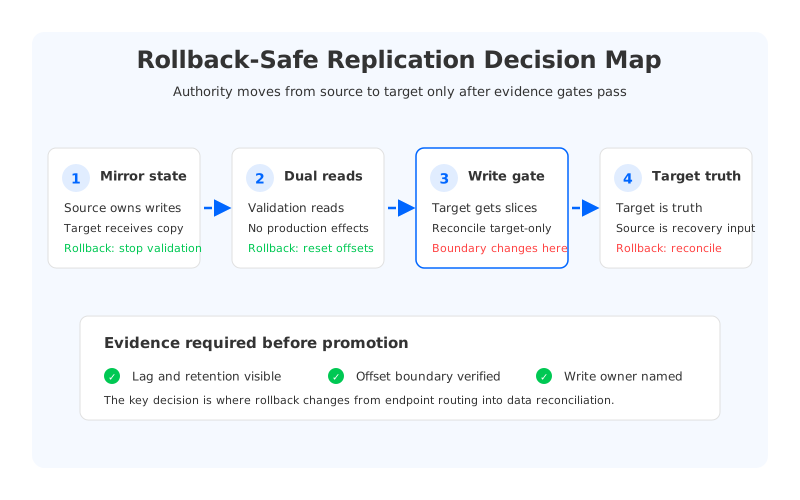
The easiest way to make rollback concrete is to define the states of authority. This turns the cutover from a vague sequence into a set of gates that SREs, application owners, and platform teams can inspect together. The exact names can vary, but the plan should cover four states.
- Mirror state: The target receives replicated records, but the source remains the write authority. Rollback means stopping validation activity and keeping production on the source.
- Dual-read state: Selected Consumers read from the target for validation, while source-side Consumers still protect production. Rollback means discarding validation progress and confirming no target-side side effects became authoritative.
- Write-promotion state: Producers begin writing to the target, often by service group or traffic slice. Rollback means routing writes back to the source and reconciling target-only records.
- Target-authority state: The target is the system of record for the stream. Rollback has become a recovery or reconciliation exercise rather than a configuration change.
The value of these states is not the vocabulary. The value is that they force the team to say when rollback stops being low-friction. A runbook that treats all four states as equal is not rollback-safe. It is optimistic.
| Gate | Required evidence | Rollback rule | Common failure mode |
|---|---|---|---|
| Mirror state | Replication lag, Topic mapping, ACLs, and retention are visible on both sides. | Stop replication or validation without changing production traffic. | Teams assume copied records prove client compatibility. |
| Dual-read state | Representative Consumers can read, deserialize, and compare outputs without production side effects. | Reset validation Consumer groups and keep source Consumers authoritative. | Validation Consumers write to external systems too early. |
| Write-promotion state | Producer idempotency, transaction behavior, and duplicate handling are tested for the promoted slice. | Move the slice back and reconcile target-only records by key and Offset range. | Both clusters accept valid writes with no ownership rule. |
| Target-authority state | Source retirement, replay policy, monitoring, and incident ownership are documented. | Treat source as recovery input, not an equal live peer. | The source cluster is kept alive but no longer trustworthy. |
The table is intentionally conservative. It does not assume that replication, offsets, and downstream state always fail together. In real migrations, they fail independently, and the rollback rule has to survive that mess.
4Compatibility is necessary, but it is not the rollback plan
Kafka-compatible migrations start with client behavior. Producers, Consumers, admin clients, Kafka Connect workers, schema tooling, transactions, and security integrations need to behave as expected against the target. Apache Kafka compatibility reduces the surface area of change, but it does not remove the need to test each usage pattern that your estate depends on.
Offset continuity deserves special attention. A Consumer group can be present on the target and still be unsafe if the committed Offset does not correspond to the intended Record boundary. MirrorMaker2 and other replication approaches can help synchronize data and offsets, but offset alignment should be treated as evidence to verify, not as a fact to assume. The proof is a replay test for representative Consumer groups, including groups that write to systems outside Kafka.
Connectors add another boundary. Kafka Connect can move data into databases, warehouses, object storage, and search systems, but those destinations have their own duplicate, ordering, and transaction behavior. A rollback-safe plan tests the connector path with dead-letter topics, idempotency rules, and destination visibility in mind. Kafka may preserve order within a Partition while the sink system still exposes partial writes.
Security and governance are part of compatibility too. ACLs, TLS settings, network routes, PrivateLink endpoints, audit logs, and identity mapping can make a target technically compatible but operationally unusable during an incident. If the on-call team cannot tell which principal is writing to which cluster, rollback decisions slow down at exactly the wrong moment.
5Cost and elasticity affect rollback, not only the monthly bill
Migration teams often discuss cost after architecture. Rollback planning forces cost into the architecture review because safe rollback usually requires temporary duplication. During the transition, the team may run two clusters, extend retention, keep more Consumers active, transfer data across networks, and run validation jobs that do not exist in steady state. The platform has to absorb that temporary shape without hiding the failure signals that operators need.
The cost question should be framed around reversibility:
- Storage headroom: Can the source and target keep enough retention for replay and reconciliation without emergency disk expansion?
- Network path: Does replication cross Availability Zone, region, cloud account, or PrivateLink boundaries in a way that changes both cost and failure domain?
- Elastic compute: Can validation Consumers, replication workers, and catch-up reads scale without forcing a storage rebalance?
- Operational ownership: Can the team see the same metrics and logs before, during, and after promotion?
These questions keep the conversation grounded. A lower steady-state bill does not help if the migration window requires manual capacity work, unclear network charges, or fragile monitoring. A cost-effective migration platform is one that lets the team buy temporary safety without turning the cutover into a storage operations project.
6How Shared Storage changes the operating model
The neutral architecture requirement is clear by this point: the target should minimize unrelated data movement while replication, offset validation, and rollback gates are being tested. That requirement does not make every Shared Storage system a fit, but it explains why Shared Storage architecture is relevant to Kafka-compatible migration.
AutoMQ is a Kafka-compatible streaming platform built around Shared Storage architecture. AutoMQ keeps the Kafka protocol and API surface while moving durable log storage out of Broker-local disks and into S3-compatible object storage through S3Stream and WAL (Write-Ahead Log) storage. In this model, AutoMQ Brokers are stateless, and compute can scale separately from retained stream data.
That separation changes what happens during a migration window. If the target needs more compute for validation reads or Consumer catch-up, the team scales Brokers without moving retained log segments between local disks. If a Broker is replaced, recovery is based on metadata, WAL recovery, and shared storage access rather than rebuilding local replicas. The rollback plan still has to define write ownership and downstream side effects, but the platform adds fewer storage-side events while those application contracts are under test.
AutoMQ Kafka Linking fits the same migration model because it is designed for topic data synchronization and offset continuity during Kafka migration. It does not remove the need for canary reads, connector checks, or rollback ownership. It gives the platform team a cleaner way to separate the gates: copy records, validate reads, move selected Producers, test Consumer progress, and promote target authority only when the evidence is strong enough.
AutoMQ BYOC also matters when governance is part of rollback safety. In BYOC (Bring Your Own Cloud), the deployment boundary sits in the customer's cloud account and VPC, so teams can inspect network paths, object storage, identity policy, monitoring, and access control within their own environment. For regulated or security-sensitive migrations, that boundary can be as important as the replication mechanism.
7A readiness checklist for the cutover meeting
The final review should not ask whether the replication job is green. It should ask whether every rollback boundary has a named owner and a tested reversal rule. Green replication lag is useful evidence, but it is only one signal in a migration that also touches clients, offsets, connectors, security, storage, and people.
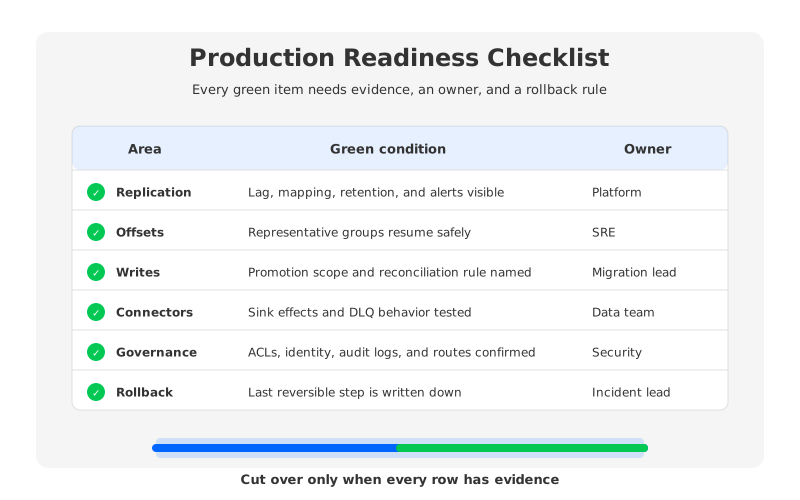
Use this checklist as the meeting agenda:
| Area | Green condition | Owner |
|---|---|---|
| Replication | Topic mapping, retention, lag, and failure alerts are visible on both source and target. | Kafka platform team |
| Offsets | Representative Consumer groups resume from verified boundaries on the target. | Application owners and SRE |
| Writes | Producer promotion is scoped by service, Topic, or traffic slice, with a target-only reconciliation rule. | Migration lead |
| Connectors | Sink behavior, dead-letter topics, and duplicate handling are tested without production side effects. | Data integration team |
| Governance | ACLs, certificates, identity mapping, audit logs, and network routes are confirmed. | Security and platform teams |
| Rollback | The last reversible step and the first reconciliation step are written into the runbook. | Incident commander |
This is the point where architecture choices become operational choices. A team that can name the authority state, prove offset continuity, and scale validation capacity without extra storage movement has a much stronger rollback posture than a team that only knows the replication job is running.
If your migration plan depends on rollback-safe replication, test the plan against your real Topics, Consumer groups, connector paths, and governance boundaries. For teams evaluating whether Shared Storage architecture and stateless Brokers can reduce cutover risk, try AutoMQ with your own migration runbook.
8References
- Apache Kafka documentation
- Apache Kafka cross-cluster data mirroring
- Apache Kafka Connect documentation
- Apache Kafka message delivery semantics
- Apache Kafka consumer configuration
- AutoMQ architecture overview
- AutoMQ compatibility with Apache Kafka
- AutoMQ migration guide
- AutoMQ eliminate inter-zone traffic overview
- AWS PrivateLink documentation
- Amazon S3 data durability documentation
9FAQ
9.1What does rollback-safe replication mean for Kafka migration?
Rollback-safe replication means the team can identify the authoritative cluster, Consumer progress boundary, connector side effects, and reversal rule at each migration gate. It is stronger than copying records because it defines how the system moves back before target writes become authoritative.
9.2Is MirrorMaker2 enough for rollback-safe Kafka migration?
MirrorMaker2 can support cross-cluster replication and offset synchronization, but the rollback plan still needs client validation, connector testing, security checks, write-ownership rules, and downstream reconciliation logic. The tool is part of the plan, not the plan itself.
9.3When does rollback stop being a configuration change?
Rollback usually stops being a configuration change when Producers write authoritative records to the target or target-side Consumers create production side effects. From that point, the team must reconcile target-only events or downstream state rather than switching endpoints back.
9.4How should teams test offset continuity?
Teams should select representative Consumer groups, map their source and target Offset boundaries, run validation reads, compare outputs, and confirm downstream systems handle replay or duplicates as expected. The test should include groups with transactional behavior and external writes.
9.5How can Shared Storage architecture help rollback planning?
Shared Storage architecture separates Broker compute from durable stream data. During migration, that can reduce storage rebalancing and local replica movement while replication, Consumer catch-up, and rollback gates are being tested.


