
Table of Contents
Table of Contents
Someone searching for rollback safe migration kafka is usually not looking for a generic migration checklist. They are looking for a way to move production Kafka workloads without turning cutover into a one-way bet. The source cluster may be costly to scale, hard to govern, or misaligned with a cloud operating model, but it is still the system application teams trust. The target may look better on paper, but it has not earned that trust under real traffic.
A rollback window is the period during which the team can still return producer and consumer traffic to the previous platform with a known recovery point, acceptable replay behavior, and clear ownership. That window is not defined by the maintenance calendar. It is defined by writes, offsets, replication lag, security state, monitoring parity, and the point at which the source and target stop being equivalent enough to reverse.
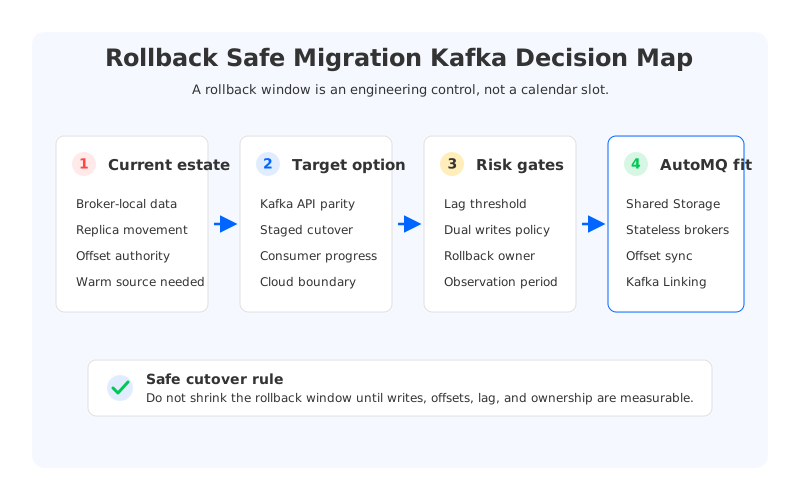
Kafka migration risk rarely sits in the cluster alone. It sits in clients, Consumer groups, Kafka Connect pipelines, stream processors, schema rules, ACLs, networking, dashboards, and incident playbooks. A rollback-safe plan makes those dependencies visible before cutover, then shrinks the window only when the evidence supports it.
1Why Teams Search for rollback safe migration kafka
Rollback becomes urgent when a platform team has accepted that the current Kafka estate needs to change. Maybe broker storage is growing faster than budgets can absorb. Maybe partition reassignment is too slow for traffic changes. Maybe the team wants a Kafka-compatible target that fits a customer-owned cloud boundary, rather than a platform that forces application rewrites or moves operational control elsewhere.
The search phrase is awkward, but the intent is precise: "How do we keep control if migration fails after traffic starts moving?" A happy-path replication demo does not answer that question. The team needs to know which cluster accepts writes, which offsets consumers will resume from, how long the source stays warm, and who has authority to stop the migration when an SLO starts to drift.
Treat rollback as a data-plane contract. Before cutover, it should answer four questions:
- Write authority: Are producers writing only to the source, only to the target, through a proxy, or to both systems by application design?
- Read progress: Which committed offsets or processing checkpoints define the restart point for each Consumer group, connector, or stream processing job?
- Equivalence: What evidence proves that records, Topic configuration, security policy, and downstream outputs are close enough to reverse traffic?
- Abort criteria: Which lag, error-rate, data mismatch, or business metric forces rollback instead of more troubleshooting?
Those questions sound operational, but architecture decides how painful they become. A migration tool can copy records; it cannot remove every coupling created by broker-local storage, application write paths, or incompatible metadata behavior.
2The Production Constraint Behind the Problem
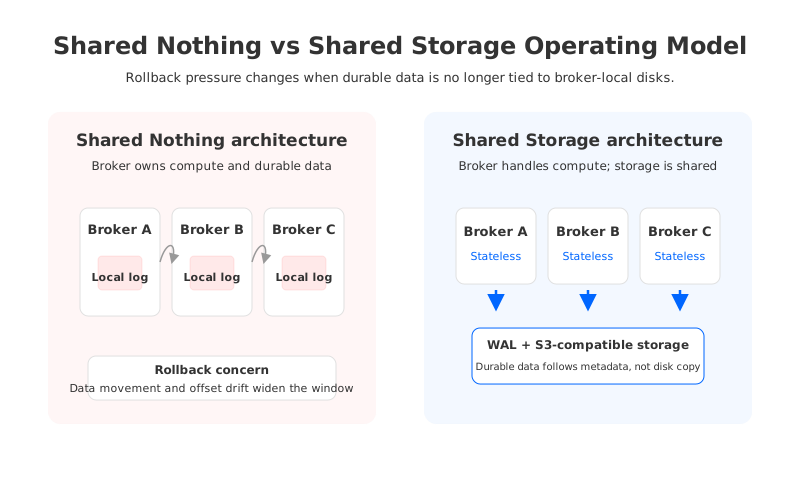
Apache Kafka's classic operating model is a Shared Nothing architecture. Each Broker owns local persistent log segments for its assigned partitions, and Kafka uses replication between leader and follower replicas for availability. That model is robust and familiar, but it also means storage, compute, and recovery behavior are tightly coupled. When a migration or scale event changes ownership, the platform has to account for data that is physically associated with Broker-local storage.
That coupling matters because time works against equivalence. The longer the migration wave runs, the more producers, consumers, and operational systems can diverge. Records may land on the target. Consumers may commit progress on one side but not the other. Connectors may flush sink state downstream. A stream processor may checkpoint against offsets that no longer mean the same thing if the copy path rewrites positions.
Kafka's own semantics make this precise. Consumers track position by Offset within a Partition, and Consumer groups coordinate which members consume which partitions. Transactional and idempotent producer behavior adds more correctness expectations for workloads that rely on exactly-once processing patterns. A rollback plan that ignores offsets is not a rollback plan; it is a replay plan with unknown duplicate and gap behavior.
There is also a capacity problem. During migration, the source and target often run in parallel. The target needs room for replicated traffic, catch-up reads, validation consumers, and cutover waves. The source still needs headroom to serve clients and remain rollback-ready. If the source is already stressed, rollback safety can require the capacity the migration was meant to escape.
3Architecture Options and Trade-Offs
Rollback windows get wider when the migration path has too many moving parts that cannot be measured together. Self-managed Kafka, managed Kafka services, Kafka-compatible alternatives, and cloud-native streaming platforms can all be valid choices, but they expose different rollback risks. Evaluate the target platform and migration mechanism as one operating model.
Start with compatibility. Kafka API compatibility reduces application change, but the proof has to be workload-specific. Test producer settings, Consumer group behavior, transactions if used, Topic configuration, ACLs, TLS/SASL behavior, AdminClient automation, Kafka Connect, Kafka Streams, and observability exporters. A platform that works for simple produce and fetch tests may still surprise you when a connector task restarts, a Consumer group rebalances, or a transactional producer retries under failure.
Then look at data movement. A replication-based migration can preserve service availability, but the rollback window depends on lag, offset treatment, and write authority. If the copy path rewrites offsets, consumers need a translation strategy. If offsets are preserved or synchronized, the team still needs evidence that each Consumer group can resume at the intended point. If producers can write to both clusters at the same time, the plan must define how ordering and duplicates are handled.
Cost and elasticity belong in the same review. Months of dual-run capacity can be painful even if the steady-state target is lower cost. A target that still binds durable data to Broker-local disks may preserve familiar operations, but scaling and recovery can still involve large data movement. A target that separates compute and storage can change the operating model, but it still has to prove latency, durability, security, and governance.
The decision matrix should be blunt:
| Evaluation area | What to verify | Rollback impact |
|---|---|---|
| Kafka compatibility | Clients, Consumer groups, Topic configs, Connect, Streams, transactions | Determines whether applications can move back without code changes |
| Offset continuity | Source offsets, target offsets, committed group progress, checkpoint mapping | Determines whether rollback is resume, replay, or manual repair |
| Write routing | Producer cutover, dual writes, proxying, DNS or bootstrap changes | Determines whether the team can stop the wave cleanly |
| Operational parity | Metrics, logs, lag alerts, dashboards, runbooks, ownership | Determines whether rollback decisions are evidence-based |
| Target architecture | Broker-local storage, Tiered Storage, Shared Storage, stateless brokers | Determines whether future scaling and recovery repeat the same problem |
This is where many migration plans become too optimistic. They treat rollback as a late-stage incident response note. In production Kafka environments, rollback is part of the architecture review.
4Evaluation Checklist for Platform Teams
The most useful rollback checklist is organized by migration wave, not by cluster. A wave might be one Topic family, one application domain, one connector group, or one consumer-facing service. Smaller waves make rollback easier because ownership is clearer.
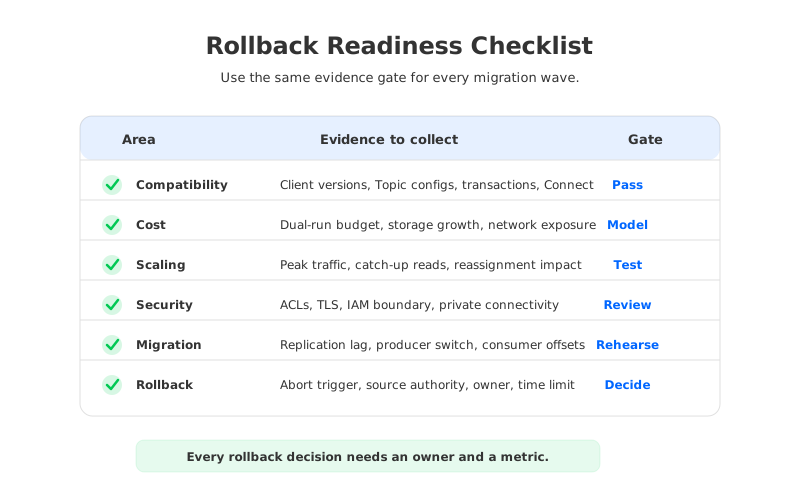
For each wave, require evidence before changing producer traffic:
- Inventory the workload surface. List producers, Consumers, Consumer groups, connectors, stream processors, schemas, ACLs, quotas, retention settings, compaction settings, and dashboards. Missing inventory becomes migration risk.
- Prove offset behavior. For each Consumer group, document whether progress is copied, synchronized, translated, or intentionally reset. Include stateful processors and external checkpoints, not only basic consumers.
- Measure replication and catch-up. Record lag under representative traffic, including peak write rates and catch-up reads. Lag is the practical boundary of recovery point objective during a rollback.
- Rehearse client movement. Test bootstrap changes, DNS or endpoint routing, credential rotation, and application restart behavior. A client that connects in a lab may behave differently during rolling deployment.
- Define the abort trigger. Choose the metric and owner before cutover. If the team waits until an incident bridge to decide what counts as failure, the rollback window is already being spent.
- Keep the source warm. Do not decommission, downsize, or relax monitoring on the source until the agreed observation period has completed and retained data requirements are satisfied.
A rollback-safe migration can still accept some replay. It can still use manual approval. It can still decide that certain low-risk workloads move forward-only after validation. The point is not to eliminate every risk. The point is to make every remaining risk explicit, owned, and measurable.
5How AutoMQ Changes the Operating Model
After the neutral checks are in place, architecture can make rollback less fragile. AutoMQ is a Kafka-compatible, cloud-native streaming platform that replaces Kafka's Broker-local log storage with a Shared Storage architecture. Brokers handle Kafka protocol processing and scheduling, while durable data is stored through S3Stream using WAL (Write-Ahead Log) storage and S3-compatible object storage.
That distinction matters because it changes what happens after migration. In a Shared Nothing model, scaling, replacement, and reassignment tend to involve data movement tied to Broker-local storage. In AutoMQ's Shared Storage architecture, Brokers are stateless, and persistent data is not tied to local disks in the same way. Partition reassignment and recovery can therefore focus more on metadata, ownership, and traffic routing than on copying large volumes of partition data between Brokers.
For rollback-safe migration, the relevant capability is continuity. AutoMQ documentation describes Kafka Linking as a migration mechanism that supports byte-to-byte data synchronization, offset-aligned Topic replication, Consumer group progress synchronization, and producer traffic switching through a proxy path. Those properties address two places where rollback plans become vague: whether records keep the same position semantics and whether producers can move without a stop-the-world cutover.
AutoMQ does not remove the need for validation. Platform teams still need to test client versions, authentication, ACLs, Topic-level behavior, Consumer groups, connectors, monitoring, and failure handling with representative traffic. What changes is the target-state operating model. Once the workload has moved, stateless brokers and shared object storage reduce the amount of operational coupling between durable data and compute capacity. That can shorten future recovery and scaling decisions, which is often the reason migration was considered in the first place.
Deployment boundaries matter as well. AutoMQ BYOC runs the control plane and data plane in the customer's own cloud account and VPC, while AutoMQ Software targets self-managed environments. For teams whose rollback concerns include security review, regional control, or customer-owned infrastructure, that boundary can be as important as protocol compatibility.
6A Practical Rollback Window Model
A rollback window should have a start condition, a live condition, and a close condition. Without those gates, teams often keep the window open emotionally while the technical ability to roll back has already decayed.
The window starts when the target has enough replicated data, configuration parity, security parity, and observability to accept traffic for a wave. It is live while the source remains authoritative enough to resume writes or reads within the agreed recovery point. It closes when the target has passed observation, source-side replay is no longer required, downstream systems have accepted the target state, and stakeholders agree that future recovery should happen on the target.
Use this scorecard before every production wave:
| Gate | Green signal | Red signal |
|---|---|---|
| Data parity | Replication lag is inside the agreed threshold under representative load | Lag is unknown, unowned, or only tested with sample traffic |
| Offset parity | Consumer group progress is verified against real workloads | Offset strategy is described as an implementation detail |
| Client routing | Producer and consumer switch paths have been rehearsed | Bootstrap, DNS, or network behavior is untested |
| Source readiness | Source cluster remains monitored, sized, and accessible | Source has been downscaled before the observation period ends |
| Decision authority | Abort trigger and owner are documented | Rollback requires live debate across teams |
The uncomfortable truth is that rollback safety is expensive at the exact moment people want migration to reduce cost. Dual-run capacity, validation consumers, source monitoring, and extra operational attention are real costs. They are also far more cost-effective than discovering during an incident that the migration can only move forward.
7FAQ
7.1What is a rollback window in Kafka migration?
A rollback window is the period during which a team can return traffic from the target Kafka-compatible platform to the source platform with known write authority, acceptable replay behavior, and validated Consumer group progress. It is defined by technical equivalence, not by the calendar.
7.2Does Kafka compatibility guarantee rollback safety?
No. Kafka compatibility reduces application-change risk, but rollback safety also depends on offsets, data replication, write routing, security parity, monitoring, and downstream state. Compatibility is one input to the rollback plan.
7.3Should rollback be designed before or after cutover?
Before cutover. The rollback plan should define abort triggers, source readiness, producer switchback, Consumer offset behavior, duplicate handling, and ownership before production traffic moves.
7.4How does Shared Storage architecture affect rollback planning?
Shared Storage architecture does not make migration risk disappear, but it changes the operating model after migration. Stateless brokers and object-storage-backed durability reduce the amount of future recovery and scaling work tied to Broker-local data movement.
7.5When can the source Kafka cluster be decommissioned?
Decommission the source only after the observation period has completed, retained data and audit requirements are satisfied, rollback is no longer needed, and every producer and Consumer group in the migration wave has moved to the target state.
8References
- Apache Kafka documentation: consumer design
- Apache Kafka documentation: message delivery semantics and transactions
- Apache Kafka documentation: KRaft operations
- Apache Kafka documentation: Tiered Storage
- Apache Kafka documentation: Kafka Connect overview
- AutoMQ documentation: Shared Storage architecture
- AutoMQ documentation: migration overview and Kafka Linking
- AutoMQ documentation: compatibility with Apache Kafka
If your migration review is blocked on offset continuity, rollback ownership, or cloud-account boundaries, use the first PoC to test those gates directly. Start with AutoMQ BYOC and validate the migration wave that would be hardest to roll back.


