
Table of Contents
Table of Contents
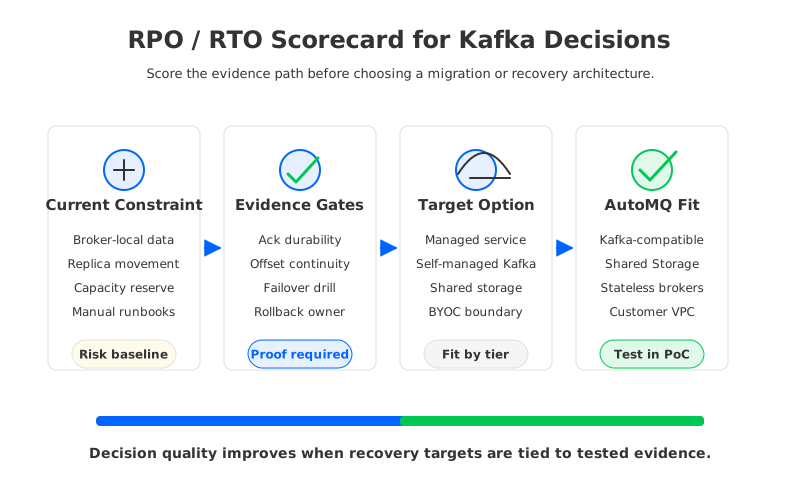
Someone searching for rpo rto scorecard kafka is usually not looking for a glossary definition. The team already knows that RPO means how much acknowledged or business-critical data can be lost, and RTO means how long the service can remain unavailable before the business impact becomes unacceptable. The harder question is whether the Kafka estate can prove those targets under the failure modes that matter: broker loss, Availability Zone isolation, regional recovery, bad deployments, offset drift, connector restart, and rollback after a partial migration.
That is why a scorecard is more useful than a generic disaster recovery checklist. It turns RPO and RTO from attractive slide labels into evidence that platform engineering, SRE, application owners, security, and finance can review together. A good scorecard does not ask whether Kafka is "reliable." It asks which workloads need zero data loss, which workloads tolerate replay, which consumers can restart idempotently, which offsets must remain consistent, and which recovery steps have been rehearsed with production-like traffic.
The practical thesis is simple: Kafka recovery planning fails when teams score topology instead of evidence. A three-AZ cluster, cross-region replication path, or managed service label may be necessary, but none of them proves the business target by itself. The scorecard has to connect application tolerance, Kafka mechanics, cloud infrastructure, operational ownership, and migration safety into one review.
1Why teams search for rpo rto scorecard kafka
RPO and RTO become urgent when Kafka stops being a single infrastructure component and becomes the coordination point for many products. Fraud systems depend on event freshness. Payment services depend on ordering and deduplication. CDC pipelines depend on offset continuity. Observability pipelines may tolerate delayed delivery, but they still need a replay window that survives incident response. The same Kafka cluster can host all of those workloads, which means a single platform-level promise often hides very different business expectations.
The search phrase usually appears during one of three moments. A team is preparing a cloud migration and needs to classify workloads before moving them. A reliability review has exposed an uncomfortable gap between stated SLOs and tested recovery. Or a platform team is evaluating Kafka-compatible alternatives and needs a neutral way to compare options without turning the discussion into vendor preference. In each case, the scorecard should protect the team from vague language.
The first useful distinction is between contractual objectives and tested objectives. If a provider or company-operated platform publishes an availability target, that target describes a service commitment. It does not automatically describe how much application data can be lost during a regional failover, whether consumers resume from the intended offsets, or whether a rollback path still exists after producers have switched. Platform teams should mark every RPO and RTO field as "officially committed," "tested by the team," or "assumed." The assumed category is where incidents tend to hide.
2The production constraint behind the problem
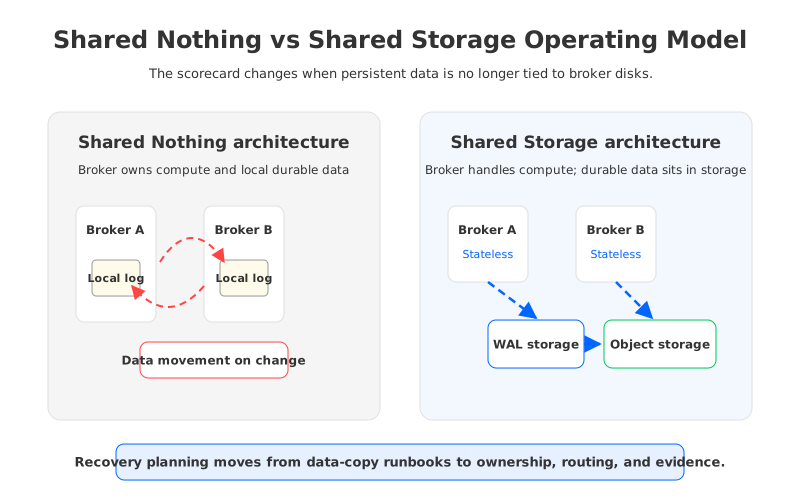
Traditional Kafka runs on a Shared Nothing architecture: each broker owns local storage, and partitions are replicated across brokers for durability and availability. That design is proven, familiar, and deeply integrated with Kafka's client and operational ecosystem. It also means recovery is tied to where data lives. When brokers fail, when partitions move, or when capacity changes, the platform has to reason about local logs, leader/follower state, in-sync replicas, network transfer, and the time it takes to rebuild enough healthy copies.
Those mechanics are not a flaw in Kafka; they are the operating model. The RPO side depends on write acknowledgment policy, replication factor, min.insync.replicas, producer settings, and whether the remaining replicas contain the acknowledged records. The RTO side depends on failure detection, leader election, client retry behavior, metadata refresh, application restart logic, and sometimes data movement before the cluster returns to a safe steady state. If the application owner only sees "Kafka was unavailable," the platform team still has to unpack several layers underneath that symptom.
The scorecard should therefore avoid one global answer. A workload with idempotent consumers, relaxed freshness requirements, and long retention can tolerate a different recovery path than a transactional stream feeding financial state. A connector pipeline may need schema, offset, and sink-side deduplication evidence more than broker failover metrics. A stream processing job may care less about raw broker recovery and more about whether its checkpoint, committed offsets, and output side effects agree after restart.
3Architecture options and trade-offs
The architecture review should start with the recovery mechanism, not with a product category. Self-managed Kafka gives the team direct control over broker configuration, replication, networking, and runbooks, but it also gives the team full responsibility for capacity planning, reassignment, upgrade safety, observability, and cloud cost exposure. Managed Kafka services reduce operational ownership in some areas, but teams still need to validate client behavior, network boundaries, replication scope, and the difference between provider availability and application recovery. Cross-region replication can improve disaster recovery posture, but it introduces lag, offset mapping, failover authority, and reconciliation questions that must be tested.
The useful trade-off table looks like this:
| Architecture choice | What it can improve | What still needs proof |
|---|---|---|
| Tune existing Kafka | Keeps client and operational familiarity; can improve common broker-failure response. | Multi-node and regional recovery, replica rebuild time, capacity reserve, and application restart behavior. |
| Add replication or DR cluster | Creates a recovery target outside the primary failure domain. | Replication lag, offset alignment, write authority, failback, and duplicate-processing tolerance. |
| Move to managed Kafka | Reduces some day-two infrastructure work and standardizes service operations. | Provider responsibility boundaries, data residency, networking, exact RPO/RTO commitments, and migration rollback. |
| Evaluate shared storage Kafka | Changes the relationship between brokers and durable data. | Kafka compatibility, WAL choice, object storage behavior, governance boundary, and workload-specific PoC evidence. |
This table is not meant to crown a winner. It forces the team to name the layer being changed. If the main problem is a poorly rehearsed failover runbook, tuning and drills may create more value than a platform migration. If the recurring problem is data movement during scaling and recovery, the target architecture has to change the broker-storage relationship, not only the management interface.
4Evaluation checklist for platform teams
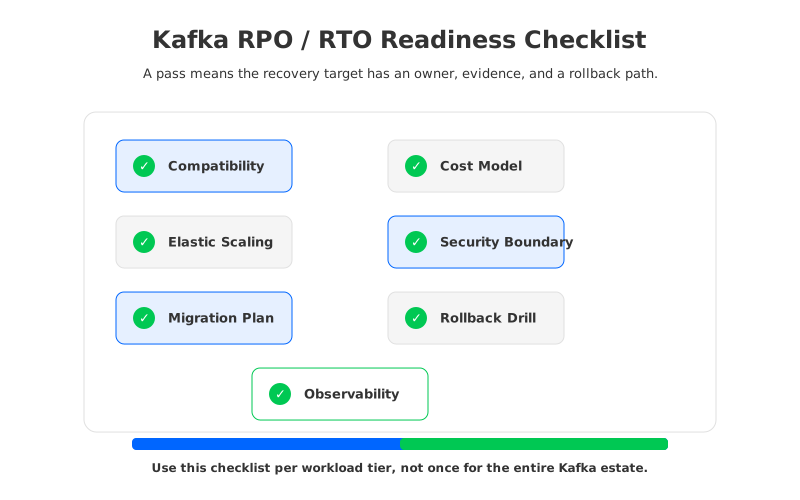
A production scorecard should be scored per workload tier. Use a small scale, such as 0 to 3, because the goal is not mathematical precision. A 0 means unknown. A 1 means documented but untested. A 2 means tested in staging or with partial production evidence. A 3 means tested with representative traffic, named owners, rollback evidence, and monitoring that would catch drift during an incident.
The categories below are a practical starting point:
- Compatibility: Client versions, producer settings, Consumer group behavior, transactions, compression, ACLs, quotas, Kafka Connect, and stream processing jobs should be tested against the target platform. "Kafka-compatible" must become evidence, not a label.
- RPO evidence: The team should know which records are considered committed, how replication or durable storage confirms them, and what happens to in-flight writes during failover.
- RTO evidence: Recovery time should include client reconnection, metadata refresh, consumer restart, connector restart, and application readiness, not only broker-side leader election.
- Cost and capacity: Recovery plans often require idle capacity, duplicate clusters, inter-zone or inter-region transfer, longer retention, and replay headroom. These costs belong in the scorecard because they shape the feasible design.
- Governance boundary: Security and compliance reviewers need to know where the data plane runs, where durable data sits, which identities can access it, and what telemetry leaves the environment.
- Migration and rollback: A migration plan should preserve ordering assumptions, offset progress, write authority, and a clear path back if cutover exposes an application issue.
- Observability: Dashboards should show consumer lag, replication lag, under-replicated partitions or equivalent health signals, producer errors, broker health, connector status, and recovery drill outcomes.
The scorecard becomes powerful when it exposes asymmetric risk. A workload can score high on broker failover and still fail the business objective if consumers cannot resume cleanly. Another workload can score high on migration replication and still be unsafe if rollback is undefined after writes have moved to the target cluster. The lowest-scoring category should drive the next engineering task.
5How AutoMQ changes the operating model
After that neutral evaluation, AutoMQ becomes relevant as an architecture pattern rather than a pitch. AutoMQ is a Kafka-compatible cloud-native streaming platform built around Shared Storage architecture. It keeps Kafka protocol and API compatibility while moving persistent stream storage away from broker-local disks and into S3-compatible object storage, with WAL (Write-Ahead Log) storage handling durable write acceleration and recovery.
That distinction matters for RPO and RTO scorecards because stateless brokers change the failure conversation. In a Shared Nothing model, a broker is both a compute process and a local custodian of partition data. In AutoMQ's model, brokers handle Kafka protocol processing, leadership, caching, and scheduling, while durable data is stored through S3Stream and object storage. A broker replacement or reassignment is therefore less about copying partition data from one local disk to another and more about metadata, ownership, routing, and cache warm-up.
This does not remove the need for testing. It changes what the team should test. Kafka compatibility still needs to cover the actual client estate, including producers, consumers, Connect workers, stream processors, transactions where used, and operational tooling. WAL storage choice should match latency, durability, and deployment requirements. Object storage permissions, regional boundaries, encryption, observability, and incident ownership still need security review. For AutoMQ BYOC, the control plane and data plane run inside the customer's cloud account and VPC, which can fit teams that want managed operations without moving business data into a vendor-hosted data plane.
AutoMQ Linking is also relevant to the migration portion of the scorecard. A safer Kafka migration is not only record copying. It has to preserve progress signals that applications care about, especially offsets and Consumer group behavior, while giving operators a path to test, cut over, and roll back. The scorecard should treat migration as a recovery drill in disguise: if the team cannot explain who owns writes, how offsets are verified, and what happens when cutover is reversed, the migration is not ready.
The cleanest way to evaluate AutoMQ is to keep the same scorecard. Do not grant points because the architecture sounds attractive. Grant points when the PoC shows client compatibility, stable Consumer group behavior, acceptable latency for the workload, clear data boundaries, operational visibility, and a rollback path that application owners understand.
6A readiness matrix you can use
The final decision should produce a next action, not a vague confidence score. If a category is unknown, discovery is the next action. If it is documented but untested, a drill is the next action. If it is tested only in staging, the next action is a production-like PoC with representative topic shapes, client versions, retention settings, and failure scenarios.
| Scorecard result | Likely interpretation | Next action |
|---|---|---|
| Compatibility below 2 | The platform target may break application assumptions. | Inventory clients and run workload-specific compatibility tests. |
| RPO below 2 | The team cannot prove what data survives a failure. | Test write acknowledgment, durable storage, and replication behavior under failure. |
| RTO below 2 | Broker recovery is not the same as application recovery. | Include client reconnect, consumer restart, connector restart, and readiness checks in drills. |
| Rollback below 2 | Migration or failover can become irreversible under pressure. | Define write authority, offset verification, DNS or bootstrap changes, and reversal steps. |
| Governance below 2 | The architecture may fail security review after technical validation. | Map data plane, storage, IAM, network, telemetry, and audit boundaries. |
Back at the original search box, rpo rto scorecard kafka is really a request for a decision process that survives production pressure. The platform team does not need a prettier DR diagram. It needs a short list of recovery promises, each tied to evidence, ownership, and a drill result. For teams evaluating Kafka-compatible shared storage as part of that target state, the next step is a workload-specific proof of concept that uses the same scorecard from day one.
If you are reviewing whether Shared Storage architecture fits your Kafka reliability goals, start with AutoMQ's technical overview or run a focused evaluation with your own topics, clients, and recovery targets: try AutoMQ.
7FAQ
7.1What is an RPO and RTO scorecard for Kafka?
It is a structured review that maps Kafka workloads to recovery targets, evidence, owners, and rollback plans. It should include application behavior, Kafka mechanics, cloud infrastructure, observability, and migration safety.
7.2Should every Kafka workload have the same RPO and RTO?
No. A payment stream, CDC pipeline, observability topic, and batch replay topic can have different loss tolerance, recovery time, ordering requirements, and replay expectations. Score them by workload tier.
7.3Does a multi-AZ Kafka cluster guarantee zero data loss?
No generic topology guarantees the business outcome by itself. Data loss risk depends on acknowledgment settings, replica health, failure scope, durable storage behavior, and what the application considers committed.
7.4How does Shared Storage architecture affect Kafka recovery planning?
Shared Storage architecture separates broker compute from durable data. That can reduce the amount of data movement required during broker replacement or scaling, but teams still need to test client compatibility, write durability, failover behavior, and rollback.
7.5Where should AutoMQ appear in the scorecard?
AutoMQ should be evaluated after the neutral criteria are defined. Score it on Kafka compatibility, Shared Storage architecture fit, stateless broker operations, customer-controlled deployment boundaries, migration tooling, observability, and workload-specific PoC results.
8References
- Apache Kafka Documentation
- Apache Kafka Consumer Design
- Apache Kafka KRaft Documentation
- Apache Kafka Tiered Storage
- Apache Kafka Transaction Design
- AutoMQ Architecture Overview
- AutoMQ S3Stream Shared Streaming Storage
- AutoMQ Compatibility with Apache Kafka
- AutoMQ BYOC Environment
- AutoMQ Migration Overview


