
Table of Contents
Table of Contents
RPO sounds clean in a disaster recovery plan. A team writes "five minutes" or "zero data loss" into a table, maps it to a business service, and moves on. Event streaming makes that table harder to defend because the recovery point is not a single database timestamp. It is a moving boundary across producer acknowledgments, broker replication, committed offsets, connector checkpoints, transactional state, topic retention, and the operational time needed to prove the cluster can accept traffic again.
That is why rpo scoring kafka is a useful search even for teams that already understand Kafka. The question is not "what does RPO mean?" The question is whether the architecture can make a stated recovery point measurable under failure, migration, and scale events. A streaming platform can look healthy during normal traffic and still have a weak recovery posture if it depends on slow data movement, unclear offset ownership, or recovery playbooks that nobody can run during an incident.
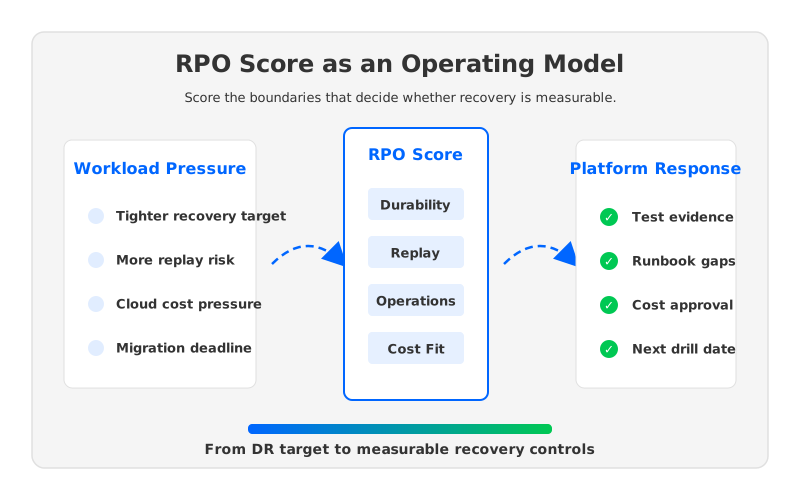
The practical answer is to score RPO as an operating model, not as a slogan. A strong score comes from evidence that recent writes are durable, consumers can resume from a known boundary, connectors can be reconciled, and the platform team can execute failover without improvising under pressure. The score also has to include cost, because permanent overprovisioning or heavy cross-zone replication may be rejected by the same buyers who need the protection.
1Why Kafka RPO Is Different from Database RPO
Traditional RPO thinking often starts with snapshots, logs, and replica promotion. Kafka-compatible streaming adds another layer: the data plane is also the coordination point for applications that publish and consume events continuously. A recovered cluster is not useful when topic data exists but producers cannot establish safe acknowledgments, consumer groups resume from unexpected offsets, or CDC connectors replay an ambiguous range.
Kafka gives teams useful primitives for this work. Producer acknowledgments, replication settings, consumer group offsets, transactions, and retention policies all influence how much data can be lost or replayed. The difficulty is that those controls sit across multiple owners: application teams configure clients, data teams operate connectors, platform teams run brokers, and security teams govern access. A score that ignores those ownership lines will look precise while hiding the real failure modes.
A defensible RPO score should separate four questions:
- Durability boundary: Which acknowledged records are protected when a broker, zone, or region fails, and where is the durable copy stored?
- Replay boundary: Which offsets, connector checkpoints, and transactional markers define the point where applications can safely resume?
- Operational boundary: How much human coordination is required before producers and consumers can use the recovery target?
- Economic boundary: What steady-state capacity, replica placement, and network transfer cost does the RPO require?
Those boundaries often disagree. A team may have strong broker replication but weak connector recovery. Another team may have clear consumer offset procedures but no budget for permanent standby capacity. RPO scoring becomes useful when it exposes those mismatches early enough to change the architecture.
2The Production Constraints Behind the Score
Shared-nothing Kafka deployments keep log segments on broker-local storage. That model has served production systems for years, but it ties recovery to the movement and placement of data across brokers. When a broker disappears, partitions need replicas. When capacity changes, data has to be redistributed. When a region-level recovery plan is tested, teams must account for how much data exists in the recovery environment and how quickly applications can point at it.
The RPO impact comes from coupling. Compute, network, and storage decisions are entangled in the same broker fleet. Adding brokers changes data placement. Replacing brokers raises replica catch-up and partition leadership questions. Keeping standby capacity improves recovery options but can leave resources idle most of the month. None of these behaviors make Kafka unreliable. They make RPO a system property rather than a setting.
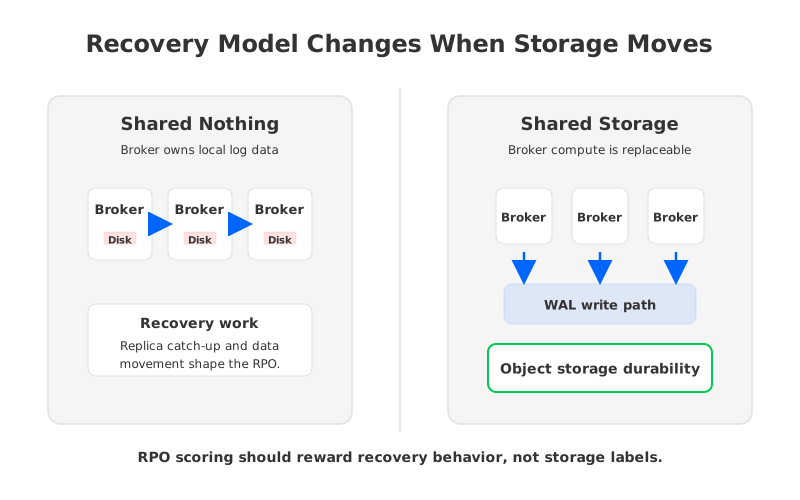
Cloud deployment adds another constraint: the lowest-cost path and the safest path are not always the same path. Replicating data across availability zones improves survivability, but it can also create network charges and extra operational surface area. Object storage changes the storage economics and durability assumptions, but teams still need a low-latency write path for hot data. A good RPO score rewards architectures that make the trade-off explicit instead of hiding it inside a sizing worksheet.
3A Scoring Model Platform Teams Can Use
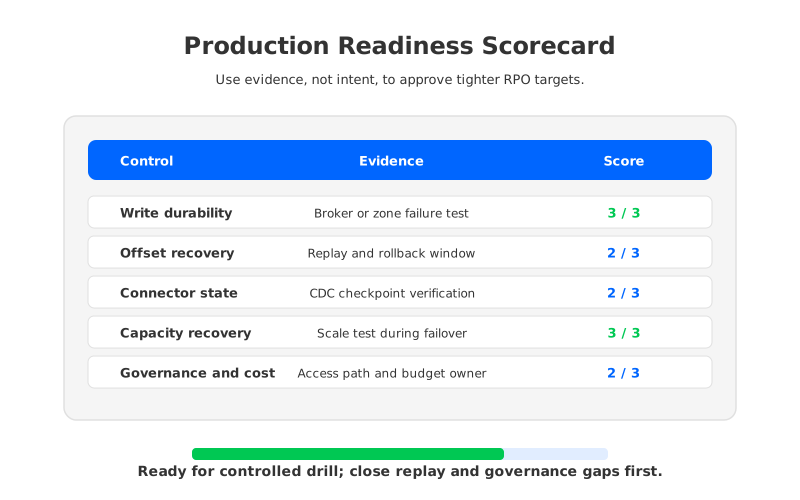
The useful score is not a single number handed down by the architecture board. It is a review process that turns ambiguous DR language into testable controls. I usually prefer a 0 to 3 scale for each dimension because it is coarse enough for a workshop and strict enough to expose weak evidence.
| Dimension | 0 | 1 | 2 | 3 |
|---|---|---|---|---|
| Write durability | No clear acknowledged-write boundary | Broker settings documented but untested | Failure tests cover broker loss | Zone or region scenario tested with evidence |
| Offset recovery | Consumer offsets treated as application detail | Reset procedure exists | Group recovery tested per critical app | Replay and rollback windows are rehearsed |
| Connector state | Source and sink checkpoints not included | Manual connector restart runbook | Connector replay range verified | CDC and sink consistency verified end to end |
| Capacity recovery | Manual broker sizing during incident | Static standby plan | Scale plan tested under load | Recovery capacity scales without data reshuffle bottlenecks |
| Governance | Access and network rules handled case by case | DR identities documented | Recovery permissions tested | Least-privilege recovery path automated |
| Cost fit | RPO depends on unapproved standby spend | Cost known but not allocated | Cost included in service ownership | Cost model supports repeated recovery tests |
The score should be assigned per workload tier, not per cluster. A fraud detection pipeline, a product analytics stream, and a cache invalidation topic may share infrastructure but deserve different recovery goals. Putting them in one score invites either overengineering or underprotection. A tiered score also helps buyers evaluate Kafka-compatible platforms without reducing the review to a feature checklist.
The scoring conversation changes when the team asks for evidence. "We use replication factor 3" is not evidence by itself. Evidence is a dated failover test, a measured offset reconciliation path, a connector replay window, a cost model, and a rollback plan that names the people and systems involved. The point is not paperwork. The point is to make the recovery point observable before the recovery event.
4Architecture Options and Trade-offs
There are several ways to improve an event streaming RPO posture. Multi-zone broker placement improves availability inside a region, but it still requires planning around replication traffic, client rack awareness, and failure domains. Cross-cluster replication can support region recovery, but it introduces lag monitoring, topic mapping, offset translation, security duplication, and cutover governance. Tiered storage can reduce local disk pressure for older segments, but the hot write path and broker-local responsibilities still matter during recovery.
That is why the scoring model should judge architectures by behavior under stress:
- How fast can the platform restore write capacity? Recovery that waits on large-scale data redistribution will struggle when the incident also involves degraded networks or constrained cloud capacity.
- Where does durable data live? Broker-local data, attached block volumes, replicated clusters, and object storage create different recovery boundaries.
- How much state is tied to a broker identity? The more state a broker owns, the more careful the replacement and scaling process becomes.
- Can teams test the plan often? A DR process that is expensive or disruptive will be tested less, and an untested RPO is a wish.
This is where cloud-native Kafka-compatible architecture becomes relevant. The interesting shift is not that one product has a longer checklist. The shift is separating compute from persistent stream storage so broker recovery is less dependent on moving large volumes of local data. Once that separation is real, the RPO score can give more weight to repeatable operations: adding capacity, replacing a broker, routing clients, and validating offsets.
AutoMQ fits that category as a Kafka-compatible streaming platform built around shared storage. Its architecture keeps the Kafka API surface familiar while moving persistent log storage into object storage, with a WAL layer for the low-latency write path and stateless brokers for compute. That does not remove the need for RPO design. It changes which risks dominate the score: less broker-local data movement, more attention on object storage configuration, WAL choice, identity boundaries, and compatibility testing.
5How AutoMQ Changes the Operating Model
In a shared-storage model, a broker is no longer the long-term owner of the data it serves. That distinction matters during recovery. If a broker fails, the platform should not need to rebuild a large local log before the workload can make progress. If the workload grows, compute capacity can scale with less dependence on partition data migration. Recovery drills become more about validating control-plane and client behavior than moving historical data.
AutoMQ also changes how teams reason about cloud cost in the RPO score. Object storage is designed for durable, scalable storage, while broker compute can be sized closer to active traffic. AutoMQ documentation describes approaches for reducing inter-zone traffic in Kafka-compatible deployments. For RPO scoring, this means the economic boundary can be evaluated as part of the architecture instead of becoming a finance surprise after DR approval.
The compatibility dimension still deserves a hard review. A Kafka-compatible platform should be tested with the same producers, consumers, security configuration, monitoring tools, and scripts that production uses. For migration, a strong score includes dual-running, lag visibility, rollback criteria, and offset validation. AutoMQ provides migration guidance for Apache Kafka workloads, but each environment still needs to prove the path with its own traffic shape and failure assumptions.
The result is not a promise of "zero risk." Shared storage can remove a category of recovery friction that broker-local storage tends to create. The platform team still needs to test WAL behavior, object storage permissions, client retries, monitoring, alerting, and governance. The difference is that those tests focus more on service correctness than on moving data between brokers.
6A Practical RPO Checklist
An RPO review should produce a score, a gap list, and a test schedule. The score shows current posture. The gap list tells the platform team what to fix. The schedule prevents the score from going stale as applications, topics, schemas, connectors, and cloud accounts change.
Use this checklist before approving a workload for a tighter RPO target:
- Define the record boundary: Document which producer acknowledgment settings, broker durability settings, and topic retention rules define protected data.
- Map the replay path: Identify consumer groups, transactional producers, CDC connectors, sink connectors, and any external checkpoint stores.
- Test broker failure separately from zone failure: A broker restart test is not a zone recovery test. Score them separately.
- Model recovery cost: Include standby compute, cross-zone or cross-region transfer, object storage, observability, and repeated drill cost.
- Prove client behavior: Validate DNS, bootstrap servers, TLS/SASL settings, retries, idempotence, and backpressure during failover.
- Set rollback rules: Decide when to return traffic to the original cluster, when to keep the recovery target, and how to avoid double writes.
The checklist should be owned by the service team and the platform team together. Platform teams understand broker behavior and cloud limits. Service teams understand the consequences of replay, duplication, and missed events. RPO scoring fails when either side treats the other as an implementation detail.
7Decision Guidance for Technical Buyers
When comparing Kafka-compatible platforms, ask vendors to walk through the score instead of asking for a generic DR statement. The strongest answers tie architecture to operations: where acknowledged data is stored, how broker loss is handled, how offsets are preserved, how migration is tested, how access control works, and what steady-state cost looks like.
The final score should not be hidden in a spreadsheet. Put it next to the workload tier, target RPO, last test date, and next test date. A workload with a target RPO of one minute and no recovery drill in the last year is not a high-score workload, no matter how many replicas it has. A workload with a looser RPO but tested recovery and clear replay rules may be safer in practice.
If your Kafka estate is moving toward tighter recovery targets, higher retention, or more elastic cloud operations, evaluate whether broker-local storage is creating work that does not serve the business goal. AutoMQ is worth considering when the team wants Kafka compatibility while shifting persistent stream storage to shared object storage and reducing the operational drag of data redistribution. To discuss whether that model fits your workload tiering and RPO scorecard, contact the AutoMQ team through the verified contact page: https://www.automq.com/contact?utm_source=blog&utm_medium=cta&utm_campaign=rpb-0090-rpo-scoring-kafka.
8References
- Apache Kafka documentation
- Apache Kafka message delivery semantics
- AWS S3 storage classes
- Amazon S3 user guide
- AutoMQ architecture overview
- AutoMQ WAL storage
- AutoMQ compatibility with Apache Kafka
- Migrating from Apache Kafka to AutoMQ
- AutoMQ inter-zone traffic overview
9FAQ
9.1What does RPO mean for Kafka workloads?
RPO is the maximum acceptable data loss boundary for a workload. In Kafka-compatible streaming, the boundary includes acknowledged producer writes, replicated log data, committed consumer offsets, connector checkpoints, and transactional state. A useful RPO target must explain how those pieces are recovered together.
9.2Is replication factor enough to define Kafka RPO?
No. Replication factor is one input into durability, but it does not cover consumer replay, connector consistency, cross-zone recovery, cloud capacity, access control, or rollback. It should be scored as part of a broader recovery model.
9.3How should teams score RPO for different topics?
Score by workload tier rather than by cluster. Group topics by business impact, replay tolerance, producer requirements, consumer behavior, and connector dependencies. Then assign target RPO, test evidence, and gaps for each tier.
9.4How does shared storage affect RPO scoring?
Shared storage can reduce dependence on broker-local data movement during replacement and scaling. That can improve the operational part of the RPO score, but teams still need to validate WAL behavior, object storage permissions, client compatibility, monitoring, and recovery runbooks.
9.5Where should AutoMQ enter an RPO evaluation?
AutoMQ belongs in the architecture option stage after the team has defined workload tiers and scoring dimensions. Evaluate it for Kafka compatibility, shared-storage recovery behavior, cloud cost model, migration path, governance boundaries, and operational testability.


