
Table of Contents
Table of Contents
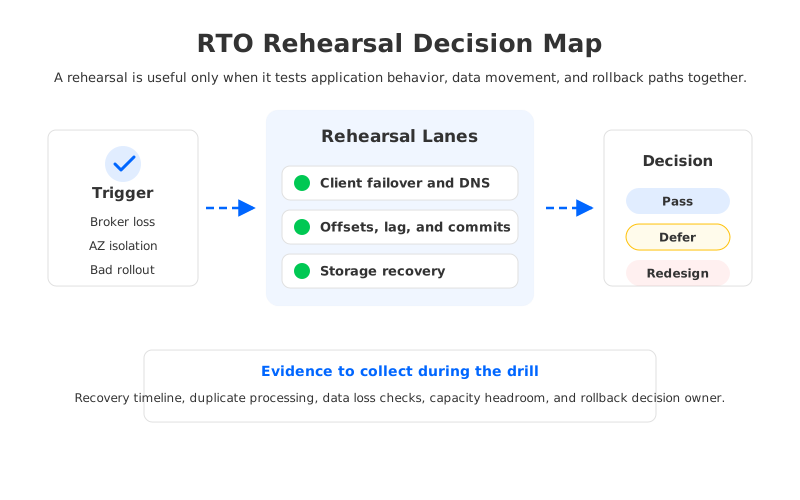
The uncomfortable part of an RTO rehearsal is not the calendar invite. It is the moment when a team realizes that "Apache Kafka is replicated" and "the business can recover inside the target window" are different claims. That is the real search intent behind rto rehearsal kafka: replication protects data under a specific failure model, while recovery time objective, or RTO, tests whether applications, clients, storage, DNS, access control, observability, and human decision paths can bring the service back before the business impact becomes unacceptable.
For Apache Kafka platform owners, that distinction matters because Kafka sits between systems that rarely fail in neat order. A payment service may continue producing while a fraud pipeline is paused. A consumer group may resume from a committed offset while the downstream database has already applied part of the batch. A connector may recover at the infrastructure layer while the schema or credentials path fails. The rehearsal has to expose these mismatches before an incident does.
1Why Teams Search for rto rehearsal kafka
Most searches for rto rehearsal kafka come from teams that already run production Kafka. They are not asking whether Kafka can replicate data. They are asking whether the platform can prove a recovery target under pressure: how long a failover takes, how much duplicate processing appears, whether consumer lag returns to normal, and who has authority to roll back when the first plan is not working.
A useful rehearsal starts with a business statement, not a broker statement. "Recover the event streaming platform in 15 minutes" is still too vague. Which topics matter? Which consumer groups must resume first? Which producers can buffer locally, and which must fail fast? Which downstream systems can tolerate duplicate events? When the target is written at that level, the rehearsal stops being a synthetic infrastructure drill and becomes a production readiness exercise.
Mature platform teams also separate RTO from RPO. RPO asks how much data loss is acceptable. RTO asks how quickly service is restored. In Kafka, the two interact through acknowledged writes, committed offsets, replication state, transaction behavior, connector state, and client retry configuration. A cluster can have a strong durability story and still miss RTO because client failover is slow, partition reassignment is blocked, or operators spend the first 20 minutes deciding whether the source cluster is still trustworthy.
2The Production Constraint Behind the Problem
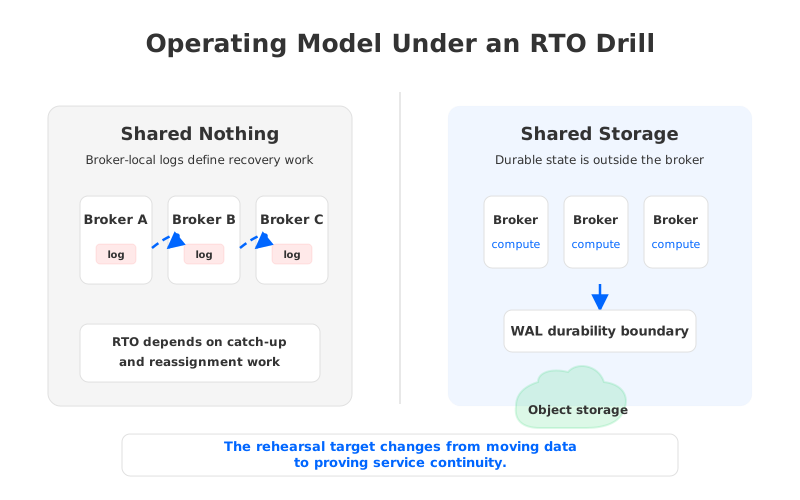
Traditional Kafka runs a Shared Nothing storage model. Each broker owns local log segments, and durability is maintained through replication across brokers. That model is proven, but it creates a specific recovery shape: when capacity changes, brokers fail, or replicas fall behind, the platform may need to move data across the broker fleet before the system is fully healthy again. During a normal day this is operational work. During an RTO drill it becomes elapsed time.
The constraint is not only disk. It is coupling. Broker identity, partition leadership, local storage, network traffic, and recovery operations are tied together tightly enough that a drill has to account for all of them. If a broker disappears, the team needs to know whether leaders move cleanly, whether under-replicated partitions recover, whether consumers can fetch from replacement leaders, and whether the remaining brokers have enough headroom to absorb the workload.
That coupling also affects cost planning. A realistic rehearsal often requires standby capacity, cross-AZ data movement, temporary overprovisioning, and monitoring coverage that mirrors production. Cloud infrastructure makes this visible on the bill. A test that passes because the team provisioned a large idle replica environment may satisfy a narrow RTO document, but it may not be a sustainable operating model.
3Architecture Options and Trade-Offs
Kafka platform owners usually evaluate three recovery patterns. The first is active-passive: a secondary environment receives replicated data and is promoted during an incident. The second is active-active or multi-cluster routing: applications can use more than one cluster, but operational and consistency complexity rises. The third is a shared-storage or cloud-native Kafka-compatible architecture, where the system changes the relationship between brokers and durable data so that broker recovery is less dependent on moving local log segments.
Those options are not interchangeable. Active-passive can be clear and auditable, but the rehearsal must prove data synchronization, offset handling, endpoint switching, and rollback. Active-active can reduce some failover delay, but it raises questions about ordering, duplicate writes, consumer semantics, and governance boundaries. Shared-storage architectures can reduce the amount of data tied to a failed broker, but they still need a clear hot path, metadata design, client compatibility story, and observability model.
The decision becomes easier when the team evaluates each option against the same criteria:
- Compatibility: Existing producers, consumers, Kafka Connect jobs, ACLs, schemas, monitoring, and client libraries should continue to behave predictably. A rehearsal that passes with a simplified test client does not prove the production estate can move.
- Recovery mechanics: The plan should state what has to happen to brokers, metadata, offsets, and endpoints before service is considered restored. If the answer is "wait for the cluster to settle," the RTO target is probably under-specified.
- Cost shape: Standby clusters, cross-zone traffic, replicated storage, and temporary capacity all belong in the rehearsal model. RTO is an engineering target, but it becomes a commercial decision when the standby plan runs every month.
- Governance boundary: Security teams need to know where data resides, who can access the recovery environment, how audit logs are preserved, and which account or VPC contains the data plane.
- Rollback path: A cutover plan without a rollback plan is an optimistic migration plan. The rehearsal should test who can declare rollback, what data cannot be reversed, and which applications need manual reconciliation.
4A Practical RTO Rehearsal Plan
Start by choosing one business flow, not the entire Kafka estate. A good first candidate is important enough to matter but contained enough to debug: one producer family, two or three critical topics, a small set of consumer groups, and one downstream system where duplicate processing can be observed. This keeps the rehearsal honest. If the team cannot prove recovery for one flow, expanding the scope will only hide the problem under more dashboards.
Then define the failure injection and the pass criteria together. For example, an AZ isolation drill should specify what traffic is blocked, which brokers or clients are affected, and which systems remain intentionally available. The pass criteria should include elapsed time, final consumer lag, duplicate-event tolerance, failed produce behavior, operator decision points, and post-recovery backlog burn-down. The plan should also state what counts as a failed drill. Ambiguous success is the fastest way to turn a rehearsal into a meeting with screenshots.
The runbook needs a timeline. At minute zero, who declares the scenario? At minute two, which dashboard confirms the failure? At minute five, which endpoint or routing change is expected? At minute ten, which consumer group should be recovering? A timeline lets the team compare expected and actual behavior without arguing from memory after the drill.
Use the same discipline for evidence collection. Platform owners should capture broker health, under-replicated partitions, controller or metadata status, produce error rates, consumer lag, offset commits, connector task status, network traffic, and application-level reconciliation. The application evidence matters most. Kafka can look healthy while the business flow is still stuck behind a downstream retry storm.
5Where AutoMQ Changes the Operating Model
The neutral evaluation above points to a deeper architectural requirement: the platform should reduce the amount of recovery work tied to broker-local persistent state while preserving Kafka protocol behavior for applications. That is where AutoMQ enters the discussion. AutoMQ is a Kafka-compatible cloud-native streaming platform that separates broker compute from durable storage, using a Shared Storage architecture with a WAL layer and object storage rather than treating each broker's local disk as the long-term source of truth.
This changes what an RTO rehearsal measures. In a traditional Shared Nothing model, a failed broker can turn the rehearsal into a test of replica catch-up, data movement, and partition reassignment under degraded capacity. In a shared-storage model, brokers are closer to stateless compute nodes, so the drill can focus more directly on service continuity: can another broker take over, can clients reconnect, can offsets and metadata remain coherent, and can the workload return to target latency and lag?
AutoMQ's value is not that teams can stop rehearsing. The opposite is true. A cleaner architecture makes the rehearsal more precise because fewer minutes are consumed by avoidable data movement. Platform teams can spend the drill validating the parts that still require human and application discipline: client retry policy, consumer idempotency, connector restart behavior, governance boundaries, and rollback decision-making.
The same logic applies to cloud cost. Kafka RTO planning often hides the cost of standby storage and cross-zone replication in the phrase "high availability." With shared storage, object storage becomes the durable data layer, and brokers can be scaled more independently from retained data. For workloads where cross-AZ Kafka replication traffic is a material cost driver, that operating model gives FinOps and platform teams a more explicit way to compare recovery readiness against monthly spend.
6Evaluation Checklist for Platform Teams
An RTO rehearsal should end with a scorecard that a CTO, SRE lead, and application owner can all read. The scorecard should not be a long incident transcript. It should answer whether the recovery model is ready, where it failed, and what investment is needed before the next drill.
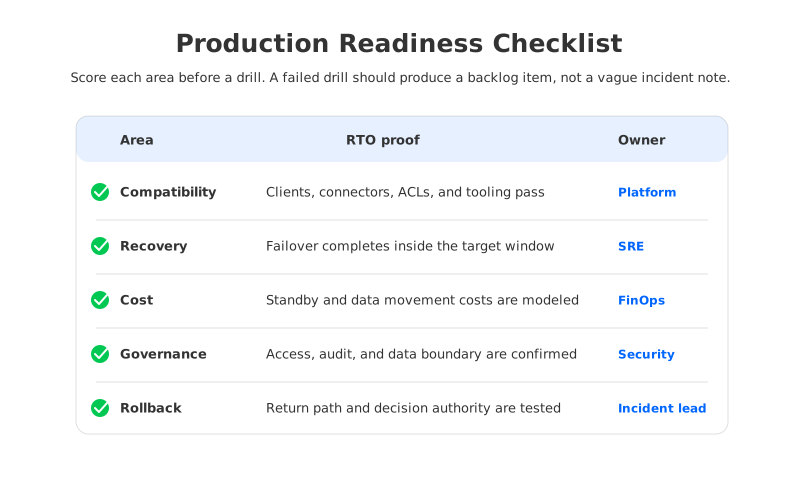
Use this checklist before scheduling the rehearsal:
| Area | Question to answer | Evidence to collect |
|---|---|---|
| Business scope | Which topics and consumer groups define the critical flow? | Topic inventory, owner map, downstream dependency list |
| RTO target | What exact event marks service restored? | Timeline, lag threshold, application success metric |
| Client behavior | How do producers and consumers discover the recovery endpoint? | Client config, retry logs, DNS or bootstrap change record |
| Offset integrity | Can consumers resume without unacceptable replay or skip? | Offset commits, duplicate-event analysis, reconciliation logs |
| Capacity | Can the recovery path absorb peak or degraded-mode traffic? | Broker metrics, throttling, request latency, backlog burn-down |
| Governance | Does the recovery path preserve data and access boundaries? | IAM review, audit logs, encryption and network evidence |
| Rollback | Who can stop the cutover, and what cannot be reversed? | Decision log, rollback procedure, application owner sign-off |
The most useful result is often a failed row. If offset handling fails, the next action may be consumer idempotency work rather than a Kafka change. If endpoint switching is slow, the fix may be service discovery or client configuration. If capacity is the blocker, the platform team needs to decide whether to pre-provision, automate scaling, or change the architecture that creates the capacity dependency.
7Migration and Rehearsal Should Share a Runbook
Migration planning and RTO rehearsal planning overlap more than teams expect. Both require topic inventory, producer and consumer ownership, endpoint switching, offset handling, synchronization monitoring, and rollback logic. The difference is intent. Migration changes the steady-state platform. RTO rehearsal proves that a platform can survive a bad day.
That overlap is worth exploiting. If a team is evaluating Kafka-compatible infrastructure, the migration runbook should include the first RTO rehearsal before production cutover. The rehearsal does not need to simulate every regional disaster. It needs to prove that the target operating model handles one critical business flow better than the current one, with clear evidence and a realistic rollback path.
For AutoMQ specifically, teams evaluating a move from Apache Kafka can review the migration guidance and then adapt the same inventory, synchronization, and rollback concepts into a rehearsal plan. A practical next step is to map one critical Kafka flow and compare how much recovery work is tied to broker-local storage, cross-AZ data movement, and manual reassignment. AutoMQ's Kafka-compatible Shared Storage architecture is relevant when that mapping shows the current RTO target is being held hostage by data movement rather than application readiness. To explore that path, start with AutoMQ's migration entry point: plan a Kafka-to-AutoMQ migration.
8References
- Apache Kafka documentation: Design
- Apache Kafka documentation: Configuration
- Apache Kafka documentation: Kafka Connect
- AutoMQ documentation: Compatibility with Apache Kafka
- AutoMQ documentation: Architecture overview
- AutoMQ documentation: Eliminate Inter-Zone Traffics
- AutoMQ documentation: Migrating from Apache Kafka to AutoMQ
- AWS documentation: Data protection in Amazon S3
- AWS: Amazon S3 FAQs
9FAQ
9.1What is an RTO rehearsal for Kafka?
An RTO rehearsal is a controlled exercise that tests whether a Kafka-backed business flow can recover within its recovery time objective. It should include clients, offsets, applications, connectors, observability, and rollback decisions, not only broker availability.
9.2Is Kafka replication enough to satisfy an RTO target?
No. Replication is part of the durability and availability design, but RTO depends on the full recovery path. Client reconnection, consumer lag, duplicate processing, endpoint changes, operator decisions, and downstream reconciliation can all cause the business flow to miss its target.
9.3How often should Kafka platform teams run RTO rehearsals?
Run a rehearsal after major platform changes, before migration cutovers, and on a regular cadence for critical flows. The exact cadence depends on business risk, regulatory needs, and how often applications, clients, and infrastructure change.
9.4What should be tested first?
Start with one critical business flow that has clear owners and measurable success criteria. Include a producer, a small topic set, important consumer groups, and one downstream system where replay or skipped processing can be detected.
9.5How does shared storage affect Kafka RTO planning?
Shared storage can reduce the recovery work tied to broker-local persistent data. That can shift the rehearsal from waiting on data movement toward proving client reconnection, metadata consistency, application idempotency, and operational decision-making.
9.6Where does AutoMQ fit in a Kafka RTO strategy?
AutoMQ fits when a team wants Kafka compatibility but needs a cloud-native operating model with stateless brokers, shared storage, object-storage-backed durability, and more independent compute and storage scaling. It should be evaluated through the same RTO scorecard as any other production platform.


