
Table of Contents
Table of Contents
Searching for runbook automation gates kafka usually means a team has moved past generic automation. The question is no longer "Can we restart a broker with a script?" It is "Should this script be allowed to run against production right now, with this consumer lag, this replication state, this migration window, and this rollback path?" That is a harder problem because Apache Kafka operations sit between application behavior, storage layout, network cost, and data governance.
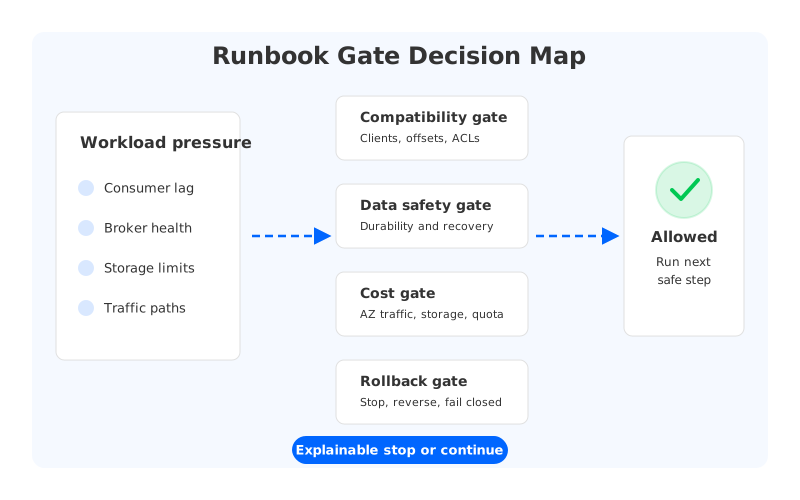
A gate is the decision point that stops an automated runbook when the cluster is not ready for the next step. It can be a policy check, a metric threshold, a change-approval rule, or a rollback test. For event streaming teams, the useful gates are not generic CI checks. They need to understand Kafka-compatible semantics, including consumer group movement, offsets, transactions, broker leadership, topic retention, and client compatibility. The core thesis is simple: runbook automation works only when the platform exposes stable operational boundaries. When the infrastructure keeps moving data around underneath the runbook, every gate has to defend against more hidden state.
1Why teams search for runbook automation gates kafka
Kafka teams rarely wake up wanting more runbooks. They get there after the same incidents repeat: a broker replacement takes longer than the maintenance window, a partition reassignment competes with production traffic, a connector restart changes lag patterns, or a migration cutover stalls because offset ownership is not where the runbook expected it to be. The first response is documentation. The second response is scripting. The third response, after someone asks why the script ran during an unsafe cluster state, is gates.
The phrase "runbook automation gates" is useful because it separates execution from permission. A runbook might know how to expand a cluster, drain a broker, promote a standby path, restart connectors, or shift a workload to another environment. A gate decides whether the runbook is allowed to continue. In a production streaming system, that decision needs evidence from several layers:
- Kafka state: partition leadership, in-sync replicas, consumer group offsets, transactional producer health, and controller availability.
- Workload pressure: produce throughput, fetch throughput, tailing reads, catch-up reads, consumer lag, and topic-level hot spots.
- Infrastructure risk: Availability Zone placement, network paths, disk pressure, object storage health, and quota limits.
- Change controls: maintenance windows, approval boundaries, audit records, rollback criteria, and data residency rules.
The mistake is treating these checks as decoration around a shell script. A gate that only asks "Did the previous command exit with code 0?" has almost no understanding of streaming risk. A useful gate asks a stronger question: "If we take the next action, can the cluster preserve Kafka semantics and recovery options without moving the incident from infrastructure into the application layer?"
2The production constraint behind the problem
Traditional Kafka runs on a Shared Nothing architecture. Each broker owns local persistent data, and replication keeps follower copies on other brokers. That model is coherent and battle-tested, but it creates a direct link between operational change and data movement. Replacing a broker is not only a compute action. It also affects local log segments, replica catch-up, leader placement, storage pressure, and network traffic between brokers.
This is where runbook gates become crowded. Before draining a broker, the gate has to inspect whether followers are caught up. Before changing capacity, it has to ask whether reassignment will push replication traffic into the same network path as producers and consumers. Before increasing retention, it has to ask whether broker-local disks can absorb the change. Before a migration cutover, it has to verify not only topic data but also offsets, consumer groups, ACLs, and client behavior.
The issue is not that Shared Nothing architecture is wrong. It was built for a world where brokers and disks were the unit of durability. The issue is that cloud operations expose a different cost and failure model. Compute nodes are replaceable, object storage is durable by design, and cross-zone network movement often shows up as a separate line item. A runbook that treats all capacity operations as broker-local actions inherits the old storage boundary even when the cloud gives it better primitives.
3Architecture options and trade-offs
There are several ways to make Kafka operations more automated. None of them is magic, and each one changes the gates you need.
| Architecture pattern | What the runbook can automate | What the gate still has to verify |
|---|---|---|
| Self-managed Kafka on local disks | Broker replacement, reassignment, rolling restart, disk expansion, and connector restart | Replica movement, disk headroom, controller health, leader balance, lag, and rollback timing |
| Managed Kafka service | Provisioning, upgrades, scaling requests, and basic health checks | Service quotas, client compatibility, networking, cost exposure, migration control, and operational visibility |
| Kafka with Tiered Storage | Longer retention with historical data offloaded from local disk | Hot-tier pressure, rebalance cost, local-disk dependency, remote-read behavior, and recovery sequencing |
| Shared Storage architecture | Compute replacement, elastic capacity, and recovery with less broker-local state | Object storage policy, WAL storage health, metadata consistency, client compatibility, and governance controls |
Apache Kafka features such as consumer groups, offsets, transactions, Kafka Connect, KRaft, and Tiered Storage give operators mature building blocks. The runbook question is how much of the production state is tied to a broker before the gate can say "continue." In a local-disk model, a safe automation gate often has to wait for data movement to finish. In a shared-storage model, the same gate can focus more on metadata, client behavior, and workload health because persistent data is not trapped on the broker being replaced.
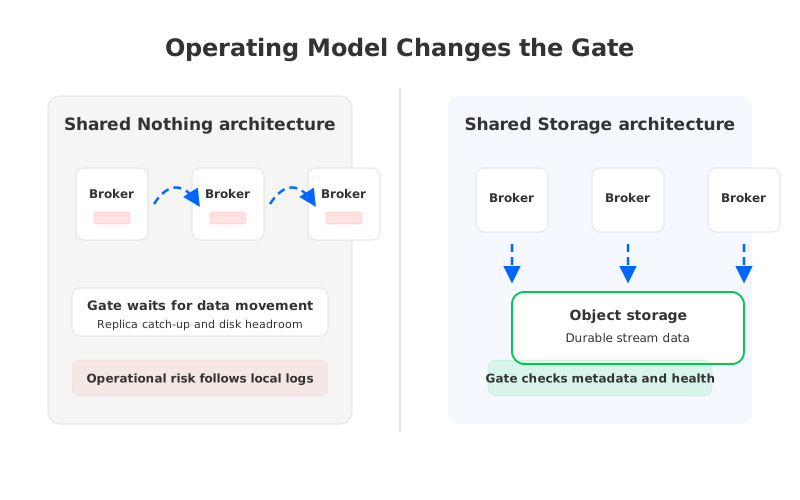
The distinction matters for platform teams because automation gates are not only safety checks. They are also organizational contracts. Application teams want predictable change windows. SREs want clear rollback points. Security teams want auditable access boundaries. FinOps teams want infrastructure actions that do not create surprising network and storage bills. The architecture either makes those contracts easier to express, or it forces every runbook to carry a private model of the cluster.
4Evaluation checklist for platform teams
A practical checklist starts with the failure you are trying to prevent. If a runbook can restart a connector but cannot tell whether consumer lag is recovering, it is not production-ready. If a migration script copies topic data but treats offsets as an afterthought, it is not a migration gate. If a broker replacement waits for disk movement but the maintenance window is fixed, the gate is really a business-risk decision disguised as a technical one.
Use the following framework when evaluating Kafka-compatible streaming infrastructure for automated operations:
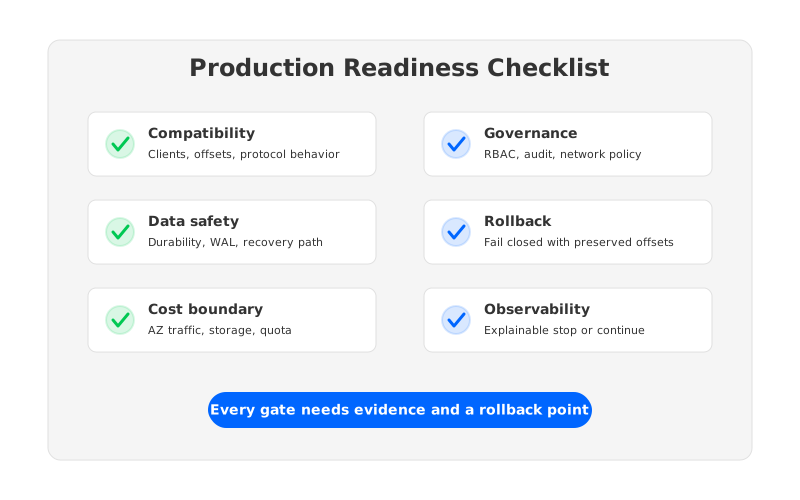
- Compatibility gate. Confirm the platform preserves the Kafka APIs, protocol behavior, client versions, consumer group semantics, offset behavior, ACL model, and transaction expectations your applications rely on.
- Data safety gate. Check replication state or shared-storage durability, WAL storage health, controller status, retention policy, and recovery path before running any destructive or irreversible action.
- Cost gate. Inspect whether the action triggers broker-to-broker replication, cross-Availability Zone traffic, over-provisioned storage, extra connector capacity, or temporary duplicate infrastructure.
- Elasticity gate. Ask whether adding or removing compute requires data movement. If it does, the gate needs thresholds for throughput, lag, and replication backlog before it can continue.
- Governance gate. Verify role-based access, audit logs, encryption boundaries, network isolation, and data residency rules before automation crosses an environment boundary.
- Rollback gate. Define the exact point where the runbook can stop, reverse, or fail closed without corrupting offsets, losing topic history, or surprising consumers.
These gates should be machine-readable, but they should not be opaque. A good platform shows why a runbook stopped. "Blocked because partition reassignment backlog exceeds the threshold" is actionable. "Blocked because risk score is high" is not. The operator needs a clear object, a current measurement, and a next action.
5How AutoMQ changes the operating model
Once the evaluation framework is in place, the architecture question becomes sharper: how much state should a broker own? AutoMQ is a Kafka-compatible, cloud-native streaming platform that uses Shared Storage architecture to separate compute from storage. Instead of making broker-local disks the durability boundary, AutoMQ stores persistent stream data in S3-compatible object storage and uses stateless brokers for Kafka-compatible serving.
That shift changes the shape of runbook gates. Broker replacement is less about evacuating local log data and more about verifying metadata, workload health, and storage access. Capacity changes are less likely to turn into long partition-reassignment projects because compute and storage scale independently. Recovery checks can focus on whether the broker can reattach to shared data and resume service, rather than whether a replacement broker has rebuilt a local copy of every affected partition.
The design also changes the cost gate. In a traditional multi-AZ Kafka deployment, replication traffic and client routing can create cross-zone movement that operators need to monitor closely. AutoMQ documents a zero cross-AZ traffic model for cloud deployments that routes produce and consume traffic with S3-backed shared storage in mind. That does not remove the need for cost governance, but it gives the runbook a cleaner rule: verify the intended routing and storage policy rather than predicting how much replication traffic a rebalance will create.
For production teams, the more interesting benefit is not a shorter script. It is a smaller state space. A broker that does not own durable local data is easier to replace. A scaling action that does not require large data movement is easier to gate. A migration tool such as Kafka Linking can be evaluated with a concrete checklist around data sync, offset consistency, rollback timing, and client cutover. AutoMQ Console, Terraform-based workflows, Self-Balancing, and monitoring then become operational interfaces for the same principle: automation should act on explicit platform state, not tribal knowledge about a particular cluster.
6A runbook gate model you can implement
The cleanest gate model has four stages. The first stage is a preflight check that reads cluster state without changing anything. The second stage is a policy check that compares the state with production rules. The third stage is an action check that runs the smallest reversible step. The fourth stage is a post-action check that proves the cluster moved toward the intended state.
For a broker replacement runbook, that model might look like this:
Preflight: controller healthy, no active incident, lag within threshold
Policy: maintenance window open, approval recorded, affected topics allowed
Action: remove broker from serving path or reduce traffic exposure
Post-action: leadership stable, consumers recovering, rollback path still valid
For a migration runbook, the same model uses different evidence:
Preflight: source and target reachable, schemas and ACLs mapped
Policy: topic list approved, data residency boundary confirmed
Action: start topic sync, validate offsets, test read path
Post-action: consumer groups caught up, cutover criteria met, source preserved for rollback
The pattern is intentionally boring. Boring is good here. A gate is not where you want cleverness. It should be strict, explainable, and tied to the smallest set of facts that prove the next step is safe.
7Decision matrix: when to invest in stronger gates
Not every Kafka environment needs the same automation maturity. A development cluster can tolerate manual recovery and broad thresholds. A payments or telemetry platform cannot. The useful question is not "Do we need automation?" It is "Which gates should block production changes?"
| Signal | Light gate is enough | Strong gate should block |
|---|---|---|
| Workload criticality | Non-production or replayable data | Revenue, security, customer-facing, or operational telemetry streams |
| Retention and replay | Short retention with simple consumers | Long retention, legal hold, audit trails, or expensive replay |
| Migration scope | A few topics and known clients | Hundreds of topics, many client teams, connectors, and ACL mappings |
| Scaling behavior | Rare manual changes | Frequent capacity changes, bursty traffic, or strict maintenance windows |
| Cost exposure | Stable single-zone test usage | Multi-AZ production, high throughput, or chargeback accountability |
This matrix is also a way to talk with application owners. Instead of asking them to trust the platform team, show them what will stop the runbook. If the consumer group is not caught up, the migration will not cut over. If rollback is no longer valid, the script will fail closed. If the network path violates the policy, the capacity change will wait. Trust comes from visible constraints.
8References
- Apache Kafka Documentation
- Apache Kafka Consumer Configurations
- Apache Kafka Producer Configurations
- Apache Kafka Connect Documentation
- AutoMQ Architecture Overview
- AutoMQ and Apache Kafka Differences
- AutoMQ Zero Cross-AZ Traffic Overview
9FAQ
9.1What is a runbook automation gate for Kafka?
A runbook automation gate is a policy or health check that decides whether an automated Kafka operation can continue. Useful gates inspect Kafka state, workload pressure, infrastructure risk, governance rules, and rollback readiness before allowing production changes.
9.2Which Kafka operations need gates first?
Start with operations that can affect data safety or client behavior: broker replacement, partition reassignment, rolling upgrades, connector restart, topic migration, ACL changes, and consumer cutover. These actions have clear failure modes and measurable preconditions.
9.3How is a gate different from an alert?
An alert tells a human that something needs attention. A gate blocks or allows an automated action. The same metric can feed both systems, but a gate needs a stricter rule because it changes production behavior.
9.4Does Shared Storage architecture remove the need for runbooks?
No. Shared Storage architecture reduces the amount of broker-local state that runbooks must manage, but teams still need gates for compatibility, object storage access, WAL storage health, governance, observability, and rollback.
9.5Where does AutoMQ fit in this framework?
AutoMQ fits after the evaluation step, when a team wants Kafka-compatible APIs with stateless brokers and S3-backed Shared Storage architecture. For teams building automation gates, that changes many operations from data-movement workflows into metadata, health, and policy checks. To evaluate it in your own environment, start with AutoMQ Cloud.


