
Table of Contents
Table of Contents
Teams searching for multi cluster migration gates kafka usually are not looking for a generic checklist. They already know a Kafka migration can be staged, replicated, shadow-tested, and cut over. The harder question is when to let the next step proceed. A source cluster may look healthy while replication lag rises, a target cluster may pass producer tests while consumer offsets remain unsafe, and a rollback plan may fail once producers have written to both sides.
That is why a migration runbook needs gates, not only tasks. A task says, "start replication." A gate says, "replication has proven topic parity, offset safety, and rollback readiness for this workload class." A Kafka migration is ready only when compatibility, data position, operating cost, failure recovery, and ownership boundaries are measurable before traffic moves.
1Why teams search for multi cluster migration gates kafka
The phrase sounds awkward because the problem is awkward. Platform teams often inherit Kafka clusters across regions, cloud accounts, business units, and lifecycle stages. Some clusters run self-managed Apache Kafka, some run managed services, and some sit behind internal platform APIs. The business label may be consolidation, cloud modernization, cost control, KRaft alignment, or vendor exit, but the operating risk is the same: production clients must move without losing data, replaying too much data, or weakening audit boundaries.
The first mistake is treating each cluster as a standalone cutover. Kafka applications rarely respect cluster boundaries cleanly. A stream processor may read from one cluster and write to another; a payment workflow may depend on committed offsets more than record counts; a connector may depend on topic configs, ACLs, schema compatibility, and network reachability. The runbook has to model those dependencies before it schedules a migration wave.
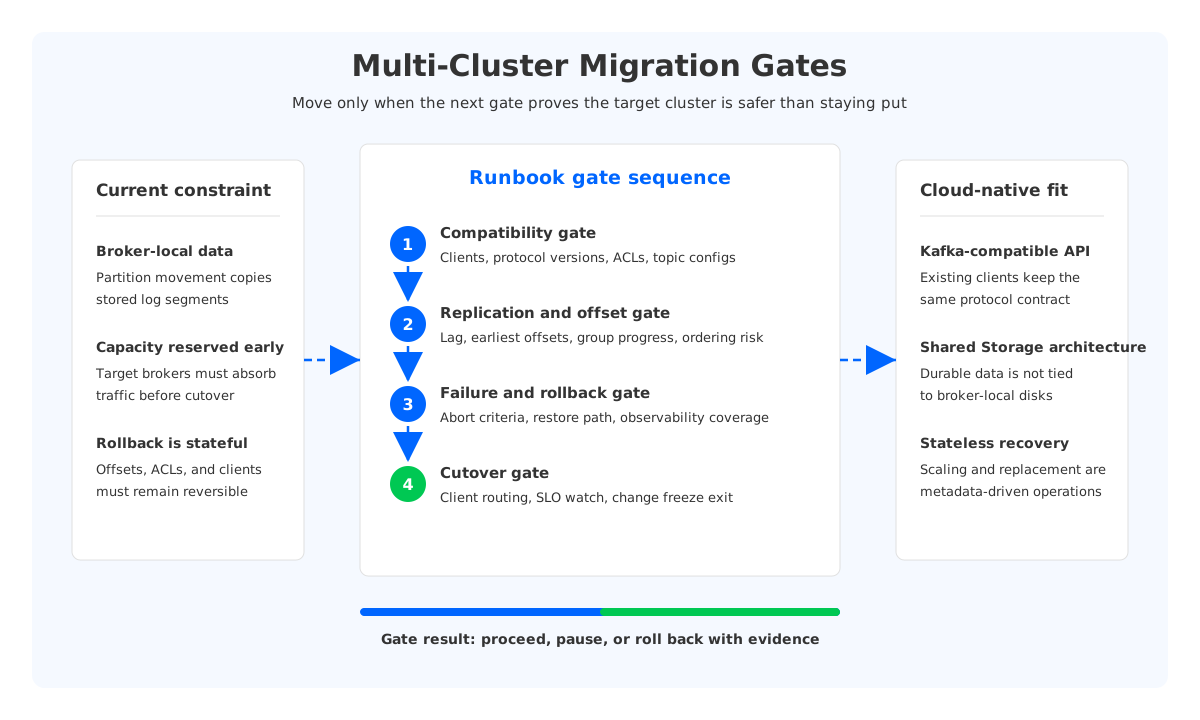
A useful migration gate asks four questions in order:
- Can the target behave like Kafka for this workload? Test producer behavior, Consumer group behavior, topic configuration, transactions if used, ACLs, quotas, and operational tooling.
- Can the target prove data position? Record parity is not enough when consumers resume from committed offsets and stateful processors depend on ordered progress.
- Can the team observe and reverse the change? A gate without metrics and abort criteria is only a meeting checkpoint.
- Can the target operating model reduce the pain that justified the migration? Moving clusters without changing the scaling, recovery, or cost constraint may only relocate the problem.
This order keeps the project honest. A target platform can be attractive on cost or elasticity, but those benefits do not matter until client behavior and offset continuity are proven.
2The production constraint behind the problem
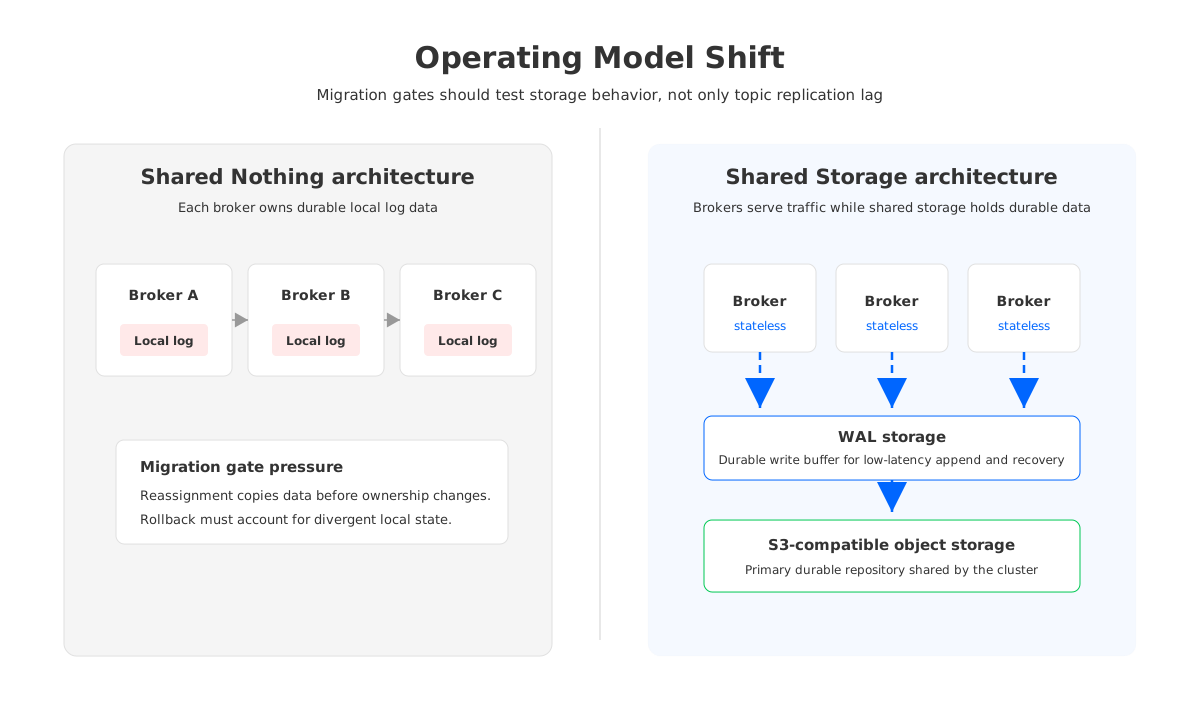
Traditional Kafka's Shared Nothing architecture makes migration gates harder because durable data is attached to broker-local storage. Each broker owns local log segments for its partitions, and reliability depends on replication among leaders and followers. That design is proven, but it turns many operational changes into data movement. Scaling, broker replacement, partition reassignment, and cluster migration all have to account for where bytes physically live.
In a single cluster, that model shows up as headroom and reassignment time. In a multi-cluster migration, it shows up as gate uncertainty. If a source cluster is still receiving writes, the target must catch up. If a Consumer group is moved too early, it may seek to an offset that does not exist on the target. If the team rolls back after target-side writes, the source cluster may no longer be the complete system of record. The runbook is protecting the meaning of Kafka offsets.
Apache Kafka's documentation separates several surfaces that matter here: producers, consumers and Consumer groups, topic configuration, authorization, transactions, Connect, and KRaft metadata. A credible migration gate does the same. It does not collapse Kafka into "the bootstrap server works." It treats the bootstrap server as the beginning of the test, then verifies the behaviors that production applications depend on after the happy path.
Migration also creates temporary capacity pressure. Source traffic, target traffic, replication traffic, validation jobs, and observability overhead may run together. The runbook should state what extra capacity is reserved, how long it will be held, and which metric releases it.
3Architecture options and trade-offs
Most multi-cluster Kafka migrations fall into three patterns. The first is replication into another traditional Kafka cluster, often using MirrorMaker2 or a Kafka Connect based pipeline. This pattern is familiar and portable, but offsets, topic configs, security rules, client routing, and broker-local storage economics still require careful handling.
The second pattern is managed Kafka migration. A managed service can reduce infrastructure ownership, standardize monitoring, and simplify upgrades. The trade-off is boundary control. Platform teams must evaluate region coverage, private networking, identity integration, operational access, service limits, and support procedures.
The third pattern is a Kafka-compatible cloud-native streaming platform with storage separated from broker compute. Durable data is held in shared storage, while brokers focus on protocol handling, leadership, routing, caching, and coordination. This does not remove migration gates. It changes what the gates test: shared storage path, WAL storage, cache behavior, metadata operations, recovery, and latency under the workload's own conditions.
| Decision area | Traditional Kafka target | Managed Kafka target | Shared-storage Kafka-compatible target |
|---|---|---|---|
| Compatibility | Strong when versions and configs match; still test edge cases | Strong for supported versions; service limits matter | Must be tested against workload behavior |
| Data movement | Replication and reassignment remain central | Tooling may help, but data still moves | Durable data is decoupled from broker-local disks after migration |
| Scaling | More brokers can mean more movement and planning | Easier provisioning, with provider limits | Broker scaling can focus more on compute, cache, and traffic |
| Governance | Highest control, highest burden | Shared responsibility | Depends on deployment model and customer cloud boundary |
| Rollback | Must handle offset mapping and dual-write risk | Same core issue, with provider steps | Same migration issue; post-migration broker recovery differs |
The table is not a ranking. If the pain is staffing, managed operations may matter most. If the pain is broker-local disk pressure, slow reassignment, and capacity over-reservation, storage architecture belongs near the top of the evaluation.
4Evaluation checklist for platform teams
A migration gate should be written as an evidence requirement. "Compatibility tested" is too vague. "All producers in wave 2 passed idempotent retry, compression, partitioning, ACL, and quota tests against the target bootstrap endpoint" is closer to a gate because someone can verify it.
Start with an inventory that includes every production dependency, not only topics. Capture producers, Consumer groups, committed offsets, manual seek behavior, schema dependencies, Connect tasks, stream processors, ACLs, quotas, network paths, retention settings, and dashboards. Then group workloads into waves by blast radius.
Use this gate sequence:
- Inventory gate. Every workload in the wave has an owner, dependency list, source cluster, target cluster, topic list, Consumer group list, and rollback contact.
- Compatibility gate. Target behavior is proven for client versions, serializers, compression, partitioning, Consumer group rebalances, ACLs, quotas, topic configs, and transactions where applicable.
- Replication and offset gate. Target topics contain the required data range, lag is inside the agreed window, and each Consumer group can resume from a valid position.
- Failure gate. Broker failure, network interruption, replication pause, validation failure, and alerting have been tested before production cutover.
- Cost and capacity gate. Migration surge capacity, steady-state cost drivers, cross-zone traffic, storage growth, and private connectivity assumptions match production traffic.
- Rollback gate. Abort triggers, DNS reversal, client config rollback, offset policy, duplicate-processing policy, and reconciliation ownership are written down and rehearsed.
- Cutover gate. Traffic moves only after previous gates have signed evidence, dashboards are live, and the rollback window has an assigned owner.
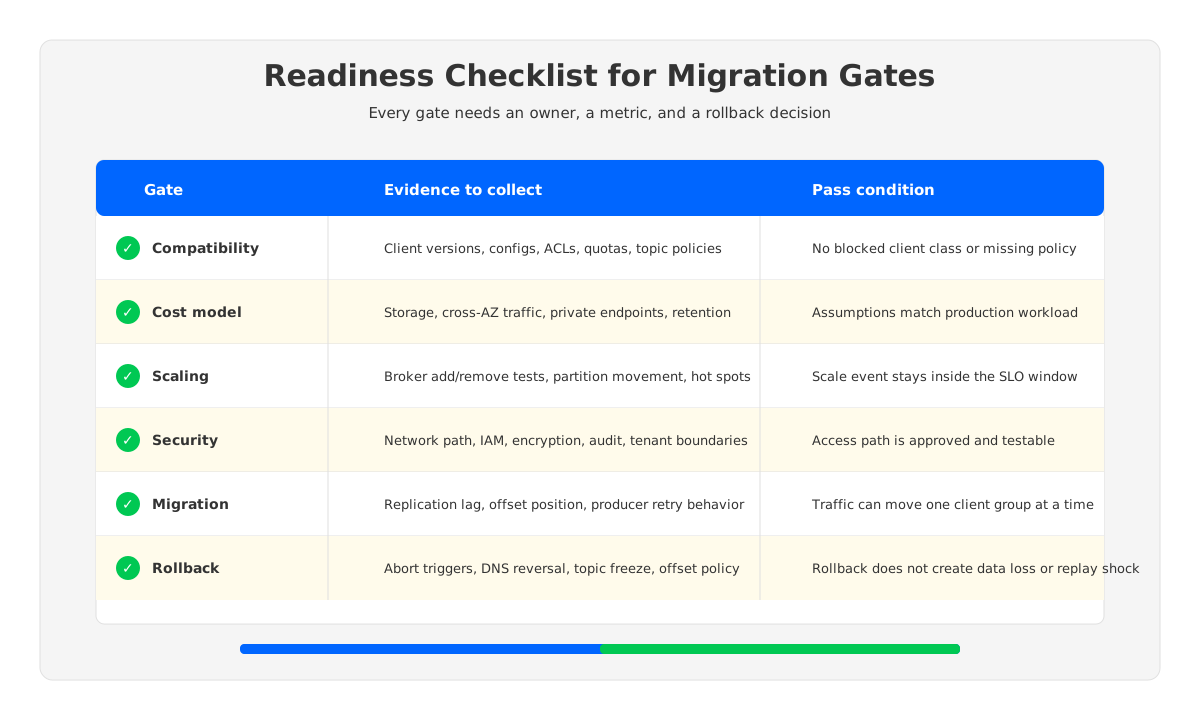
The rollback gate is often the most revealing. If the plan cannot explain what happens to target-side writes during rollback, it is not ready. If it cannot explain how consumer offsets move safely, it is not ready. If it assumes application owners can tolerate duplicate processing without confirming it, it is not ready.
Cost belongs in the checklist, but not as a spreadsheet detached from architecture. Kafka migration cost is driven by retained storage, replication factor, broker headroom, inter-zone traffic, validation reads, private connectivity, and operational time. Some teams discover that the expensive part is the overlap period where source, target, replication, and validation run together.
5How AutoMQ changes the operating model
Only after the neutral gates are clear does it make sense to evaluate a specific platform. AutoMQ fits the shared-storage Kafka-compatible category: it keeps Kafka protocol and ecosystem compatibility while redesigning the storage layer around Shared Storage architecture, S3Stream, WAL storage, and stateless brokers.
In traditional Kafka, a broker incident can become a storage incident because broker-local disks hold durable partition data. In AutoMQ, durable data is placed in S3-compatible object storage, while WAL storage supports durable appends and recovery. Brokers still matter for traffic, leadership, cache, and request handling, but they are not the long-term home of partition data. That shifts post-migration runbooks away from emergency data copying and toward metadata, traffic placement, cache behavior, and object-storage path validation.
For migration itself, AutoMQ's Kafka Linking documentation describes byte-level data synchronization, source and target topic mapping, Producer proxy behavior, and Consumer group offset synchronization. Those capabilities should still be tested as gates: data range, consumer progress, producer cutover behavior, and rollback safety for each workload class.
AutoMQ BYOC also changes the governance conversation. In a customer-controlled deployment, the control plane and data plane can run inside the customer's cloud boundary. That gives security reviewers concrete objects to inspect: VPC boundaries, IAM permissions, object storage buckets, network paths, audit logs, and operational access.
Evaluate AutoMQ against the same gates as every other target, then add architecture-specific tests:
- Shared storage validation. Verify object storage configuration, WAL storage type, durability assumptions, cache behavior, and recovery after broker replacement.
- Stateless broker validation. Add and remove brokers under controlled load, then measure client impact, leadership movement, and observability signals.
- Migration validation. Test topic parity, offset consistency, producer cutover, and rollback on a representative workload.
- Boundary validation. Confirm where control components, data plane services, object storage, metrics, and logs reside in the customer's environment.
A shared-storage design is not a shortcut around due diligence. It is a reason to redesign what due diligence measures.
6A runbook template that works in production
A production runbook should fit on a screen during the change window but carry enough evidence for audit. The short version is a gate table; the long version contains test logs, dashboard links, ownership records, and rollback rehearsal notes.
| Gate | Owner | Evidence | Pass threshold | Abort trigger |
|---|---|---|---|---|
| Inventory | Platform lead | Workload map, topic list, Consumer group list | All dependencies assigned | Unknown owner or dependency |
| Compatibility | Application owner | Client tests, ACL and config comparison | No blocker for wave workload | Unsupported client behavior |
| Data position | Migration owner | Lag, offset parity, payload samples | Valid resume point for every group | Missing data range or invalid offset |
| Failure | SRE | Broker, network, and replication drill notes | Alerts and recovery match runbook | Observability blind spot |
| Cost | FinOps or platform | Temporary and steady-state model | Budget and capacity approved | Unexplained migration surge |
| Rollback | Change owner | Rehearsal record and owner list | Reversal path tested | Dual-write or offset ambiguity |
The final cutover should be boring. Producers switch in a controlled wave, consumers resume from validated positions, dashboards show expected lag behavior, and the rollback owner watches predefined abort conditions. The absence of drama is the result of refusing to advance through gates that were not proven.
If your team is planning a multi-cluster Kafka migration, use the gates above against one representative production workload before setting a global cutover date. When broker-local storage is the recurring source of scaling, recovery, or cost pressure, evaluate AutoMQ with the same evidence standard: start an AutoMQ BYOC evaluation.
7FAQ
7.1What is a migration gate in a Kafka migration?
A migration gate is a decision checkpoint backed by evidence. It defines what must be true before the team advances from inventory to compatibility testing, from replication to cutover, or from cutover to completion.
7.2How is a gate different from a Kafka migration checklist?
A checklist tracks tasks. A gate decides whether the project is safe to advance. For example, "start replication" is a checklist item, while "replication lag, payload sampling, and offset parity meet the wave threshold" is a gate.
7.3What is the hardest part of multi-cluster Kafka migration?
The hardest part is usually not copying records. It is preserving the operating meaning of offsets, client behavior, security rules, and rollback boundaries while source and target clusters overlap.
7.4Where should AutoMQ appear in the evaluation?
AutoMQ should appear after the team has defined neutral gates for compatibility, data position, recovery, cost, governance, and rollback. Then it can be tested as a Kafka-compatible shared-storage target with stateless brokers, object-storage-backed durability, and customer-controlled deployment options.
7.5Does Shared Storage architecture remove the need for rollback planning?
No. Shared Storage architecture changes the broker recovery and scaling model after migration, but cutover still creates application-level state. Producers, consumers, offsets, schemas, and downstream processors still need a rollback plan.
8References
- Apache Kafka documentation for Kafka producers, consumers, Consumer groups, authorization, transactions, Connect, KRaft, and operations.
- AutoMQ compatibility with Apache Kafka for Kafka protocol and client compatibility guidance.
- AutoMQ architecture overview for Shared Storage architecture and separation of compute and storage.
- AutoMQ S3Stream overview and WAL storage for storage-path design.
- AutoMQ Kafka Linking overview and migration execution guide for migration synchronization and offset handling.
- AutoMQ BYOC overview for customer-controlled deployment boundaries.


