
Table of Contents
Table of Contents
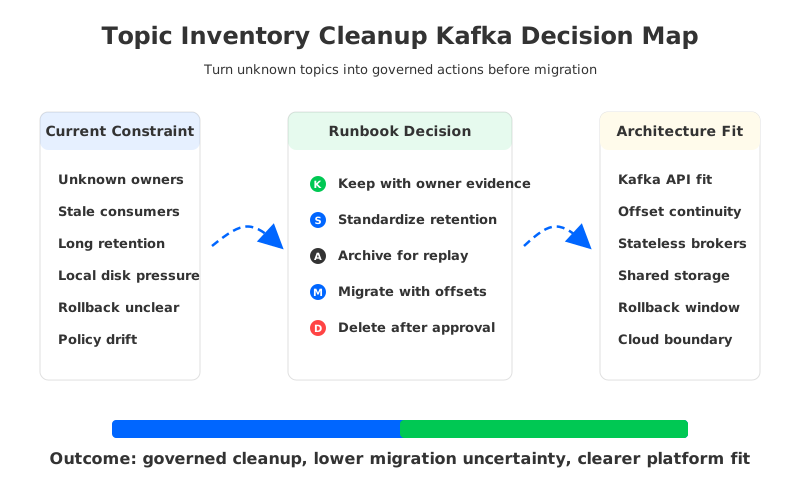
Searches for topic inventory cleanup kafka usually start after a team finds a cluster that no longer matches its own documentation. Topic owners have changed teams, consumers have disappeared, retention settings were copied from old templates, and migration planning is blocked because nobody can say which topics are safe to move, merge, archive, or delete. The problem looks administrative on the surface. In production, it is a reliability, cost, and governance problem.
A weak cleanup effort treats the topic list as a spreadsheet exercise. A useful runbook treats it as a change-control process for a distributed log. The goal is not to make the topic count smaller for its own sake. The goal is to identify which streams still carry business state, which streams can be retired, which streams need stronger ownership, and which architectural constraints will follow you into the next platform if you do not expose them before migration.
1Why teams search for topic inventory cleanup kafka
Topic inventory cleanup becomes urgent when a Kafka platform reaches one of three moments: a migration, a cost review, or an incident review. In a migration, stale topics create uncertainty because every unknown stream expands the blast radius of the cutover. In a cost review, unused topics keep consuming storage and replication capacity even when their business value has disappeared. In an incident review, missing ownership turns a small retention or consumer-lag question into a cross-team escalation.
The difficult part is that a Kafka topic is rarely "unused" in a simple sense. A topic may have no active consumers but still be needed for replay. Another topic may have low write traffic but contain compliance-sensitive records. A third may be a temporary integration stream that became permanent because downstream services quietly depended on it. A runbook has to distinguish these cases before it recommends deletion or migration.
That is why the first artifact should not be a delete list. It should be a topic register with enough evidence for a platform team to make a reversible decision. At minimum, capture owner, producer, consumer group, retention policy, partition count, average write pattern, replay requirement, security boundary, schema or serialization format, and downstream dependency. The register does not need to be perfect on day one. It needs to make uncertainty visible.
2The production constraint behind the problem
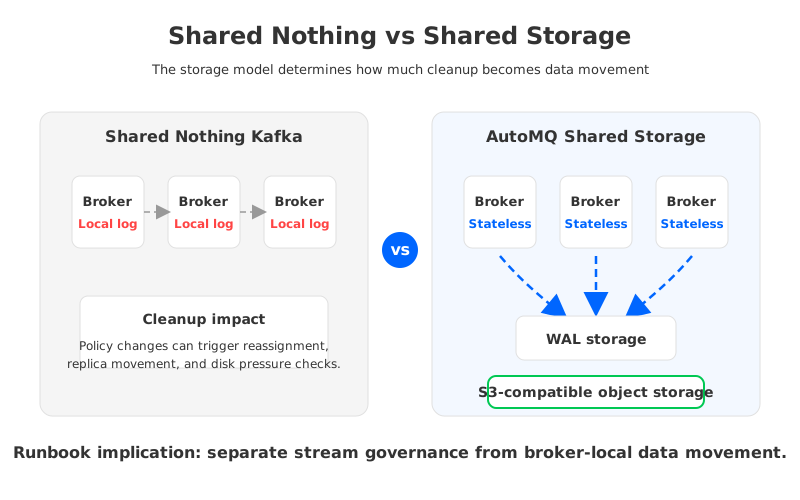
Traditional Kafka operations make topic cleanup heavier than the word "cleanup" suggests. Apache Kafka stores partition replicas on broker-local storage and uses leader/follower replication through In-Sync Replicas (ISR). That Shared Nothing architecture is proven and widely understood, but it means each topic decision is tied to broker capacity, local disk pressure, partition placement, and replication traffic. When you clean up inventory before a migration, you are also cleaning up the physical shape of the cluster.
The operational friction shows up in a few predictable places. Each one connects a governance decision to a physical Kafka operating concern.
- Broker-local storage hides topic cost behind capacity pools. A topic with long retention consumes disk on multiple brokers, but the cost is often seen as "cluster storage" rather than a topic-level decision.
- Partition movement turns governance work into infrastructure work. If cleanup changes partition distribution or migration scope, the platform team may need reassignment, throttling, and careful monitoring before the business change is complete.
- Consumer state makes deletion risky. Consumer groups track progress with offsets, and the presence or absence of lag does not fully prove that a stream has no replay value.
- Cloud networking can magnify old assumptions. Replication and recovery traffic that looked acceptable in a data center can become a cost and capacity concern across Availability Zones (AZs).
None of this makes Shared Nothing architecture wrong. It does mean a topic cleanup runbook has to respect the storage and recovery model underneath Kafka. If you ignore that layer, the cleanup plan may look clean in a spreadsheet and still fail during execution.
3Architecture options and trade-offs
There are four common ways teams handle topic inventory cleanup. The right choice depends less on tooling preference and more on how much change the team is willing to introduce while the platform is still carrying production traffic.
| Option | Where it helps | Trade-off to manage |
|---|---|---|
| Manual inventory and owner review | Fast start, good for governance gaps, and useful before any migration | Relies on team memory unless backed by metrics, ACLs, consumer group data, and schema evidence |
| Retention and policy standardization | Reduces accidental long-term storage and makes future topics easier to audit | Can break replay assumptions if owners did not document recovery requirements |
| Mirror-based migration cleanup | Lets teams migrate active topics and leave retired topics behind | Requires offset planning, rollback design, and clear cutover checkpoints |
| Platform architecture change | Addresses the operating model that made cleanup expensive | Requires compatibility checks, deployment planning, and a staged migration path |
This is also where Apache Kafka features need to be separated by purpose. Consumer group data helps identify active consumption, but it is not a legal proof that a topic is disposable. KRaft simplifies Kafka metadata management by removing ZooKeeper from Kafka clusters, but it does not by itself make broker-local data movement disappear. Tiered Storage moves older log segments to remote storage, but brokers still retain local storage responsibilities for the active log. Kafka Connect can expose producer and sink dependencies, but connector configuration is only one slice of ownership.
A practical architecture review asks a narrower question: which parts of the cleanup burden come from weak governance, and which parts come from the storage model? Governance problems need owners, policies, and review cadence. Storage-model problems need a platform decision, because the runbook cannot make broker-local data less local.
4Evaluation checklist for platform teams
Before deleting or migrating any topic, put each stream through the same decision path. Consistency matters more than cleverness here. A team that handles every topic with a different exception will finish with a cleaner spreadsheet and a more fragile platform.
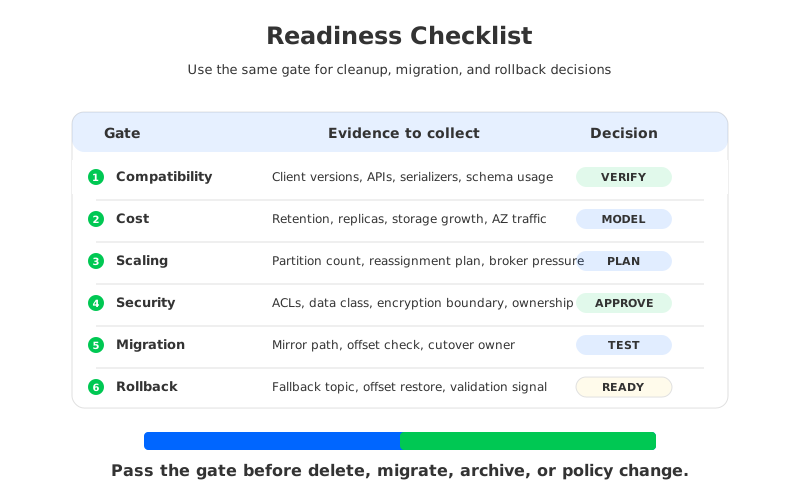
Use this checklist as the working gate. It gives every team the same burden of evidence before a topic is deleted, migrated, archived, or left alone.
- Ownership: Is there a named owning team, and do they accept the current producer and consumer list?
- Traffic: Is the topic receiving writes, reads, or only occasional replay access?
- State: Are offsets, transactions, or downstream checkpoints tied to this topic?
- Retention: Does the retention policy match the business recovery window?
- Security: Do ACLs, encryption boundaries, and data classification match the current data content?
- Migration: Can the topic be mirrored, verified, and rolled back without changing application code?
- Observability: Are lag, throughput, error rate, and storage growth visible before and after the change?
The checklist should produce one of five decisions: keep, standardize policy, archive, migrate, or delete. "Unknown" is also a valid result, but it should trigger an owner review instead of silently becoming "keep." Unknown topics are often where platform debt hides.
5How AutoMQ changes the operating model
Once the neutral evaluation is complete, the remaining question is whether the current platform architecture makes future cleanup easier or harder. AutoMQ approaches that question as a Kafka-compatible streaming platform with Shared Storage architecture. It keeps Kafka protocol compatibility while moving persistent log data away from broker-local disks and into S3-compatible object storage through S3Stream.
That architectural change matters because topic cleanup is not only about topic metadata. In a Shared Nothing cluster, a topic maps to replicas that occupy local broker storage, participate in reassignment, and shape recovery work. In AutoMQ, stateless brokers serve Kafka traffic while durable data is stored in shared object storage, with WAL (Write-Ahead Log) storage used for durability and recovery on the write path. The broker is important, but it is no longer the long-term home of the partition data.
The operational effect is straightforward: cleanup and migration decisions can focus more on application semantics and less on data relocation mechanics. Scaling a cluster, replacing a broker, or rebalancing traffic does not require the same style of large broker-to-broker data copying. Self-Balancing can continuously adjust traffic distribution, and the Shared Storage architecture changes the failure-recovery boundary because durable data is not trapped on the failed broker.
For migration projects, Kafka Linking is the more relevant capability. A good cleanup runbook needs byte-level message synchronization, offset consistency, and a rollback design that does not force every application team to improvise during cutover. AutoMQ Linking is designed around that migration problem: keep Kafka client compatibility, synchronize data, preserve offset continuity, and give the platform team a controlled path to validate before switching traffic.
This does not remove the need for governance. AutoMQ will not tell you whether a topic contains regulated data, whether a service owner has left the company, or whether a replay stream still matters to finance close. What it changes is the cost of being wrong about infrastructure shape. When brokers are stateless and data is held in shared storage, cleanup outcomes are less entangled with broker-local disk layout and long partition movement windows.
6A production runbook you can actually run
The runbook should be written as a sequence of gates, not as a one-time cleanup sprint. Kafka estates grow because teams ship systems, and a cleanup process that happens only before migration will decay as soon as the migration finishes.
Start with discovery. Export topic metadata, partition count, retention settings, ACLs, producer and consumer evidence, consumer group lag, connector references, schema references, and storage growth. Then classify each topic by action: keep, standardize, archive, migrate, delete, or investigate. After classification, run owner review for every destructive or irreversible action. Deletion should require both technical evidence and business approval.
The execution phase should be boring by design. Apply retention changes before deletion when possible. For migration, mirror data first, verify consumer offsets, run a controlled application cutover, and keep a rollback window. For archival, document where historical records live and who can request replay. For deletion, record the approval, date, and validation signal so that the next incident review does not start with archaeology.
The final step is to turn the runbook into policy. Future topic creation should require owner, retention class, data classification, and expected consumers at creation time. Existing topics should be reviewed on a schedule. Platform teams do not need a heavyweight governance board for every stream, but they do need a default path that prevents anonymous, unbounded topics from becoming permanent infrastructure.
7Decision matrix: when cleanup should trigger platform evaluation
Topic cleanup does not always justify a platform change. If the main issue is missing ownership, fix ownership. If the main issue is inconsistent retention, standardize retention. But if the same cleanup exercise keeps exposing broker-local storage pressure, slow reassignment, cross-AZ replication concerns, or migration rollback risk, the team is no longer looking at a topic hygiene problem. It is looking at an operating model problem.
Use this matrix when deciding whether to stay with process changes or evaluate a Kafka-compatible architecture shift. The point is to identify when topic cleanup has become a signal about the platform itself.
| Signal | Process fix is enough when... | Architecture evaluation is warranted when... |
|---|---|---|
| Unknown ownership | Owners can be found and policies can be enforced | Topics repeatedly survive because nobody can risk touching them |
| Storage pressure | A few retention settings are out of policy | Cleanup is driven by broker disk exhaustion rather than business lifecycle |
| Migration scope | Only active topics need movement | Cutover risk is dominated by offset continuity, rollback, and data-copy windows |
| Recovery model | Broker replacement is a routine procedure | Failed or overloaded brokers trigger long data movement and reassignment work |
| Cost governance | Costs map cleanly to topic policy | Costs are hidden in replication, over-provisioning, and capacity buffers |
The matrix is intentionally conservative. A platform migration should not be the first answer to messy metadata. It should become part of the conversation when cleanup reveals that the team is spending more effort managing physical Kafka shape than governing the streams themselves.
8Closing the loop
The original search was not really about deleting topics. It was about regaining confidence in a Kafka estate that has outgrown informal ownership. A strong topic inventory cleanup kafka runbook gives platform teams that confidence by connecting governance evidence, migration readiness, and architecture constraints in one repeatable process.
If your cleanup review shows that broker-local storage, reassignment windows, and rollback risk are driving the plan more than topic semantics, evaluate whether a Kafka-compatible Shared Storage architecture belongs in the migration path. To see how AutoMQ changes that operating model in your own cloud boundary, start with the AutoMQ BYOC workflow: try AutoMQ.
9FAQ
9.1What is topic inventory cleanup in Kafka?
Topic inventory cleanup identifies owners, producers, consumers, retention policies, security boundaries, replay requirements, and migration status. It may lead to deletion, but deletion is only one possible outcome.
9.2How do I know whether a Kafka topic is unused?
Start with write traffic, consumer group activity, connector references, ACLs, schema references, and owner confirmation. No single signal proves that a topic is unused. Treat uncertain topics as investigation items rather than automatic deletes.
9.3Should topic cleanup happen before Kafka migration?
Yes. Cleanup reduces migration scope and exposes rollback requirements before cutover. The safest sequence is inventory, classify, owner review, mirror or archive, verify offsets and dependencies, then execute the approved action.
9.4Does Shared Storage architecture replace Kafka governance?
No. Shared Storage architecture changes the infrastructure burden behind scaling, recovery, and data placement. Governance still requires owners, retention policies, access controls, and review cadence.
9.5Where does AutoMQ fit in a cleanup project?
AutoMQ fits after the team has separated governance problems from operating-model problems. If cleanup exposes broker-local storage pressure, slow reassignment, or migration rollback complexity, AutoMQ offers a Kafka-compatible Shared Storage architecture with stateless brokers and customer-controlled deployment boundaries.


