
Table of Contents
Table of Contents
Teams search for traffic shadowing kafka migration when the migration plan has become too real for a slide deck. They may have a target Kafka-compatible platform in a test account and a producer team willing to run a pilot. What they do not have is evidence that production traffic, consumer offsets, retry behavior, transactions, authorization, and rollback will behave the same at cutover.
Traffic shadowing is attractive because it lets a team observe the target system under production-shaped load before moving the business path. It is also easy to misuse. Mirroring records without a runbook can create duplicate side effects, hide offset drift, and produce a false sense of readiness. The useful version is narrower and more disciplined: copy selected traffic to the target cluster, isolate consumers from external writes, compare behavior with explicit acceptance criteria, and keep a rollback path that is tested before the first producer is moved.
That is the argument of this runbook. A Kafka migration should not ask, "Can we copy bytes?" It should ask, "Can we prove that client compatibility, consumer progress, failure handling, governance, and operating cost still hold under the traffic pattern we actually run?"
1Why Teams Search for traffic shadowing kafka migration
The search usually starts after a team has ruled out a blind cutover. Their source Kafka estate has too many clients, owners, and assumptions hidden in client configuration. Some producers rely on idempotent writes. Some consumer groups commit offsets at different points in the processing loop. Some applications use transactions, while others depend on partition ordering and tolerate replay only inside a known range.
The pressure comes from the gap between a compatibility claim and a migration decision. Apache Kafka documents the abstractions that matter here: topics, partitions, offsets, consumer groups, transactions, KRaft metadata, and client behavior. Those abstractions are stable enough for ecosystem compatibility, but a production estate also includes client library versions, timeout choices, ACL patterns, monitoring assumptions, and consumers that are not idempotent.
Traffic shadowing gives platform teams a way to turn that uncertainty into evidence. The source cluster continues to serve production, while the target cluster receives a copy of chosen topics. Shadow consumers read from the target with controlled identities and controlled sinks. The team compares lag, error rates, record counts, ordering assumptions, schema behavior, and operational signals without asking business applications to trust the target cluster yet.
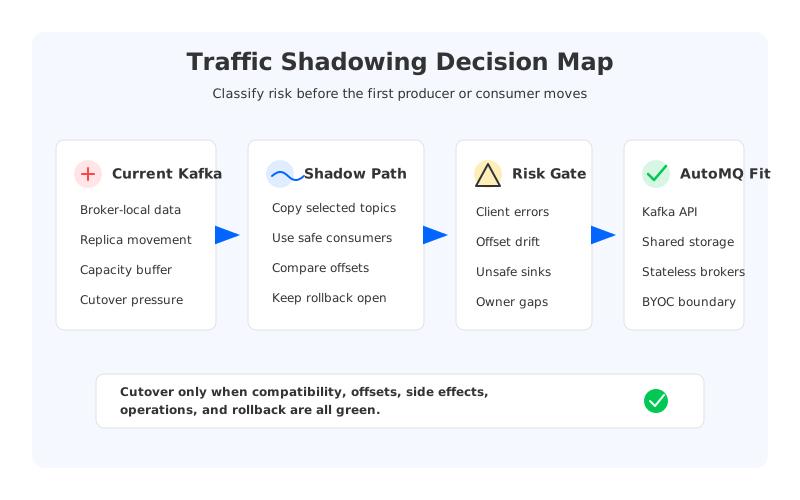
The trap is treating shadowing as a generic "copy and compare" exercise. Kafka migration risk is not evenly distributed. A topic with append-only audit events and idempotent downstream storage has a different risk profile from a payment workflow that uses transactional writes and a non-idempotent sink. The runbook needs to classify traffic before it copies traffic.
2The Production Constraint Behind the Problem
Traditional Kafka runs as a Shared Nothing architecture: each broker owns local storage, and partition replicas are spread across brokers for durability and availability. That model is proven and well understood, but it ties migration and operations to broker-local state. When a cluster grows, shrinks, rebalances, or recovers, the platform team must reason about data placement, replica movement, disk pressure, network paths, and recovery time as one coupled system.
Shadowing exposes that coupling because the migration is not only a data pipeline. It is a second operating model running beside the first. The source cluster still needs production capacity. The replication or mirroring path needs network and compute budget. The target cluster must absorb traffic, serve validation reads, and retain shadowed data long enough for comparison. If the target is another local-disk Kafka cluster, the team also inherits broker storage sizing, partition movement, and cross-Availability Zone replication traffic.
This is where a migration runbook has to be honest about cloud mechanics. Object storage, cross-zone transfer, private connectivity, and procurement all have pricing and governance rules. A runbook does not need to forecast every line item on day one, but it should prevent a migration test from hiding the same cost drivers that made the source estate hard to operate.
Use a traffic inventory before you design the shadow path:
- Compatibility scope. List client versions, serializers, authentication, ACLs, transactions, idempotent producers, and Kafka Connect dependencies.
- Side-effect scope. Identify consumers that write to external systems, send notifications, mutate databases, or call APIs. Replace them with safe sinks during shadow testing.
- Offset scope. Record how each consumer group commits offsets and handles replay.
- Network and cost scope. Map source, replication workers, target brokers, object storage, and consumers by Region, Availability Zone, VPC, and account boundary.
- Governance scope. Verify ownership for credentials, topic creation, ACL changes, schema changes, audit logs, and cutover approval.
The output should be a shortlist of candidate topics, not a universal migration wave. Shadowing works when the team can isolate risk and measure it. It becomes theater when every topic is copied and no one can say which result would stop the migration.
3Architecture Options and Trade-offs
There are three common ways to run a Kafka shadowing exercise. The first is application-level dual write, where producers write to both source and target. It gives the strongest producer-compatibility signal, but it puts migration logic into business applications. That can work for a few critical services. It is a poor default for an estate with many teams.
The second option is broker-side or connector-based mirroring. Kafka Connect-based replication can copy selected topics while producers remain unchanged. This fits platform-led migration because it centralizes the shadow path. The trade-off is that the copied stream is not the original producer session, so producer authentication, client metadata, transactions, and cutover readiness still need separate validation.
The third option is a platform-native migration path that treats Kafka compatibility, message synchronization, and offset continuity as part of the target platform. This can reduce custom glue, but the team still has to define topic eligibility, consumer safety, acceptance thresholds, and rollback.
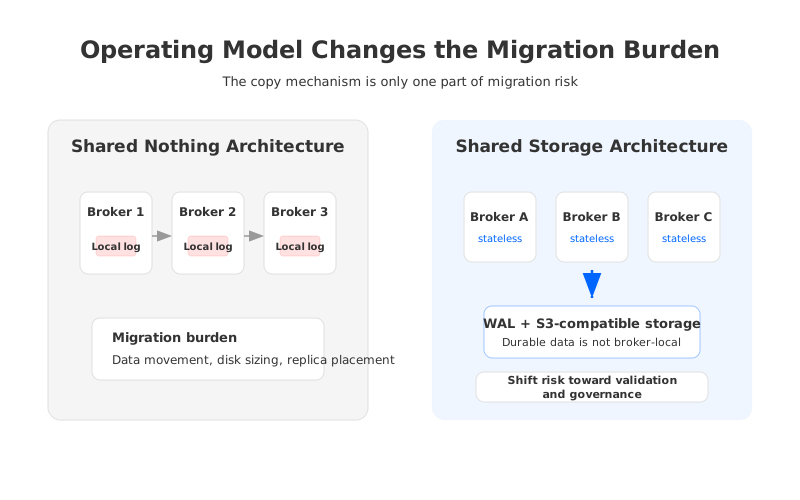
The operating model matters as much as the copy mechanism. In a local-disk target, shadow traffic can create a second round of partition placement and capacity planning. In a Shared Storage architecture, brokers are less tied to durable local data, so scaling and recovery decisions can be made with a smaller data-movement burden. That distinction does not make migration risk disappear. It changes where the risk sits: away from broker-local data movement and toward compatibility, governance, observability, and the correctness of the cutover plan.
The decision table should be short enough for a migration meeting, but specific enough to block vague optimism.
| Decision area | What to test during shadowing | Evidence that should block cutover |
|---|---|---|
| Producer compatibility | Client versions, idempotence, transactions, compression, retries, and timeouts | Client errors or retry patterns that differ from the source under the same traffic class |
| Consumer progress | Offset mapping, lag trend, replay behavior, and group ownership | Unexplained offset drift or shadow lag that grows under normal load |
| Data correctness | Record counts, keys, ordering within partitions, schema compatibility, and headers | Missing records, unexpected duplicates, or schema failures |
| Operations | Scaling behavior, broker health, storage growth, alert quality, and recovery drills | A failed broker or worker recovery that requires manual data movement outside the runbook |
| Governance | ACLs, audit logs, secret rotation, ownership, and approval gates | A cutover step that depends on unreviewed credentials or unclear ownership |
A migration runbook should make it easier to say "not yet" before cutover than to discover the same problem while clients are already moving.
4Evaluation Checklist for Platform Teams
Start the runbook with a written scope. Pick the topics, consumer groups, and client teams that will prove the migration path without turning the first test into a whole-estate rehearsal. For each topic, define the source of truth for record counts, the comparison window, and the conditions that pause rollout: no unexplained record gaps, no unauthorized access failures, no sustained lag growth, and no offset mismatch outside the agreed replay window.
The runbook should then separate the migration into five phases.
- Inventory. Capture topic configuration, partitions, retention, ACLs, schemas, client versions, consumer group behavior, and external side effects.
- Shadow path. Configure replication or linking for selected topics. Keep the source as production authority and tag all target traffic, metrics, and logs as shadow.
- Safe consumers. Run validation consumers against the target with isolated credentials and non-production sinks. Never let a shadow consumer mutate production systems.
- Comparison. Check record counts, key distribution, partition ordering, lag, error rate, schema behavior, and offset continuity against prewritten thresholds.
- Cutover and rollback. Move one producer or consumer class at a time, verify offsets, hold the rollback window open, and document the point after which replay becomes the recovery plan.
Two details deserve extra attention. Kafka offsets are only meaningful within a partition log, and consumer groups use committed offsets to resume processing. During migration, the team must know whether offsets are copied, translated, reset, or restarted from a known point. Rollback also needs precision. It must say what happens to target-only records, which consumer groups may replay, and how external side effects are reconciled.
5How AutoMQ Changes the Operating Model
After the neutral checklist, the architectural question becomes sharper: what kind of target platform reduces the operational work that shadowing has to prove? AutoMQ is a Kafka-compatible streaming platform that uses a Shared Storage architecture with stateless brokers and object-storage-backed durability. It keeps the Kafka protocol familiar while moving durable stream storage away from broker-local disks.
That matters because the target cluster is not only a protocol endpoint. It must absorb shadow load, tolerate failures during validation, and scale when the migration wave grows. In AutoMQ, persistent data is stored through S3Stream using WAL (Write-Ahead Log) storage and S3-compatible object storage. Brokers handle Kafka protocol processing, caching, leadership, and scheduling, but durable data is not bound to local disk as in a Shared Nothing architecture.
The practical effect is a different failure and scaling conversation. Broker replacement or partition reassignment is less about moving a large local log and more about changing ownership, metadata, leadership, and traffic routing. AutoMQ documentation describes this through Shared Storage architecture, stateless brokers, Self-Balancing, and seconds-level partition reassignment. For a migration team, the shadow runbook can focus more on client behavior, offsets, rollback, and governance instead of broker-local data movement.
AutoMQ Linking is the relevant migration capability for teams that need a managed path from Apache Kafka to AutoMQ. In runbook terms, the important questions are whether message synchronization, offset consistency, producer cutover, consumer cutover, and rollback are represented as explicit, observable steps. A good plan treats AutoMQ Linking as one part of the control surface, alongside topic inventory, safe consumers, validation dashboards, and approval gates.
This is also where BYOC boundaries matter. AutoMQ BYOC runs the control plane and data plane in the customer's cloud account and VPC. Production traffic, object storage, credentials, and network controls remain inside customer-controlled boundaries. The runbook should still verify IAM permissions, encryption, audit logging, and VPC paths.
6A Readiness Scorecard You Can Use
A scorecard turns migration debate into an engineering review. Mark each area green, yellow, or red, and require every red item to have an owner and a retest date. Do not average the result. A green score for cost does not compensate for a red score on offset recovery.
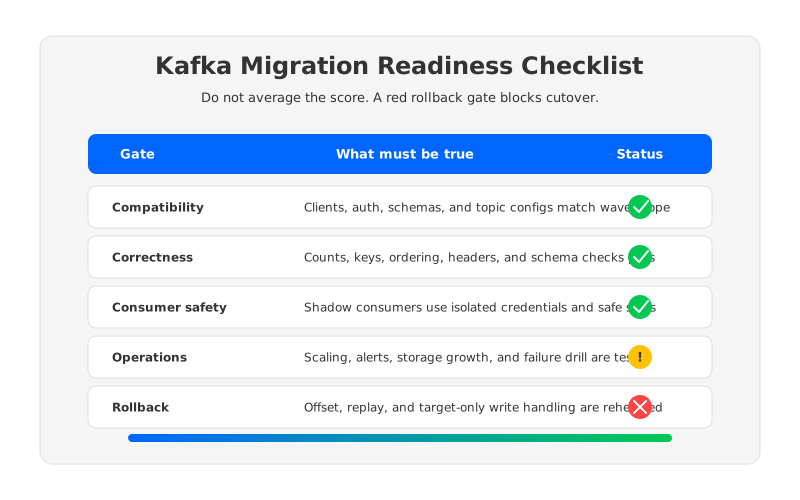
Use the scorecard in the final pre-cutover meeting:
- Compatibility is green when the target accepts the same client classes, authentication paths, schemas, and topic configurations needed for the first wave.
- Correctness is green when comparison jobs show expected record counts, key distribution, partition ordering, and header behavior for the selected topics.
- Consumer safety is green when every shadow consumer writes only to safe sinks and every production consumer has a documented offset plan.
- Operations are green when broker, replication, storage, and alert behavior have been tested under the selected traffic class and one failure drill.
- Rollback is green when the team has tested the exact client reversion path and knows what happens to target-only writes.
- Governance is green when ownership, credentials, audit logs, network boundaries, and approval gates are written down and reviewed.
Keep the scorecard attached to the runbook after cutover. Migrations fail quietly when shadowing becomes a one-time test and comparison stops as soon as the first clients move. Keep validation running through the first production wave, then retire it only after the business path, offset path, and rollback path have all been exercised.
7FAQ
7.1Is traffic shadowing the same as dual write?
No. Dual write means the producer writes to both clusters. Traffic shadowing can use dual write, replication, linking, or connector-based mirroring. Choose the mechanism based on producer ownership, side-effect risk, and rollback requirements.
7.2Can shadow consumers write to production databases?
They should not. Shadow consumers are for validation, so their sinks should be isolated. Test real side effects only in a controlled cutover with explicit business approval.
7.3What is the hardest part of a Kafka migration rollback?
The hard part is not changing bootstrap servers back. It is reconciling offsets and records that may exist only on the target after cutover. Define the replay window, target-only write handling, and consumer group recovery plan.
7.4Where does AutoMQ fit in a traffic shadowing runbook?
AutoMQ fits after the team has defined compatibility, correctness, operations, governance, and rollback requirements. Its Kafka-compatible API, Shared Storage architecture, stateless brokers, AutoMQ Linking, and BYOC model can reduce broker-local operational risk.
If you are evaluating a Kafka-compatible migration target, start with AutoMQ BYOC. Bring one workload, one rollback path, and the hardest consumer group you have.


