
Table of Contents
Table of Contents
Teams searching for s3 analytics feeds kafka are rarely asking a narrow connector question. They usually already have Kafka topics carrying product events, CDC records, clickstream data, or observability signals, and they want those streams to become queryable files in S3 without turning the streaming platform into another warehouse staging system. The pressure comes from both sides: downstream analysts want fresher tables, while platform teams need retention, replay, and governance to stay predictable under production traffic.
That tension is easy to underestimate. Kafka is excellent at ordered event movement, consumer group coordination, offset tracking, and back-pressure isolation. S3 is excellent at durable object storage, lakehouse economics, and broad integration with engines such as Spark, Trino, Flink, Athena, and Iceberg readers. The hard part is the line between them. If the feed is designed as a simple sink, replay can become expensive. If it is designed as a permanent event system, read efficiency and table layout can suffer.
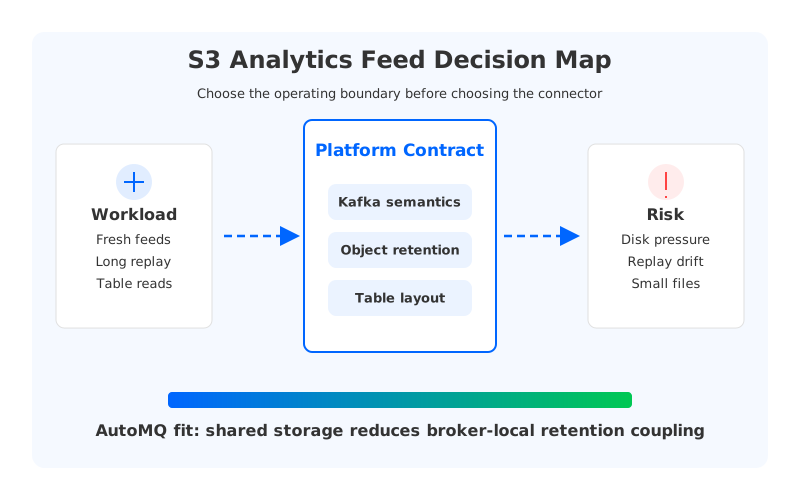
The practical architecture question is not whether Kafka should send data to S3. It is how much operational responsibility remains in Kafka after the data lands there. A good design lets Kafka absorb bursty writes and coordinate real-time consumers, while S3 holds retained event history and table-oriented derivatives with a clear ownership boundary.
1Why teams search for s3 analytics feeds kafka
The search phrase usually appears when a team has outgrown one of two simpler patterns. The first pattern is direct application writes to S3: each service writes JSON, Avro, or Parquet objects to a bucket and lets analytics jobs pick them up later. This keeps Kafka out of the picture, but it pushes ordering, schema discipline, retry behavior, and late-arriving records into every application team. The second pattern is a Kafka-to-S3 connector that copies topic data into files. That centralizes the feed, but it does not automatically solve replay scope, partition layout, object size, table metadata, or consumer isolation.
Production teams tend to discover the same constraints:
- The lakehouse wants fewer, larger, well-partitioned objects, while real-time systems produce many small records continuously.
- Compliance teams ask how long raw events are retained, who can replay them, and whether replay creates duplicate downstream rows.
- SREs need to know whether a sink outage affects online consumers, broker storage, or only the analytics feed.
- Data engineers need schema evolution, partitioning, and compaction rules that do not depend on tribal knowledge inside each producer service.
Those are not connector settings in disguise. They are platform contracts. Kafka gives the contract a familiar shape: topics, partitions, offsets, consumer groups, delivery semantics, and client compatibility. S3 gives the contract a durable destination. The architecture between them decides whether the system stays understandable as volume grows.
2The lakehouse freshness constraint behind the workload
Analytics feeds create a specific kind of freshness problem. A dashboard team may tolerate a few minutes of delay, but a fraud pipeline, customer-facing metric, or operational search index may need events to appear close to real time. At the same time, lakehouse readers dislike tiny files and unstable partition layouts. The feed must bridge streaming write cadence with batch-efficient read shape.
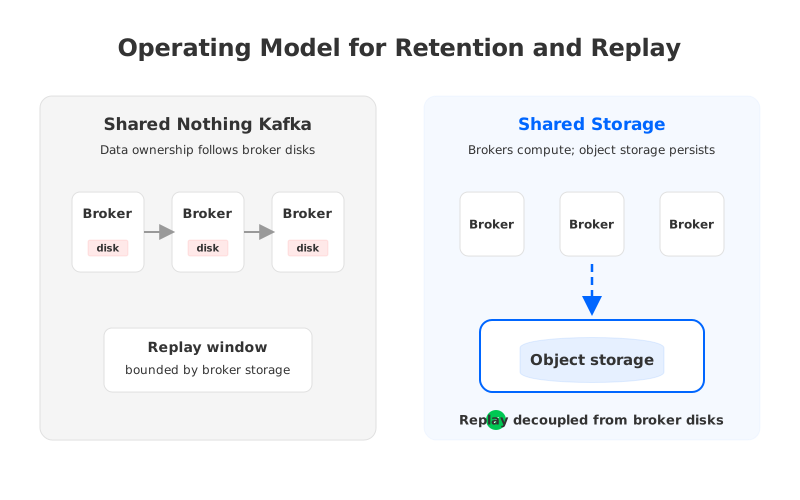
This is why event retention and read efficiency belong in the same discussion. If Kafka holds a long replay window on broker-local disks, teams can recover from sink bugs and rebuild S3 tables from source topics, but recovery time and storage cost stay tied to broker capacity. If S3 becomes the primary retained history, the design has to answer different questions: Can raw events be replayed by offset or by object range? Are table files compacted independently of ingestion? Can the platform distinguish real-time consumers from historical analytics readers?
The wrong boundary creates familiar failure modes. A sink connector falls behind, broker disks fill, and platform engineers expand the cluster even though the durable destination is object storage. A schema change lands in the topic, the S3 feed writes incompatible objects, and the team has to replay a full day of data while real-time consumers keep moving.
The lesson is blunt: S3 analytics feeds should be designed around replay intent, not only write path plumbing. Teams need to decide which data is hot stream state, which data is raw retained history, and which data is optimized table state.
3Stream-to-table architecture options
Most production architectures fit into three categories. None is universally right, but each moves cost, ownership, and failure recovery to a different place.
| Pattern | Where retention lives | Replay behavior | Read efficiency risk | Operational fit |
|---|---|---|---|---|
| Kafka topics plus S3 sink | Kafka brokers for the replay window; S3 for copied history | Simple when replay stays inside topic retention | Small files and partition drift if sink policy is weak | Good when Kafka is already the operational center |
| Stream processor writes tables | Kafka holds source events; Flink or Spark writes curated tables | Rebuild depends on processor checkpoints and topic retention | Better table layout, more stateful job ownership | Good when transformations are central to the feed |
| Shared-storage streaming platform | Object storage participates in stream durability and retained history | Replay pressure moves away from broker-local disks | Table efficiency still needs format and compaction policy | Good when retention windows and elasticity dominate |
The first pattern is common because it is easy to explain. Kafka Connect can move records from a topic into object storage while producers and consumers keep using Kafka clients. The risk is that the connector becomes the place where too many responsibilities accumulate: serialization, schema compatibility, file rotation, partition naming, error routing, retry policy, and backfill.
The second pattern is more deliberate. A stream processor can transform records, apply event-time logic, write Iceberg or Parquet tables, and maintain checkpoints. That improves table quality, but replay may require checkpoint decisions, sink idempotency, and table snapshot cleanup. The third pattern changes the storage contract underneath Kafka-compatible APIs. Instead of treating S3 only as a downstream sink, the streaming layer itself can use shared object storage for durable data while brokers remain primarily compute and protocol nodes.
The table makes one point clear: the feed architecture should not be selected by connector availability alone. It should be selected by the failure mode the team is willing to own.
4Evaluation checklist for platform teams
A useful evaluation starts with neutral questions. The answers are more important than the product category because they expose which team will be paged when the feed misbehaves.
| Dimension | What to verify | Why it matters |
|---|---|---|
| Kafka compatibility | Producer, consumer, admin, Connect, and security behavior match existing clients | Migration risk stays bounded when applications do not change first |
| Retention boundary | Hot topic retention, raw event history, and table retention are separate decisions | Replay safety should not depend on broker sizing |
| Replay control | Offsets, consumer groups, table snapshots, and backfill jobs have a documented rollback path | Reprocessing should not corrupt analytics tables or disrupt online consumers |
| Read efficiency | Object size, partition strategy, compaction, and table metadata are explicit | S3 is durable, but query engines still pay for poor file layout |
| Cost model | Compute, broker storage, object storage, replication traffic, and cross-AZ traffic are separated | Cloud bills become explainable instead of hidden in cluster expansion |
| Governance | Schema evolution, access control, encryption, audit logs, and retention policy have owners | Analytics feeds often carry regulated or customer-sensitive events |
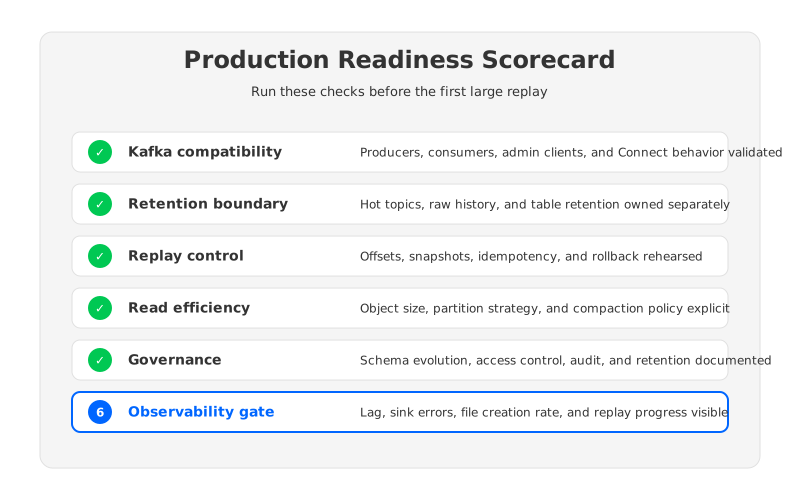
| Observability | Lag, sink errors, file creation rate, table commit latency, and replay progress are visible | The team needs to distinguish ingestion delay from query-layer delay |
This checklist also helps avoid a common false trade-off. Teams sometimes frame the choice as "Kafka for real time" versus "S3 for analytics." In practice, production feeds need both: Kafka-compatible semantics for live event movement, and object-storage-backed durability for retained history and efficient lakehouse access. The difference between a clean architecture and a fragile one is whether those responsibilities are explicit.
A readiness scorecard should be run before the first large backfill, not after the first outage. The most valuable test is a controlled replay of a representative topic into an isolated table namespace. During that test, measure behavior when the sink is paused, consumers lag, a schema version changes, and the replay is aborted halfway through. If the rollback plan is "delete objects and hope offsets line up," the architecture is not ready.
5How AutoMQ changes the operating model
Once the team has separated the concerns above, AutoMQ enters the discussion as an architectural option rather than a shortcut. AutoMQ is a Kafka-compatible, cloud-native streaming system that keeps the Kafka protocol surface familiar while using Shared Storage architecture. In this model, Brokers are stateless compute nodes, and storage is decoupled from broker-local disks.
That distinction matters for S3 analytics feeds because retention and replay are storage-heavy workloads. In a traditional Shared Nothing architecture, each broker owns local log segments and participates in replication. Expanding storage or moving partitions usually means moving data between brokers. For feeds that need long retention windows, the platform may grow because history is large, not because active traffic needs more compute.
With Shared Storage architecture, retained stream data can live in object storage while brokers handle protocol, scheduling, caching, and compute-facing responsibilities. This changes several operational behaviors:
- Capacity planning separates hot compute from retained data. Teams can reason about broker count and storage footprint independently.
- Broker replacement and scaling are less coupled to data movement.
- Replay-heavy workloads become less disruptive to the broker storage layer because historical data is not anchored to local disks.
- Multi-AZ traffic can be reduced when the architecture avoids application-level cross-zone replica copying for every write path.
AutoMQ also introduces a lakehouse-oriented concept called Table Topic, which is relevant when the feed is not only "copy topic data to S3" but "make streaming data available as analytics tables." The important point is not that every S3 feed must use a table abstraction. It is that platform teams should have a first-class place to decide how stream records become table-readable data, instead of burying that decision in a sink connector's rotation settings.
There are still trade-offs to evaluate. Object storage changes latency assumptions, so the streaming layer needs a write-ahead log design that protects low-latency writes before objects are finalized. Table-oriented feeds still need schema governance and compaction policy. Existing Kafka estates still need migration planning, client validation, and rollback procedures. A shared-storage platform reduces one class of operational coupling, but it does not excuse teams from designing the feed contract.
The strongest fit appears when the team has three pressures: replay windows, elastic traffic, and S3-centered analytics. If the feed only needs short retention and a small daily export, a conventional connector may be enough. If the feed is becoming a durable event backbone for analytics and compliance replay, storage architecture becomes a first-order decision.
6Migration and rollout plan
The safest migration starts by proving that the feed contract is portable. Pick one representative topic with realistic schema evolution, a meaningful replay window, and downstream readers that care about both freshness and historical correctness.
A practical rollout follows this order:
- Freeze the contract: topic name, key strategy, schema policy, retention target, table partitioning, and rollback criteria.
- Run dual ingestion into an isolated S3 prefix or table namespace.
- Validate replay by resetting a controlled consumer group or replay job, then compare row counts, deduplication behavior, and table snapshots.
- Exercise failure cases: stop the sink, pause consumers, introduce a bad schema version in a test topic, and confirm recovery steps.
- Move one downstream workload at a time.
This rollout is intentionally conservative. S3 analytics feeds sit between application events and business-facing data products; a silent duplication bug can be worse than an obvious outage. The goal is to make replay boring, so the team can change retention windows, table layouts, and streaming infrastructure without treating every backfill as a special incident.
For teams evaluating a Kafka-compatible shared-storage path, the next useful step is to map one live topic against AutoMQ's Table Topic model and Shared Storage architecture. The AutoMQ documentation on Table Topic is a good starting point for that design review, especially if your current S3 feed is already carrying replay and lakehouse responsibilities that no single connector should own alone.
7References
- Apache Kafka documentation: Consumer configuration, Kafka Connect, delivery semantics, and Tiered Storage
- AWS documentation: Amazon S3 Event Notifications and replication overview
- Apache Iceberg documentation: Apache Iceberg latest docs
- AutoMQ documentation: AutoMQ overview, architecture overview, S3 storage, and Table Topic configuration
8FAQ
8.1Is Kafka still needed if S3 is the long-term analytics store?
Usually, yes. S3 is a durable object store, but it does not replace Kafka's producer and consumer protocol, partition ordering, consumer groups, offset management, or real-time fan-out behavior. The clean pattern is to use Kafka-compatible streaming for live event movement and S3 for retained history, table storage, and broad analytical access.
8.2Should an S3 analytics feed write raw events or curated tables?
Many teams need both. Raw event retention gives you replay safety and auditability, while curated tables give analysts and query engines a cleaner read path. Mixing both responsibilities into one sink path can work at small scale, but larger teams usually separate raw landing, transformation, compaction, and table publication.
8.3How long should Kafka retain events before they are copied to S3?
Retention should be based on recovery objectives, not only storage budget. A short Kafka retention window is acceptable when S3 raw history and replay tooling are trusted. A longer topic retention window is useful while the S3 feed is still being validated or when downstream systems need fast offset-based replay.
8.4Does shared storage remove the need for Kafka Connect or stream processors?
No. Shared Storage architecture changes where durable stream data lives and how brokers scale, but teams still need ingestion, transformation, table creation, and connector logic. Kafka Connect, Flink, Spark, and table formats remain relevant; broker-local disk capacity no longer has to define retention.
8.5What is the main risk in S3 analytics feed design?
The main risk is treating the feed as a pipe instead of a contract. A production feed needs explicit decisions about schema evolution, replay, deduplication, table layout, ownership, and rollback. Without those decisions, the first large replay or sink failure becomes a cross-team incident.


