
Table of Contents
Table of Contents
In traditional Apache Kafka, partition data has a physical home. A broker stores log segments on its attached disks, leaders append to those logs, followers replicate them, and every operational workflow has to respect that local ownership. This is why adding brokers, replacing brokers, shrinking a cluster, and rebalancing partitions often feel less like compute scheduling and more like a storage migration.
S3-backed Kafka changes the question. Instead of asking which broker owns the durable bytes, the architecture asks which broker currently serves the partition while durable data lives in shared object storage. That difference sounds small until an operator has to replace a failed node, drain capacity after a traffic drop, or rebalance a cluster with long-retention topics.
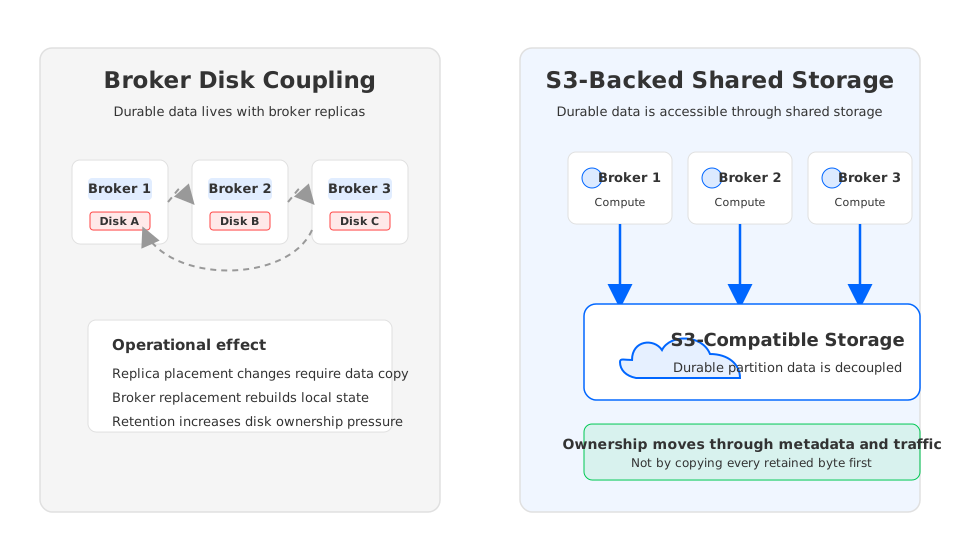
The shift is not that object storage magically behaves like a local disk. It does not. Kafka expects ordered append, offset-based fetch, low-latency tail reads, metadata consistency, and predictable recovery. An S3-backed Kafka-compatible system must build a streaming storage layer, write-ahead path, cache, and metadata model that make object storage usable for Kafka semantics. The architectural payoff is that durable data ownership can move away from broker machines.
1The Broker Disk Coupling in Traditional Kafka
Kafka's classic storage model is Shared Nothing. Each broker owns local log data for the partition replicas assigned to it. Replication through ISR (In-Sync Replicas) gives Kafka durability and failover, but it also means the cluster's data layout is tied to the broker fleet.
That coupling shows up in daily operations:
- Scaling out adds compute, but it does not automatically move existing partition data to the new brokers. Reassignment has to copy data until new replicas catch up.
- Scaling in removes compute only after partition replicas have moved away from brokers that will be terminated.
- Broker replacement requires replicas on the replacement node to rebuild from other brokers or from available remote tiers, depending on the Kafka configuration.
- Rebalancing is constrained by network, disk throughput, follower lag, and operational windows.
- Recovery depends on whether enough replicas remain healthy and how much data must be copied before the cluster returns to its desired state.
This model is robust and familiar. It also makes retained bytes part of the compute lifecycle. A broker is not just a process that can be restarted elsewhere; it is a process plus a storage assignment. If a topic keeps 7 days, 30 days, or 180 days of data, that retention expands the operational footprint of every replica move.
Tiered Storage reduces part of this pressure by moving older completed segments to remote storage. Apache Kafka's Tiered Storage documentation describes a local tier that still uses broker disks and a remote tier for completed log segments. That distinction matters: tiering helps with long retention, but the active write path and local tier remain broker-centered.
2What S3-Backed Shared Storage Changes
In an S3-backed shared-storage architecture, durable stream data is stored in object storage, while brokers act more like compute nodes responsible for Kafka protocol handling, leadership, caching, and coordination. A broker may still use fast local or attached storage as a WAL (Write-Ahead Log), cache, or staging layer, but the durable ownership of partition history is not permanently bound to that broker's local disk.
This changes the operational primitive. Traditional Kafka moves data to change ownership. Shared-storage Kafka changes metadata, leadership, and traffic routing while durable data remains accessible from the shared storage layer. The difference is especially visible when the retained dataset is much larger than the hot working set.
The architecture usually includes several pieces:
- A Kafka-compatible broker layer that preserves producer, consumer, topic, partition, offset, and consumer group semantics.
- A stream storage layer that maps ordered append and fetch operations onto object storage.
- A WAL or equivalent persistence path for durable acknowledgments before data is organized into objects.
- A cache for tailing reads and prefetched catch-up reads.
- Metadata that records object-to-stream mappings, leader epochs, offsets, and ownership state.
AutoMQ is one example in this category. It keeps Kafka protocol compatibility while replacing broker-local log storage with S3Stream, a shared streaming storage layer that writes durable data through WAL storage and S3-compatible object storage. The important point for this discussion is not a product label; it is the architectural category: Kafka-compatible brokers no longer need to be permanent owners of all durable partition bytes.
3Scaling Out: Adding Brokers Without Moving the Past
In traditional Kafka, adding brokers is only the first step. The cluster has more compute capacity, but existing partition replicas stay where they are until reassignment moves them. If the cluster is storage-heavy, scale-out can take time because new brokers must receive data from existing brokers before they carry their intended share of replicas.
That makes scaling a two-part operation: provision machines, then move data. The second part is the difficult one. Operators have to choose reassignment plans, throttle replication, watch lag, and avoid saturating disks or inter-zone links. For high-retention topics, the amount of data copied can be far larger than the amount of traffic that triggered the scale event.
S3-backed shared storage changes the scale-out sequence. New brokers can join the compute pool and begin serving assigned partitions after leadership, ownership, and cache state are established. Historical durable data is already in shared storage. The new broker may need to warm cache and read metadata, but it does not need to receive the entire retained log history from another broker before it can become useful.
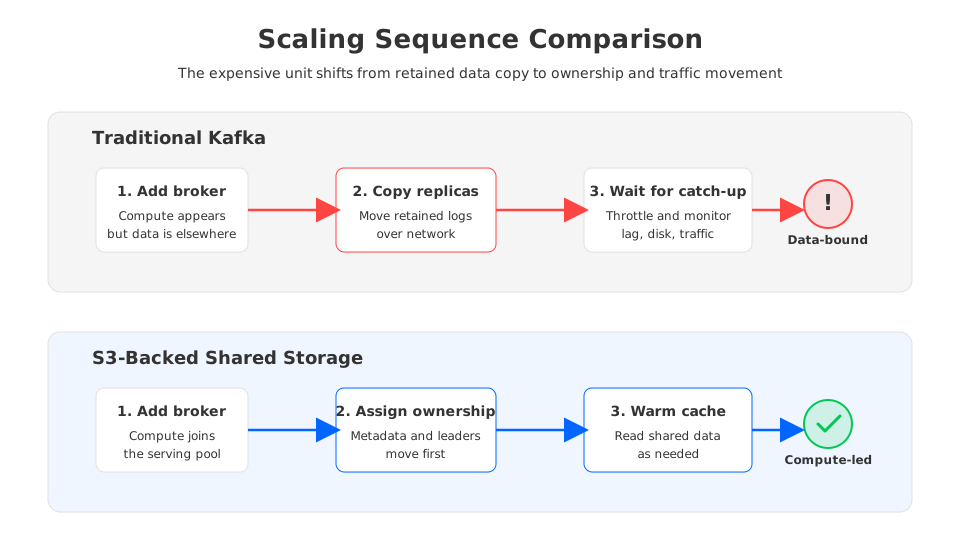
This does not remove all operational work. The cluster still has to balance leaders, handle cache misses, respect object storage limits, and avoid moving too much traffic at once. But the expensive unit is different. Scaling becomes less about copying retained bytes and more about redistributing request handling and hot data access.
4Shrinking: Removing Brokers Without Evacuating Every Byte
Scale-in is where local-disk ownership becomes most visible. In traditional Kafka, a broker cannot be removed until its partition replicas have been moved elsewhere or the cluster is willing to lose redundancy. The process is careful for good reason: every partition replica on that broker represents durable data and availability responsibility.
The operational cost is that shrinking can be slower than adding capacity. A team may reduce traffic after a campaign ends, but the cluster still needs time and bandwidth to evacuate data before machines can be terminated. If long-retention topics dominate disk usage, the amount of data to move may have little relationship to the current traffic drop.
In an S3-backed design, removing a broker is closer to draining compute. The cluster shifts leadership and serving responsibility away from the node, preserves durable data in shared storage, and lets remaining brokers take over traffic. Cache locality changes, and some reads may become colder during the transition, but the cluster is not forced to copy the broker's whole retained partition history to make scale-in safe.
The practical result is that capacity planning can separate two questions that traditional Kafka tends to merge:
| Question | Traditional broker-local Kafka | S3-backed shared-storage Kafka |
|---|---|---|
| How much compute do we need? | Broker count must cover CPU, network, and storage ownership | Broker count primarily covers request handling, cache, and coordination |
| How much retained data do we keep? | Retention drives broker disk sizing and replica placement | Retention is mainly a shared storage capacity question |
| How do we shrink? | Move replicas away before termination | Drain traffic and ownership while durable data remains shared |
This separation does not mean every cluster should scale constantly. Frequent resizing still needs guardrails, observability, and workload-aware policies. It means the architecture no longer treats every retained byte as an obstacle to compute elasticity.
5Broker Replacement and Failure Recovery
Broker replacement is the operational story many teams care about most. A failed broker in traditional Kafka leaves the cluster relying on other replicas. If the broker comes back with intact storage, recovery may be straightforward. If it is replaced by a fresh machine or volume, replicas need to rebuild. That rebuild competes for network, disk, and broker resources with live traffic.
With Tiered Storage, older remote segments can reduce the amount of historical data that must be reconstructed locally, but the local tier and active segments still matter. The broker replacement path remains tied to local storage state.
In S3-backed shared storage, a replacement broker does not need to inherit the failed broker's full durable log. The durable data is in shared storage, and the replacement can take over serving after the control plane assigns work and the storage layer can locate the relevant stream objects. Recovery becomes a question of metadata, WAL recovery for unflushed data, cache warmup, and traffic reassignment rather than wholesale log copy.
That distinction is not cosmetic. It changes failure-domain thinking:
- A broker failure is less likely to become a large data rebuild event.
- Replacement nodes can be more disposable because durable history is not trapped on their disks.
- Recovery objectives depend more on metadata availability, WAL design, object storage health, and cache strategy.
- Operators need observability for object storage latency, request rates, WAL backlog, cache hit ratio, and stream metadata, not only broker disk usage.
The risk moves, too. A shared-storage design concentrates more importance in the storage layer and metadata system. Architects should ask how the system handles object storage throttling, bucket outages, WAL media failure, metadata compaction, and cold-read storms after failover. S3-backed Kafka is a different architecture, not a free pass from reliability design.
6Rebalance: From Replica Copy to Ownership and Traffic
Traditional Kafka rebalance often means partition reassignment. Moving replicas changes where data lives, so the cluster copies log data and waits for new replicas to catch up. This is necessary for even storage distribution, availability, and performance, but it can be operationally heavy.
In shared-storage Kafka, rebalancing can focus more on ownership and traffic distribution. Since durable data is accessible from shared storage, assigning a partition to a different broker does not require copying its retained history to that broker first. The new broker needs the right metadata, authority to serve the partition, and enough cache or storage throughput to handle reads and writes.
This can make balancing more continuous. Instead of saving reassignments for planned windows, a system can respond to CPU, network, cache pressure, partition skew, and broker health with smaller adjustments. AutoMQ's architecture documentation describes this in terms of storage-compute separation, stateless brokers, and partition reassignment that avoids data duplication.
The operational focus shifts from "How long will the copy take?" to "What traffic and cache impact will this ownership move create?" That is a healthier question for elastic infrastructure, but it still requires discipline. A bad rebalance policy can create cold-cache penalties, object storage request spikes, or leadership churn. Good shared-storage systems need rate limits, placement constraints, and feedback loops.
7Workload Fit Checklist
S3-backed Kafka is most compelling when the application wants Kafka semantics but the infrastructure problem is dominated by retained data, elasticity, and broker lifecycle friction. It is less compelling when the workload is small, stable, extremely latency-sensitive, and already well served by broker-local disks.
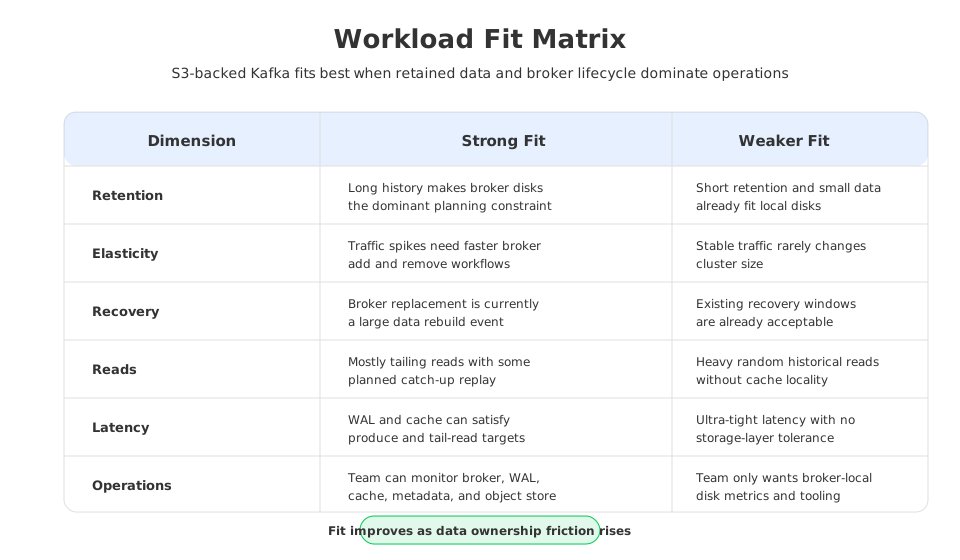
Use this checklist before choosing an architecture:
- Retention profile: Do topics keep enough history that local broker disks dominate cost, recovery time, or resize complexity?
- Elasticity need: Does traffic rise and fall enough that faster scale-out or scale-in would change capacity planning?
- Failure recovery: Is broker replacement currently a data rebuild event that affects production traffic or operational windows?
- Latency target: Can the storage engine's WAL and cache design meet producer acknowledgment and tail-read expectations?
- Operational maturity: Can the team monitor object storage, WAL, cache, metadata, and broker metrics together?
A common fit is a cloud platform team running many Kafka topics with uneven retention, bursts, and frequent infrastructure changes. The team wants Kafka compatibility without every broker replacement or resize becoming a retained-data migration.
A weaker fit is a compact cluster with predictable traffic, short retention, tight single-digit millisecond goals, and no pressure from broker disks or reassignments. In that case, the architectural change may not justify the new storage-layer considerations.
8How to Evaluate an S3-Backed Kafka Design
The evaluation should start from operational scenarios rather than vendor claims. Ask what happens when a broker disappears, when three brokers are added for a traffic spike, when two brokers are removed after the spike, when a consumer replays a day of data, and when object storage latency rises.
For each scenario, trace the real data path:
- When is a produce request acknowledged, and what durable media protects it at that moment?
- Where does hot tail data live, and how does the cache behave after leadership changes?
- How are offsets mapped to objects, and how large can the metadata grow?
- What happens to reads during broker replacement or ownership transfer?
- Which metrics tell operators that object storage, WAL, cache, or metadata is becoming the bottleneck?
This framing keeps the discussion grounded. S3-backed Kafka is not "Kafka plus a bucket." It is a storage architecture that decouples durable data from broker disks while preserving Kafka's application contract. When implemented well, that decoupling changes scaling, shrinking, broker replacement, rebalance, and recovery from data-copy problems into compute-and-ownership problems. That is the real architectural change.
9References
- Apache Kafka Tiered Storage documentation
- Apache Kafka KIP-405: Kafka Tiered Storage
- AutoMQ Architecture Overview
- AutoMQ S3Stream Overview
- AutoMQ S3 Storage Architecture
10FAQ
10.1Is S3-backed Kafka the same as exporting Kafka data to S3?
No. Exporting Kafka data to S3 usually means a connector writes records into object storage for analytics or archive. Kafka itself still stores its log on broker disks. S3-backed Kafka uses object storage as part of the durable Kafka-compatible storage architecture.
10.2Is S3-backed Kafka the same as Kafka Tiered Storage?
No. Tiered Storage keeps a local broker tier for active log data and moves completed segments to remote storage. S3-backed shared storage moves the durable storage foundation off broker disks more completely, although implementation details vary by system.
10.3Does S3-backed Kafka make brokers stateless?
It can make brokers much closer to stateless compute nodes because durable partition data is no longer permanently owned by broker disks. Brokers may still hold cache, WAL data, leadership state, and runtime metadata, so the exact recovery model depends on the implementation.
10.4When should a team consider S3-backed Kafka?
Consider it when long retention, frequent scaling, broker replacement, or partition rebalancing makes local-disk Kafka operationally heavy. Teams with stable traffic, short retention, and no storage pressure may not need the architectural shift.


