
Table of Contents
Table of Contents
Teams usually search for s3 sink batching kafka after the first simple version of an S3 export pipeline starts to hurt. The connector works. Files land in a bucket. Downstream jobs can query them. Then the questions arrive from every direction: why are there so many small files, why does the lake see data late, why did a replay produce duplicates, why did a schema change split files, and why did the Kafka cluster need more disk to feed an object-storage sink?
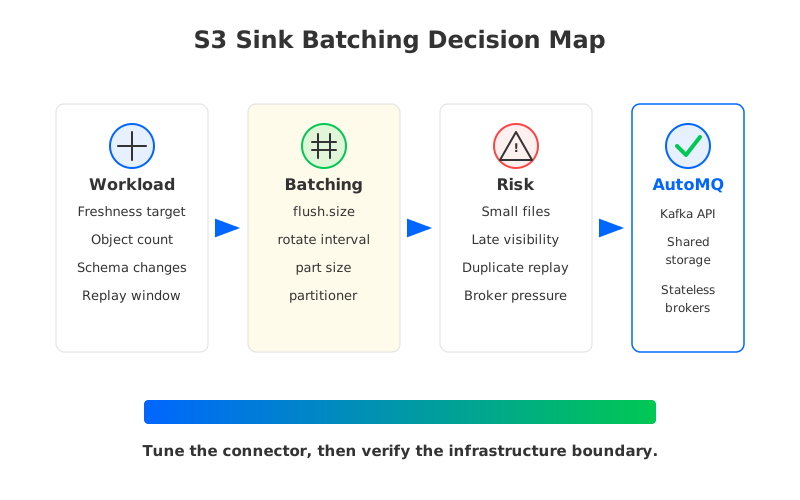
That last question is the one platform teams should not ignore. S3 sink batching looks like a connector setting problem, but it is really a boundary problem between streaming, object storage, and operations. Kafka wants ordered partitions and committed offsets. S3 wants complete objects. Lakehouse readers want file sizes large enough to scan efficiently. Governance teams want deterministic paths, schema discipline, encryption, and retention. SREs want a recovery plan that does not turn a failed task into a manual archaeology project across offsets and object keys.
The useful mental model is not "larger batches lower cost" or "smaller batches are lower latency." Both statements are incomplete. A batch is a contract. It defines when a record stops being an event in a Kafka partition and becomes part of an immutable object that downstream systems will treat as data at rest.
1Why teams search for s3 sink batching kafka
An S3 sink connector is often introduced for a reasonable reason: Kafka is the operational system of record for events, and object storage is the analytical and retention boundary. CDC events, telemetry, user behavior streams, billing events, security logs, and operational audit trails all need a path from Kafka-compatible topics into a bucket. Kafka Connect gives teams a familiar runtime for this path, and common S3 sink connectors expose batching controls such as flush.size, time-based rotation, output format, partitioner selection, compression, multipart upload part size, and error handling.
Those controls look local, but each one pushes pressure somewhere else. A small flush.size can reduce time-to-object but create many small files. A larger file target can improve downstream scan efficiency but widen the window between Kafka ingestion and S3 visibility. Time-based rotation can make hourly partitions predictable, but late-arriving records can force extra files. Schema compatibility can protect readers, but a schema mismatch may close a file early or send records to a dead letter queue.
The practical decision starts with five questions:
- What is the freshness target for S3 readers: seconds, minutes, hourly partitions, or audit-grade daily archives?
- What is the expected replay unit: one Kafka offset range, one object, one table partition, or one business time window?
- Which system owns deduplication: the connector, object naming, the lakehouse table format, or downstream jobs?
- What file shape do readers need: JSON for operational replay, Avro for schema binding, Parquet for analytics, or raw bytes for external systems?
- How much infrastructure headroom is reserved for connector catch-up after downtime?
The search query is about batching because batching is the visible knob. The production issue is that the knob sits in the middle of a chain of contracts.
2The operational constraint behind connector-heavy platforms
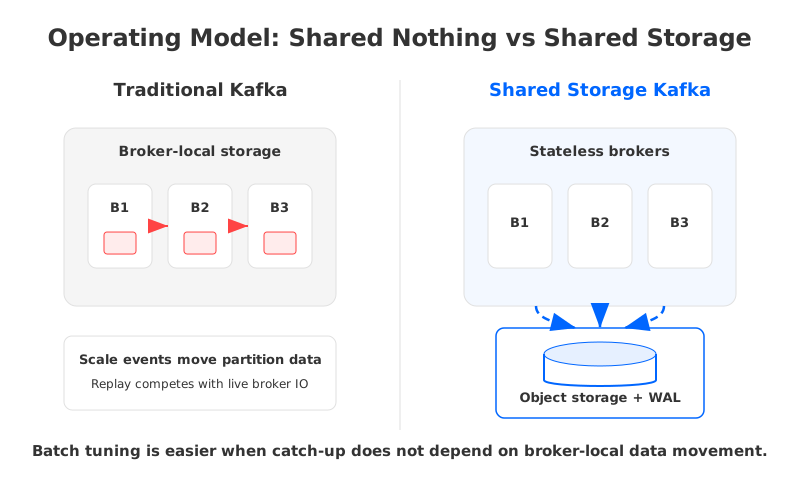
Traditional Kafka architecture makes this chain more expensive than it first appears. In the classic shared-nothing model, each broker owns local storage, replicas are distributed across brokers, and partition reassignment involves moving data between broker disks. That model is reliable and well understood, but connector-heavy platforms place a specific type of stress on it: they turn Kafka into both the online event backbone and the staging layer for large downstream exports.
When an S3 sink falls behind, Kafka brokers retain more data for longer, consumers read older segments, and replays compete with live traffic. If the platform team adds brokers, partition movement can become its own large data transfer event. If the team increases retention to protect recovery windows, local or block storage consumption rises. If the team spreads brokers across Availability Zones for resilience, replication and client traffic can create cross-zone data movement that is unrelated to the S3 sink itself but still lands on the infrastructure bill.
The connector runtime also has its own state. Kafka Connect stores connector offsets and task status, while the S3 objects encode topic, partition, and offset information depending on the partitioner and object naming strategy. This is useful during recovery because the object path can tell you which Kafka range is represented. It also means every operational action needs to preserve the relationship between three timelines: Kafka offsets, connector commits, and S3 object creation.
Cost is not only about object storage price. S3 pricing includes storage, request, retrieval, data transfer, and optional acceleration or multi-region routing dimensions. Multipart upload improves throughput and recovery for larger objects, but unfinished multipart uploads can retain parts until they are completed or stopped. AWS recommends multipart upload for objects of 100 MB or larger, and the S3 API model bills request activity as well as storage. A pipeline that emits too many small files may look low-cost per object but remain inefficient for request volume and downstream compute; a pipeline that waits too long may hide freshness problems until an incident.
The broker layer matters because connector backlogs amplify retention and read pressure. If the Kafka cluster cannot scale independently from stored data, S3 sink tuning becomes a compromise between lake efficiency and broker safety. A platform team may tune batches perfectly and still lose the larger cost argument because the staging system is carrying too much persistent state.
3Failure handling, schema, and replay trade-offs
The hardest S3 sink incidents are rarely simple task failures. They are boundary failures. A worker dies after uploading parts but before the final commit. A schema change arrives mid-window. A topic partition is replayed after a connector offset reset. A downstream table job reads a prefix while files are still arriving. A late event belongs to a closed time partition. Each incident asks the same question: which boundary is authoritative?
For Kafka, the durable boundary is the partition log and the committed consumer position. For S3, the durable boundary is the completed object. For downstream analytics, the durable boundary may be a table snapshot or a partition discovery cycle. These boundaries do not move at the same time. The connector bridges them, so its configuration determines how much uncertainty the team must handle during recovery.
| Decision area | Lower-latency bias | Lower-cost / lake-efficiency bias | Replay boundary to document |
|---|---|---|---|
| Record count commit | Smaller flush.size | Larger flush.size | Offset range per object |
| Time rotation | Short rotate.interval.ms or scheduled rotation | Longer rotation windows | Event-time or wall-clock window |
| Object size | Smaller files visible sooner | Larger files, often with multipart upload | Object key and completed upload |
| Schema handling | Fail fast or DLQ problematic records | Preserve compatible batches | Schema ID / subject version |
| Partitioning | Fine-grained prefixes for readers | Coarser prefixes for fewer objects | Prefix plus Kafka partition |
There is no universally correct column. CDC pipelines often prefer clear replay and schema discipline because a duplicate row can be manageable but a missing delete event can corrupt a table. Observability pipelines often tolerate occasional duplicate records if query cost and freshness stay predictable. Security audit streams may accept higher latency to preserve deterministic, immutable archives.
The team should write the recovery rule before choosing the batch size. A healthy rule sounds like this: "For topic X, partition Y, every completed object contains a contiguous Kafka offset range; if a connector task restarts, downstream readers deduplicate by object key and offset metadata; if a schema change is incompatible, records go to a DLQ and the object prefix remains queryable." That is operationally useful because it names the exact evidence a responder will use during an incident.
4Evaluation checklist for platform teams
The neutral evaluation framework for S3 sink batching has three layers: connector semantics, Kafka infrastructure, and organizational ownership. Connector semantics tell you whether files are correct. Kafka infrastructure tells you whether the cluster can survive catch-up and replay. Ownership tells you whether the right team will notice when the boundary breaks.
Use this checklist before production rollout:
- Compatibility: Confirm that existing producers, consumers, Kafka Connect plugins, Schema Registry usage, and security settings work without application changes.
- Freshness: Define the maximum acceptable delay between Kafka append and S3 object visibility for each topic class.
- File economics: Estimate object count, average object size, PUT/LIST/GET request patterns, and downstream scan behavior under normal and replay traffic.
- Replay: Document offset reset, duplicate handling, DLQ processing, object overwrite/versioning policy, and downstream table repair steps.
- Scaling: Test connector catch-up after a realistic outage, not only steady-state throughput.
- Network and placement: Map where producers, brokers, connector workers, VPC endpoints, PrivateLink endpoints, and buckets live.
- Governance: Require bucket encryption, IAM least privilege, object tagging or metadata where needed, schema compatibility policy, and lifecycle rules for incomplete uploads.
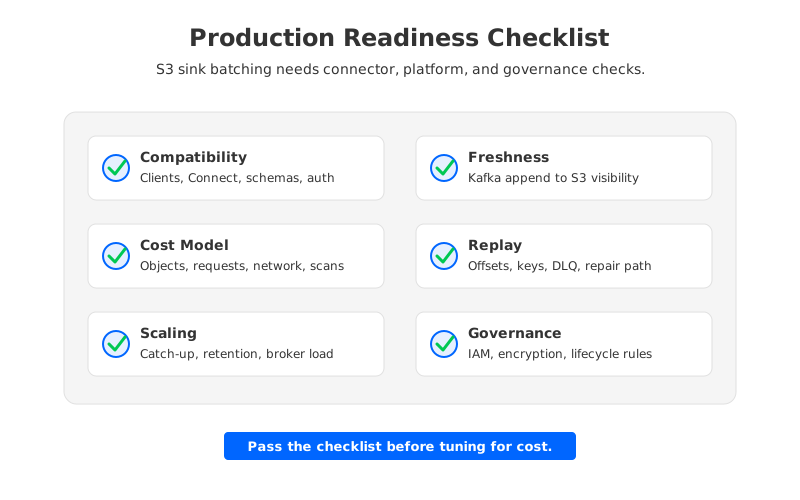
This checklist usually exposes a gap in team boundaries. The data integration team owns connector configuration, the Kafka platform team owns broker capacity, the data lake team owns file layout, the security team owns bucket policy, and FinOps owns the bill. S3 sink batching crosses all of those lines. A production design that optimizes one line item while hiding risk in another team is not optimized; it is deferred work.
5How AutoMQ changes the operating model
Once the evaluation reaches broker cost, scaling, and recovery boundaries, architecture becomes part of the S3 sink batching decision. A Kafka-compatible platform with shared storage changes the trade-off because the broker no longer has to be the long-lived owner of all persistent log data. AutoMQ is one implementation of this model: it keeps Kafka protocol compatibility while replacing the storage layer with S3Stream, a shared streaming storage layer backed by object storage and a write-ahead log.
The practical difference is not that an S3 sink connector disappears. Many teams will still use Kafka Connect and S3-compatible sinks because the connector boundary is useful for file format, partitioning, schema conversion, and lake ingestion. The difference is that connector backlogs and replays do not force the same broker-local storage posture. AutoMQ's architecture uses object storage as the primary repository and makes brokers stateless, so scaling compute capacity does not require moving partition data between broker disks.
That changes how platform teams reason about three production moments. During normal export, Kafka-compatible clients and connectors continue to use familiar APIs while storage grows in object storage rather than on broker-local volumes. During catch-up, the team can add broker capacity without treating every scale event as a data migration project. During failure recovery, replacing broker instances is less entangled with persistent log ownership, so the connector replay boundary can stay focused on offsets, object keys, and downstream idempotence.
AutoMQ also addresses a cost dimension that often sits outside the connector dashboard: inter-zone traffic. In multi-AZ Kafka deployments, producer routing, broker replication, and consumer placement can all create cross-zone data transfer. AutoMQ's documentation describes an S3-based shared storage and routing model designed to reduce inter-zone broker replication and client read/write traffic. For an S3 sink platform, that matters because the export pipeline should not require a second hidden network tax to keep Kafka resilient.
The right way to evaluate AutoMQ in this context is not as a connector replacement, but as a Kafka-compatible substrate for connector-heavy workloads. Ask whether your current Kafka cluster can absorb S3 sink backlog, replay, retention, and scale events without over-provisioned disks or disruptive reassignment. If the answer is no, then batch tuning alone will not fix the architecture.
For teams evaluating this path, AutoMQ provides Kafka compatibility documentation and migration guidance, including MirrorMaker2-based migration for open source deployments and commercial migration tooling for stricter offset consistency requirements. A practical pilot should use one connector-heavy topic class, reproduce a backlog event, validate object output against the existing S3 sink contract, and compare operational steps before expanding the rollout.
If your team is already treating S3 sink batching as an architecture decision rather than a connector-only setting, the next step is to test the storage and replay model directly. You can contact the AutoMQ team through this verified link: discuss Kafka-compatible S3 sink architecture.
6References
- Apache Kafka Documentation
- Confluent Amazon S3 Sink Connector Overview
- Confluent Amazon S3 Sink Connector Configuration Reference
- Amazon S3 multipart upload documentation
- Amazon S3 pricing
- AWS PrivateLink pricing
- AutoMQ overview
- AutoMQ compatibility with Apache Kafka
- AutoMQ architecture overview
- AutoMQ eliminate inter-zone traffic overview
- AutoMQ migration overview
7FAQ
7.1What is a good flush.size for an S3 sink connector?
A good value depends on freshness, object size, downstream scan cost, and replay requirements. Start from the file size and latency target your readers need, then test connector catch-up under failure. A value that looks efficient during steady-state traffic may be too slow to recover after a worker outage.
7.2Should S3 sink batching be based on record count or time?
Most production designs use both concepts. Record count helps control object size, while time rotation helps create predictable partitions for downstream jobs. The important part is documenting which clock is authoritative: Kafka record time, connector wall-clock time, or downstream table partition time.
7.3Does exactly-once delivery remove the need for replay planning?
No. Exactly-once connector semantics can reduce duplicate output for supported configurations, but teams still need operational rules for connector restarts, schema failures, late data, object versioning, DLQ processing, and downstream table repair.
7.4How does shared storage help an S3 sink workload?
Shared storage separates persistent Kafka log data from broker-local disks. For connector-heavy workloads, that can reduce the operational cost of retention, catch-up, and scaling because brokers can be replaced or scaled without moving large local partition data.
7.5Is AutoMQ a replacement for Kafka Connect?
No. AutoMQ is a Kafka-compatible streaming platform with a shared storage architecture. Kafka Connect and S3 sink connectors can still be used for file format conversion, partitioning, schema handling, and delivery into object storage.


