
Table of Contents
Table of Contents
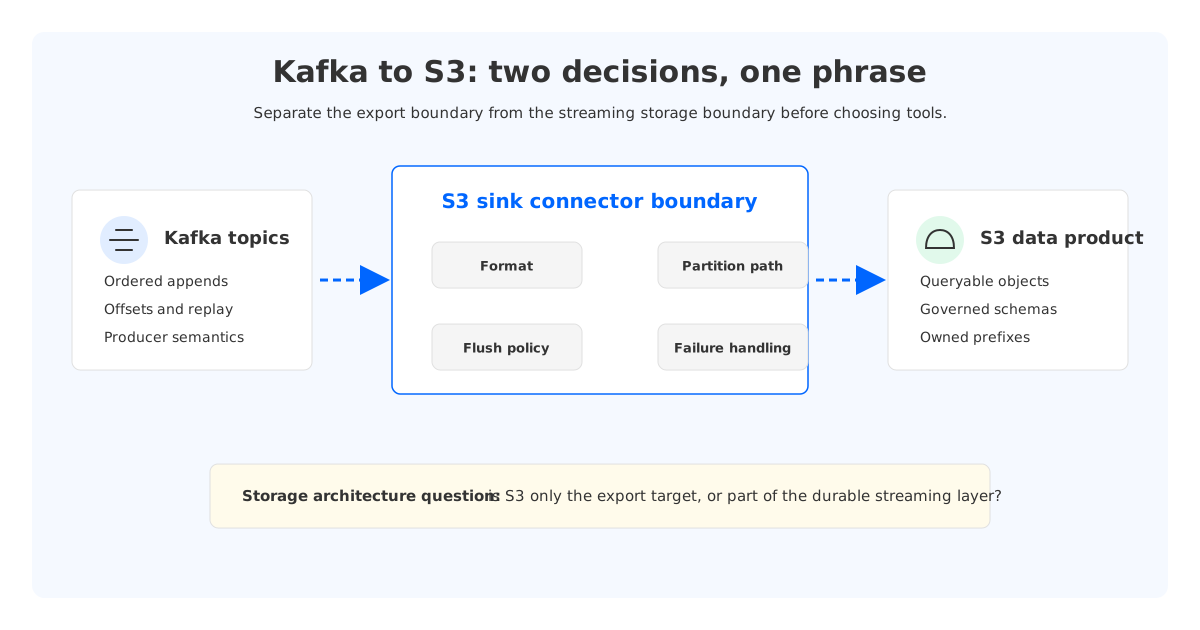
Teams searching for Kafka on S3 are usually trying to answer two questions with the same phrase. The first is practical: how do we move records from Kafka topics into Amazon S3 so downstream analytics, lakehouse tables, machine learning jobs, or compliance archives can use them? The second is architectural: should S3 be only a sink at the edge of Kafka, or should object storage become part of the streaming platform itself?
Those questions look similar in a search box, but they lead to different decisions. An S3 sink connector is a data movement component. It reads from Kafka, writes objects to S3, and turns a stream into files with naming, partitioning, and buffering rules. A Kafka-compatible shared-storage platform changes where durable streaming data lives before it is exported. If teams blur those boundaries, they may solve a pipeline problem while leaving the underlying cost, retention, recovery, and scaling problem untouched.
The connector path is still important. Kafka Connect exists because teams do not want every application team to hand-roll offset management, task parallelism, retries, and delivery behavior. The evaluation gets serious when the sink becomes a shared data product boundary. At that point, a connector configuration becomes an operational contract between streaming producers, platform owners, data lake consumers, cloud networking, governance, and FinOps.
1Why Kafka to S3 becomes a platform decision
A single connector can start as a convenience: take a topic, write records to an S3 bucket, and let Athena, Spark, Snowflake, Databricks, or internal batch jobs read the output. The happy path is straightforward: records arrive, the connector buffers them, and objects appear under a configured prefix. The real design work begins after more teams depend on those objects as a product.
The first pressure is file layout. Data lake consumers care about object size, partition paths, schema evolution, and late-arriving data. Kafka producers care about record order, throughput, and partition count. The connector has to translate between the two worlds without pretending they have the same shape. A Kafka topic is optimized for ordered append and offset-based replay. S3 is optimized for durable object storage and high-scale reads across objects.
The second pressure is ownership. If a topic feeds a governed data product, someone has to own the bucket path, schema rules, dead-letter handling, retention policy, encryption settings, and consumer expectations. A connector without an operating model becomes a shared failure point because every downstream issue turns into a question of whether Kafka, Connect, S3, schema governance, or consumer code caused the problem.
2What an S3 sink connector actually decides
Apache Kafka Connect provides a framework for moving data between Kafka and external systems through connectors. In the S3 sink case, the connector reads Kafka records, manages task progress, and writes objects to S3 according to connector-specific settings. Confluent's Amazon S3 Sink Connector documentation describes common controls such as formats, partitioners, flush behavior, schema handling, and output organization. AWS also documents an MSK Connect example using managed Connect infrastructure with Amazon MSK and S3.
That stack has several production decision points:
- Record format and schema contract. JSON, Avro, Parquet, and raw bytes create different downstream expectations. Schema Registry integration can help, but the team still needs compatibility rules and a plan for records that fail serialization or evolution checks.
- Object layout and partitioning. Topic-based paths are easy to understand, while time-based or field-based partitioning can be more useful for analytics. The wrong layout creates either too many small files or too much downstream filtering.
- Flush and rotation policy. Buffer size, time interval, and record count settings decide when files become visible. They also influence object count, latency to the lake, and the blast radius of retries.
- Failure handling and replay. Connector offsets, dead-letter queues, task restarts, and idempotent object naming decide whether a retry duplicates, overwrites, or safely completes output.
- Cloud access boundary. IAM roles, bucket policies, encryption keys, VPC routing, and private connectivity decide whether the connector is merely functional or acceptable to security teams.
None of these settings is exotic. The difficulty is that they interact. A very low flush interval may improve lake freshness but increase object count and S3 request activity. Field partitioning may improve query pruning but amplify small-file pressure if the field has high cardinality. Parquet may be better for analytics, but it raises the bar for schema discipline.
3The cost model is not only connector runtime
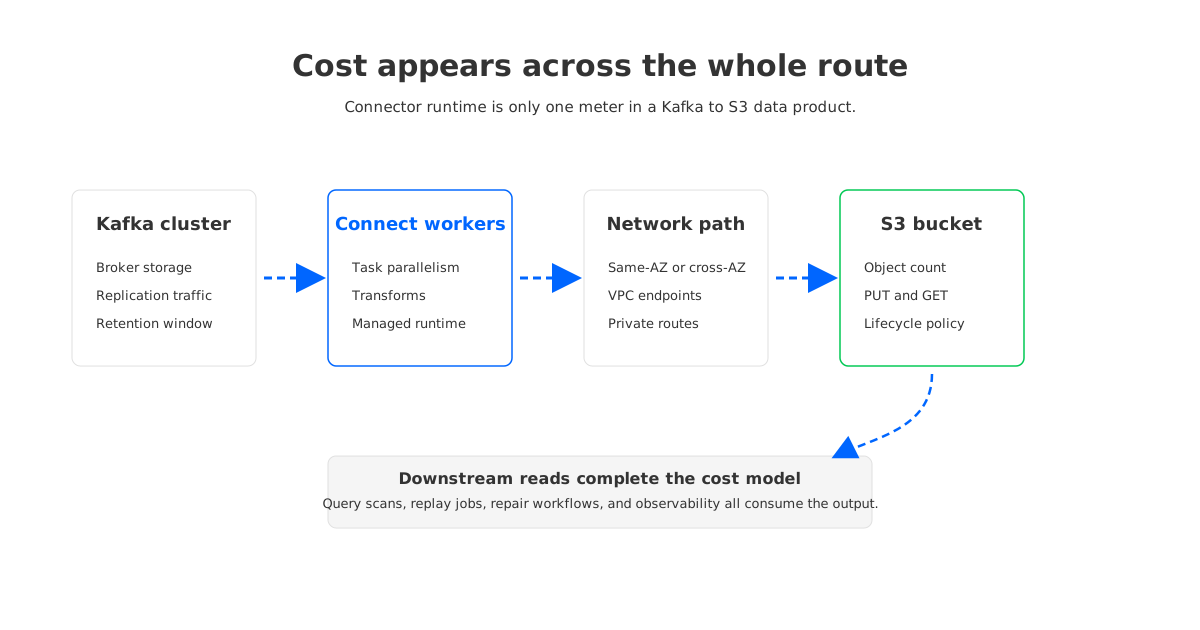
FinOps reviews often start with the most visible meter: the worker infrastructure running Kafka Connect or a managed connector service. A Kafka to S3 pipeline also creates cost across brokers, S3 storage, S3 requests, network transfer, observability, and operational labor. Missing one layer makes the pipeline look cleaner than it is.
The important cost question is: which bytes are copied, transformed, stored, and reread? A record can be written to Kafka, replicated across brokers or zones, fetched by a connector task, written to S3, scanned downstream, and replayed after connector or schema failures. Some of that movement is necessary. Some of it is an artifact of architecture and placement.
| Cost surface | What to inspect | Why it matters |
|---|---|---|
| Kafka storage and replication | Broker disks, replication factor, cross-zone traffic, retention | The S3 sink does not remove Kafka's internal storage cost. |
| Connector runtime | Worker count, task parallelism, managed connector charges | Runtime cost scales with throughput, transformations, and availability goals. |
| S3 storage and API activity | Object count, PUT/GET/list activity, lifecycle policy, storage class | Small files and frequent flushes can make request behavior visible. |
| Network path | Same-AZ, cross-AZ, VPC endpoint, PrivateLink, NAT, cross-region flows | Cloud network charges can dominate when topology is ignored. |
| Operations | Reprocessing, schema fixes, failed tasks, ownership reviews | Labor cost appears when the data product has no runbook. |
AWS publishes separate pricing pages for S3, MSK, and EC2 data transfer, which is a useful reminder: the bill is organized around cloud services, not your data product. A sink connector may look inexpensive in isolation while the end-to-end pipeline pays for broker replication, connector egress paths, object requests, and repeated scans. The defensible estimate is workload-specific: throughput, record size, partition count, flush policy, retention, replay frequency, and topology all matter.
4Connector design does not replace storage architecture
The phrase Kafka on S3 becomes misleading when an S3 sink connector is treated as if it makes Kafka itself object-storage-backed. It does not. A sink connector exports data out of Kafka. Kafka still ingests records, replicates them, retains them, recovers brokers, serves consumers, and rebalances partitions according to its own storage model. S3 becomes a destination, not the primary durable log.
This distinction matters during retention and replay discussions. If the goal is to create an analytics copy of the stream, the connector model is appropriate. Keep Kafka retention aligned with recovery needs, and let S3 hold longer-lived analytical data. If the goal is to reduce broker-local storage pressure, avoid large partition reassignments, lower cross-zone replication traffic, or recover brokers without moving local log data, a sink connector is the wrong layer to optimize.
The difference is easiest to see during failure. If a connector task fails, the platform team cares about task restart, offset progress, duplicate files, dead-letter records, and S3 object consistency. If a Kafka broker fails, the team cares about partition leadership, replicas, local disk recovery, and client impact. The connector can help recover the export path. It cannot make broker-local durable data stateless.
A good S3 sink strategy answers, "How should this stream become lake data?" A good Kafka storage strategy answers, "Where should durable streaming data live before anyone exports it?"
Both strategies can be valid in the same platform. The mistake is asking one to do the other's job.
5A production evaluation framework
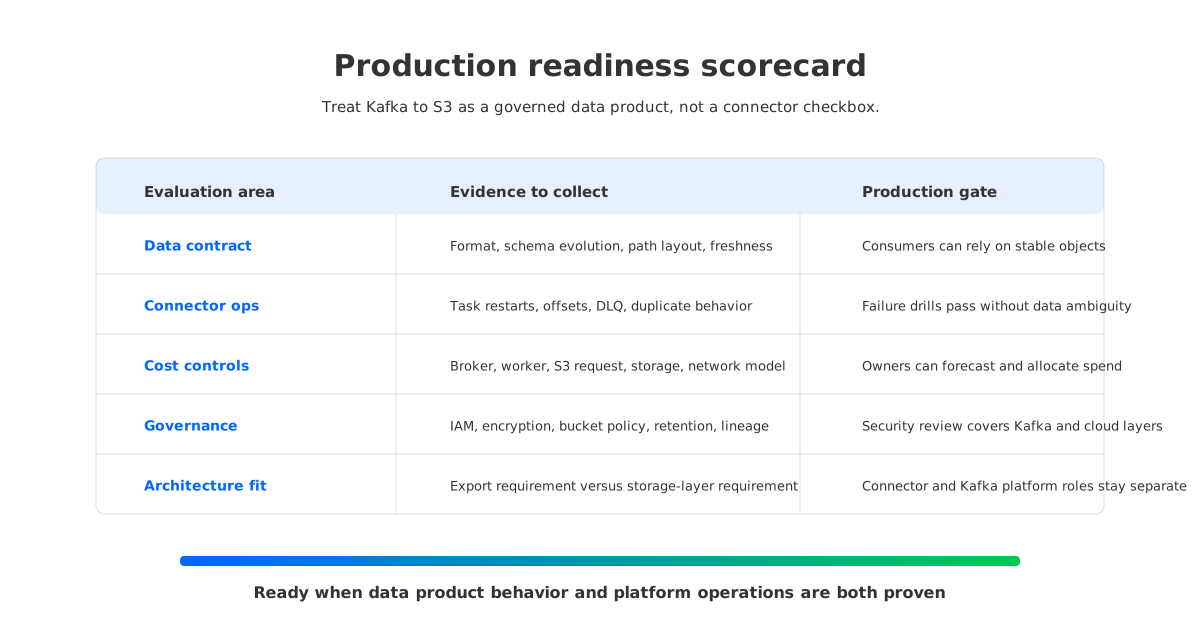
The practical way to evaluate Kafka to S3 is to separate the data product contract from the infrastructure contract. The data product contract says what downstream consumers can expect: file format, path layout, freshness, schema compatibility, retention, and failure handling. The infrastructure contract says what the platform can operate: worker placement, Kafka capacity, network boundary, access control, and recovery.
Start with the data product because it defines the externally visible behavior. Choose the file format based on how the data will be read. Define partition paths around query patterns, not only around topic names. Set flush behavior around freshness and object efficiency. Decide whether records that fail schema or serialization rules go to a dead-letter topic, a quarantine path, or a manual repair workflow.
Then review the platform side with the same rigor:
- Compatibility: Confirm producer and consumer expectations, Kafka Connect version support, connector plugin version, Schema Registry behavior, security mechanisms, and monitoring integrations.
- Scalability: Test task parallelism against real topic partitions and record sizes. A connector cannot parallelize beyond the constraints of topic layout and worker capacity.
- Failure semantics: Rehearse worker restart, task rebalance, S3 throttling, bad records, credential rotation, and downstream schema breakage.
- Cost controls: Model broker retention, connector runtime, S3 object count, request rate, and network path together. Do not compare only worker cost.
- Governance: Assign owners for bucket prefixes, schemas, IAM roles, retention policies, replay approvals, and consumer-facing data quality.
This framework also prevents a common procurement error. A managed connector can reduce operational burden, but it does not remove the need to understand file layout, schema evolution, retry behavior, and cost surfaces. A self-managed connector can provide more control, but it may increase patching, scaling, and incident response work.
6When to rethink the Kafka layer itself
The S3 sink evaluation often exposes a deeper pattern. The team may start by optimizing the export pipeline, then realize the expensive part is not only the export. Kafka retention is growing. Broker disks are over-provisioned. Cross-zone replication traffic is hard to allocate. Rebalancing takes planning. Consumer replays compete with normal traffic. The connector is doing its job, but the platform architecture still carries broker-local state as the center of gravity.
That is where Kafka-compatible shared-storage systems enter the evaluation. The requirement is not "write files to S3." It is to keep Kafka-facing semantics while reducing the coupling between broker compute and durable data. In that model, brokers handle protocol, scheduling, caching, and request processing, while a shared storage layer holds durable stream data. A WAL absorbs the low-latency write path before data is organized into object storage. Cache protects hot reads and catch-up reads from becoming a naive object-store fetch loop.
AutoMQ is one implementation of this category. AutoMQ is a Kafka-compatible cloud-native streaming platform that keeps Kafka protocol and ecosystem compatibility while redesigning the storage layer around shared storage, stateless brokers, WAL storage, cache, and S3-compatible object storage. Its documentation describes S3Stream as the shared streaming storage layer and WAL storage as the durable write path, letting object storage serve as the long-term repository without forcing every append to behave like a direct object write.
That does not make an S3 sink connector irrelevant. Most data platforms still need lake exports, governed data products, and warehouse ingestion paths. The change is that the connector is no longer the sole place where S3 participates in the architecture. S3 can be both the durable foundation of the streaming platform and the analytical destination for selected streams.
The right test is still workload-specific. Validate Kafka client behavior, connector compatibility, transactions, compaction, read latency, object storage behavior, network topology, recovery, and tooling before moving production traffic. AutoMQ becomes relevant when the same evaluation points to broker-local storage, cross-zone traffic, slow rebalancing, and retention cost as root causes rather than connector configuration mistakes.
7Decision rule for platform teams
Use an S3 sink connector when the problem is data product delivery: exporting Kafka topics into durable, queryable, governed object storage. Spend design time on format, path layout, schema evolution, flush policy, replay behavior, access control, and ownership. That is where the connector succeeds or fails.
Rethink the Kafka storage layer when the problem is infrastructure gravity: broker disks, replication traffic, scaling windows, recovery data movement, retention economics, or replay pressure. Those issues may show up while building Kafka to S3 pipelines, but they are not solved by writing more objects to a bucket. They are solved by changing where the streaming platform keeps durable state.
The search for Kafka on S3 starts with a connector configuration, but the production decision is broader. Treat the S3 sink as a data product boundary, treat Kafka storage as an architecture boundary, and evaluate each with the evidence it deserves. If your review points toward shared-storage Kafka, start with the AutoMQ documentation and run a proof using your topics, connector workloads, retention windows, and cloud network topology.
8References
- Apache Kafka documentation: Kafka Connect
- Confluent documentation: Amazon S3 Sink Connector overview
- AWS documentation: Use MSK Connect for an S3 sink connector
- AWS pricing: Amazon MSK pricing
- AWS pricing: Amazon S3 pricing
- AWS pricing: EC2 data transfer within the same AWS Region
- AutoMQ documentation: S3Stream shared streaming storage overview
- AutoMQ documentation: WAL storage
9FAQ
9.1Is an S3 sink connector the same as Kafka running on S3?
No. An S3 sink connector exports records from Kafka topics into S3. Kafka still stores, replicates, serves, and recovers stream data according to the Kafka cluster's storage architecture. Kafka running with shared object storage is a deeper architectural decision that changes where durable streaming data lives.
9.2What should teams test before using an S3 sink connector in production?
Test record format, schema evolution, partition path design, flush policy, task parallelism, worker restarts, bad records, dead-letter handling, S3 throttling, credential rotation, and duplicate output behavior. Also test downstream query performance because file size and path layout can matter as much as connector throughput.
9.3When is Kafka to S3 a good fit?
Kafka to S3 is a good fit when the goal is durable lake ingestion, analytical replay, compliance archive, or feeding warehouse and machine learning workloads from event streams. It is less suitable as a fix for broker storage pressure, slow partition reassignment, or cross-zone replication cost because those are Kafka platform architecture issues.
9.4How does AutoMQ relate to Kafka on S3?
AutoMQ is relevant when the evaluation moves from exporting data to S3 toward using shared object storage as part of the Kafka-compatible streaming platform. It keeps Kafka protocol compatibility while using shared storage, WAL storage, cache, and S3-compatible object storage to reduce the coupling between broker compute and durable data.


