
Table of Contents
Table of Contents
Teams usually search for kafka sasl authentication operations when the authentication setting itself is no longer the hard part. A developer can add security.protocol=SASL_SSL to a client configuration, a platform engineer can create a SCRAM credential, and a security team can require stronger identity controls. The production problem starts when that change has to survive hundreds of applications, private endpoints, ACLs, connector runtimes, secret rotation, audit evidence, and a rollback plan that does not interrupt the business.
Kafka makes this interesting because identity is attached to a living distributed system. Clients cache metadata, discover broker endpoints, join consumer groups, commit offsets, and retry under failure. Brokers authenticate clients, authorize operations, replicate data, expose metrics, and participate in cluster membership. A SASL change therefore touches more than a login module. It changes the contract between applications, platform automation, network boundaries, and the storage architecture underneath the brokers.
The useful question is not "does the platform support SASL?" Most serious Kafka-compatible platforms do. The better question is: can your team operate authentication changes without turning every security improvement into a capacity event, migration project, or emergency application patch?
1Why SASL operations become a platform problem
SASL is an authentication framework. In Kafka deployments it is commonly combined with TLS for encrypted transport and with ACLs for authorization. The mechanism may be SCRAM, PLAIN in controlled environments, OAuth-based integration, or a cloud-provider-specific identity path. On paper, that layering is clean: authenticate the principal, encrypt the connection, authorize the action. In production, each layer has a different owner and a different failure mode.
A typical platform team has to answer questions that do not fit inside a single Kafka property file. Which service identity owns each topic? Which team rotates the credential? What happens to long-running stream processors during rotation? Are connector tasks using the same principal as application producers? Can the security team prove that administrative access is separated from data-plane access? Does the private network path match the identity boundary, or is the cluster reachable from places that should never attempt authentication in the first place?
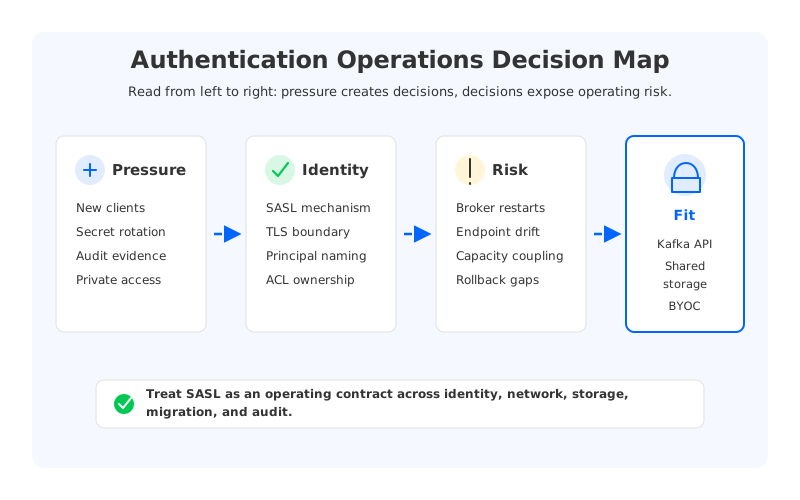
This is why SASL operations should be treated as an operating contract rather than a checkbox. The contract has five parts:
- Identity model: each application, connector, operator, and automation path needs a principal naming convention that maps to ownership.
- Transport boundary: SASL should be paired with a clear decision about TLS, mTLS where relevant, private networking, DNS, and endpoint exposure.
- Authorization boundary: ACLs should map principals to topics, consumer groups, transactional IDs, and administrative operations.
- Rotation procedure: credentials, certificates, and client configuration must be changed in a sequence that avoids a mixed-state outage.
- Evidence trail: failed authentication, principal activity, ACL changes, and administrative access need to be observable enough for incident review and audit.
If those pieces are owned by different teams, the real work is coordination. Kafka itself will enforce the rules you configure; it will not decide whether your organization can safely change them.
2The production constraint behind authentication change
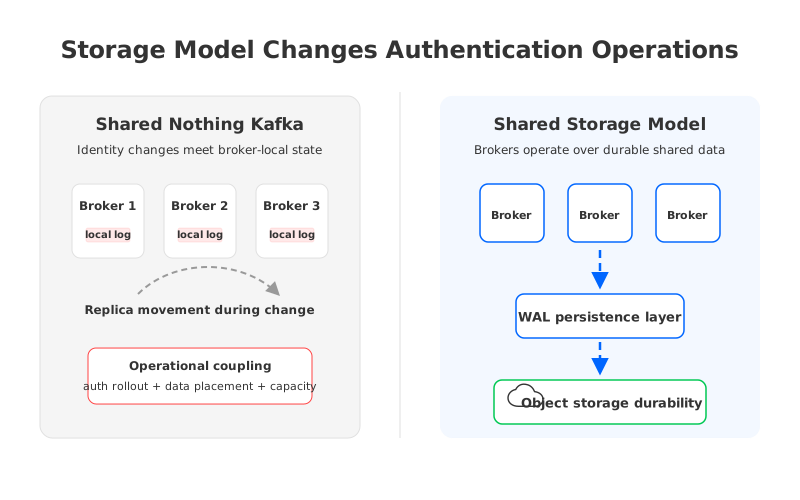
Traditional Kafka architecture couples compute and durable state at the broker. Each broker is responsible for the replicas stored on its local or attached disks, and operational changes often have to respect where data already lives. That is a reasonable design for many deployments, but it affects security operations in a subtle way: the team may want to change identity policy quickly, while the cluster still has to move carefully around broker capacity, replica placement, partition reassignment, and rolling restarts.
Consider a security-driven migration from shared credentials to per-application principals. The application change is straightforward in isolation. The operating plan is not. You need to create principals, apply ACLs, distribute secrets, update clients, watch authentication failures, verify consumer group continuity, and keep the old path alive long enough for rollback. If the same maintenance window also includes broker changes, listener changes, endpoint changes, or capacity expansion, authentication becomes entangled with the cluster's stateful operating model.
This coupling matters most when the platform is already under pressure. A cluster that is close to disk limits is harder to roll. A cluster with hot partitions is harder to rebalance. A cluster with retention-heavy topics is slower to move. A cluster with many private endpoints has more DNS and certificate surface area. None of these issues is caused by SASL, but all of them decide whether SASL policy can be operated confidently.
3Architecture options and trade-offs
Kafka-compatible platforms can preserve the Kafka client contract while changing how much operational responsibility the platform team owns. The first decision is deployment boundary. Self-managed Kafka gives maximum control but also leaves the team responsible for the full security stack, broker lifecycle, storage sizing, network design, and emergency response. Managed Kafka services reduce cluster lifecycle work, but the team still has to validate how authentication, ACLs, private connectivity, audit logs, and client compatibility map to its governance model.
The second decision is storage architecture. Broker-local storage keeps data placement tied to broker operations. Tiered storage can reduce pressure from older data, but the active log still depends on broker-local or attached storage. A shared-storage architecture changes the operating model more deeply: brokers become closer to schedulable compute, while durable log data is stored in a shared object storage layer with a write-ahead log path for low-latency persistence and recovery.
That distinction is not academic. Authentication operations often require controlled change across the fleet. A platform where broker replacement or scale-out requires large data movement will have a different risk envelope from a platform where brokers can change without carrying the full retained log history with them. The SASL mechanism may be identical, but the operational blast radius is different.
Use this comparison when evaluating a Kafka-compatible platform for authentication-heavy environments:
| Evaluation area | What to verify | Why it matters for SASL operations |
|---|---|---|
| Kafka compatibility | Producers, consumers, admin APIs, ACL behavior, transactions, offsets, and tooling | Authentication changes are rarely isolated from client behavior and admin automation. |
| Identity integration | SASL mechanisms, TLS options, principal mapping, secret storage, and rotation workflow | A secure mechanism still fails operationally if teams cannot rotate or audit it. |
| Network boundary | Private endpoints, DNS, firewall rules, cloud account ownership, and support access | Authentication should reduce risk, not compensate for broad network exposure. |
| Storage model | Broker-local state, tiered storage, or shared storage with stateless brokers | Storage coupling affects maintenance windows, scale events, and rollback options. |
| Migration path | ACL export, credential mapping, offset continuity, connector credentials, and validation tests | Security drift during migration is both a reliability risk and a compliance risk. |
| Observability | Failed auth metrics, broker logs, principal activity, ACL changes, and client error visibility | Authentication incidents need fast attribution, not guesswork across teams. |
The table also prevents a common mistake: treating "SASL support" as the decision. Support is table stakes. The decision is whether the platform lets your team operate identity policy as part of normal production change.
4Evaluation checklist for platform teams
A useful SASL readiness review starts with inventory, not configuration. List every workload that connects to Kafka: application producers, consumer groups, Kafka Streams jobs, Flink jobs, Kafka Connect workers, MirrorMaker-style replication, schema registry integrations, admin scripts, CI jobs, dashboards, and emergency tools. Then map each workload to a principal, an owner, a secret source, an ACL scope, and a rotation procedure. Missing ownership is the first production risk.
The second step is to test failure on purpose. Disable a test credential and confirm that the right client fails, the alert identifies the principal, and the application owner can see the error. Rotate a credential in staging and observe whether long-running consumers continue processing. Change an ACL and verify both denial and recovery. A readiness review that only proves successful authentication is incomplete; the more useful evidence is how clearly the system fails.
The third step is to separate identity change from infrastructure change where possible. Combining a SASL migration with a broker upgrade, a listener rename, a DNS cutover, and a storage expansion may look efficient on a project plan, but it makes root-cause analysis painful. If the client cannot connect after the window, the cause could be a credential, truststore, ACL, advertised listener, firewall rule, DNS cache, broker availability issue, or consumer group recovery problem. Smaller changes create better rollback paths.
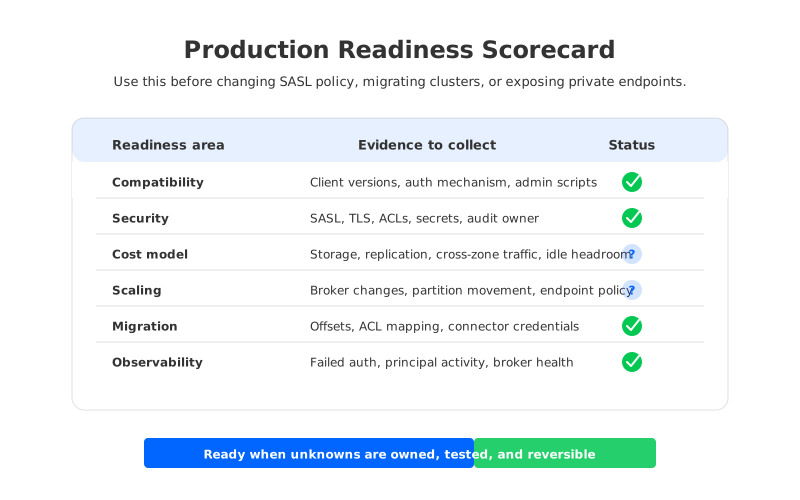
The scorecard should produce a decision, not a document. Green means the team has evidence from tests. Unknown means an owner must be assigned before production change. Red means the migration or policy rollout should be split until the failure mode is understood.
5How AutoMQ changes the operating model
Once the evaluation frame is clear, AutoMQ becomes relevant as an architectural option rather than a generic product pitch. AutoMQ is a Kafka-compatible, cloud-native streaming platform that keeps the Kafka protocol and ecosystem surface while moving the storage layer to a shared-storage architecture backed by object storage. Brokers are designed to be stateless relative to the durable log, with a WAL layer handling efficient persistence before data is committed to object storage.
For SASL authentication operations, the important point is not that AutoMQ has a different login syntax. The point is that authentication changes happen on top of a platform with different state boundaries. When durable data is not permanently tied to broker-local disks, broker replacement, scaling, and partition movement can be planned with less dependence on bulk local log movement. That gives platform teams more room to separate identity policy changes from storage and capacity events.
AutoMQ's BYOC model also matters for governance. In a customer-controlled cloud environment, network boundaries, private access, cloud IAM, object storage, logs, and operational ownership can be mapped to the organization's existing control plane. For security teams, that mapping is often as important as protocol compatibility. They need to know who owns the data path, where durable data resides, how support access is bounded, and how Kafka principals relate to cloud resources.
This does not remove the need for careful validation. A migration still has to test client versions, SASL mechanisms, TLS settings, ACLs, offsets, connectors, observability, and rollback. But it changes the shape of the work. Instead of treating every production change as a negotiation with broker-local storage, the platform team can evaluate compute, storage, identity, and network boundaries more independently.
6A practical rollout pattern
For production teams, the safest SASL rollout is usually staged. Start with a non-critical workload and build the operating evidence before touching the busiest topics. The goal is to prove the whole loop: principal creation, ACL scope, secret distribution, client restart behavior, failure alerting, rotation, and rollback. Once that loop is repeatable, the remaining work becomes portfolio management rather than improvisation.
Use a four-stage pattern:
- Inventory and classify. Group clients by owner, runtime, library version, authentication mechanism, topic scope, and rollback tolerance.
- Build the target identity map. Define principal naming, ACL templates, secret storage, expiration rules, and emergency access.
- Run controlled cutovers. Move workloads in small groups while tracking authentication failures, consumer lag, offset continuity, and application errors.
- Retire the old path. Remove shared credentials, close unused listeners, tighten network access, and capture audit evidence.
The final stage is where many teams hesitate. Leaving old credentials or broad ACLs in place feels safer because rollback is easier. It is usually the opposite. A long-lived exception becomes a second production system with weaker ownership, and the next incident has to reason about both paths.
7When to revisit the platform
If SASL operations are painful only because a few clients are old, fix the clients. If the pain comes from missing ownership, fix the operating model. But if every authentication change becomes tied to broker capacity, partition movement, long maintenance windows, or cloud-network exception handling, the platform architecture is part of the problem.
That is the moment to compare Kafka-compatible options with a broader lens. Ask whether the target platform preserves the Kafka behavior your applications rely on, whether it gives security teams the boundary they need, and whether its storage model makes routine change easier or harder. Authentication is a useful forcing function because it crosses the exact boundaries that matter in production: application identity, network access, storage durability, observability, and operational control.
If your team is reviewing Kafka authentication because security policy is moving faster than your cluster can safely change, evaluate whether a shared-storage Kafka-compatible architecture fits the workload. The AutoMQ architecture documentation and AutoMQ BYOC overview are practical next reads when you want Kafka compatibility, customer-controlled deployment boundaries, and an operating model that separates durable storage from broker-local state. To discuss the fit against your own workload and security boundary, contact AutoMQ.
8References
- Apache Kafka Documentation, Security: SASL, SSL, and Authorization
- Apache Kafka Documentation, Authorization and ACLs
- Apache Kafka Documentation, Encryption and Authentication with SSL
- AWS Documentation, IAM access control for Amazon MSK
- AutoMQ Documentation, Architecture Overview
- AutoMQ Documentation, Technical Advantages Overview
- AutoMQ Documentation, Migration Prerequisites
9FAQ
9.1Is SASL enough to secure a Kafka-compatible platform?
No. SASL authenticates a principal, but production security also needs encrypted transport, authorization, private networking, secret management, observability, and audit ownership. In Kafka environments, SASL is usually one layer in a broader identity and access model.
9.2Which SASL mechanism should a Kafka team choose?
The right mechanism depends on the organization's identity system, client support, operational maturity, and compliance requirements. SCRAM is common because it is broadly supported. OAuth-based patterns can align with centralized identity providers, but they require careful broker and client validation. PLAIN should only be considered when transport encryption and boundary controls are appropriate for the environment.
9.3Why does storage architecture matter for authentication operations?
Authentication policy changes often require rolling client changes, broker-side configuration checks, endpoint validation, and rollback planning. If broker operations are tightly coupled to local durable data, security changes can become entangled with capacity and data movement. Shared-storage architectures reduce that coupling by separating broker compute from durable log storage.
9.4Can a Kafka-compatible migration preserve existing SASL and ACL behavior?
It can, but teams should test rather than assume. Validate client versions, mechanisms, listener names, TLS settings, ACL export and import, principal mapping, connector credentials, offsets, consumer groups, and failure behavior before production cutover.
9.5Where does AutoMQ fit in a SASL operations review?
AutoMQ fits when the review is not only about enabling SASL, but about operating Kafka-compatible identity policy within customer-controlled cloud boundaries. Its shared-storage architecture and stateless broker model are most relevant when broker-local storage movement, scaling windows, and governance boundaries are part of the authentication operations problem.


