
Table of Contents
Table of Contents
Teams usually search for catch up read performance kafka after a bad operational moment. A consumer group fell behind during an upstream burst. A replay job needed to rebuild a materialized view. A recovery drill looked fine until dozens of partitions fetched older offsets at once. The first instinct is to tune consumers or add workers, but catch-up read performance is rarely only a consumer problem. It is where Kafka storage layout, broker capacity, network paths, retention policy, and recovery objectives collide.
That collision matters because catch-up reads are not background noise in production. They show up during incident recovery, backfills, schema repair, feature rebuilds, analytics reprocessing, disaster recovery validation, and migration dry runs. A platform can look healthy during tailing reads and still struggle when older data has to be fetched at scale. The question is not "How fast can one consumer read old data?" It is "Can the platform serve catch-up reads while writes, replication, rebalancing, and recovery continue?"
1Why teams search for catch up read performance kafka
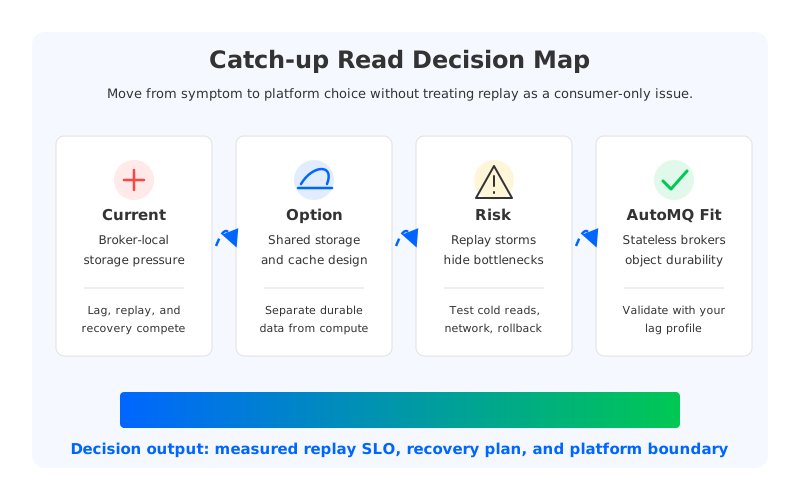
Consumer lag is the visible symptom, but the cause can sit several layers below the consumer group. Apache Kafka stores records in partition logs, and consumers track progress through offsets. When a group falls behind, it asks the broker for older offsets, often across many partitions. If those reads stay near the active log and page cache, the cluster may recover quickly. If they require colder data, congested disks, remote tiers, or overloaded brokers, lag becomes a platform-wide capacity event.
The most common mistake is to benchmark catch-up reads in isolation. A single replay consumer reading from a quiet topic tells you little about the real pressure point. Production catch-up reads often overlap with incoming writes, active consumers, compaction, retention cleanup, leader movement, partition reassignment, and failure recovery. They also tend to arrive in groups: one downstream outage can create lag across multiple applications.
For platform teams, the useful starting point is a workload inventory rather than a tuning list:
- Replay scope. Identify whether catch-up reads are small operational recoveries, full topic replays, or recurring analytical backfills. The storage path and cache plan differ for each pattern.
- Lag tolerance. Define how long a consumer group may remain behind before user-facing systems, batch windows, or compliance jobs are affected.
- Concurrency. Count how many groups can replay the same retained data at once. Fan-out changes broker egress and cache behavior more than a single-consumer test suggests.
- Failure overlap. Decide whether replay must work during broker replacement, Availability Zone disruption, migration, or disaster recovery validation.
- Ownership. Assign who can approve offset resets, replay windows, and duplicate-processing risk. Kafka compatibility does not remove application-level semantics.
That inventory turns catch-up read performance from a vague complaint into an architecture requirement. It also prevents a narrow optimization from hiding a bigger constraint.
2The production constraint behind the problem
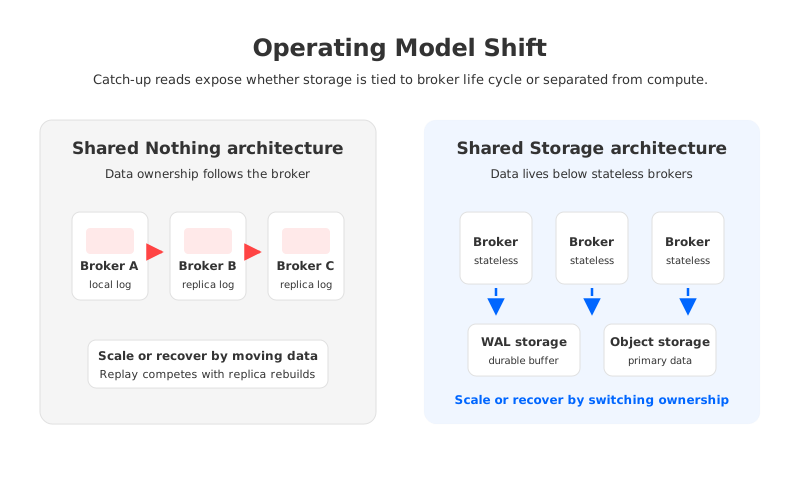
Traditional Kafka follows a Shared Nothing architecture: each broker owns local storage, and partitions are replicated across brokers for durability. This model is proven and familiar. It also means that broker sizing carries several jobs at once. The same broker fleet must absorb writes, serve tailing reads, serve catch-up reads, replicate data, retain local segments, rebuild replicas after failure, and sometimes move partition data during reassignment.
Catch-up reads stress that coupling. If a replay fetches old data from broker-local storage, it consumes disk throughput and network egress on the broker that owns the relevant partition. If the cluster is already recovering from a broker issue, the replay competes with replica fetch traffic. If operators add brokers to create headroom, partition reassignment may move stored data before the added capacity helps. The team can add hardware, but the time between "we added capacity" and "the workload is safer" depends on how much data must be redistributed.
Tiered Storage changes part of that picture by allowing older log segments to live in remote storage. It can reduce pressure from long retention on local disks and can keep historical offsets available through the Kafka API. It does not automatically make the active write path, broker recovery path, or replay path stateless. Teams still need to test how remote fetches behave under replay concurrency, how metadata is managed, and how broker-local hot data interacts with the remote tier.
This is why catch-up read performance belongs in the same review as scaling and recovery. A cluster that can ingest peak traffic may still be poorly shaped for replay. A cluster that stores months of history may still be slow to restore a failed application. A cluster that can add brokers may still need time-consuming data movement before those brokers reduce the bottleneck. The architecture question is whether durable data is bound to broker life cycle or whether compute can scale and recover independently from stored history.
3Architecture options and trade-offs
There are several valid ways to improve catch-up read performance, and each one moves the constraint to a different place. More brokers can add fetch capacity, but they also add operational surface and do not remove the need to place partition data correctly. More local disk throughput can help replay, but it ties cost to retained data and peak recovery plans. Tiered Storage can improve retention economics, but remote-read behavior becomes part of the SLO. A Kafka-compatible shared storage design changes the operating model more deeply, but it must prove compatibility, latency, cache behavior, and governance fit.
The decision should be made with a matrix, not a slogan.
| Option | What it can improve | What still needs validation |
|---|---|---|
| Tune consumers | Fetch batching, parallelism, and application processing rate | Whether brokers and storage can serve the requested offsets |
| Add broker capacity | More aggregate CPU, network, and request handling | Partition placement, data movement time, and cost of reserved headroom |
| Increase local storage performance | Faster reads from broker-local logs | Storage overprovisioning, rebuild behavior, and retained-history cost |
| Use Tiered Storage | Longer retention with less local disk pressure | Remote fetch latency, replay concurrency, metadata, and recovery semantics |
| Evaluate shared storage | Compute elasticity separated from durable log data | Kafka compatibility, WAL design, cache efficiency, network boundary, and migration safety |
The table is intentionally practical. A platform team does not need a philosophical debate about storage architecture; it needs to know what will happen when 50 consumer groups replay retained data during a migration rehearsal. If the answer depends on a broker's local disk, that disk is part of the recovery SLO. If the answer depends on a remote object store, the object store, cache layer, and request pattern are part of the SLO. If the answer depends on offset translation, application idempotency is part of the SLO.
The strongest evaluation uses the same workload slice across options. Pick one high-throughput topic, one topic with long retention, one compacted topic if you use compaction, and one consumer group with downstream state. Run a controlled lag build-up, then measure catch-up time while producers continue writing. Repeat with concurrent replay groups and with one broker removed or replaced. This exposes whether the platform is limited by consumer CPU, broker fetch capacity, storage read throughput, metadata, network egress, or downstream systems.
4Evaluation checklist for platform teams
Catch-up reads become manageable when the team writes down the gates before changing the platform. The checklist should be stricter than a normal performance test because replay often happens when people are already under pressure. A green dashboard is not enough; you need evidence that the system can return to a known position.
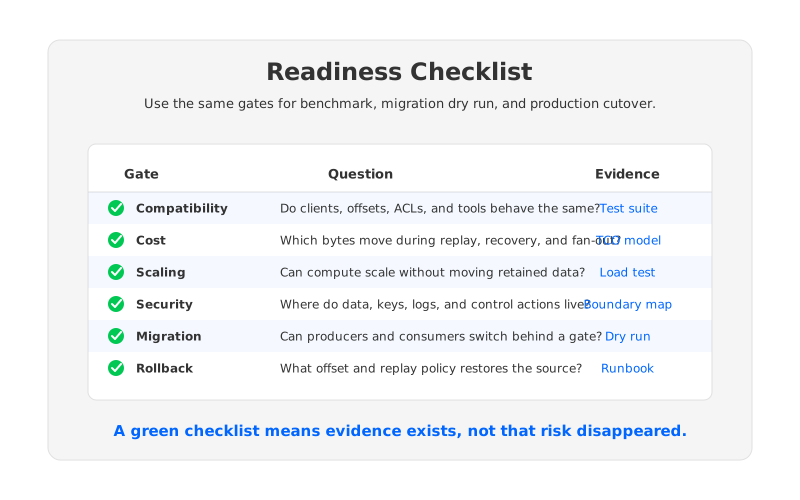
Use these questions as the minimum review:
- Compatibility: Do existing producers, consumers, admin tools, connectors, ACLs, offset commits, and group rebalance behavior continue to work through the same Kafka client contract?
- Cost: Which bytes move during catch-up reads, broker recovery, replica rebuilds, cross-AZ paths, and fan-out? Include storage requests and network transfer, not only broker instance cost.
- Elasticity: Can compute capacity be added for replay without waiting for retained data to move across brokers?
- Governance: Where do business data, object storage, keys, logs, metrics, and control actions live? This matters for regulated workloads and BYOC boundaries.
- Recovery: What is the measured time to restore service after consumer lag, broker loss, bad deployment, or offset reset?
- Migration: Can a pilot prove topic configuration, offset behavior, client authentication, monitoring, and rollback before the main cutover?
- Observability: Can dashboards separate tailing read latency, Catch-up Read throughput, object storage behavior, broker saturation, and downstream processing bottlenecks?
This checklist also keeps teams honest about numbers. If you quote a catch-up time, include topic size, partition count, message size, compression, consumer count, producer load, broker count, storage type, network placement, and the measurement window. Without those conditions, the number should not drive an architecture decision by itself.
5How AutoMQ changes the operating model
Once the evaluation framework is clear, AutoMQ fits into a specific architecture category: a Kafka-compatible streaming platform that uses Shared Storage architecture and stateless brokers. It keeps the Kafka protocol and client ecosystem while moving durable stream data out of broker-local disks and into S3-compatible object storage, with WAL (Write-Ahead Log) storage and Data caching in the S3Stream layer.
That change matters for catch-up reads because the broker is no longer the long-term owner of the data it serves. In a broker-local model, scaling and recovery often require data placement work before capacity is useful. In AutoMQ's Shared Storage architecture, durable data is in shared object storage, and brokers primarily provide compute, protocol handling, caching, and scheduling. A broker can be replaced or added without copying retained partition logs from another broker first. The operational objective shifts from moving data to switching ownership, warming cache, and balancing traffic.
AutoMQ still needs serious validation. Object storage is not a magic disk, and WAL choice, cache behavior, network placement, and workload shape affect results. The difference is that the architecture gives platform teams a different set of levers. Catch-up Read traffic can be evaluated as a storage-and-cache workload rather than as a side effect of broker-local disk ownership. Scaling can focus on compute and read-serving pressure. Recovery can focus on metadata, WAL recovery, and traffic redistribution instead of rebuilding durable log ownership on replacement brokers.
The BYOC angle is also relevant for governance. In AutoMQ BYOC, the data plane runs in the customer's cloud environment, so teams can align object storage, networking, IAM, encryption, logs, and monitoring with their own cloud controls. That does not make compliance automatic. It does make the deployment boundary explicit, which is useful when catch-up reads involve retained customer data, audit history, or regulated replay windows.
For migration, the safest plan treats AutoMQ like any serious Kafka-compatible target: prove the client contract, measure replay with retained data, validate offset behavior, rehearse rollback, and compare the total operating model. AutoMQ's Kafka Linking can be part of a migration path when teams need byte-level message synchronization and offset consistency, but the decision should still be based on a dry run with representative topics and consumers.
6A practical scorecard
Before you approve a platform change for catch-up read performance, score each area from 0 to 2. A score of 0 means there is no evidence. A score of 1 means there is a design answer but no production-like test. A score of 2 means the team has measured evidence and an owner.
| Area | 0 | 1 | 2 |
|---|---|---|---|
| Replay SLO | No target | Target exists | Target measured under load |
| Consumer behavior | Unknown | Client configs reviewed | Lag, commits, and restarts tested |
| Storage path | Assumed | Architecture documented | Hot and historical reads measured |
| Scaling | Manual guess | Capacity model exists | Scale event tested during replay |
| Recovery | Incident-driven | Runbook drafted | Failure drill completed |
| Migration | Endpoint switch only | Pilot planned | Cutover and rollback rehearsed |
| Governance | Not reviewed | Boundary mapped | IAM, encryption, logs, and audit checked |
The score matters more than the platform name. If a traditional Kafka deployment scores well and the catch-up SLO is met at reasonable cost, keep it boring. If the score keeps failing on storage growth, replay concurrency, broker rebuilds, or data movement during scaling, then the architecture is telling you something. Tuning can improve the edge of the problem, but a storage ownership constraint often needs an operating-model change.
The search that started with catch up read performance kafka should end with a runbook, not a bigger consumer. Define the replay scenarios, measure the storage path, test recovery overlap, and decide whether broker-local storage is still the right boundary for your workload. If you want to evaluate AutoMQ against that checklist, start with the open source project or discuss a BYOC workload review through the AutoMQ team.
7FAQ
7.1What is catch-up read performance in Kafka?
Catch-up read performance is the speed and stability of reading older offsets when a consumer group has fallen behind or a replay job needs retained data. It depends on consumers, brokers, storage, network paths, and downstream processing.
7.2Is catch-up read performance the same as consumer lag?
No. Consumer lag is the observed backlog. Catch-up read performance is the platform's ability to reduce that backlog while normal writes, reads, recovery, and operational tasks continue.
7.3Does Tiered Storage solve catch-up reads?
Tiered Storage can help with long retention and historical availability, but teams still need to validate remote fetch latency, replay concurrency, metadata behavior, and how active broker workloads interact with remote reads.
7.4Why does shared storage help scaling and recovery?
Shared storage separates durable data from broker-local life cycle. When brokers are stateless, adding or replacing compute does not require moving retained partition logs in the same way a broker-local architecture does.
7.5How should teams benchmark catch-up reads?
Use representative topics, keep producers running, create controlled lag, run multiple replay consumers, and include failure or scale events. Record partition count, message size, compression, broker count, storage type, network placement, and measurement duration.
8References
- Apache Kafka, Consumer configuration
- Apache Kafka, Operations: Tiered Storage
- Apache Kafka, KRaft configuration
- AutoMQ Docs, Compatibility with Apache Kafka
- AutoMQ Docs, Architecture overview
- AutoMQ Docs, WAL storage
- AutoMQ Docs, Migration overview


