
Table of Contents
Table of Contents
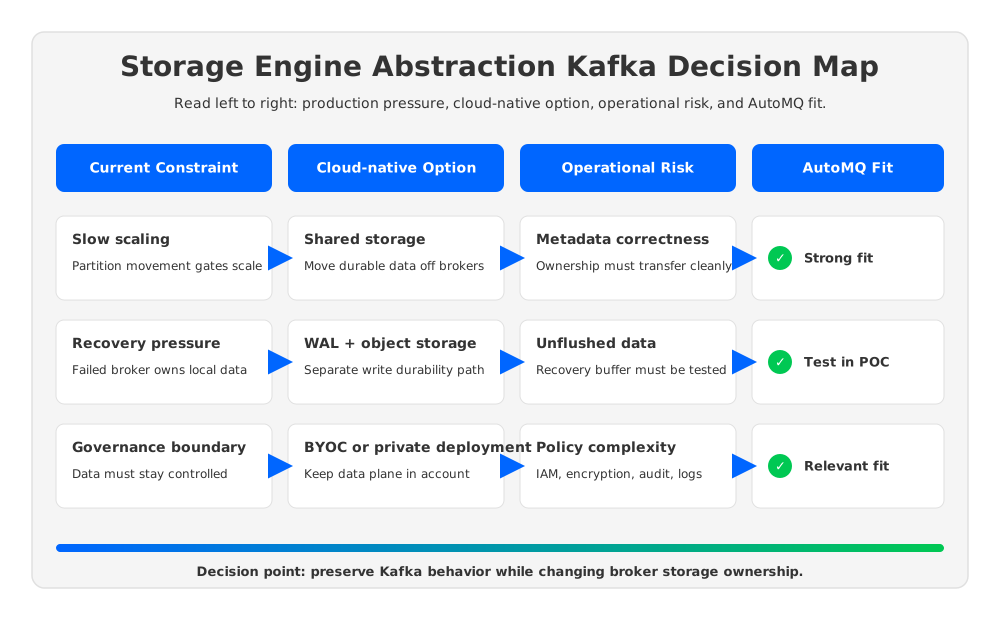
Teams usually search for storage engine abstraction kafka after a practical constraint becomes hard to ignore. The Apache Kafka API still works. Producers, consumers, offsets, Consumer groups, Kafka Connect jobs, and dashboards may look familiar. The pressure appears elsewhere: scaling takes too long, recovery depends on broker-local data movement, retained data keeps growing, and every capacity change feels like a storage migration disguised as a cluster operation.
That is the real question behind storage-engine abstraction in Kafka: can a platform team keep Kafka semantics while changing the part of the architecture that binds durable data to individual brokers? Once the storage engine becomes an abstraction boundary, scaling and recovery stop being only broker-count questions. They become questions about compatibility, data ownership, failure domains, cost, governance, and migration risk.
1Why teams search for storage engine abstraction kafka
Kafka is attractive because its contract is concrete. A Producer writes records to a Topic, a Partition gives ordering, an Offset gives position, and a Consumer group shares work across members. Transactional producers, idempotent writes, committed offsets, client compatibility, and Kafka Connect integrations are operating assumptions for applications, stream processors, CDC pipelines, data lake ingestion, and real-time analytics systems.
Many production problems do not start at the API surface. They start when the storage system underneath the API has to change shape. A retention policy grows from days to weeks. A hot Topic needs more headroom. A broker must be replaced during an incident. A region or Availability Zone design changes because the network bill or resilience plan changed. Application teams still ask for the same Kafka behavior, while the platform team touches storage, replication, networking, and placement at the same time.
That is why "storage engine abstraction" is a useful phrase. It names the boundary Kafka operators often want during scaling and recovery. A good abstraction does not make storage disappear. It makes storage responsibilities testable: where durable data lives, how writes are acknowledged, how reads catch up, how metadata moves, and what must happen before a failed broker can be replaced.
2The production constraint behind the problem
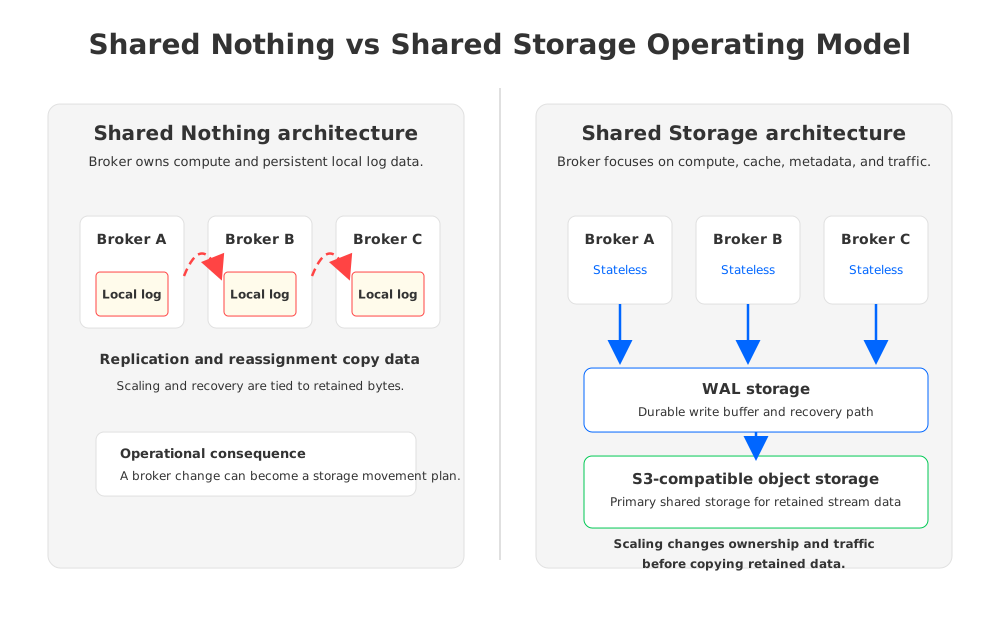
Traditional Kafka uses a Shared Nothing architecture. Each broker owns local log data for the partitions it hosts, and durability is achieved through replication between brokers. This design made sense when local disks were close to compute, broker-level replication gave fault tolerance, and horizontal scaling meant adding machines that each carried their own data.
In cloud environments, the same design turns storage ownership into an operational constraint. When a partition moves, its data often has to move. When a broker is drained, retained bytes and active replicas influence elapsed time. When the cluster spans multiple Availability Zones, replication traffic crosses network boundaries. When retention grows, local disk capacity planning affects compute sizing even if the workload mainly needs storage.
The result is a familiar capacity trap. The broker is no longer only a Kafka process; it is a compute node, storage owner, replica participant, network endpoint, and recovery unit. These responsibilities are tightly coupled:
- Scaling out adds compute, but the cluster still needs partition movement and traffic rebalancing before added capacity becomes useful.
- Scaling in removes compute, but it also forces the team to prove that partition ownership, retained data, and replicas can move safely.
- Recovery replaces a failed process, but the actual recovery plan depends on what data was local, what was replicated, and what metadata still points to the failed broker.
- Cost optimization reduces one resource, but it can increase replication traffic, storage pressure, or maintenance risk somewhere else.
Tiered Storage changes part of this equation by moving older log segments to remote storage. That can be valuable for long retention. The important distinction is that Tiered Storage is not the same as making brokers stateless. The active log path, broker ownership model, and recovery workflow can still depend on broker-local responsibilities. Storage-engine abstraction asks whether durable stream storage itself can move behind a different boundary.
3Architecture options and trade-offs
The decision is not "traditional Kafka is bad, shared storage is good." A platform team should compare architecture options by the work they create during failure, growth, and migration. The right answer depends on latency, retention, cloud topology, compliance boundaries, team skills, and how much change the application estate can tolerate.
| Architecture option | What changes | Scaling behavior | Recovery behavior | Main validation work |
|---|---|---|---|---|
| Traditional Shared Nothing architecture | Brokers own local logs and replicate to other brokers | Capacity changes require broker, partition, and storage planning | Broker recovery depends on replica state and local data ownership | Reassignment time, replica health, disk headroom, cross-AZ traffic |
| Kafka with Tiered Storage | Older log segments can move to remote storage | Long retention pressure can decrease, but active broker duties remain | Recovery can still depend on local active data and broker ownership | Remote-read behavior, active-segment sizing, client latency under catch-up reads |
| Kafka-compatible Shared Storage architecture | Durable storage moves behind a shared storage layer | Brokers can focus more on compute, metadata, cache, and traffic | Broker replacement can rely more on shared durable data and ownership transfer | Compatibility, WAL behavior, object storage performance, metadata correctness |
| Fully managed Kafka service | Provider operates more of the platform | Scaling model depends on provider limits and pricing model | Provider controls much of the recovery workflow | Data boundary, feature support, network path, exit plan |
This table is useful because it separates two decisions that are often mixed together. One decision is whether applications keep the Kafka protocol and semantics. The other is whether brokers must continue to own durable storage locally. A team can want Kafka compatibility and still want a different storage model underneath.
The hardest trade-off is latency versus elasticity. Object storage gives durability and capacity, but object storage APIs are not designed to behave like a local append log for every Partition. Any serious shared-storage Kafka design therefore needs a write path that absorbs object storage latency, reduces API call pressure, and provides a recovery buffer for data not yet in the primary object store. This is where a WAL (Write-Ahead Log), cache design, and metadata model matter.
The second trade-off is governance. Shared storage can simplify broker replacement, but it also concentrates more responsibility in storage configuration, access control, encryption, bucket policy, object lifecycle, observability, and regional placement. That is not a reason to reject the model. It is a reason to evaluate it like infrastructure, not like a feature checkbox.
4Evaluation checklist for platform teams
Storage-engine abstraction should be tested through the workflows that normally create production risk. A proof of concept that only sends records for 10 minutes is not enough. The evaluation has to exercise client behavior, retained data, failover, catch-up reads, operational tooling, and migration rollback.
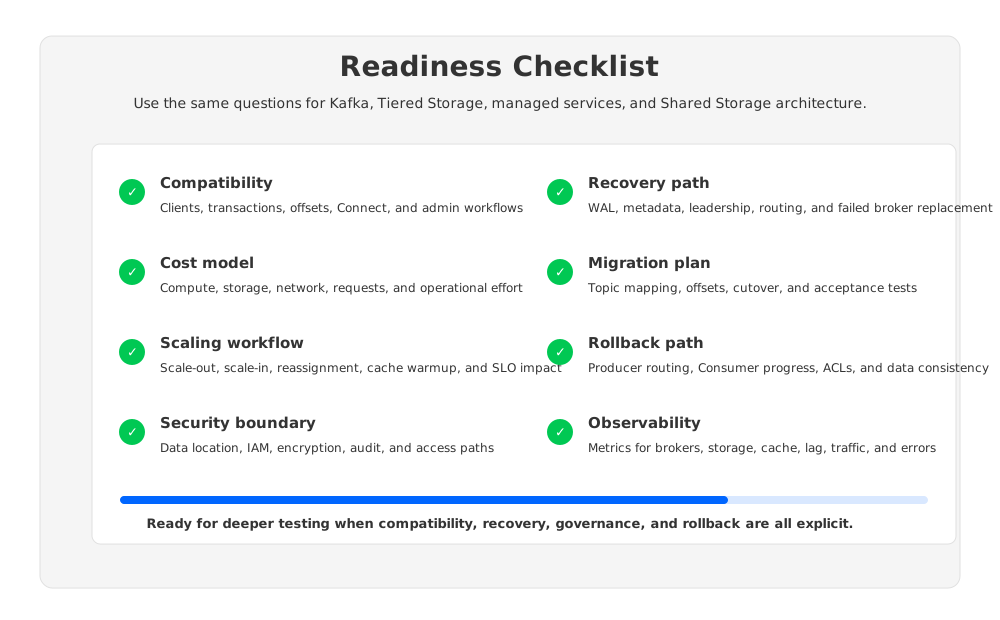
Use this checklist as a readiness scorecard before choosing a Kafka-compatible streaming platform:
- Compatibility surface. Validate the exact Producer, Consumer, AdminClient, Kafka Connect, serialization, transactions, idempotence, Consumer group, and offset workflows your applications use. Compatibility is a behavior set, not a badge.
- Write durability path. Identify when a write is acknowledged, where the WAL lives, how unflushed data is recovered, and what happens if a broker fails during upload to shared storage.
- Read path under lag. Test tailing reads and catch-up reads separately. Many systems look healthy when consumers are current and behave differently when a large Consumer group resumes from older offsets.
- Scaling workflow. Measure what changes during scale-out and scale-in: broker count, partition leadership, metadata ownership, data movement, cache warmup, client reconnection, and SLO impact.
- Network and Availability Zone model. Trace Producer, replication, Consumer, storage, and management traffic. Cross-AZ traffic can be a hidden cost and a hidden failure path.
- Governance boundary. Confirm where data, metadata, credentials, logs, metrics, and control operations live. This is especially important for BYOC, private cloud, and regulated workloads.
- Migration and rollback. Require a plan for topic mapping, offset continuity, producer cutover, consumer progress, ACLs, observability, and rollback if the target platform fails acceptance testing.
The checklist also prevents a common mistake: treating storage abstraction as only a cost project. Cost matters, but a lower storage bill does not help if recovery gets harder or application semantics change. The better question is whether the changed storage boundary reduces operational work while preserving Kafka behavior.
5How AutoMQ changes the operating model
After that neutral evaluation, AutoMQ becomes relevant because it targets the storage boundary directly. AutoMQ is a Kafka-compatible, cloud-native streaming platform that keeps Kafka protocol and ecosystem compatibility while replacing broker-local log storage with S3Stream, WAL storage, S3 storage, data caching, and stateless brokers. The goal is to change what brokers own underneath the Kafka API.
In AutoMQ's Shared Storage architecture, durable stream data is stored through shared object storage, while WAL storage handles low-latency durable writes and recovery for data not yet uploaded to S3 storage. AutoMQ documentation describes S3Stream as a stream storage library with append, fetch, trim, and position-management APIs. That detail matters because the storage abstraction is not a remote archive bolted onto Kafka. It is the layer that replaces the local log storage responsibility.
This changes scaling. In a Shared Nothing architecture, adding a broker is only the beginning; partition and data movement determine when the broker actually helps. With stateless brokers, the scaling problem shifts toward metadata, ownership, cache, and traffic distribution. AutoMQ documents capabilities such as seconds-level partition reassignment and Self-Balancing because the durable data is not anchored to the broker-local disk in the same way.
It also changes recovery. A failed broker does not have to be treated as the long-term owner of irreplaceable local log data. Recovery can focus on WAL recovery, metadata correctness, leadership, and routing clients to healthy brokers. That does not remove the need for operational discipline. It changes the discipline from "how do we move all this local data safely?" to "how do we verify the shared storage path, WAL path, metadata path, and client path under failure?"
For cloud teams, the deployment boundary carries the same weight as the storage design. AutoMQ BYOC runs control plane and data plane components in the customer's cloud environment, while AutoMQ Software targets private data centers. That matters for teams evaluating governance because storage-engine abstraction should not force business data through a vendor-hosted data plane. The architecture has to fit the organization's cloud account, network, identity, audit, and compliance model.
AutoMQ should be evaluated where the current bottleneck is broker-local storage ownership: slow reassignment, difficult broker replacement, retained-data growth, cross-AZ traffic exposure, or capacity planning that couples compute and storage too tightly. It is less relevant if the main issue is poor Topic design, inefficient consumers, under-tested client retries, or missing observability. Architecture helps when architecture is the constraint.
6Decision matrix: when the abstraction is worth testing
The strongest signal is not a single metric. It is a repeated pattern where storage ownership blocks otherwise reasonable operations. If the platform team keeps delaying scaling, retention, or recovery work because the data movement is too risky, storage-engine abstraction deserves a serious test.
| Production question | If the answer is yes | What to test next |
|---|---|---|
| Does scaling require long partition or replica movement windows? | Broker-local storage is shaping elasticity. | Compare reassignment and recovery workflows under equivalent retained data. |
| Does retention growth force compute overprovisioning? | Storage and compute are coupled. | Model retained bytes separately from CPU, memory, and network demand. |
| Do catch-up reads disturb hot traffic? | Read isolation and cache behavior matter. | Test tailing reads and Consumer lag recovery at the same time. |
| Does cross-AZ traffic dominate the architecture discussion? | Network topology is part of the storage design. | Trace Producer, Consumer, replication, and storage paths by Availability Zone. |
| Is migration risk mostly about offsets and cutover? | Compatibility alone is not enough. | Validate offset continuity, Consumer group progress, Producer routing, and rollback. |
The conclusion should be a readiness decision, not a slogan. Keep traditional Kafka if the workload is stable, the team is comfortable with broker-local operations, and the cost profile is acceptable. Use Tiered Storage when long retention is the dominant issue and active broker responsibilities remain manageable. Evaluate a Kafka-compatible Shared Storage architecture when scaling and recovery are repeatedly constrained by local data ownership.
7FAQ
7.1Is storage-engine abstraction the same as Tiered Storage?
No. Tiered Storage can offload older log segments to remote storage, which helps with retention-heavy workloads. Storage-engine abstraction is a broader architectural question: whether durable stream storage can move behind a shared storage layer so brokers are less tied to local persistent data.
7.2Does a shared storage model remove the need to test Kafka compatibility?
No. Kafka compatibility still has to be validated through the exact workflows your applications use: producers, consumers, transactions, offsets, Consumer groups, Kafka Connect, admin operations, and failure handling. The storage model changes the operating layer, not the need to verify client behavior.
7.3What is the main recovery question for a storage-abstracted Kafka platform?
Ask what must be recovered after a broker fails. In a broker-local model, local data and replicas dominate the plan. In a shared storage model, the plan should focus on WAL recovery, metadata correctness, leadership transfer, cache behavior, and client routing.
7.4When should AutoMQ be part of the evaluation?
Evaluate AutoMQ when your team wants Kafka compatibility but needs a different storage and scaling model. It is most relevant for workloads constrained by broker-local storage, slow reassignment, retained-data growth, cross-AZ traffic exposure, or cloud governance requirements that favor BYOC or private deployment boundaries.
If your next Kafka review is really a storage ownership review, test the storage model directly. Run the workload through scale-out, broker replacement, Consumer lag recovery, and rollback. AutoMQ Open Source and commercial editions can be explored from the AutoMQ GitHub project when a Kafka-compatible Shared Storage architecture belongs on the shortlist.


