
Table of Contents
Table of Contents
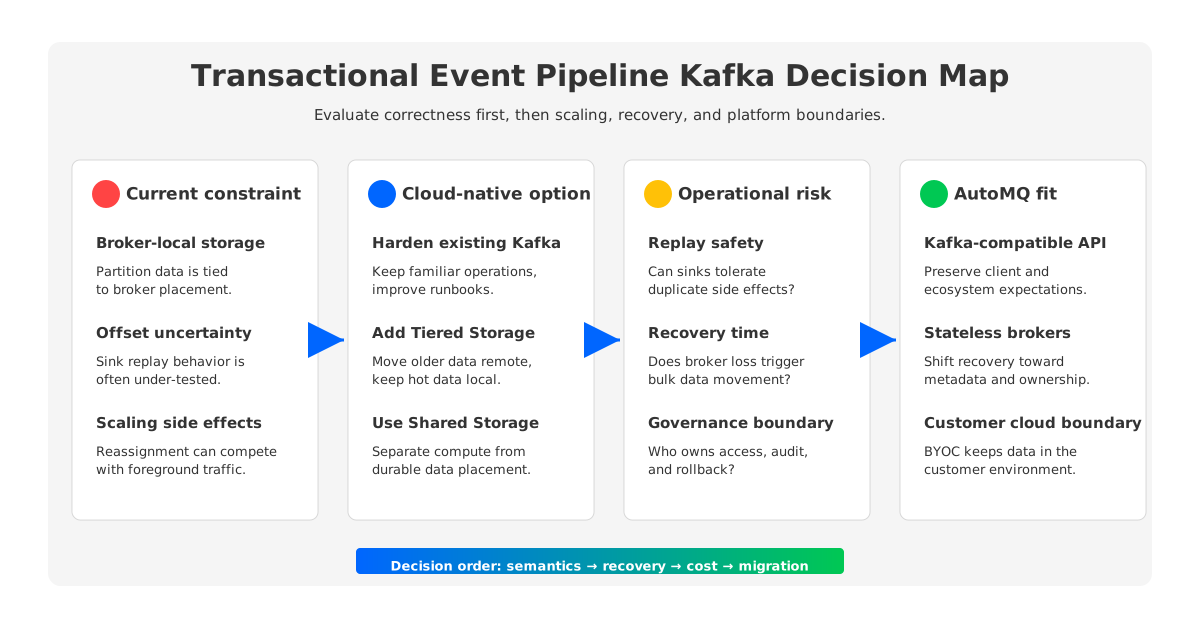
Teams searching for transactional event pipeline kafka are rarely asking whether Kafka can move events from one service to another. They are usually staring at a harder production question: can the pipeline preserve business correctness while brokers scale, consumers lag, connectors replay, and a failed node returns without turning yesterday's offsets into today's incident? The phrase sounds narrow, but the decision is broad. It touches producer transactions, consumer group behavior, offset ownership, schema evolution, cloud networking, migration paths, and the recovery model underneath the broker.
Transactional pipelines often fail at the edges, not in the happy-path write. A payment authorization event can be produced atomically, yet the downstream ledger connector may restart with an old offset. A change-data-capture stream can preserve order in a partition, yet recovery can still take long enough for the consumer group to rebalance multiple times. Extra brokers may trigger data movement that competes with the workload they were meant to protect. The architecture question is therefore not "Does Kafka support transactions?" It is "What happens when the platform is under pressure?"
1Why Teams Search for Transactional Event Pipeline Kafka
Transactional event pipelines sit between systems that do not all share the same transaction boundary. The source may be a database, a service may produce multiple records in one Kafka transaction, and the sink may be a warehouse, lakehouse table, search index, or another operational system. Kafka gives teams useful building blocks: idempotent producers, transactional producers, offsets, consumer groups, and Kafka Connect. Those pieces are powerful, but they do not remove platform-level design.
The design work starts by separating application semantics from infrastructure recovery. Application teams usually care about whether an order, payment, shipment, or account update is processed once in the business sense. Platform teams must translate that expectation into lower-level questions:
- Which writes need atomicity across partitions, and which writes only need idempotence?
- Where are offsets committed, and can the sink's side effect be coordinated with those offsets?
- How much replay is acceptable after a connector, consumer, or broker failure?
- What happens when a broker scale-out, broker replacement, or partition reassignment overlaps with peak traffic?
- Which team owns schema compatibility, ACLs, client configuration, observability, and rollback?
That list is the boundary between a pipeline that survives routine platform events and one that turns normal operations into data repair work.
2The Production Constraint Behind the Problem
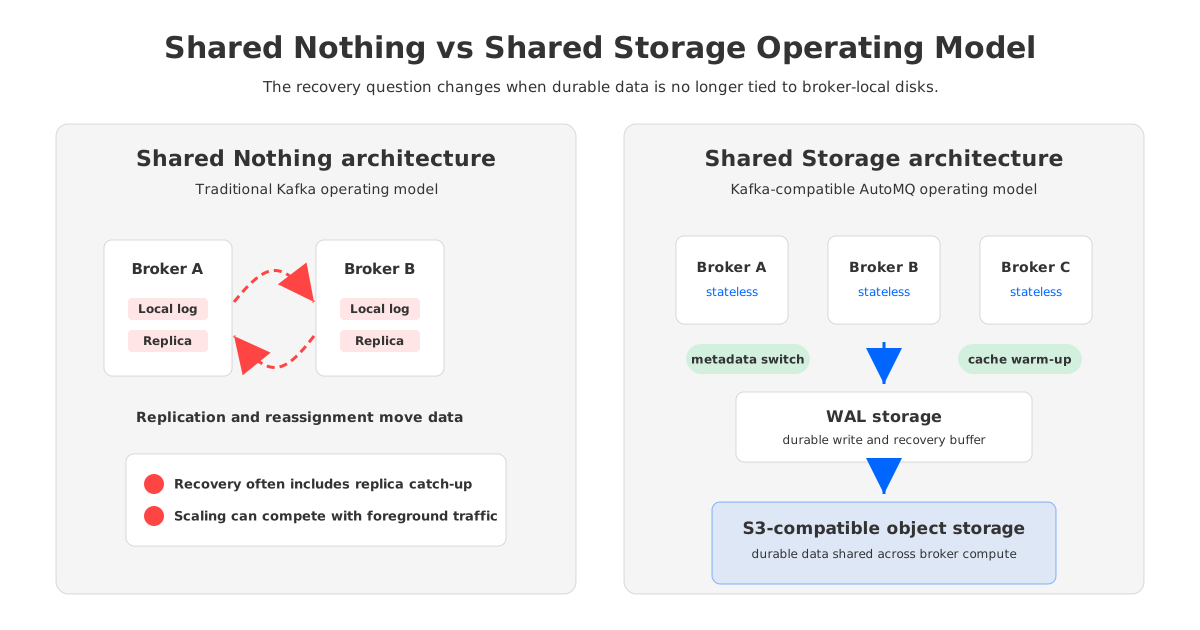
Traditional Kafka runs on a Shared Nothing architecture. Each broker owns local log segments for the partitions it hosts, and durability is achieved through replication among brokers. This model is clear and battle-tested. It also makes broker-local storage a central operational constraint. When a broker is added, removed, replaced, or rebalanced, partitions and replicas are tied to data placement. The operational action is not only a metadata change; it can become a storage movement event.
That matters for transactional pipelines because recovery time is part of correctness. If a platform can restore broker capacity quickly but needs a long window to move partition data, the application sees a mixed signal. The cluster is "up," but the pipeline is still constrained by catch-up reads, reassignment traffic, and consumer group churn. If a sink connector has to replay a range of offsets during the same window, the team must know whether the sink is idempotent, whether offsets are committed after side effects, and whether the connector can be paused without losing ordering assumptions.
Cloud infrastructure adds another layer. Multi-AZ deployment is the right default for production reliability, but broker-to-broker replication can create cross-AZ data transfer that scales with write throughput and replication factor. Storage capacity is also commonly provisioned ahead of demand because local disks or block volumes are attached to brokers. A transactional pipeline that has modest average throughput but sharp bursts may therefore pay for idle storage and still face slow recovery when the cluster shape changes.
The constraint is not that traditional Kafka is broken. The constraint is that its storage model couples three things that platform teams often want to manage separately: compute capacity, durable data placement, and recovery workflow. Once those are coupled, a scaling decision can become a recovery decision, and a recovery decision can become a cost decision.
3Architecture Options and Trade-offs
The first option is to keep a conventional Kafka architecture and harden the operating model around it. This is a reasonable path when the team already has mature Kafka operations, stable throughput, predictable retention, and clear ownership of connector recovery. It favors operational familiarity over architectural change. The trade-off is that capacity planning, partition reassignment, local disk utilization, and replica movement remain part of the team's regular work.
The second option is to add Tiered Storage. Apache Kafka Tiered Storage moves older log data to remote storage while recent data remains on local broker storage. This can help with longer retention and reduce pressure on local disks for historical data. It does not make brokers stateless, and it does not remove the need for local storage in the hot path. For transactional pipelines, that distinction is important. Tiered Storage may improve retention economics, but broker replacement and hot data recovery still need careful planning.
The third option is to evaluate a Kafka-compatible platform built around Shared Storage architecture. In that model, the broker handles protocol, leadership, routing, and caching, while durable data is stored in shared object storage through a streaming storage layer. The goal is not to change Kafka semantics for applications. The goal is to change what the platform has to do when compute capacity changes or a broker fails.
| Evaluation area | Shared Nothing architecture | Tiered Storage | Shared Storage architecture |
|---|---|---|---|
| Broker state | Broker-local logs remain central | Hot data remains local | Brokers can be stateless for persistent data |
| Scaling action | Often includes partition and replica movement | Still depends on local hot data | Primarily compute and ownership changes |
| Recovery pressure | Broker replacement can trigger data catch-up | Historical data is remote, hot path remains local | Durable data is already in shared storage |
| Cost surface | Compute, local storage, replication traffic | Local storage plus remote storage | Compute, object storage, WAL storage, and cache |
| Migration risk | Lowest architectural change | Moderate operational change | Requires platform evaluation and migration design |
This table is not a universal ranking. A team with simple retention and tuned operations may not need an architectural shift. A team running bursty transactional workloads across multiple Availability Zones may care more about whether broker replacement is a metadata-level operation than whether the hot log lives on a local disk. The right answer depends on where incidents and costs actually come from.
4Evaluation Checklist for Platform Teams
A useful checklist starts with failure modes, not features. If the platform team cannot explain recovery behavior, application teams will fill the gap with retries, duplicate checks, and manual reconciliation. Those safeguards help, but they become expensive when every service has to rediscover the same platform boundary.
For a transactional event pipeline Kafka evaluation, ask the questions in this order:
- Compatibility: Can existing Kafka clients, transactional producers, consumer groups, Kafka Connect workers, ACLs, and monitoring tools keep their expected behavior? Check protocol compatibility, client versions, authentication methods, and admin tooling before comparing cost.
- Write semantics: Which producers use transactions, which use idempotence, and which are at-least-once by design? A platform migration should not blur those categories.
- Offset and sink recovery: Can each sink tolerate replay? If not, where is idempotence enforced: in the sink, in the connector, or in an application-level transaction table?
- Scaling window: How does the platform add capacity during a traffic spike? Measure whether scaling competes with foreground traffic through data movement, cache misses, or partition reassignment.
- Failure recovery: What is the expected path for broker loss, slow broker isolation, object storage degradation, connector restart, and consumer group rebalance?
- Cost boundary: Which costs scale with retained bytes, produced bytes, cross-AZ traffic, API calls, and idle capacity? Avoid a single blended number until the workload profile is clear.
- Migration and rollback: Can the team mirror data, preserve offsets, test cutover, and roll back without asking application owners to rewrite clients?
The order matters. Compatibility and recovery come before cost because transactional pipelines are not valuable when correctness is uncertain. Cost should be measured after the team knows which architecture can preserve the pipeline's operating assumptions.
5How AutoMQ Changes the Operating Model
Once the evaluation reaches the storage and recovery layer, AutoMQ becomes relevant as a Kafka-compatible streaming platform built on Shared Storage architecture. AutoMQ keeps Kafka protocol and API compatibility while moving persistent log storage away from broker-local disks. AutoMQ Brokers handle Kafka compute responsibilities, while S3Stream writes data through WAL (Write-Ahead Log) storage and S3-compatible object storage.
That architectural change affects the operational model in a specific way: broker capacity is no longer the same thing as durable data placement. When brokers are stateless for persistent data, scale-out can focus on compute, and recovery can focus on leadership, metadata, cache warm-up, and WAL recovery rather than copying full partition replicas. This is why Shared Storage architecture matters for transactional pipelines. It narrows the recovery surface at the layer application teams control least.
WAL storage is still an important design point. AutoMQ Open Source uses S3 WAL, which keeps deployment simple and uses S3-compatible object storage as both WAL and main storage. AutoMQ commercial editions, including AutoMQ BYOC and AutoMQ Software, support additional WAL storage options such as Regional EBS WAL and NFS WAL. Platform teams should choose based on latency, durability, deployment boundary, and cloud environment. The useful question is: "Which WAL storage option matches this pipeline's recovery and latency envelope?"
The other change is cost visibility. Traditional Kafka replication can turn multi-AZ durability into broker-to-broker transfer. AutoMQ's object-storage-backed model is designed to reduce cross-AZ data movement by putting durable data in shared storage and routing traffic with AZ awareness. That does not make every cost disappear. Teams still need to account for compute, object storage, WAL storage, requests, observability, and support. The difference is that scaling and recovery no longer have to be dominated by bulk partition data movement.
Deployment boundaries also matter for transactional workloads. In AutoMQ BYOC, the control plane and data plane run in the customer's cloud account and VPC, so business data remains inside the customer's environment. For regulated pipelines, that boundary can be as important as the storage architecture. A platform that changes the broker recovery model but forces data outside the required trust boundary may not pass security review.
6A Practical Readiness Scorecard
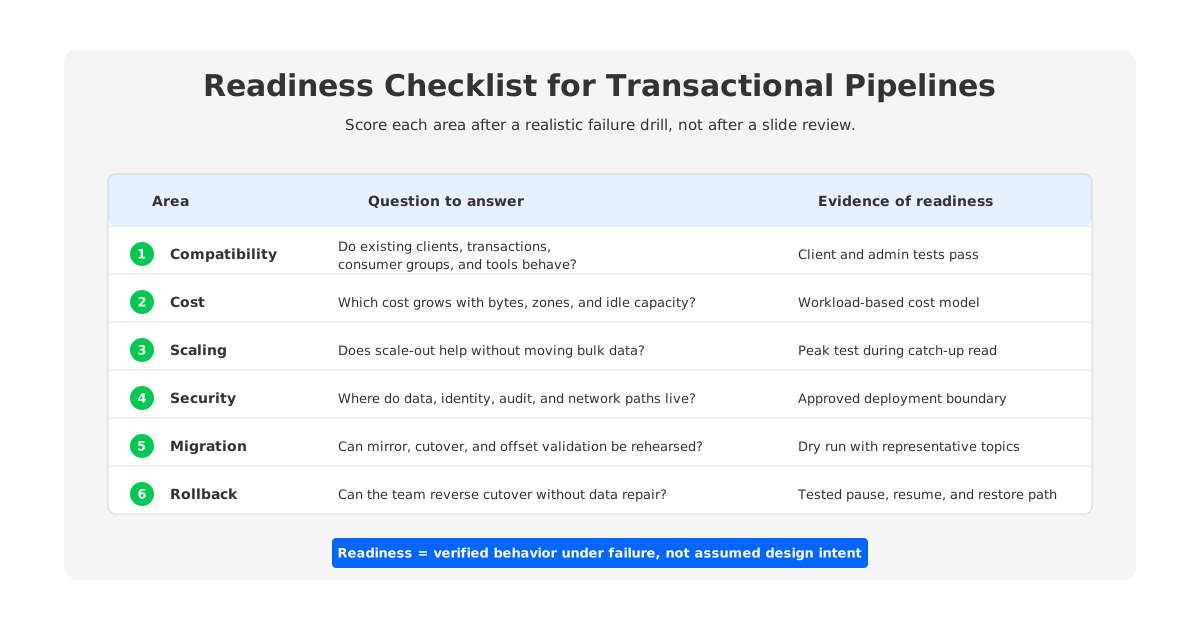
Before changing a production pipeline, give each category a score from 1 to 5. A score of 1 means "unknown or untested"; a score of 5 means "verified under a realistic failure drill." The exercise is useful because it exposes vague confidence. Many teams discover that they trust Kafka transactions but have never tested connector replay, or that they know broker recovery but have no rollback path for a partial migration.
| Category | What a 5 looks like | What to test |
|---|---|---|
| Client compatibility | Existing clients run without code changes | Producer transactions, consumer groups, admin tools |
| Sink idempotence | Replay does not corrupt downstream state | Connector restart and offset reset |
| Broker recovery | Node loss has a documented recovery path | Broker termination during peak write |
| Scaling behavior | Added capacity helps foreground traffic | Scale-out while consumers are catching up |
| Governance | Access, encryption, and audit boundaries are clear | ACLs, identity, network path, data location |
| Migration rollback | Cutover can be reversed without data repair | Mirror, offset sync, pause, resume, rollback |
The scorecard should be owned jointly by platform and application teams. Platform engineers can validate broker behavior, metrics, and scaling. Application owners can validate business idempotence and sink semantics. Security teams can validate identity and deployment boundaries. The pipeline is transactional only when those boundaries line up.
7FAQ
7.1Is Kafka transaction support enough for a transactional event pipeline?
No. Kafka transactions help with atomic writes across partitions and offset commits in supported workflows, but the full pipeline also depends on sink behavior, connector restart handling, consumer group rebalances, schema compatibility, and recovery procedures.
7.2Does Tiered Storage make brokers stateless?
No. Tiered Storage moves older data to remote storage while keeping recent data on broker-local storage. It can help retention, but it is not the same operating model as Shared Storage architecture with stateless brokers.
7.3When should a team consider Shared Storage architecture?
Consider it when broker replacement, partition reassignment, cross-AZ transfer, burst scaling, or long retention creates recurring operational pressure. The stronger the coupling between data movement and routine operations, the more valuable it is to evaluate a storage model that separates compute from durable data.
7.4How should teams test migration risk?
Start with a non-production mirror of representative topics, then test producer compatibility, consumer group behavior, connector replay, offset preservation, rollback, and observability. A migration plan is incomplete until rollback has been tested, not only described.
8Closing Thought
The search for transactional event pipeline kafka starts with correctness, but it usually ends at the platform boundary. Transactions, offsets, and connectors define what the application wants. Scaling, recovery, storage placement, and deployment boundaries decide whether that intent survives real operations. If your team is evaluating a Kafka-compatible architecture for this workload, test AutoMQ against your own failure drills and migration path with the AutoMQ BYOC trial.
9References
- Apache Kafka documentation
- Apache Kafka design: message delivery semantics and transactions
- Apache Kafka operations: KRaft
- Apache Kafka operations: Tiered Storage
- Apache Kafka Connect
- AutoMQ compatibility with Apache Kafka
- AutoMQ Shared Storage architecture
- AutoMQ S3Stream shared streaming storage
- AutoMQ WAL storage
- AutoMQ migration overview


