
Table of Contents
Table of Contents
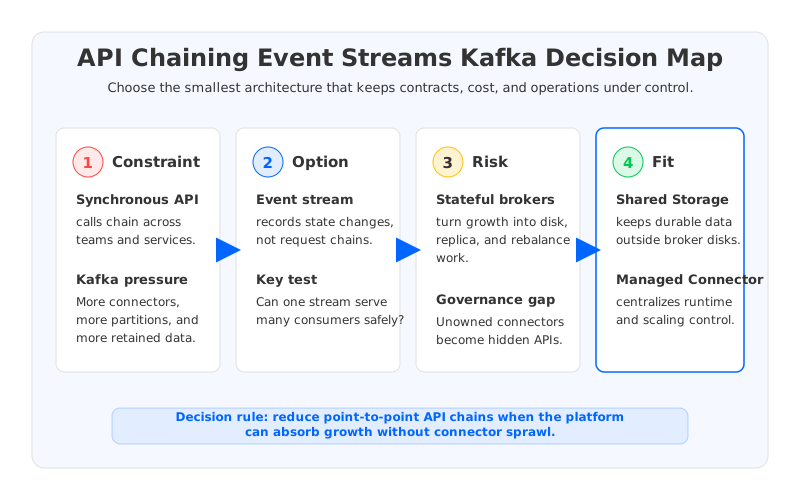
Teams searching for api chaining event streams kafka are usually not looking for another definition of event streaming. They know the basic pattern: replace a brittle chain of synchronous service calls with an event log that downstream systems can consume at their own pace. The hard part is deciding where that pattern stops being clean architecture and becomes a platform problem. Every API you remove can become a connector, topic, schema, consumer group, retry path, and security boundary.
API chaining is a production question before it is a design pattern question. A checkout flow, identity workflow, device telemetry pipeline, or customer-data enrichment job may start with a few HTTP calls. As teams add enrichment steps and consumers, the chain leaks operational risk: one slow dependency holds the caller open, one schema change surprises multiple teams, and one retry storm multiplies load. Kafka can absorb this pressure only when the streaming platform is shared infrastructure rather than a pile of connectors around a stateful cluster.
The useful thesis is narrower than "events are better than APIs." Event streams help when the business fact is reusable, durable, and independently consumable. They hurt when the platform turns every integration into another bespoke runtime. The winning design breaks synchronous coupling without creating connector sprawl.
1Why teams search for api chaining event streams kafka
API chains grow for rational reasons. A service needs a risk score before approving a payment. A billing workflow needs account metadata before creating an invoice. A personalization service needs inventory, profile, and policy data before returning a response. Direct APIs feel natural because each call has an owner and typed contract. Trouble appears when the call graph becomes a runtime dependency graph.
Kafka changes the shape of that graph. Instead of asking every downstream service to participate in the request path, a producer records a business event once, and consumers subscribe to the topics they need. Topics, partitions, offsets, and Consumer groups give teams a durable coordination layer for independent readers. Kafka Connect extends that model with a framework for moving data between Kafka and external systems.
The shift is not free. Once the stream becomes the shared contract, the team must govern schemas, ordering expectations, replay behavior, poison records, credentials, and ownership. A synchronous API usually fails loudly inside a request. A bad event contract can fail later, after several consumers have already stored or acted on the data. The architecture therefore needs a stronger operating model, not only a different transport.
Three signals usually mean an event-stream design is worth evaluating:
- Repeated reads of the same business fact. If multiple services ask for the same state change, an event stream gives them a shared source instead of many point-to-point calls.
- Latency tolerance outside the critical request path. If the caller does not need every enrichment result before responding, the work can move to asynchronous consumers.
- Replay value. If teams need backfills, audit trails, machine-learning features, or downstream repair, retained events provide leverage that transient API responses do not.
Those signals also explain connector sprawl. A useful stream attracts consumers, and every consumer tends to bring its own connector, transformation, credentials, deployment pipeline, and alert set. Without a platform boundary, "decoupling" becomes many small systems that fail independently.
2The production constraint behind the problem
Traditional Kafka was built around a Shared Nothing architecture: each broker owns local storage, and partitions are replicated between brokers for durability. That design is mature and well understood. It also means retained data, broker placement, leader movement, and capacity planning are tied together. When an API-chaining workload becomes a shared event backbone, growth does not show up as a single clean metric. It shows up as more partitions, more read fanout, longer retention, more connector workers, and more operational headroom.
The storage model matters because API-chain replacement workloads grow unevenly. One topic may be hot for an hour after a campaign launch. Another may be cold most of the day but require long retention for audit or replay. A third may serve consumers that lag during batch windows. In a broker-local model, the platform team plans disk, network, and compute together even when pressure is mostly in one dimension.
Cloud infrastructure makes this trade-off more visible. In a multi-AZ deployment, broker replication and some client traffic can cross zone boundaries. Cloud providers charge for many forms of inter-zone or private network data movement, so architecture reviews should model the team's own traffic profile rather than copy a generic percentage.
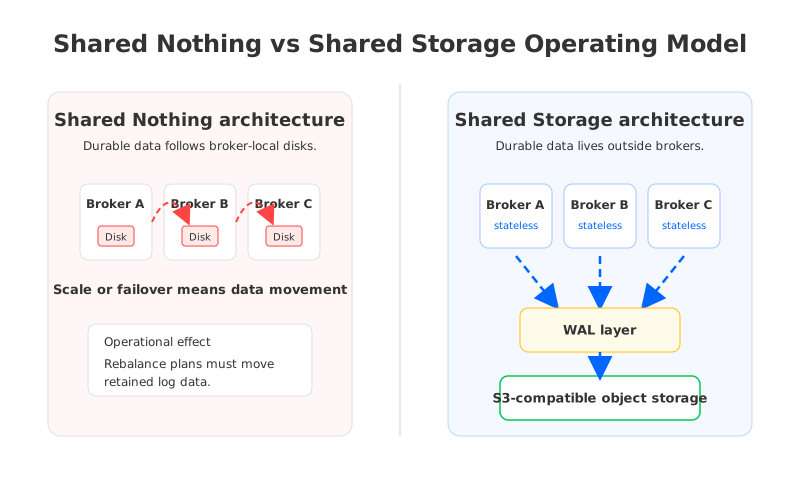
Tiered Storage can help when the main pain is long retention, but it does not make brokers stateless or remove the need to reason about the primary broker storage tier, partition placement, or rebalancing. API chaining usually stresses many dimensions at once: hot-path latency, replay depth, connector scaling, and governance.
The connector layer adds another constraint. Kafka Connect is a standard framework, but connector operations still need worker capacity, task placement, plugin lifecycle management, secret handling, and monitoring. If every team runs its own workers, the organization may remove synchronous API coupling while recreating ownership problems at the integration layer.
3Architecture options and trade-offs
The first option is to keep API chaining and tune it. This can be right for request-critical dependencies where the caller needs a response before it can proceed. Strong contracts, circuit breakers, deadlines, and idempotent retries help, but every dependency still joins the caller's latency and availability budget.
The second option is to publish domain events into Kafka and let downstream systems consume them. This works well when the event represents a completed fact, such as PaymentAuthorized, ShipmentCreated, or UserPreferenceUpdated. The producer no longer waits for every consumer, and consumers can use offsets to track progress independently. The trade-off is that teams must design event contracts with the same seriousness they apply to public APIs.
The third option is to use Kafka Connect or managed connector runtimes to bridge systems that should not own streaming code. This is attractive for databases, SaaS applications, warehouses, search indexes, and lakehouse sinks. It also creates the biggest sprawl risk because connector count grows with integration count. A connector runtime should be treated as shared platform infrastructure, with standard deployment, scaling, observability, and security controls.
| Option | Best fit | Main risk | Platform question |
|---|---|---|---|
| Keep synchronous APIs | Request-critical decisions | Cascading latency and retries | Can each dependency fit the caller's SLO? |
| Publish domain events | Shared facts and replayable state changes | Weak event governance | Who owns schemas, retention, and compatibility? |
| Use Kafka Connect or managed connectors | External systems and repeatable integrations | Connector sprawl | Who owns workers, plugins, secrets, and scaling? |
| Adopt Shared Storage architecture | Fast-growing Kafka-compatible platforms | WAL and object-storage design choices | Can storage, compute, and connectors scale separately? |
This table is deliberately neutral. A strong platform uses more than one option. The mistake is using Kafka as a universal escape hatch without checking whether the operating model is ready.
4Evaluation checklist for platform teams
The most practical review starts with contracts, not products. For each candidate API chain, write down the event that would replace the synchronous call, the system of record for that event, the consumers that need it, and the consequence of delayed consumption. If the event is not a stable business fact, or if consumers need a response before the original request can complete, keep the API path and improve its resilience instead.
When the event model is valid, review the platform against seven areas:
- Compatibility. Existing Kafka clients, serializers, Schema Registry usage, transactions, idempotent producers, Consumer group behavior, and Connect plugins must be tested before migration.
- Cost. Model compute, retained storage, object-storage requests, cross-zone transfer, PrivateLink or equivalent networking, and connector-worker capacity together.
- Elasticity. Check whether brokers, partitions, connector workers, and consumers can scale independently during bursts and backfills.
- Governance. Define schema ownership, compatibility policy, access control, retention policy, and topic lifecycle before onboarding broad consumers.
- Failure recovery. Test poison records, consumer lag, replay windows, broker failure, connector task failure, and dependency outages.
- Migration. Plan dual writes, mirroring, offset continuity, cutover order, and rollback before the first production chain moves.
- Team boundary. Decide which responsibilities belong to application teams and which belong to the streaming platform team.
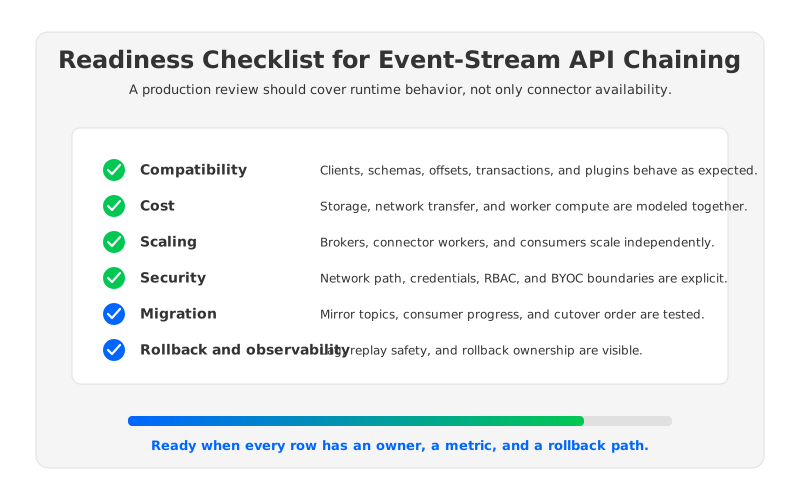
The checklist prevents a common failure mode: proving that Kafka can move data while leaving connector, security, and rollback models ambiguous. A production platform should make the boring parts explicit: paging, schema approval, and whether a backfill may consume shared capacity during business hours.
5How AutoMQ changes the operating model
After the evaluation framework is clear, AutoMQ enters the discussion as a Kafka-compatible streaming platform with a different storage architecture. AutoMQ keeps Kafka protocol and ecosystem compatibility as the application-facing contract, while its Shared Storage architecture moves durable data away from broker-local disks and into S3-compatible object storage. Brokers become stateless compute nodes, and the WAL (Write-Ahead Log) layer handles the immediate durable write path before data is organized into object storage.
That change matters for API-chaining workloads because it separates several concerns that grow at different speeds. Connector count can grow because integration demand grows. Retention can grow because replay and audit needs grow. Broker count can grow because throughput grows. In a broker-local model, these pressures often meet at the same operational choke point: the broker and its attached storage. In AutoMQ's model, the platform team can reason about compute, WAL choice, object storage, and connector runtime as more distinct levers.
AutoMQ BYOC also changes the deployment boundary. In BYOC (Bring Your Own Cloud), the control plane and data plane run in the customer's cloud account and VPC (Virtual Private Cloud), so teams evaluating API-chain replacement can keep data paths, network rules, cloud resources, and compliance controls inside their own environment. For integration-heavy workloads, that boundary is not a procurement detail. Connectors touch databases, SaaS endpoints, warehouses, and private APIs; their network placement and credential scope are part of the system design.
Managed Connector fits this same operating model. AutoMQ's public FAQ describes Managed Connector as built on Apache Kafka Connect, with support for standard Kafka Connect plugins when their dependencies, credentials, and network access are configured correctly. The value is not that connectors disappear. The value is that connector deployment and scaling become a platform function instead of a collection of one-off worker clusters. That is how teams reduce connector sprawl without abandoning the connector ecosystem.
Migration also deserves a specific note. AutoMQ Kafka Linking is designed for migrations from Apache Kafka or Kafka-compatible systems, including byte-to-byte topic replication and consumer progress synchronization according to AutoMQ documentation. For API-chaining projects, this helps teams avoid turning the platform migration into a second application migration. The cleaner path is to validate client compatibility, mirror the relevant topics, test consumer progress, and move one chain at a time with an explicit rollback plan.
WAL type, object-storage configuration, network topology, connector plugins, and consumer lag patterns still matter. The difference is that evaluation focuses on visible architecture levers rather than accepting broker-local storage as unavoidable.
6A practical migration sequence
Start with one chain that is painful enough to matter but bounded enough to reason about. A customer-profile enrichment chain, inventory-update fanout, or audit-log distribution path is usually safer than the primary payment authorization path. The goal is not to prove that every API can become an event. The goal is to prove that the platform can turn one repeated state dependency into a governed stream.
Use a sequence that keeps the failure domain small:
- Define the event contract and the owning team.
- Publish the event alongside the existing API path.
- Add one consumer and measure lag, replay behavior, and schema evolution.
- Move repeat consumers to the stream when the contract is stable.
- Retire synchronous calls only after rollback and observability are tested.
This sequence keeps the conversation grounded. If the stream cannot survive a replay, cannot expose useful lag metrics, or cannot handle a connector restart without manual repair, the team has found the issue before it becomes the backbone for multiple services.
7FAQ
7.1Is API chaining always a bad pattern?
No. Synchronous APIs are still the right fit when a caller needs an immediate decision from another service. Event streams are better when the information is a durable business fact that multiple systems can consume independently.
7.2Where does Kafka Connect fit?
Kafka Connect is useful when a source or sink can be represented as a repeatable connector task rather than custom application code. The platform team still needs to manage worker capacity, plugins, credentials, task failures, and observability.
7.3How does Shared Storage architecture help with connector sprawl?
Shared Storage architecture does not reduce connector count by itself. It reduces the chance that connector-driven growth also forces broker-local storage growth, data-heavy rebalancing, and rigid capacity planning. Connector governance is still required.
7.4Should teams use Tiered Storage or a diskless architecture?
Tiered Storage can help when long retention is the main issue. A diskless architecture is more relevant when the team wants stateless brokers, independent compute and storage scaling, and a different cross-zone traffic model.
7.5What should be tested before moving a production API chain?
Test client compatibility, schema evolution, Consumer group behavior, replay, lag, connector restart behavior, dependency outages, security rules, migration cutover, and rollback. A successful prototype that only checks happy-path throughput is not enough.
8Closing thought
The original API chain was clear because every dependency was visible in the call path. Moving to Kafka should not make the system harder to own. The point is to move reusable business facts into a durable stream, keep integration runtimes under platform control, and make scaling behavior predictable before the next team adds another consumer.
If you are evaluating a Kafka-compatible platform for this kind of integration workload, try AutoMQ in your own environment through the AutoMQ BYOC console.


