
Table of Contents
Table of Contents
A search for iot protocol ingestion kafka usually starts after the first architecture has already worked. Devices publish through MQTT, industrial gateways emit OPC UA data, field systems expose HTTP endpoints, and a few vendor SDKs have found their way into the pipeline. Kafka sits behind that edge layer because downstream teams need durable fan-out, replay, Consumer group coordination, offsets, and a common integration point for analytics and operations. The first version feels reasonable because every protocol gets a path into a Topic.
The trouble starts when that path becomes the operating model. Each additional factory, vehicle fleet, region, or device partner adds one more connector shape. Each connector needs credentials, retry behavior, schema handling, dead-letter routing, network placement, and ownership. At the same time, the Kafka cluster behind those connectors must absorb bursty telemetry, long retention, catch-up reads, and uneven consumer demand. The hard part is not choosing whether MQTT or Kafka is better. The hard part is deciding where protocol diversity ends and where the durable streaming backbone begins.
1Why teams search for iot protocol ingestion kafka
IoT ingestion rarely has a single producer type. A connected-vehicle platform may receive compact telemetry over MQTT, batch diagnostics over HTTPS, and maintenance records from enterprise systems. A manufacturing platform may normalize PLC, historian, OPC UA, and MES signals before any event reaches Kafka. Even a cleaner cloud IoT architecture often mixes device gateways, API producers, stream processors, lake ingestion, and alerting consumers.
Kafka is a strong fit for the shared backbone because it gives backend teams ordered Partitions, durable retention, replay, offsets, transactions, and Consumer group scaling. Those semantics matter once telemetry becomes operational data rather than transient device chatter. A field alert may need immediate processing, but the same record may later feed failure analysis, fleet dashboards, model retraining, and compliance review.
Protocol connectors solve the first mile. They do not automatically solve the platform boundary. When every device protocol gets its own Kafka Connect cluster, custom bridge, or gateway-to-Topic mapping, the ingestion estate can expand faster than the team can govern it. Connector count becomes a proxy for organizational drift: one group owns edge connectivity, another owns Kafka, another owns schema contracts, and another owns cost.
The better question is not "How many connectors can we run?" It is "Which parts of ingestion should be standardized before they reach Kafka, and which parts should be handled by the Kafka-compatible platform itself?"
2The production constraint behind the problem
Traditional Kafka gives you a clear and proven model: brokers store Partition logs locally, replicate data through ISR, and use leaders and followers for availability. That Shared Nothing architecture has served many workloads well. It also turns IoT variability into broker-local storage work. When ingestion spikes, you need enough broker CPU, network, and disk throughput. When retention grows, you need enough local or attached storage. When Partitions move, data movement becomes part of the scaling event.
IoT workloads amplify those mechanics because traffic is uneven by design. A firmware rollout, a weather event, a production shift, or a carrier outage recovery can change write volume quickly. Consumers can be equally uneven. Real-time alerting may stay close to the tail of the log, while analytics, data lake jobs, or incident reviews may perform Catch-up Reads over older telemetry. Kafka can support these access patterns, but the storage model determines how painful they are to operate.
Connector sprawl makes that pain harder to diagnose. A lag spike might come from an MQTT gateway reconnect storm, a Kafka Connect task restart, a schema conversion issue, a broker disk bottleneck, or a consumer group rebalance. If the team treats all of these as connector issues, it over-tunes the edge. If it treats all of them as Kafka issues, it over-provisions brokers. Either path hides the real boundary between protocol normalization and durable stream storage.
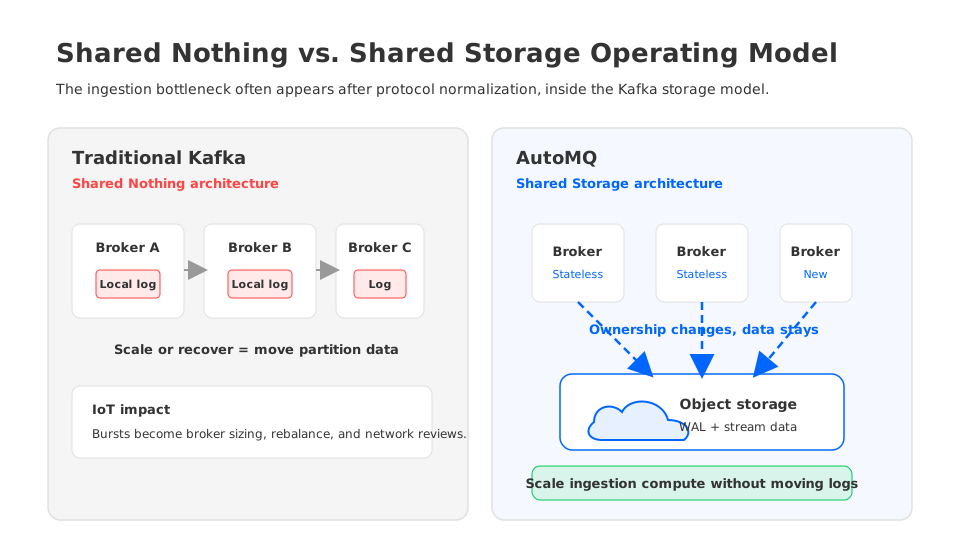
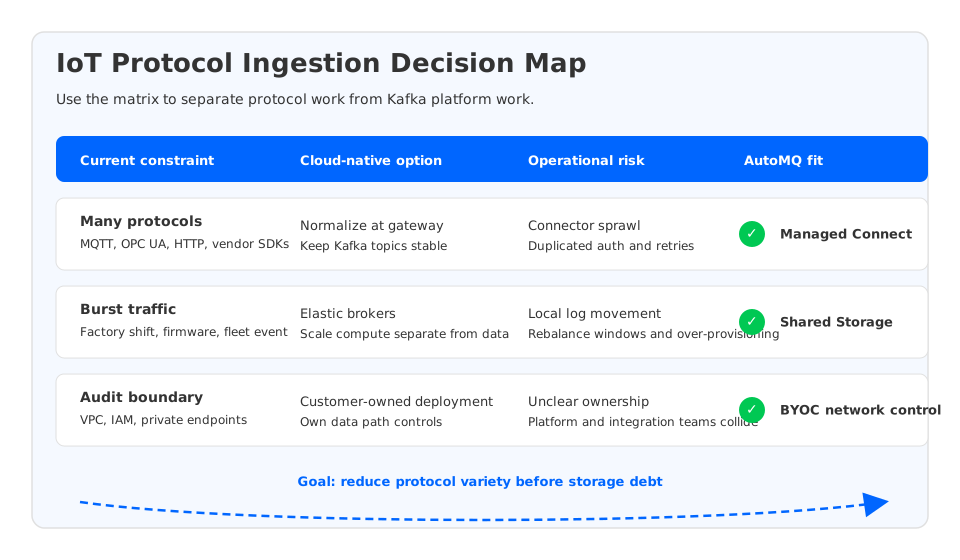
That boundary is where most platform decisions should start. Protocol gateways should absorb device-specific behavior: sessions, QoS policy, endpoint authentication, payload envelopes, and local retry semantics. Kafka should receive normalized events with clear Topic contracts, keying rules, ordering expectations, and retention policy. The Kafka platform then has to make those Topics durable, scalable, observable, and cost-effective without forcing every burst to become a storage migration exercise.
3Architecture options and trade-offs
There are several reasonable ways to build IoT protocol ingestion into Kafka. The wrong move is pretending they are interchangeable. Each option gives one team more control while pushing a different risk to another team.
| Option | What it handles well | What to watch |
|---|---|---|
| Protocol gateway before Kafka | Device sessions, protocol translation, edge authentication, and coarse filtering. | Gateway logic can become a hidden data platform if schemas, retries, and routing are not standardized. |
| Kafka Connect source connectors | Repeatable ingestion for supported systems, worker-level operations, and connector lifecycle management. | Many connector variants can duplicate security, task sizing, and error-handling logic. |
| Custom bridge services | Specialized protocol handling and tight control over message format. | Custom code often owns retries, offset-like checkpoints, and failure recovery without shared tooling. |
| Direct Kafka-compatible producers | Clean Topic contracts when producers can speak Kafka natively. | Not realistic for many constrained devices, embedded systems, and industrial protocols. |
The decision depends on where the variation lives. If variation is mainly at the device session layer, keep it in the gateway. If variation is mainly at the data-system integration layer, Kafka Connect can be a good fit. If the variation is in how Kafka itself scales, stores, and rebalances data, adding connectors will not fix it. That is a platform architecture problem.
This is also where Tiered Storage is often misunderstood. Apache Kafka Tiered Storage can move older log segments to remote storage while brokers still maintain the active log locally. That can help retention-heavy workloads, but it does not turn brokers into stateless compute nodes. Platform teams still need to reason about local storage, active segment capacity, broker replacement, and reassignment behavior. For IoT ingestion, Tiered Storage may reduce one retention pressure without removing the operational coupling that appears during bursts and failures.
4Evaluation checklist for platform teams
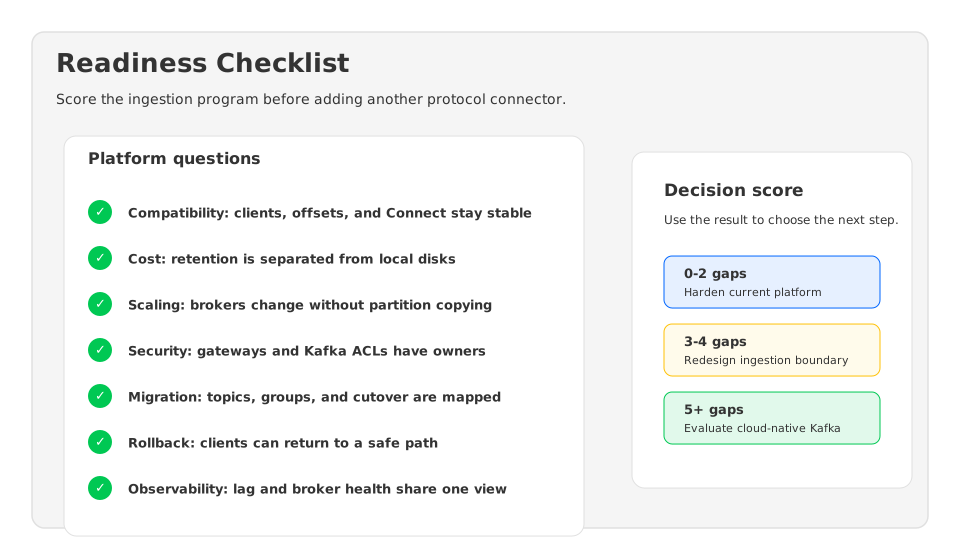
Before choosing another connector, score the ingestion program against seven questions. The point is not to create a perfect architecture diagram. The point is to expose which team is carrying risk.
- Compatibility: Can existing Kafka clients, Connect workers, stream processors, Schema Registry integrations, Consumer groups, offsets, and transactional producers keep their expected behavior?
- Cost: Are storage retention, burst capacity, cross-zone traffic, and connector worker capacity reviewed as separate cost drivers instead of one blended Kafka bill?
- Elasticity: Can the platform add or remove broker capacity without waiting for large Partition data movement to finish?
- Governance: Are Topic naming, schema evolution, dead-letter handling, credentials, and audit ownership consistent across protocol families?
- Failure recovery: When a gateway, connector task, broker, or consumer group fails, can the team identify the recovery point without guessing which component owns the checkpoint?
- Migration risk: If the team changes the Kafka-compatible backend, can it preserve Topic layout, offsets, producer behavior, and consumer cutover order?
- Team boundary: Does the integration team own protocol translation while the platform team owns durable streaming, or are both teams debugging the same incident from different dashboards?
A healthy score does not require every box to be green. For example, a small deployment with stable protocols and short retention may only need better connector governance. A fleet-scale deployment with regional bursts, long retention, and strict network boundaries deserves a deeper look at the Kafka storage model. The evaluation should force that distinction early, before the team grows a set of connectors that are expensive to retire.
5How AutoMQ changes the operating model
Once the evaluation points to storage coupling rather than protocol translation, the architecture question changes. The platform no longer needs a different MQTT bridge or another Connect worker group as its main lever. It needs a Kafka-compatible backend that preserves Kafka semantics while reducing the amount of operational work tied to broker-local data.
AutoMQ is a Kafka-compatible streaming platform built around Shared Storage architecture. It keeps the Kafka protocol and ecosystem surface, including Producers, Consumers, Topics, Partitions, offsets, Consumer groups, Kafka Connect, and common Kafka tooling. The architectural difference is that durable stream data is stored in S3-compatible object storage through S3Stream, while AutoMQ Brokers act as stateless compute nodes for Kafka request handling, caching, routing, and scheduling.
That difference matters for IoT protocol ingestion because it separates two scaling problems that are often tangled together. Protocol gateways and Managed Connector workflows can focus on normalizing device or system inputs. The Kafka-compatible backend can focus on durable retention, replay, broker elasticity, Self-Balancing, and failure recovery. When broker capacity changes, the platform does not need to treat scaling as a large local-log copy operation. Ownership and traffic can move while durable data remains in shared storage.
AutoMQ BYOC also fits the governance side of the problem. In BYOC deployments, the control plane and data plane run inside the customer's cloud account or VPC, and customer message data stays within that environment. For IoT programs with regional data boundaries, private connectivity, or strict cloud-account ownership, this deployment model lets the platform team evaluate Kafka-compatible streaming without handing the data path to a third-party-hosted service.
Managed Connector is the other relevant piece, but it should not be treated as a shortcut around architecture. Its value is strongest when the team has already defined the ingestion boundary: which protocols terminate at gateways, which data systems use Connect, which Topics are canonical, and which errors require dead-letter routing. AutoMQ's managed Kafka Connect capability can then reduce worker lifecycle and observability burden while the Shared Storage architecture reduces the broker-side operational pressure behind it.
For teams that already run Kafka, migration planning should be explicit. AutoMQ commercial editions provide Kafka Linking for migration scenarios where byte-level message synchronization, offset consistency, and cutover behavior matter. Open-source Kafka ecosystems can also use tools such as MirrorMaker2, with the usual need to validate offsets, consumer behavior, and rollback. The right migration path depends on how much downtime, offset translation, and producer change the workload can tolerate.
6A practical readiness scorecard
Use a simple readiness score before adding another protocol path. Count one gap for each item that is not documented, tested, and owned.
| Score | Interpretation | Next action |
|---|---|---|
| 0-2 gaps | The architecture is probably constrained by implementation details rather than platform design. | Harden gateway standards, connector templates, and schema review. |
| 3-4 gaps | The boundary between protocol ingestion and Kafka operations is unclear. | Redesign ownership, observability, and Topic contracts before scaling connector count. |
| 5+ gaps | The Kafka operating model is carrying too much of the ingestion burden. | Evaluate a cloud-native Kafka-compatible platform and plan a controlled migration test. |
The scorecard works because it resists the usual shortcut. It does not ask whether the team can make another connector run. Most teams can. It asks whether the next connector will make the whole platform easier to operate, or whether it will add one more moving part on top of a storage model that is already difficult to scale.
7FAQ
7.1Is Kafka a replacement for MQTT or OPC UA?
No. MQTT, OPC UA, HTTP, and industrial protocols solve first-mile communication problems. Kafka is usually the durable event backbone behind the protocol layer, where normalized events can be retained, replayed, processed, and consumed by many downstream systems.
7.2Should IoT teams use Kafka Connect for every protocol?
Not always. Kafka Connect is useful when the source or sink fits a connector model and the team wants repeatable worker operations. Device-session protocols, edge authentication, and constrained-network behavior often belong in a protocol gateway before Kafka.
7.3Does Tiered Storage solve IoT retention pressure?
It can help with retention-heavy workloads by moving older log segments to remote storage. It does not fully remove broker-local storage from the operating model, so teams should still evaluate broker scaling, active log capacity, and reassignment behavior.
7.4Where does AutoMQ fit in an IoT ingestion architecture?
AutoMQ fits behind the protocol normalization layer as a Kafka-compatible streaming backend. It is most relevant when the main bottleneck is broker-local storage, burst scaling, long retention, cross-zone traffic exposure, or migration complexity rather than protocol translation itself.
7.5What should a migration proof of concept measure?
Measure client compatibility, Topic and Partition behavior, offset handling, connector task recovery, consumer lag, catch-up reads, failure recovery, observability, and rollback. Avoid judging the platform only by a steady-state throughput test.
8References
- Apache Kafka documentation
- AutoMQ Kafka compatibility
- AutoMQ architecture overview
- AutoMQ S3Stream Shared Streaming Storage
- AutoMQ Kafka Connect overview
- AutoMQ Kafka Linking overview
If the next connector is really a platform decision in disguise, start with a controlled AutoMQ evaluation instead of another one-off bridge. You can review the BYOC path and talk to the AutoMQ team through AutoMQ Cloud.


