
Table of Contents
Table of Contents
Teams usually search for oracle change stream kafka after the first working pipeline has stopped being the hard part. The connector can read Oracle redo logs, publish change events, and feed a warehouse, search index, fraud service, or cache refresh path. Then more tables arrive. A snapshot runs longer than expected. A downstream sink slows down. A schema change needs a replay window. The problem is no longer "can we stream changes from Oracle into Kafka?" The problem is whether the whole operating model can grow without turning every source table, connector task, topic, and consumer group into a special case.
Oracle change streams are demanding because they sit between two systems that both care about order and recovery. Oracle provides a transactional source of truth. Kafka provides ordered partitions, offsets, replay, and consumer groups. The connector layer has to translate database log position into Kafka records without losing restart, resnapshot, retry, and incident explainability. That translation gets harder as teams add databases, regulated tables, and consumers with different freshness targets.
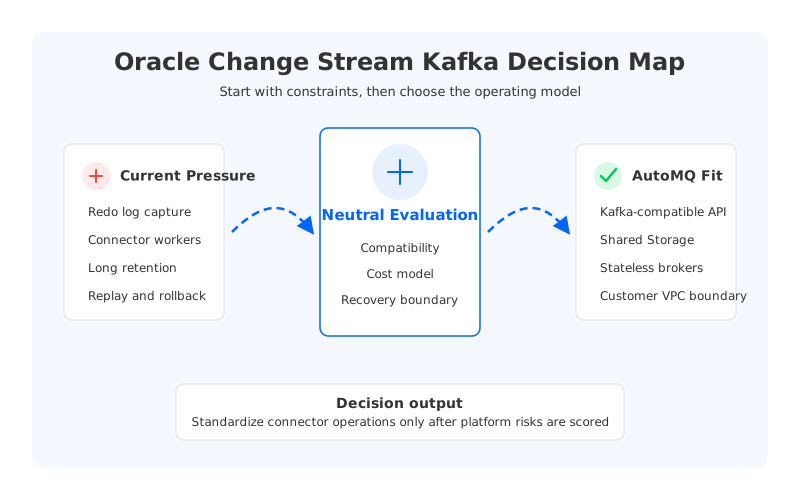
Connector sprawl is often a symptom of a platform boundary problem. If every new Oracle feed requires its own worker pool, retention exception, network path, and recovery runbook, the team is compensating for limits in the shared streaming layer. A better evaluation starts with the full path: Oracle log capture, connector runtime, Kafka topic design, retained data, consumer offsets, security boundaries, and rollback.
1Why Teams Search For oracle change stream kafka
The search phrase is narrow, but the production intent is broad. Some teams want a pattern for Oracle CDC into Kafka. Others already run Debezium, Kafka Connect, a managed connector service, or Oracle-native replication tools and are trying to understand why the estate is getting harder to operate. They are asking where risk moves when the pipeline becomes shared infrastructure.
The first risk is source pressure: log mining, snapshotting, schema history, and long-running transactions can delay changes. The second is connector state: Kafka Connect has worker coordination, task assignment, offsets, internal topics, retry behavior, and plugin dependencies. The third is Kafka capacity. Change streams are often retained longer than application events because teams need replay for backfills, audit checks, data repair, and downstream rebuilds.
Those risks do not grow independently. A slow sink can increase consumer lag and turn into a retention question. A connector outage can force replay and expose broker storage limits. Broker replacement can trigger partition movement for topics that were supposed to be durable change history. This is how sprawl starts: each team adds an exception because the shared path cannot offer predictable ownership.
The operating questions are concrete:
- Can one connector platform handle source isolation, plugin versions, secret rotation, and worker scaling without every database team owning a custom runtime?
- Can Kafka retain enough change history for replay without forcing brokers to carry storage that has little to do with current compute demand?
- Can platform teams prove where data travels, which network endpoints are used, and how access is audited?
- Can recovery be rehearsed without changing the source database, topic layout, or consumer offset policy during the incident?
If the answer is unclear, adding connectors will make the unclear parts more expensive to reason about.
2The Production Constraint Behind The Problem
Traditional Kafka deployments use a Shared Nothing architecture. Each broker owns local storage for hosted partitions, and durability comes from replication across brokers. That model is proven, but it becomes awkward for Oracle change streams when retention and replay become platform requirements rather than side settings.
CDC topics often have a different shape from ordinary event topics. They produce steady traffic, burst during snapshots or recovery, and support consumer groups that read at different speeds. A warehouse loader may tolerate batch windows. A search index may need fresher updates. A compliance consumer may need longer replay. Kafka gives these consumers independent offsets, but retained bytes still land somewhere.
In a broker-local model, retained bytes affect broker sizing, replication traffic, and partition movement. If Oracle CDC volume grows, the team may add disk, add brokers, reduce retention, or split topics across clusters. Each option has a cost: larger brokers mix compute and storage requirements, more brokers increase operational surface area, shorter retention weakens recovery, and more clusters multiply connector deployments and governance rules.
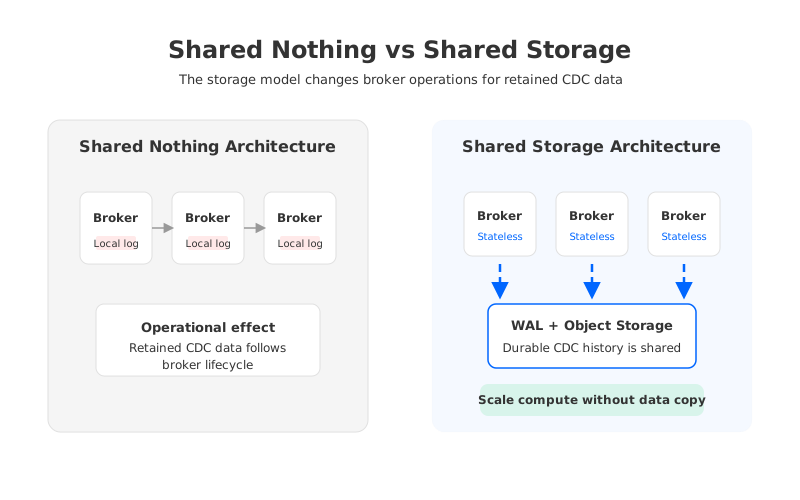
The problem is not that Kafka cannot run CDC. It can. The problem is that Oracle change streams punish tight coupling between compute, storage, and operations. A connector task is small compared with a long-retained topic tied to local broker disks. Once the team moves, replaces, or scales brokers, retained change history becomes part of the operation.
Cloud networking exposes the same constraint from another angle. Multi-Availability Zone deployments are normal, but cross-zone replication, private connectivity, NAT paths, and connector placement affect cost and failure behavior. AWS documents that data transfer rules vary by path, and that NAT gateways and VPC paths can introduce processing and data transfer charges. A change-stream architecture should treat network placement as design input, not an afterthought.
3Architecture Options And Trade-Offs
There are several valid ways to stream Oracle changes into Kafka. The right choice depends less on connector brand than on source ownership, platform ownership, and replay expectations.
| Option | What It Solves | Trade-Off To Test |
|---|---|---|
| Self-managed Kafka Connect with an Oracle CDC connector | Maximum control over plugins, worker sizing, network placement, and offset topics | Requires operational maturity across workers, source load, topic design, retries, and upgrades |
| Managed connector service | Reduces worker lifecycle work and may simplify deployment | Can constrain connector versions, private networking, pricing units, and recovery procedures |
| Oracle-native replication into a streaming sink | Keeps Oracle-specific capture behavior close to the database team | May introduce a separate runtime, licensing model, or transformation boundary |
| Kafka-compatible platform modernization | Keeps Kafka APIs and ecosystem patterns while changing broker storage and scaling behavior | Requires migration validation for clients, Connect, offsets, security, observability, and rollback |
This table separates connector convenience from platform behavior. A managed connector can reduce worker toil, but it may not change Kafka retention economics. A Kafka-compatible platform can improve storage and scaling behavior, but it does not remove the need to understand Oracle log capture, connector offsets, schema evolution, or downstream idempotency.
The cleanest architecture usually has a small number of shared patterns. One covers high-value Oracle tables with strict ordering, longer retention, and strong audit controls. Another covers lower-risk replication where freshness matters but replay does not need to be long. A third may cover migration or one-time backfill. The point is to keep exceptions visible and governed.
For platform teams, evaluation should happen before the next connector wave. A useful design review asks what happens during a snapshot, schema change, worker rebalance, broker outage, sink outage, and rollback. If those events require different people to edit different systems under pressure, the architecture is carrying hidden coordination debt.
4Evaluation Checklist For Platform Teams
The evaluation framework should start neutral. Score the platform on properties that matter for Oracle change streams in production.
| Dimension | Question To Ask | Strong Signal |
|---|---|---|
| Compatibility | Do producers, consumers, Kafka Connect workers, Admin clients, and security mechanisms work without application rewrites? | Client behavior, offsets, transactions, and operational tooling are validated in staging |
| Cost model | Does cost scale with retained change history, connector count, task parallelism, network paths, or provisioned broker capacity? | The team can explain the cost of normal streaming, snapshotting, replay, and failure recovery |
| Elasticity | Can the platform absorb snapshots, backfills, and consumer catch-up without long broker data movement? | Scaling compute does not require moving large amounts of retained topic data |
| Governance | Can teams define ownership for sources, topics, schemas, connectors, credentials, and downstream consumers? | Exceptions are approved through a shared control process, not hidden in one-off deployments |
| Recovery | Can operators restart connectors, replay topics, restore offsets, and roll back consumers without improvising? | Runbooks are rehearsed with realistic lag and retained data volumes |
| Security boundary | Does the data path stay inside the expected VPC, account, region, and private connectivity model? | Routes, endpoint policies, IAM roles, and audit logs match the compliance design |
| Observability | Can teams correlate Oracle lag, connector lag, Kafka lag, broker storage, and sink errors? | Dashboards show where delay is introduced, not only that delay exists |
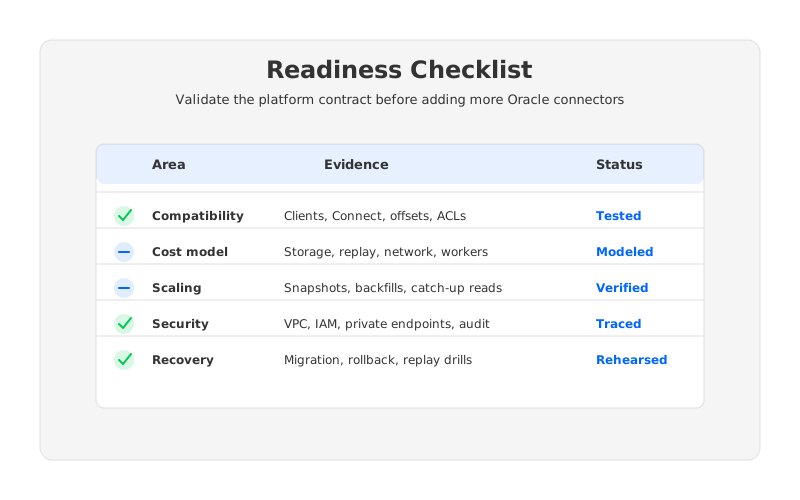
Compatibility deserves special attention because "Kafka-compatible" can mean different things. For Oracle change streams, producer and consumer APIs are not enough. Kafka Connect internal topics, offset storage, consumer group behavior, transactions where used, ACLs, TLS, Schema Registry integrations, and monitoring hooks all need validation against the parts your estate actually uses.
Cost deserves the same discipline. Avoid one-line comparisons that only count connector runtime or broker storage. The useful model includes source database impact, connector workers, Kafka storage, replication or object storage, private endpoints, cross-zone traffic, monitoring, incident time, and replay.
5How AutoMQ Changes The Operating Model
Once the evaluation is framed around compatibility, retained data, elasticity, governance, and recovery, AutoMQ fits as a Kafka-compatible streaming platform that changes the broker storage model underneath the connector estate. It does not replace Oracle CDC tools. It changes the Kafka side of the design: durable stream data is backed by S3-compatible object storage through AutoMQ's Shared Storage architecture, while brokers operate as stateless compute nodes.
That distinction matters because CDC pressure often lands on retention and recovery. In AutoMQ, S3Stream replaces Kafka's local log storage with a layer that uses WAL storage for durable write buffering and object storage as the primary repository. Brokers still present Kafka-compatible APIs, but retained data is no longer bound to broker-local disks. Broker replacement, scaling, and partition reassignment become metadata and traffic-management operations rather than copy projects.
Kafka Connect, Debezium-style CDC tools, Oracle-native replication tools, and downstream consumers can continue to use Kafka-compatible interfaces while the platform team changes how retained stream data is stored and scaled. If the pain is long CDC retention, repeated replay, broker capacity planning, and multi-AZ cost exposure, Kafka platform architecture is part of the solution.
AutoMQ BYOC also matters for data-boundary reviews. In BYOC deployments, the control plane and data plane run in the customer's cloud account and VPC boundary. That is relevant when the source database sits behind private networking, strict IAM policies, and audit requirements. Teams still need to validate connector placement and network routes.
Managed Connector support is the control-plane counterpart. When connector deployment, worker lifecycle, routing, and observability are handled through a shared platform, teams can reduce custom worker islands. The value is a cleaner boundary: source teams own database permissions and schema intent, platform teams own connector runtime and Kafka capacity, and consumers own processing contracts and offsets.
There are still trade-offs to test. S3 WAL, Regional EBS WAL, and NFS WAL have different latency, durability, and deployment characteristics. Open source and commercial deployment modes have different capability boundaries. A serious migration should test the exact Oracle connector, topic layout, retention policy, security settings, and failure runbooks.
6A Practical Readiness Scorecard
Use this scorecard before adding another connector pool. Give each item a green, yellow, or red rating and write down the evidence.
- The Oracle source owner can describe log retention, snapshot windows, schema-change process, and acceptable load.
- The connector owner can restart, resnapshot, pause, resume, and upgrade connectors without losing track of offsets.
- The Kafka platform owner can show retained bytes, partition distribution, consumer lag, broker headroom, and replay capacity for CDC topics.
- The security owner can trace the data path from Oracle to connector workers, Kafka brokers, object storage or broker disks, and consumers.
- The data product owner can define acceptable duplication, ordering, replay, and rollback for each consumer group.
- The incident owner can run a failure drill that includes source delay, connector failure, Kafka lag, sink failure, and recovery.
The scorecard often reveals that the next problem is not another connector. It is the absence of a platform contract for capture, storage, replay, governance, and recovery. Without that contract, each team builds its own path and calls it flexibility.
AutoMQ is worth evaluating when the desired contract is Kafka-compatible, cloud-native, and controlled inside the customer's deployment boundary. Start with a non-critical Oracle feed, mirror the topic design, keep the existing consumer behavior, and test uncomfortable cases: snapshot surge, connector restart, broker replacement, long replay, and rollback. If the system behaves predictably there, the platform team can reduce sprawl by standardizing the operating model.
If your Oracle change streams are turning into one-off worker pools and retention exceptions, try AutoMQ with a controlled CDC workload and measure the storage, scaling, and recovery path: start from the AutoMQ deployment workflow.
7FAQ
7.1Is Kafka a good target for Oracle change streams?
Kafka is a strong target when multiple downstream systems need independent consumption, replay, partition ordering, and durable offsets. The platform still needs careful topic design, connector state management, schema handling, and recovery procedures.
7.2Does a Kafka-compatible platform replace an Oracle CDC connector?
No. A Kafka-compatible platform changes the streaming and storage layer. You still need a capture mechanism for Oracle changes, such as Kafka Connect, Debezium, or an Oracle-native replication path.
7.3What causes connector sprawl in Oracle CDC programs?
Sprawl appears when teams create separate worker pools, topics, credentials, monitoring, and runbooks for each source or consumer requirement. Some separation controls risk, but unmanaged exceptions make security, recovery, and cost harder to govern.
7.4Where should AutoMQ enter the evaluation?
AutoMQ should enter after the team has identified Kafka-layer constraints: retained CDC data, replay cost, broker scaling, partition movement, and customer-controlled deployment boundaries. It is not a shortcut around source and connector design.
7.5What should be tested before migrating Oracle CDC workloads?
Test connector offsets, internal Kafka Connect topics, consumer groups, security settings, schema evolution, snapshots, replay, broker replacement, rollback, and observability. Validate failure behavior, not only steady-state throughput.


