
Table of Contents
Table of Contents
A search for real time alerting workflows kafka rarely comes from curiosity. It usually comes from a team that already has Kafka in the path of something urgent: fraud signals, SRE incident routing, product abuse detection, trading risk, IoT safety events, or customer-facing workflow automation. The first version worked. The second version added more producers, consumers, retention, teams, and on-call expectations. Then the question changed from "can Kafka move the events?" to "how much Kafka do we need to reserve so alerting does not fall over?"
That pressure is specific to alerting. Average throughput is a poor planning metric because the workload is defined by bursts, fan-out, and uneven reads. A quiet system can become noisy when an upstream service degrades, fraud campaign starts, or deployment creates a metric storm. The platform is judged by tail behavior: how fast consumers catch up, how predictable failover feels, and whether a noisy tenant can starve critical signals.
The hard part is that over-provisioning looks rational. If missed alerts are expensive, extra broker capacity feels like insurance. But Kafka capacity is not a single dial. It is compute, broker-local storage, replication traffic, partition placement, consumer lag, connection count, retention, governance, and operational headroom tied together. Scaling real-time alerting workflows without waste starts by separating those dimensions instead of treating "more brokers" as the default answer.
1Why teams search for real time alerting workflows kafka
Alerting pipelines often start as a clean event flow. Producers publish normalized events into topics, stream processors enrich or correlate those events, rule engines evaluate conditions, and downstream consumers notify humans or systems. Apache Kafka fits that model well because the official Kafka documentation defines durable topics, partitions, offsets, consumer groups, transactions, and Kafka Connect as core parts of the ecosystem rather than add-on patterns.
The production version is less tidy. A platform team may need to support multiple alert classes with different retention policies. Security may ask for audit replay. Application teams may want independent consumer groups so they can build their own routing, suppression, or analytics logic without blocking the central alerting service. Data teams may want the same event stream for offline investigations. Each use case is reasonable on its own; together, they change the cluster's capacity shape.
The most common scaling signals appear before a full outage:
- Consumer lag grows during incident storms, then falls back after the burst. That makes the platform look healthy in daily averages while missing the exact period that matters.
- Rebalancing becomes more disruptive as more consumers join, leave, or deploy independently. Consumer groups are powerful, but group coordination is still part of the operational surface.
- Retention requests expand because alert investigations need replay. Longer retention increases the storage attached to the streaming system, even when the hot alerting path only needs recent data.
- Partition movement becomes a planning event. A capacity change that requires moving large amounts of broker-local data competes with the workload it is supposed to protect.
Those symptoms are not signs that Kafka is the wrong abstraction. They are signs that the alerting platform has crossed from "event transport" into "shared production substrate." Once that happens, the architecture has to be evaluated like infrastructure, not like a library choice.
2The production constraint behind the problem
Traditional Kafka uses a Shared Nothing architecture: brokers own local log segments, partitions are placed on brokers, and durability is achieved through replicated partition copies. That model is battle-tested and understandable. It also means storage ownership and compute ownership are coupled. When a broker is added, removed, replaced, or rebalanced, the system has to reason about where the data lives, not only where the traffic should go.
For alerting workflows, the coupling shows up in three places. First, the platform has to reserve storage for retention and replication, even if compute pressure is spiky. Second, scaling decisions can trigger data movement, so operators may delay capacity changes until the cluster is quiet. Third, multi-AZ deployments can introduce network cost and replication planning that are not visible in a simple throughput estimate.
This is why "add brokers" is a blunt response. It may reduce immediate CPU pressure, but it also expands the fleet that must be patched, monitored, secured, and balanced. It may add disk headroom, but that disk is still attached to broker placement. It may reduce risk in one failure mode while creating a larger recovery and cost-management surface.
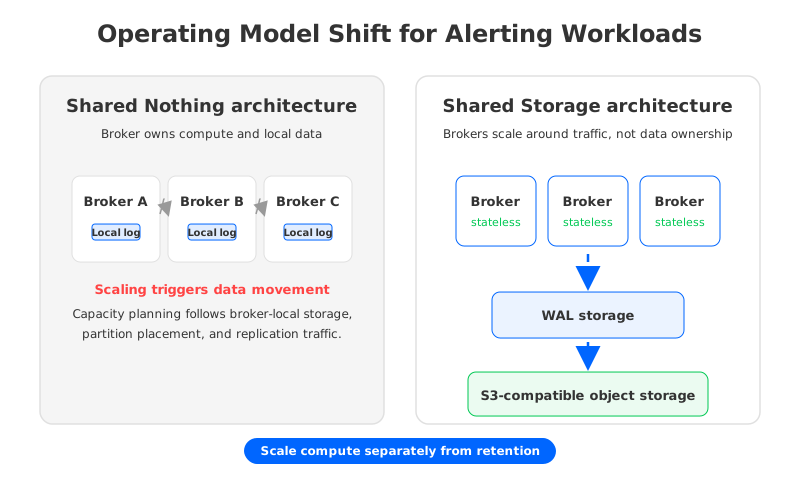
The issue is whether the operating model lets the platform team scale the parts under pressure without permanently paying for idle capacity. Alerting makes that unavoidable because the system must be ready for rare bursts without funding rare-burst capacity every hour.
3Architecture options and trade-offs
The first option is conventional self-managed Kafka. It gives teams the most direct control over broker configuration, client behavior, storage, upgrades, and network placement. That control is valuable when the team already has Kafka expertise and clear workload boundaries. The trade-off is that every capacity decision remains close to the mechanics of brokers, disks, partitions, replication, and operational runbooks.
The second option is a managed Kafka service. It can reduce the undifferentiated work around provisioning, patching, and basic monitoring. For many teams, that is the right trade. The platform still needs to understand quota boundaries, scaling behavior, data residency, networking, client compatibility, and cost controls. Managed does not mean the alerting architecture becomes elastic by default; it means a different party owns parts of the operational workflow.
The third option is to keep the Kafka API but change the storage architecture underneath. In this model, the important question is not "who runs the brokers?" but "are brokers still the durable home of the data?" If data remains tied to broker-local storage, scaling compute and scaling storage stay entangled. If durable data is moved into shared storage, brokers can become more replaceable, and capacity planning can focus more directly on traffic and latency.
That difference matters for real-time alerting because the workload has two personalities. The hot path needs predictable write and tail-read behavior for fresh alerts. The cold path needs replay for investigations, audits, and model improvement. A design that treats all retained data as broker-local operational burden will push teams toward over-provisioning. A design that separates durable retention from broker fleet size gives platform teams more room to tune the hot path without dragging the full history along with every scaling decision.
4Evaluation checklist for platform teams
The practical evaluation should start before any product comparison. A good alerting platform review asks what must remain compatible, what must become more elastic, and what the organization is willing to operate. The following checklist is useful because it forces the conversation away from a single throughput number.
| Dimension | Question to ask | Why it matters for alerting |
|---|---|---|
| Kafka compatibility | Can existing producers, consumers, stream processors, schemas, and Kafka Connect jobs keep their expected behavior? | Alerting platforms often have many owners. Client rewrites create migration risk across teams. |
| Burst elasticity | Can compute capacity change without waiting on large data movement? | Incident storms are temporary, but delayed scaling turns temporary pressure into missed alerts. |
| Retention economics | Is long retention priced and operated separately from broker fleet size? | Investigations need replay, but replay history should not force permanent hot-path overcapacity. |
| Failure recovery | What happens when a broker, zone, or node pool fails during peak alert volume? | The worst recovery time is the one observed during a live incident. |
| Governance | Are topics, ACLs, encryption, audit logs, and deployment boundaries clear? | Alert payloads can contain sensitive operational or customer data. |
| Migration path | Can offsets, consumer groups, and producer cutover be controlled with rollback options? | Alerting systems are hard to freeze because they protect other systems. |
| Observability | Can the team see lag, broker health, storage behavior, client errors, and routing anomalies together? | A platform that cannot explain alert delay becomes another incident source. |
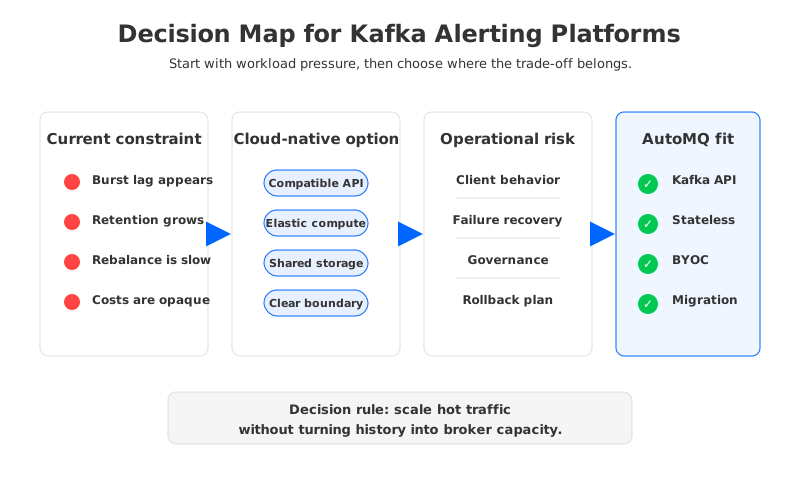
This matrix also makes a useful architectural point: the goal is not to remove every trade-off. The goal is to choose where the trade-off lives. If the team wants maximum control, it may accept more operational work. If it wants less operational work, it may accept service boundaries. If it wants elastic scaling without changing Kafka clients, it should look closely at the storage model behind the Kafka-compatible endpoint.
5How AutoMQ changes the operating model
This is where AutoMQ enters the evaluation: as a Kafka-compatible streaming platform that changes the storage layer rather than asking application teams to change the eventing model. AutoMQ uses a Shared Storage architecture with stateless brokers and object-storage-backed durability. The Kafka-facing concepts remain familiar, while the durable data path moves away from broker-local disks.
The mechanism is important. AutoMQ replaces Kafka's local log storage layer with S3Stream, a streaming storage library that writes through WAL (Write-Ahead Log) storage and persists data to S3-compatible object storage. AutoMQ documentation describes the Shared Storage architecture and the WAL storage layer as the foundation for stateless broker behavior. In practice, that means broker replacement, scaling, and partition reassignment are less dominated by copying broker-local historical data.
For real-time alerting, the architectural effect is straightforward. The platform team can reason about hot traffic, retention, and broker fleet size as related but separable concerns. Bursty alert writes still need enough compute and WAL capacity. Consumers still need correct group behavior, offset management, and lag monitoring. But long-lived retained data no longer has to be treated as a reason to keep oversized brokers attached to oversized local disks.
AutoMQ BYOC also matters for teams with strict data boundaries. In BYOC (Bring Your Own Cloud), the control plane and data plane run in the customer's cloud account and VPC, while business data remains in the customer's environment. For organizations building alerting around security, fraud, infrastructure health, or regulated operational events, that boundary can be as important as the scaling model. AutoMQ Software provides an option for private data center environments where the same separation of responsibilities needs to fit a customer-operated deployment.
Migration deserves the same level of caution as architecture. If an alerting workflow is already in production, the migration plan should track producer cutover, consumer group progress, offset expectations, replay windows, and rollback points. AutoMQ's Kafka Linking documentation describes migration capabilities such as byte-level data synchronization and consumer progress synchronization for AutoMQ BYOC scenarios, but the right plan still depends on the existing cluster, authentication mode, client versions, and operational tolerance for parallel running.
The benefit is not that platform teams stop thinking about Kafka. They still need topic design, partition strategy, schema discipline, consumer isolation, and observability. The benefit is that the expensive safety margin can move closer to the workload that actually needs it.
6A readiness scorecard before you scale
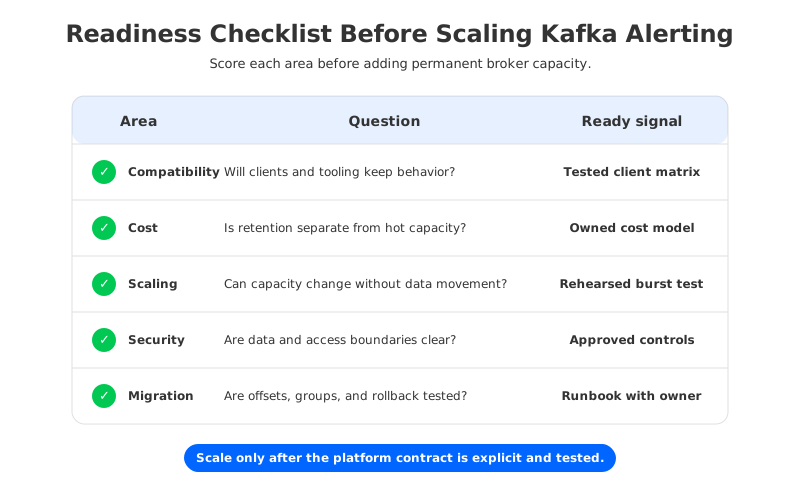
Before buying more capacity, score the current alerting platform in a working session with application owners, SREs, security, and finance. Use a simple 0-2 scale: 0 means unknown or weak, 1 means partially covered, and 2 means documented and tested.
| Area | 0 | 1 | 2 |
|---|---|---|---|
| Burst behavior | No tested burst profile | Synthetic burst tests exist | Burst tests map to incident scenarios |
| Consumer recovery | Lag is observed after the fact | Lag alerts exist | Lag, ownership, and replay runbooks are tested |
| Storage growth | Retention grows by request | Retention has policies | Retention has cost, replay, and compliance owners |
| Scaling workflow | Broker changes are manual events | Scaling is scripted | Scaling is tested with failure and rollback |
| Migration safety | No offset plan | Consumer group plan exists | Cutover and rollback are rehearsed |
| Governance | Topic ownership is informal | ACLs and naming are standardized | Audit, encryption, and ownership are enforced |
A low score does not automatically mean the platform needs a replacement streaming system. It means the next capacity purchase may hide a process gap.
If the scorecard shows that broker-local storage and capacity reservations are the main sources of waste, a Shared Storage architecture becomes worth serious evaluation. If the scorecard shows weak topic ownership or missing lag runbooks, fix those first. Architecture can reduce the amount of machinery you operate, but it cannot replace ownership of the alerting contract.
7FAQ
7.1Is Kafka a good fit for real-time alerting workflows?
Yes, Kafka is a strong fit when alerting depends on durable event streams, independent consumers, replay, and integration with stream processing or Kafka Connect. The scaling problem usually appears when alerting becomes a shared platform with bursty workloads, multiple owners, and long retention requirements.
7.2What causes over-provisioning in Kafka-based alerting?
Over-provisioning usually comes from planning around worst-case bursts while using broker-local storage and static capacity assumptions. Teams add brokers or disks for safety, but the added capacity also increases operational surface, replication planning, and cost.
7.3Does Tiered Storage solve the problem?
Tiered Storage can reduce pressure from historical data by moving older segments to remote storage, and it is useful in many Kafka deployments. It does not fully separate broker compute from local storage ownership for the hot path, so platform teams still need to evaluate scaling, failover, and reassignment behavior.
7.4When should a team evaluate AutoMQ?
Evaluate AutoMQ when existing Kafka clients and ecosystem tools are important, but the current operating model is constrained by broker-local storage, slow scaling workflows, cross-AZ traffic planning, or retention-driven overcapacity. The strongest fit is a team that wants Kafka-compatible behavior with a cloud-native storage model.
7.5What should be tested before migration?
Test producer cutover, consumer group progress, offset expectations, replay behavior, authentication, topic configuration, observability, and rollback. Alerting workflows should be migrated with rehearsed runbooks because they protect other production systems.
8References
- Apache Kafka Documentation
- Apache Kafka Consumer Configuration
- Apache Kafka Transactions
- Apache Kafka KRaft
- Apache Kafka Tiered Storage
- Apache Kafka Connect
- AutoMQ Shared Storage Architecture
- AutoMQ WAL Storage
- AutoMQ Kafka Linking
- AWS Regions and Availability Zones
When your alerting platform starts reserving capacity for rare bursts, the next useful question is not "how many more brokers?" It is "which part of the system actually needs to scale?" Start with AutoMQ BYOC.


