
Table of Contents
Table of Contents
A search for retail inventory signals kafka usually comes from a team that has already moved past the whiteboard. The platform is carrying stock updates from stores, fulfillment centers, ecommerce carts, replenishment systems, point-of-sale feeds, and downstream analytics. The question is no longer whether Apache Kafka can move events. The question is whether the inventory signal layer can survive retail demand patterns without turning every seasonal peak into a permanent infrastructure bill.
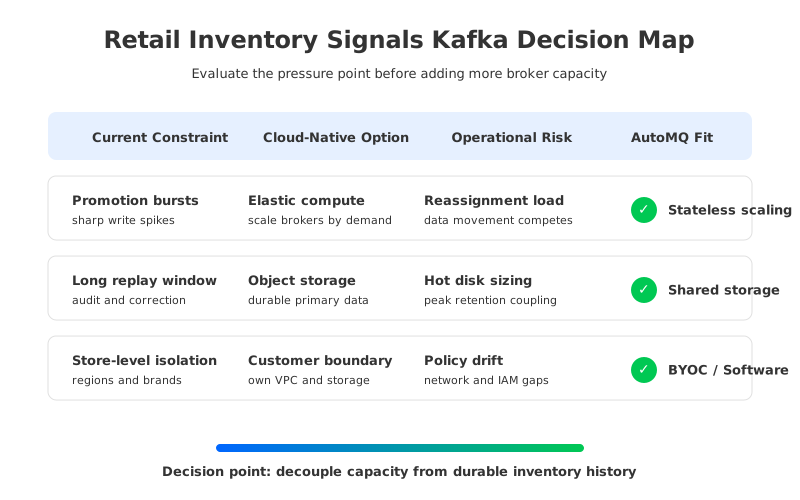
Retail inventory is awkward for streaming platforms because the workload is spiky, business-critical, and full of replay requirements. A promotion can multiply write traffic for a short window. A stock correction can trigger a burst of downstream reads. A store-level reconciliation job may need historical events long after the hottest data has aged out of memory. If the answer is to size Kafka for the highest possible peak, the platform becomes reliable by being wasteful.
The better question is narrower: which parts of the system must be provisioned for peak, and which parts can follow demand? Once you separate those two ideas, the architecture decision becomes clearer. Inventory signals need Kafka semantics, but the operating model does not have to inherit every constraint of broker-local storage.
1Why Teams Search for retail inventory signals kafka
Inventory signals sit between operational systems that disagree about time. A store shelf scanner sees one view of availability. The ecommerce promise engine sees another. A warehouse management system may update allocations in batches, while a mobile app expects an answer before the customer taps checkout. Kafka is attractive here because it gives teams an ordered, replayable stream of changes instead of a chain of point-to-point integrations.
The stream is not one thing, though. It usually contains several classes of events: stock-on-hand changes, reservations, cancellations, replenishment suggestions, price and promotion context, store transfer movements, and exception signals from damaged or missing goods. Each class has a different latency expectation and retention reason. The cart path cares about freshness; finance and audit teams care about explainability; data science teams care about historical features.
That mix creates four production requirements that are easy to blur together:
- Consumer independence. Store operations, ecommerce, analytics, and replenishment services should read the same signal stream at their own pace. Kafka Consumer groups and offsets are a useful fit because teams can scale readers without rewriting the producer side.
- Replay without panic. When a rule changes, teams need to rebuild derived availability views from prior events. Retention policy becomes a business control, not a storage afterthought.
- Burst absorption. Promotions, holiday traffic, supplier delays, and marketplace campaigns can push traffic above the weekday baseline. Capacity should follow that curve without requiring a long broker rebalancing window.
- Governance boundaries. Inventory data often crosses brands, regions, stores, vendors, and channels. The streaming platform must support network isolation, access control, encryption, observability, and audit paths that match those boundaries.
These are not exotic requirements. They are what happens when Kafka becomes the inventory signal backbone instead of a sidecar queue for one application.
2The Production Constraint Behind the Problem
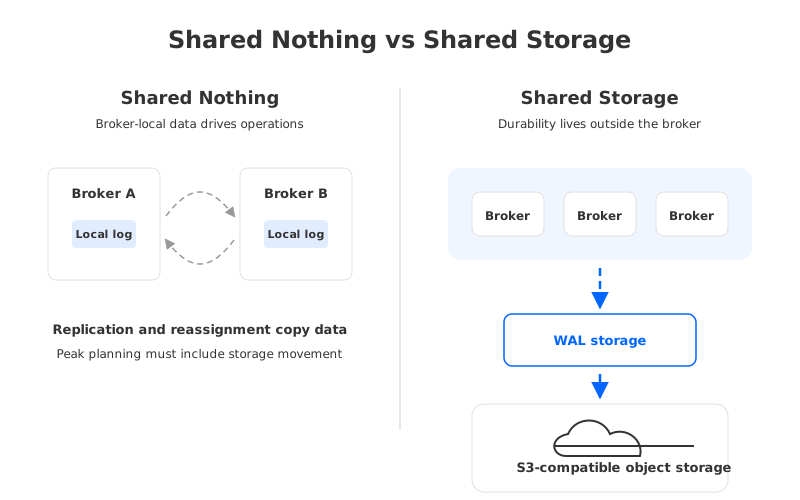
Traditional Kafka uses a Shared Nothing architecture: each broker owns local log storage, and partition replicas are placed across brokers for durability and availability. This model is proven and widely understood. It also makes the broker both a compute node and a storage owner. That coupling is where retail inventory workloads start to feel expensive.
When traffic rises, adding brokers is not the same as adding stateless compute. The cluster has to rebalance partition leadership, replica placement, and broker-local data. If the working set is large, the rebalancing operation competes with application traffic for disk and network resources. The peak that forced the scale-out can become the same moment when the platform is busy moving data around.
Retention adds a second coupling point. Retail teams often keep inventory event history for correction, compliance, investigation, or model training. In broker-local Kafka, retention affects local disk sizing, replacement time, and reassignment cost. Tiered Storage can reduce how much historical data remains on hot broker disks, and it is a useful option for some clusters. But the primary write path and recent local log still matter for broker sizing, failover behavior, and operational planning.
Cross-AZ design adds another layer. A production Kafka deployment typically spreads replicas across Availability Zones for resilience. That improves failure tolerance, but it can also turn replication and client placement into a network cost and routing problem. A retail platform that serves stores and channels across zones has to model not only storage and compute, but also the path each write and read takes through the cloud network.
The constraint is not "Kafka is bad for retail." Kafka is often the right interface. The constraint is that broker-local durability makes capacity planning absorb more responsibilities than the application actually needs: write throughput, read fanout, retention, replica movement, failure recovery, and cloud network topology all converge on the broker fleet.
3Architecture Options and Trade-Offs
Before choosing a platform, map the workload to the operating model. A self-managed Kafka cluster gives maximum control and a familiar ecosystem, but the team owns capacity planning, upgrades, partition reassignment, disk lifecycle, network placement, monitoring, and incident response. A managed Kafka service can remove part of that operational burden, yet the underlying economics may still depend on provisioned broker capacity, storage policy, and network paths. A Kafka-compatible cloud-native platform changes the storage and scaling model while preserving the client-facing interface.
The right answer depends on which constraint is dominant:
| Decision Area | What to Ask | Why It Matters for Inventory Signals |
|---|---|---|
| Compatibility | Do existing producers, consumers, Kafka Connect jobs, and monitoring tools keep working? | Inventory streams usually have many owners; application rewrites raise migration risk. |
| Elasticity | Can compute capacity scale without moving durable log data? | Retail spikes are short-lived; permanent over-provisioning hides an architecture mismatch. |
| Retention | Is historical replay tied to broker-local disk capacity? | Corrections, audits, and model rebuilds need history beyond the hottest data. |
| Network cost | Where do writes, reads, replicas, and private endpoints cross zones? | Multi-AZ resilience should not make every normal write path expensive. |
| Governance | Who owns the VPC, storage bucket, identity policy, and audit trail? | Regional and brand-level boundaries often matter as much as throughput. |
| Migration | Can the team dual-run, validate offsets, and roll back? | Inventory mistakes are customer-visible, so cutover must be reversible. |
The matrix matters because platform debates often start with throughput and end with operations. Throughput is necessary, but a retail inventory signal platform usually fails in the spaces between metrics: a delayed rebalance during a promotion, a replay job that starves live consumers, a migration that changes offsets, or a network path that no one priced before launch.
Kafka-native semantics should remain the baseline. Producers, Topics, Partitions, Offsets, Consumer groups, transactions, Kafka Connect, and KRaft are part of the operational language many data teams already use. A candidate platform that breaks that language may save infrastructure work while creating application and governance work somewhere else.
4Evaluation Checklist for Platform Teams
A practical evaluation starts with workload segmentation. Do not average the whole inventory platform into one throughput number. Split signals by freshness, retention, fanout, and blast radius. A cart reservation stream and a nightly reconciliation stream may both use Kafka, but they should not drive the same capacity assumptions.
Use the following scorecard before picking or migrating a platform:
- Define the write envelope. Measure normal, promotional, and exceptional write rates separately. Include batch repairs and supplier updates, not only customer-facing traffic.
- Define the read envelope. Count live consumers, delayed consumers, replay jobs, and analytics exports. Consumer lag is a capacity signal, but it is also a product signal when inventory views fall behind.
- Classify retention by reason. Keep history because a team needs replay, audit, correction, or analytics. Each reason has a different recovery and access pattern.
- Model failure domains. Decide what happens when a broker, zone, network path, or storage dependency fails. The answer should include operational ownership, not only replication settings.
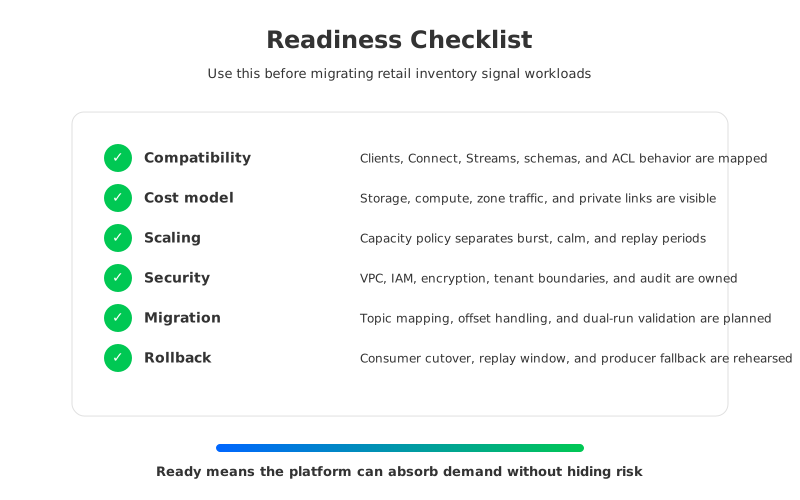
- Validate migration behavior. Test topic configuration, offset continuity, schema compatibility, access control, monitoring, and rollback before moving production producers.
- Price the full path. Include compute, storage, cross-zone transfer, private connectivity, observability, and idle peak capacity. A narrow broker quote is not a platform cost.
This checklist is intentionally operational. Architecture diagrams become useful when they predict what the on-call engineer does at 2 a.m. during a promotion, a replenishment delay, or a data correction incident.
5How AutoMQ Changes the Operating Model
Once the evaluation framework is clear, AutoMQ is best understood as a Kafka-compatible streaming platform that changes where durable state lives. It preserves Kafka protocol and ecosystem expectations while replacing broker-local log storage with a Shared Storage architecture built on S3-compatible object storage and S3Stream.
In AutoMQ, brokers are stateless from the durable data perspective. The write path durably records data through WAL (Write-Ahead Log) storage and then persists stream data into S3 storage. The WAL layer exists because object storage has different latency and request economics from local disks; it lets the system batch and sequence writes efficiently while keeping object storage as the primary durable layer. Read paths use caching for hot data and prefetch behavior for catch-up reads.
This changes the scaling conversation. Adding or removing brokers no longer implies copying durable partition data from one broker-local disk to another. Partition ownership and traffic can be reassigned without treating the broker as the place where the long-lived log resides. For retail inventory signals, that means platform teams can evaluate compute elasticity separately from historical retention.
It also changes the cost and governance discussion. With AutoMQ BYOC (Bring Your Own Cloud), the control plane and data plane run in the customer's cloud account and VPC (Virtual Private Cloud), so teams keep deployment boundaries, storage ownership, networking, and access policies close to their existing cloud governance model. AutoMQ Software provides a similar customer-controlled model for private environments. AutoMQ Open Source can be useful for evaluation and self-managed deployments with S3 WAL, while AutoMQ commercial editions provide additional WAL choices for workloads with stricter latency and durability needs.
The migration path still deserves discipline. AutoMQ documentation describes MirrorMaker2 for open-source migration scenarios and Kafka Linking for AutoMQ commercial editions where byte-level synchronization and offset consistency matter. Retail teams should run dual reads, compare derived inventory views, track consumer lag, rehearse rollback, and move producers in stages. A more elastic architecture does not remove the need for a careful cutover; it makes the destination easier to operate after the cutover succeeds.
AutoMQ is not the answer to every retail integration problem. If the workload is small, stable, and already well-operated, a conventional Kafka deployment may be adequate. If the workload is growing around bursty inventory signals, long replay windows, and multi-zone cloud operations, the architectural benefit is sharper: durable history moves out of the broker fleet, and broker capacity can follow demand rather than permanently reserving for the worst week of the year.
The next time the search starts with retail inventory signals kafka, do not begin by adding brokers. Begin by asking what should be stateful, what should be elastic, and who owns each operational boundary. If that points toward Kafka-compatible shared storage, you can evaluate AutoMQ against your own workload by starting from the deployment and migration docs, or by opening a technical conversation through AutoMQ Cloud.
6FAQ
6.1Is Kafka a good fit for retail inventory signals?
Kafka is a strong fit when multiple systems need an ordered, replayable stream of inventory changes. It is less attractive when the use case is a small point-to-point integration with no independent consumers, no replay requirement, and no need for event history.
6.2What is the main risk of over-provisioning Kafka for retail traffic?
The risk is not only higher infrastructure spend. Over-provisioning can hide whether the platform can scale down, replay safely, recover from broker failures, and handle seasonal spikes without manual data movement.
6.3Does Tiered Storage solve the inventory retention problem?
Tiered Storage can help reduce pressure from older data on local broker disks. It does not fully remove the coupling between brokers and the primary write path, so platform teams should still evaluate reassignment behavior, hot data sizing, and failure recovery.
6.4When should a team evaluate AutoMQ?
Evaluate AutoMQ when Kafka compatibility matters but broker-local storage is becoming a bottleneck for elasticity, retention, cross-zone operations, or cloud cost control. The strongest candidates are workloads with bursty demand and meaningful replay windows.
7References
- Apache Kafka consumer design
- Apache Kafka delivery semantics and transactions
- Apache Kafka Connect
- Apache Kafka KRaft configuration
- AutoMQ compatibility with Apache Kafka
- AutoMQ architecture overview
- AutoMQ WAL storage
- AutoMQ migration overview
- AutoMQ zero cross-AZ traffic overview
- AWS S3 pricing
- AWS PrivateLink for Amazon S3


