
Table of Contents
Table of Contents
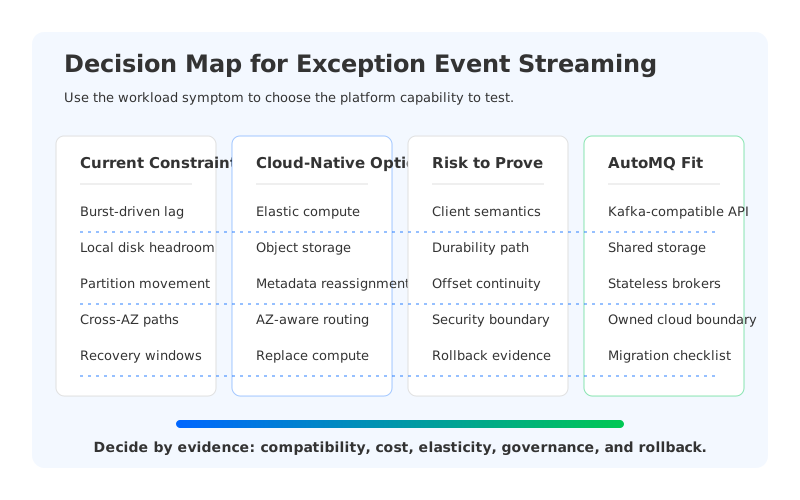
Teams usually search for supply chain exception events kafka after the first version of the event backbone has already worked. Orders flow, shipments update, warehouse scans arrive, and transportation milestones land in Kafka topics. Then the exception stream starts behaving differently from the planned stream. A supplier misses a ship date, a port delay changes estimated arrival times, a temperature sensor crosses a threshold, or a retailer cancels demand across a region. The event count may not look huge over a month, but the bursts arrive exactly when the business is already under pressure.
That is why this problem is often underestimated in capacity planning. Normal supply chain telemetry is steady enough to model with average write throughput, retention, and consumer fan-out. Exception events are not steady; they cluster around disruption. They also attract more consumers than routine events: procurement wants supplier exposure, transportation wants rerouting, customer service wants order impact, finance wants accrual changes, and analytics wants the full history for post-incident review.
Kafka is a strong fit for this pattern because it gives teams topics, partitions, offsets, consumer groups, replay, and a mature ecosystem of clients and connectors. The hard part is not whether Kafka can carry exception events. The hard part is whether the platform team can scale the Kafka operating model without reserving too much broker capacity for the worst week of the quarter.
1Why Teams Search for supply chain exception events kafka
A useful exception-event architecture starts with the shape of the event, not with the cluster. These records are usually small, business-critical, and connected to an operational decision. A late ASN, a changed ETA, an inventory discrepancy, a failed quality check, or a customs hold may trigger a workflow that fans out across several systems. The event must arrive quickly enough to support action, remain durable enough for audit, and retain its offset semantics so downstream processors can recover after failure.
The search query often hides several decisions:
- Routing and ownership. Which team owns the event contract, and which teams can add consumers without turning every topic change into a coordination meeting?
- Replay and retention. How far back must the business replay exceptions after a rule change, a failed integration, or a disputed chargeback?
- Burst handling. Can the platform absorb disruption-day traffic without running the normal-day estate at disruption-day size?
- Governance. Which records contain supplier, shipment, customer, or regulated data, and where must that data stay?
- Migration. If the current Kafka estate is already expensive or operationally tight, can the team move without rewriting every producer and consumer?
Those questions are bigger than topic design, but topic design is where they show up first. A team may split exceptions by business domain, severity, geography, or event type. Each split creates trade-offs around partition count, ordering, access control, retention, and consumer lag. A clean domain model can still become an expensive platform model if every new topic and replay requirement maps to more broker-local storage and more reserved capacity.
2The Production Constraint Behind the Problem
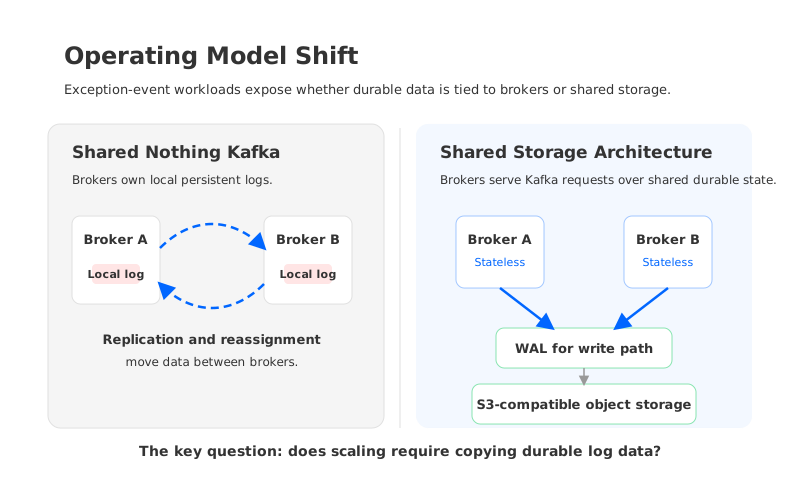
Traditional Kafka is a Shared Nothing architecture. Brokers own local log storage, partitions are assigned to brokers, and durability is built through replicated partition data across the in-sync replica set. That model is proven and well understood, and Apache Kafka documentation remains the right baseline for client behavior such as consumer groups, committed offsets, transactions, Kafka Connect, and KRaft metadata. The cost of the model is that storage, compute, and recovery are tied together in day-to-day operations.
Supply chain exception events stress that coupling in three ways. First, bursts raise write and read pressure at the same time, because the same disruption creates more producers, more alerting, and more investigation. Second, retention pressure increases after incidents, because teams want to replay what happened and prove what changed. Third, rebalancing becomes more sensitive, because moving partitions or replacing brokers during a live disruption can compete with the traffic the platform is trying to stabilize.
This is where over-provisioning becomes a tempting answer. Add brokers. Increase disk headroom. Reserve capacity for the spike. It works, but it also turns rare disruption capacity into a recurring cost. Worse, it can hide the real bottleneck: if every scale-out or broker replacement requires moving durable log data, the platform is still treating capacity as a storage-placement problem.
3Architecture Options and Trade-Offs
There are several reasonable paths, and none should be chosen from a slogan. A tuned Kafka cluster may be enough when exception bursts are predictable, retention is modest, and the team already has mature runbooks. Tiered Storage can help when the main pain is keeping older log segments on broker disks, but platform teams should verify what remains local, how reads behave, and whether brokers still own the active log state they must recover. A managed Kafka service changes the operational responsibility boundary, which may be valuable when the team wants fewer cluster-management tasks.
A Kafka-compatible architecture replacement is a different move. It keeps the Kafka-facing application model in scope while changing the storage and scaling mechanics underneath. That option is relevant when application compatibility matters, but broker-local storage has become the recurring source of cost, scaling delays, and recovery risk.
Use a decision matrix before naming a platform:
| Evaluation area | What to validate | Why it matters for exception events |
|---|---|---|
| Kafka compatibility | Producers, consumers, offsets, transactions, admin operations, ACLs, and Connect patterns | Exception workflows often include several application owners and cannot tolerate semantic surprises |
| Cost behavior | Broker capacity, retained data, inter-zone traffic, object storage, private networking, and migration overlap | Disruption traffic should not force permanent worst-case sizing |
| Elasticity | Scale-out, scale-in, partition reassignment, broker replacement, and consumer lag recovery | Bursts are useful only if the platform can respond without long maintenance windows |
| Governance | VPC boundaries, IAM, encryption, network paths, audit logging, and operational access | Supplier and customer data often has contractual or regional constraints |
| Migration risk | Topic replication, offset continuity, producer cutover, consumer validation, and rollback | A failed migration during a supply chain incident is worse than the original cost problem |
The matrix also prevents a common architecture mistake: treating object storage as a single feature. Object storage can appear in multiple designs, but the operating model depends on whether it is the primary durable stream storage, a remote tier for older data, a backup target, or a migration staging area. Those are different systems with different recovery and scaling behavior.
4Evaluation Checklist for Platform Teams
The practical evaluation should start with a representative exception-event domain. Pick one that has bursty writes, multiple consumer groups, a replay requirement, and a clear owner. Then run the design as if it were production: create the topics, load realistic keys, test consumer lag, add a new consumer group, simulate a delayed downstream system, and replace a broker or compute node during the test.
Do not skip the boring parts. The boring parts are usually where the real risk lives. Validate client versions against the platform's compatibility statement. Confirm how consumer group offsets are stored, migrated, and reset. Test transaction behavior if upstream applications use idempotent or transactional producers. Check Kafka Connect assumptions if exceptions enter or leave through connectors rather than application code.
The platform team should be able to answer five questions without hand-waving:
- When exception volume spikes, what resource becomes scarce first: CPU, network, local disk, object storage requests, connector capacity, or downstream processing?
- When retention grows, does the team buy more broker-local storage, adjust remote storage policy, or rely on shared durable storage?
- When a broker fails, does recovery rebuild local log state, copy partition data, or reassign compute over already durable state?
- When audit asks where data resides, can the team draw the data path, control path, key boundary, and network boundary?
- When migration is necessary, can producers, consumers, offsets, topics, and rollback be validated independently?
5How AutoMQ Changes the Operating Model
Once the evaluation reaches this point, AutoMQ becomes relevant as a Kafka-compatible cloud-native streaming platform rather than as a generic Kafka replacement. AutoMQ preserves Kafka protocol and ecosystem expectations while changing the storage layer below the Kafka interface. Its Shared Storage architecture uses S3Stream to place durable stream data on S3-compatible object storage, with WAL storage and cache used for the write and read paths. Brokers become closer to stateless compute nodes over shared durable state than long-lived owners of local persistent logs.
That architectural shift matters for supply chain exception events because it attacks the source of over-provisioning. If durable history is no longer pinned to broker-local disks, adding or replacing compute does not have to mean copying large amounts of retained log data between brokers. AutoMQ documentation describes seconds-level partition reassignment and Self-Balancing as part of this model, where the control problem is ownership, traffic, and metadata rather than bulk data relocation.
For platform teams, the useful question is not "does AutoMQ use object storage?" The useful question is "which operational responsibilities move when durable data is in shared storage?" In a supply chain context, that changes the review in several concrete ways:
- Capacity planning focuses on workload shape. Compute can be evaluated against burst windows, consumer fan-out, and catch-up behavior instead of being sized mainly around retained local data.
- Recovery planning separates cache loss from durable data loss. A failed broker still matters, but the durable stream state is designed to live outside that broker.
- Governance review gets a clearer boundary. AutoMQ BYOC and AutoMQ Software deployment models are relevant when teams need customer-controlled cloud or private infrastructure boundaries.
- Migration planning can remain Kafka-centered. Existing Kafka clients, topics, consumer groups, and offset behavior still require validation, but the evaluation can avoid turning into an application rewrite.
AutoMQ also includes capabilities that matter around the edges of this architecture review. AutoMQ Linking is designed for Kafka migration scenarios, including topic and consumer group synchronization patterns that should be tested against the team's cutover plan. Table Topic can help when the exception stream also needs to become an analytical table path. Zero cross-AZ traffic features are relevant when the platform team is modeling multi-AZ network cost and routing behavior, especially in cloud environments where inter-zone data movement can become visible on the bill.
None of this removes the need for workload testing. A team should still validate throughput, latency, client behavior, connector dependencies, observability, security controls, and rollback under production-like conditions. The difference is that the test is no longer limited to "how much bigger should the Kafka cluster be?" It becomes "can this operating model absorb exception bursts without making storage placement the center of every scaling and recovery decision?"
6A Practical Readiness Scorecard
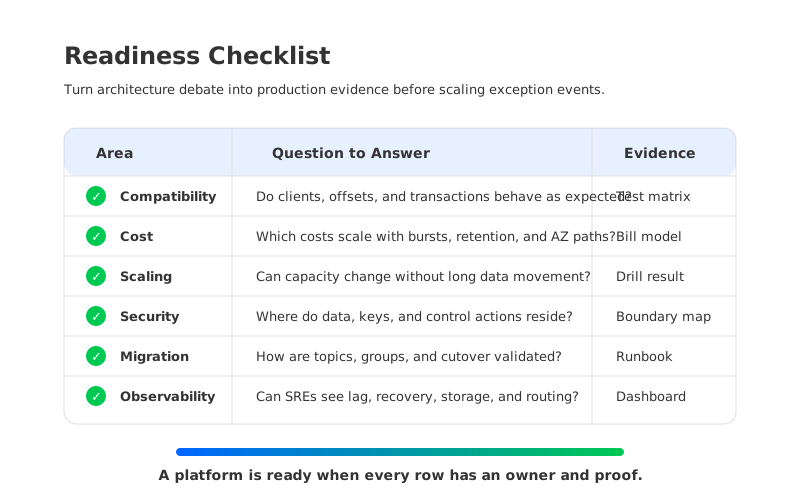
Before approving a supply chain exception-event platform, give each area an owner and a proof artifact. A green checkbox without evidence is not a decision; it is a hope that the incident will be polite.
| Readiness area | Minimum proof before production |
|---|---|
| Compatibility | A matrix covering producer and consumer versions, offset commits, transactions if used, admin APIs, security settings, and connector assumptions |
| Cost | A model that separates compute, storage, inter-zone traffic, private networking, migration overlap, and operational labor |
| Scaling | A drill showing scale-out, scale-in, broker or node replacement, and consumer catch-up under burst traffic |
| Security | A boundary diagram for business data, credentials, control operations, logs, metrics, and network paths |
| Migration | A runbook for topic replication, offset continuity, producer cutover, consumer validation, and rollback |
| Observability | Dashboards and alerts for lag, broker health, storage path, WAL behavior where applicable, connector health, and cloud billing signals |
The strongest signal is not a perfect benchmark. It is a test that fails early enough to teach the team something. If a consumer group cannot catch up after a simulated supplier incident, the platform has exposed a capacity or downstream limit. If a broker replacement creates a long data movement window, the architecture has exposed a storage-coupling limit. If the security team cannot tell where records or keys reside, the platform has exposed a governance limit.
Return to the search that started the work: supply chain exception events kafka. The answer is not to make Kafka bigger by default. The answer is to decide which parts of the platform must remain Kafka-compatible, which parts must become more elastic, and which boundaries must be provable under stress. If your checklist points toward a customer-controlled Kafka-compatible Shared Storage architecture, start a focused evaluation through AutoMQ Cloud and test it against one exception-event domain before widening the rollout.
7FAQ
7.1Is Kafka a good fit for supply chain exception events?
Yes, when the team needs durable event streams, replay, consumer groups, and a broad integration ecosystem. The key is to design for burst behavior, not only average throughput.
7.2Should exception events use separate Kafka topics?
Often yes, but the split should follow ownership, ordering, access control, and retention needs. Too many small topics can create operational overhead, while overly broad topics can make governance and replay harder.
7.3Does Tiered Storage solve over-provisioning?
It can reduce pressure from retained historical data, but teams still need to verify what remains broker-local, how active logs recover, and whether scaling still involves broker-owned state.
7.4What should teams test before migrating a supply chain Kafka workload?
Test client compatibility, topic configuration, consumer group offsets, transaction behavior if used, connector dependencies, security boundaries, lag recovery, and rollback. Migration is not complete until rollback has been rehearsed.
7.5Where does AutoMQ fit in the evaluation?
AutoMQ fits when teams want Kafka-compatible behavior with a Shared Storage architecture, stateless brokers, object-storage-backed durability, and customer-controlled deployment options. It should be validated against the same workload scorecard as any production platform.
8References
- Apache Kafka Documentation
- Apache Kafka: KRaft
- Apache Kafka: Transactions
- Apache Kafka: Kafka Connect
- AutoMQ Documentation: Compatibility with Apache Kafka
- AutoMQ Documentation: Shared Storage Architecture
- AutoMQ Documentation: Glossary
- AutoMQ Documentation: Continuous Self-Balancing
- AutoMQ Documentation: Kafka Linking Overview
- AutoMQ Documentation: Eliminate Inter-Zone Traffic
- AWS S3 Pricing
- AWS PrivateLink Pricing


