
Table of Contents
Table of Contents
Teams usually start caring about schema-aware integration after something breaks in production. A field changes type in a database capture stream. A sink connector starts rejecting records that looked harmless in staging. A downstream analytics table silently receives nulls because an optional field became business-critical. Kafka kept the bytes moving, which is exactly what it was designed to do, but the integration contract failed somewhere around the boundary between producer intent and consumer expectation.
That is the real search intent behind schema aware integration kafka. The reader is not asking whether Kafka can carry JSON, Avro, Protobuf, or raw bytes. They are asking how to run integration pipelines where schema evolution, replay, connector behavior, platform cost, and operational ownership are part of the same design. A schema registry helps, but a registry by itself does not decide who owns a breaking change, how a failed sink should replay data, or whether the streaming platform can absorb retention and fan-out growth without turning every schema incident into a capacity incident.
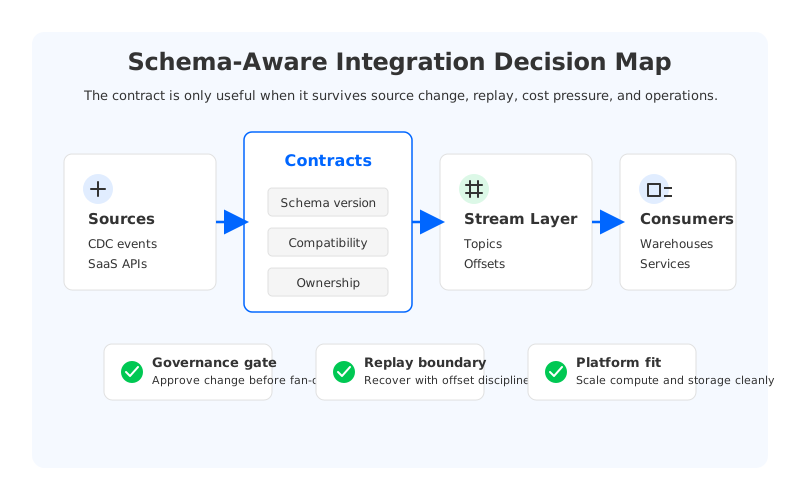
The hard part is that streaming contracts are not static API contracts with a request and a response. They are time-ordered commitments. Once a topic contains a bad event, a consumer may see it today, during a replay next month, or after a backfill that rebuilds a table from offset zero. Schema-aware integration therefore has to treat the log, the connector, the schema policy, and the recovery plan as one production surface.
1Why Teams Search for schema aware integration kafka
Kafka integration projects tend to expand in a predictable way. The first pipeline moves events from an operational system into a warehouse or search index. The second pipeline reuses the same topic for real-time services. The third pipeline adds CDC from another database, and the fourth sends selected records into a lakehouse table. At that point the topic is no longer a transport detail. It is a shared product interface, even when no team has formally declared it one.
Schema awareness matters because each consumer reads the same stream through a different failure lens. A warehouse sink cares about column compatibility and table evolution. A fraud service cares about low-latency fields and semantic meaning. A CDC platform cares about delete semantics, snapshots, transaction boundaries, and ordering. A data governance team cares about whether fields contain regulated data. None of those concerns lives inside Kafka's partition log alone, yet all of them are exposed through it.
The common mistake is to treat schema checks as a gate at the producer edge. That gate is necessary, but too narrow. A production contract needs to answer several questions before the first record lands in the topic:
- Which schema formats are accepted, and how are converters configured for Kafka Connect tasks?
- Which compatibility rule applies to this topic: backward, forward, full, or a stricter team-specific policy?
- Who approves a field deletion, a type change, or a semantic change where the field name stays the same?
- How will consumers replay data if a connector writes malformed output for several hours?
- Which metrics tell the platform team that schema failures are becoming an integration incident rather than an application bug?
These questions sound procedural, but they are architectural. If they are not answered in the platform design, they will be answered during an outage by whoever is holding the pager.
2The Operational Constraint Behind Connector-Heavy Platforms
Kafka Connect made integration pipelines repeatable by separating connector runtime concerns from application code. Source connectors pull from databases, files, or APIs. Sink connectors write into warehouses, search systems, object storage, and analytics engines. Converters translate records between Kafka Connect's internal data model and serialized formats such as Avro, JSON Schema, or Protobuf. That model is powerful because it standardizes plumbing, but it also concentrates operational risk in the connector platform.
The connector platform becomes the place where schemas, offsets, task failures, retries, and dead-letter queues meet. If the schema policy rejects records too aggressively, the connector stalls and consumer lag grows. If the policy accepts too much, invalid records spread into downstream systems and become harder to remove. If the platform team keeps long retention so consumers can replay safely, storage and network assumptions change. If retention is too short, the recovery plan depends on source-system snapshots that may no longer match the stream.
This is why schema-aware integration cannot be reduced to "use a schema registry." A registry can enforce compatibility between versions, but the operational model has to connect that rule to how records are produced, consumed, replayed, and audited. For example, a backward-compatible schema change may still break a sink if the target table has stricter constraints than the event format. A nullable field may be valid at the schema layer but invalid for a downstream model that treats the field as a feature. A CDC delete record may be perfectly valid and still require special handling in a lakehouse table.
The contract has three layers, and each layer has a different owner:
| Layer | Main question | Typical owner |
|---|---|---|
| Event schema | Can this serialized record be read by current and future consumers? | Producer team, schema governance |
| Integration behavior | Can source and sink connectors process, retry, and route failures correctly? | Data integration platform team |
| Streaming platform | Can the log retain, replay, scale, and isolate the workload under production pressure? | Kafka platform team, SRE |
The third layer is easy to ignore during planning because Kafka abstracts it well when traffic is steady. It becomes visible when traffic changes. Connector-heavy platforms often have uneven fan-out, bursty backfills, and catch-up reads after sink failures. Schema incidents amplify those patterns because the safest recovery action is usually replay, and replay turns old data into fresh load.
3Failure Handling, Schema, and Replay Trade-Offs
A schema-aware pipeline should define failure handling before a failure happens. The weak version of this design is a dead-letter queue attached to every connector and a dashboard that shows failed records. That is better than dropping data, but it does not define whether the DLQ is a temporary quarantine, a permanent audit log, or a replay source. It also does not define who fixes the record, who changes the schema, and who decides when the original sink can resume.
The stronger version treats replay as a first-class workflow. Offsets are not just consumer bookkeeping; they are the line between "this system has accepted the contract" and "this system needs to reprocess history." Kafka's consumer group model gives teams a practical way to track progress, reset offsets, and coordinate consumers, but the platform still has to decide how much history is available and how disruptive catch-up reads can become.
This is where schema policy meets infrastructure cost. Long retention makes recovery more forgiving. It also changes the storage profile of a topic. More consumers make event reuse more valuable. They also increase read fan-out and make cross-zone traffic more important in cloud deployments. More connectors create a richer integration ecosystem. They also increase the number of task states, plugin versions, credentials, schema dependencies, and error paths that have to be observed.
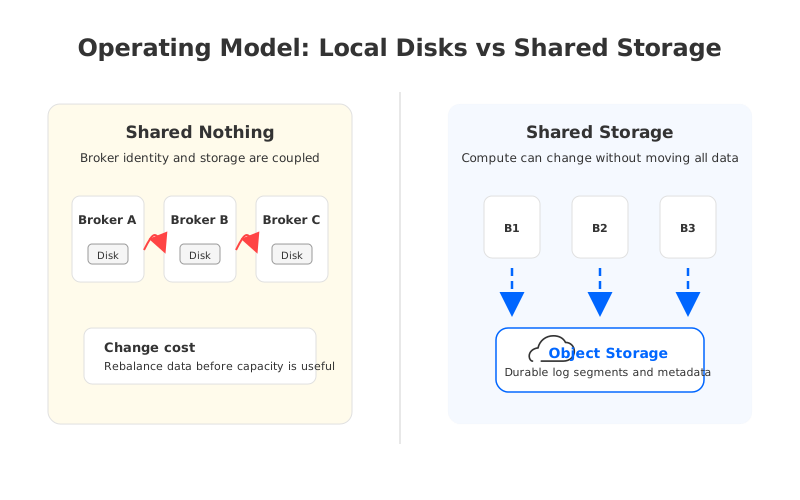
Traditional Kafka deployments use a shared-nothing model: brokers own local log segments, and replication protects data by copying it between brokers. That design has served Kafka well, but it ties compute decisions to storage placement. When a broker is added, removed, or replaced, the platform may need partition reassignment and data movement before the topology is healthy. During schema-driven replay or connector backfill, that coupling matters because the platform is already under read pressure.
A cloud-native shared storage model changes the operating question. Instead of asking how much broker-local disk must be provisioned for the next retention or replay event, the platform can ask which compute capacity is needed to serve the workload while durable data lives in object storage. That shift does not remove the need for schema governance or connector discipline. It makes those controls less likely to collide with storage rebalancing, broker replacement, and capacity preallocation.
4Evaluation Checklist for Platform Teams
Schema-aware integration is a buying and architecture decision as much as a development practice. A team that evaluates only serializer support will miss the production constraints. A team that evaluates only infrastructure cost will miss the contract semantics that determine whether replay is safe. The useful checklist sits between those two extremes.
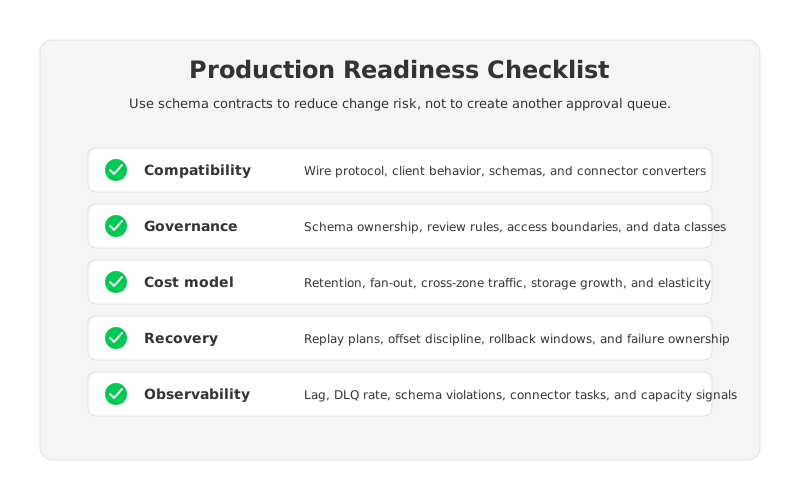
Start with compatibility. Kafka-compatible should mean more than "the client can connect." Validate producer and consumer behavior, Kafka Connect runtime assumptions, converter configuration, transaction needs, compression, authentication, ACLs, monitoring tools, and offset-management workflows. If the platform requires client changes before migration, the migration plan has to include application teams, not just infrastructure teams.
Then test governance against a real schema change. Add a field, delete a field, change a type, and change the meaning of a field without changing its name. The last case is the one that reveals whether the process is serious. Schema tooling can catch structural changes, but semantic changes require ownership. A mature contract has a human approval path for business meaning and a mechanical policy for serialization compatibility.
Cost should be evaluated through workload shape, not average throughput alone. Connector platforms often look quiet until they retry, backfill, or replay. Model retention, peak catch-up reads, consumer fan-out, cross-zone traffic, and storage growth. In cloud Kafka deployments, those dimensions can dominate the bill even when producer write throughput looks stable. A schema-aware program that encourages safer replay needs a platform cost model that can tolerate replay.
Resilience should be tested with failed connectors, not only failed brokers. Stop a sink, let lag build, introduce a schema violation, route records to a DLQ, fix the issue, and replay. The result should be a documented runbook: which offsets move, which connectors restart, which dashboards confirm recovery, and which team signs off. The runbook is part of the contract.
Security and data boundaries also belong in the checklist. Integration pipelines often move regulated fields from systems of record into broader analytical surfaces. Schema metadata should identify sensitive fields, but network placement, identity, encryption, and access control determine whether that metadata has operational force. For BYOC and private deployments, buyers should verify where data flows, where credentials live, and which operational access paths exist.
5How AutoMQ Changes the Operating Model
Once the evaluation reaches platform elasticity, storage growth, and replay pressure, AutoMQ becomes relevant as an architectural option rather than a product shortcut. AutoMQ is a Kafka-compatible streaming platform that separates broker compute from durable storage by using a shared storage architecture backed by object storage. The Kafka API surface remains familiar to producer, consumer, and connector workloads, while the storage model changes the way platform teams think about capacity and recovery.
The practical effect for schema-aware integration is not that AutoMQ "solves schemas." Schema ownership, compatibility policies, connector configuration, and DLQ workflows still need to be designed. The difference is that the streaming platform is less tied to broker-local disk planning. If a schema incident requires replay, the platform team can reason about compute capacity and durable storage separately. If connector traffic grows unevenly, scaling does not have to start with a large data movement exercise. If a cloud deployment is sensitive to cross-zone data transfer, AutoMQ's architecture and zone-aware traffic controls give teams another lever to evaluate.
This distinction matters during migration from an existing Kafka estate. The safer migration path is rarely a dramatic platform swap. It is a controlled sequence: mirror representative topics, validate client and connector compatibility, compare offset behavior, run replay tests, check governance workflows, and then move workloads by risk tier. AutoMQ's Kafka compatibility is useful here because the migration conversation can focus on operating model and cost structure instead of rewriting application integrations.
For connector-heavy teams, AutoMQ managed Kafka Connect can also reduce the amount of integration runtime that platform teams operate themselves. That does not remove the need to understand connector behavior. It changes the boundary between application data contracts and platform operations. The platform team can spend more time on schema policy, observability, replay design, and cloud architecture, and less time maintaining connector runtime scaffolding.
The most defensible way to evaluate AutoMQ is to run the same checklist used for any Kafka-compatible platform:
- Can existing Kafka clients, connectors, ACL patterns, and observability tools work with acceptable change?
- Does the shared storage model improve the team's retention, replay, and elasticity constraints?
- Are BYOC or private deployment boundaries aligned with security and compliance requirements?
- Can the team prove recovery behavior with a connector failure and an offset-reset exercise?
- Does the cost model hold under catch-up reads and consumer fan-out, not only under steady writes?
That framing keeps the decision technical. Schema-aware integration is not a branding exercise around data contracts. It is the discipline of making schema change, replay, and platform capacity part of the same production design.
If your team is evaluating Kafka-compatible infrastructure for connector-heavy or CDC-heavy workloads, use the checklist above against a real topic and a real replay scenario. To compare that result with AutoMQ's shared storage model, start from the AutoMQ documentation and deployment guides: Explore AutoMQ.
6References
- Apache Kafka Documentation: Kafka Connect
- Apache Kafka Documentation: Concepts and Terms
- Apache Iceberg Documentation: Schema Evolution
- Confluent Documentation: Schema Evolution and Compatibility
- AutoMQ Documentation: Shared Storage Architecture
- AutoMQ Documentation: Compatibility with Apache Kafka
- AutoMQ Documentation: Kafka Connect Overview
- AutoMQ Documentation: Inter-Zone Traffic Overview
7FAQ
7.1What does schema-aware integration mean in Kafka?
Schema-aware integration means the pipeline understands more than message transport. It defines serialization formats, compatibility rules, connector converter behavior, ownership for schema changes, replay procedures, and observability for schema failures. Kafka still provides the durable ordered log; the integration platform adds the contract discipline around that log.
7.2Is a schema registry enough for streaming data contracts?
A schema registry is necessary in many environments, but it is not enough by itself. It can enforce compatibility rules for schemas, yet it cannot decide semantic ownership, DLQ policy, replay windows, connector restart procedures, or cloud capacity planning. Those decisions belong in the platform operating model.
7.3How should teams test schema-aware Kafka pipelines?
Use a realistic connector workflow. Introduce compatible and incompatible schema changes, stop a sink connector, create lag, route invalid records to a DLQ, fix the schema or data issue, and replay from a known offset. The test should produce both technical evidence and an operational runbook.
7.4Where does AutoMQ fit in this architecture?
AutoMQ fits at the Kafka-compatible streaming platform layer. It does not replace schema governance, but its shared storage architecture can change how teams handle retention, replay pressure, elasticity, and cloud traffic patterns. That makes it relevant when schema-aware integration programs depend on safe replay and connector-heavy operations.


