
Table of Contents
Table of Contents
Teams usually search for schema compatibility gates kafka after a change has already hurt someone. A producer shipped a field rename that looked harmless in code review. A downstream job started failing because a nullable field was not really nullable in its runtime model. A connector kept running, but the warehouse table filled with bad records. Kafka accepted bytes, ordered records within partitions, and delivered them to consumers. The production breakage happened because the contract around those bytes was weaker than the deployment pipeline.
That distinction matters. Kafka is a durable event log, not a contract negotiator. Schema Registry systems, CI checks, topic ownership, and consumer test suites provide the contract layer around Kafka. A compatibility gate is the point where a proposed schema change is evaluated before it reaches a production topic. The goal is not to freeze schemas. The goal is to let teams evolve events without making every consumer a hostage to the fastest producer release.
The hard part is that schema compatibility is never only a serialization problem. It touches service ownership, release order, retention, replay, connector behavior, migration risk, and platform cost. A good gate catches a bad Avro, Protobuf, or JSON Schema change before it breaks production. A better gate also tells the platform team what is exposed if that change is approved.
1Why Teams Search for schema compatibility gates kafka
The search term is specific because the failure mode is specific. Teams are not asking whether schemas are useful. They are asking where to put enforcement so that producers can move quickly while consumers remain safe. That question shows up in CI pipelines, internal developer portals, and platform migration programs.
CI is the first obvious place. A producer repository can validate a proposed schema against the previous version before merge. That catches many backward-incompatible changes, especially field removals, type changes, enum changes, and required-field additions. It also gives developers fast feedback, which is better than discovering the issue from a consumer lag alert.
CI alone is not enough. A repository may know its own producer, but it rarely knows every consumer. A shared platform should know which services subscribe to the topic, which connectors export the data, which retention policy allows replay, and which business domain owns the contract. When a schema change crosses a domain boundary, the gate should behave less like a unit test and more like a production-risk review.
The failure pattern is familiar to platform teams. The first version of a schema process is usually a convention: producers register schemas, consumers tolerate old records, and teams avoid breaking changes. The second version becomes a checklist. The third version becomes a gate because conventions do not survive high release frequency, multiple teams, and long retention windows.
2Compatibility Is a Contract, Not a File Format
Schema compatibility modes compress a lot of risk into a machine-checkable rule. Backward compatibility protects newer consumers reading older data. Forward compatibility protects older consumers reading newer data. Full compatibility tries to preserve both directions. Those rules matter in Kafka because retained records can outlive several application releases, and replay can make old data relevant again.
The contract is wider than the registry rule. A field can be technically compatible and still operationally dangerous. Changing a field's meaning without changing its name may pass the registry but break a fraud model. Adding an optional field may be safe for consumers but expensive for a downstream sink if it increases payload size or expands a table schema.
For production Kafka platforms, the gate should therefore evaluate four layers:
- Schema rule: Does the proposed change satisfy the configured compatibility mode for its subject?
- Consumer behavior: Are known consumers tolerant of the change, including batch jobs, stream processors, and connectors?
- Topic contract: Does the change match the topic's domain, ownership, retention, and data classification?
- Operational blast radius: Could approval trigger replay pressure, connector failures, schema drift, or migration blockers?
This is why a mature gate often lives outside the schema registry itself. The registry answers whether a schema version is allowed under a compatibility rule. The platform gate decides whether the whole production system is ready for that version.
3Where the Gate Belongs in the Release Path
A useful schema gate should be early enough to protect production and late enough to have real context. Put it only in the registry, and developers may discover failures after a release artifact has already been built. Put it only in CI, and the gate may miss consumer ownership and runtime exposure. Put it only in manual approval, and teams will route around it during urgent releases.
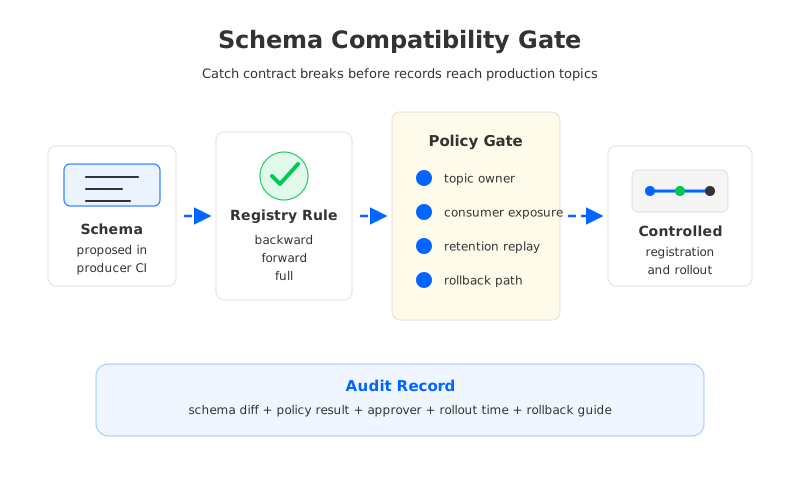
The practical pattern is layered. Local developer checks catch obvious mistakes. CI validates schema evolution against the registry rule. A platform policy gate adds ownership, topic, and consumer context. Production registration and rollout controls then make the approved schema available under a traceable version.
| Gate layer | What it catches | What it usually misses |
|---|---|---|
| Local schema test | Syntax, generated code, obvious incompatible changes | Shared consumer context |
| CI registry check | Compatibility mode violations and subject naming mistakes | Runtime impact and ownership exceptions |
| Platform policy gate | Domain boundary, approvals, retention, connector exposure | Bugs in consumer business logic |
| Production rollout check | Registry state, deployment order, rollback path | Design mistakes already approved upstream |
There is no single correct place to enforce compatibility. Each layer protects a different failure boundary, and the layers should share the same contract metadata instead of retyping it in separate tools.
4The Governance Pressure Behind Shared Streaming Platforms
Schema changes become political when Kafka becomes shared infrastructure. A topic may start as an internal stream for one application and later become a source for analytics, search, billing, machine learning features, or a customer-facing API. The original producer team still owns the write path, but not every consequence of the event shape.
That is the moment when compatibility gates need ownership data. The platform should know who owns the topic, who owns the schema, which teams consume it, and which changes require approval from a data steward or domain owner. Without that metadata, every risky change becomes a detective exercise.
The cost side is easy to understate. A rejected schema is low cost. A schema that passes but causes a consumer to fail may trigger reprocessing, dead-letter growth, connector retries, incident response, and backfill traffic. In a traditional Shared Nothing architecture, that load can land on brokers that already manage local storage, partition leadership, replication, and cache pressure. A schema gate cannot solve broker sizing, but it can stop schema evolution from becoming an unplanned load test.
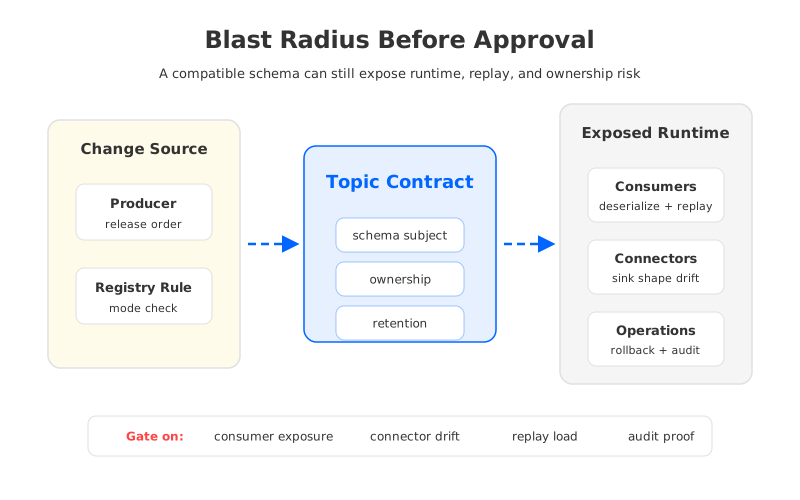
Governance teams often focus on audit evidence: who approved the change, which policy was applied, and when the version entered production. SREs ask a different question: if this change is wrong, how do we stop the damage? The gate should answer both. Audit evidence helps after the fact, while rollback paths, compatibility modes, and consumer test coverage reduce the odds that the incident happens at all.
5A Production Checklist for Kafka Schema Gates
The checklist below is operational. It assumes you already have a schema registry or equivalent contract repository. The question is whether the compatibility process is ready for production scale.
- Define subject ownership. Every schema subject should map to a topic, owning team, service, repository, and escalation path. Orphaned subjects become migration risk.
- Choose compatibility by domain. Not every topic needs the same mode. Public event streams, internal command topics, and connector sink topics carry different release-order assumptions.
- Test generated clients. A registry check can pass while generated code or consumer deserialization fails. CI should compile or test representative consumers when the contract is widely shared.
- Record consumer exposure. The gate should know which consumer groups, connectors, and stream processing jobs depend on the subject.
- Protect replay paths. Long retention means old records remain part of the contract. A gate that ignores replay can approve changes that only fail during recovery.
- Attach rollback instructions. Reverting application code is not the same as unregistering a schema version, restoring a connector, or draining bad records.
The checklist works because it treats schema compatibility as a production lifecycle. A schema version is proposed, checked, approved, registered, observed, and eventually superseded. Each stage leaves evidence. Each stage also gives the platform a place to stop a risky change before it becomes a runtime failure.
6Migration Risk: The Gate Has to Travel With the Topic
Schema compatibility gets harder during Kafka migration. A migration may move topics between clusters, change network paths, switch client bootstrap addresses, or split a shared cluster into multiple domains. If schema policy lives in one place and topic migration state lives somewhere else, the cutover plan has a blind spot.
The gate should travel with the topic as metadata. Before migration, platform teams should export subject versions, compatibility modes, topic ownership, consumer groups, connector dependencies, and rollback rules. During migration, they should validate that producers and consumers see the same schema subjects and that the target cluster can support the same contract. After cutover, drift detection should compare source-of-truth policy with registry state and cluster state.
This is where Kafka-compatible infrastructure matters. Application teams do not want a schema governance project to become a client rewrite. They want the same Kafka protocol behavior, serializers, registry integration pattern, and a clearer operating model underneath. Schema gates reduce semantic risk. Kafka-compatible migration planning reduces infrastructure risk.
7How AutoMQ Changes the Operating Model
Once the neutral gate is in place, the architecture underneath Kafka becomes part of the evaluation. AutoMQ is a Kafka-compatible streaming platform that uses a Shared Storage architecture: durable stream data is moved away from broker-local disks and into an object-storage-backed design with WAL storage. AutoMQ does not replace Schema Registry, CI tests, or domain approvals. It changes the operational surface around those controls.
A schema gate decides whether an event contract can evolve. AutoMQ helps platform teams run the Kafka-compatible data plane behind that contract with stateless brokers, independent compute and storage scaling, and documented support for zero cross-AZ traffic in relevant deployment patterns. When brokers are less tied to local persistent data, platform teams can separate contract risk from some data-movement and capacity-planning work that traditionally surrounds Kafka operations.
For schema governance, the benefit is indirect but useful. A replay-heavy consumer test, connector recovery, or migration validation still needs capacity. On Shared Nothing Kafka, the platform may evaluate those activities alongside broker-local storage, partition reassignment, and replication overhead. On AutoMQ's Shared Storage architecture, storage durability is object-storage-backed, brokers are stateless, and scaling decisions are less coupled to moving retained log data between brokers.
Deployment boundary also matters. AutoMQ BYOC is relevant when the customer wants the control plane and data plane in their own cloud account. AutoMQ Software is relevant when the platform must run in a private data center. In both cases, schema governance remains the customer's policy layer. AutoMQ provides a Kafka-compatible infrastructure base for migration, scaling, and multi-AZ operations after the contract gate has done its job.
8Build the Gate as a System of Record
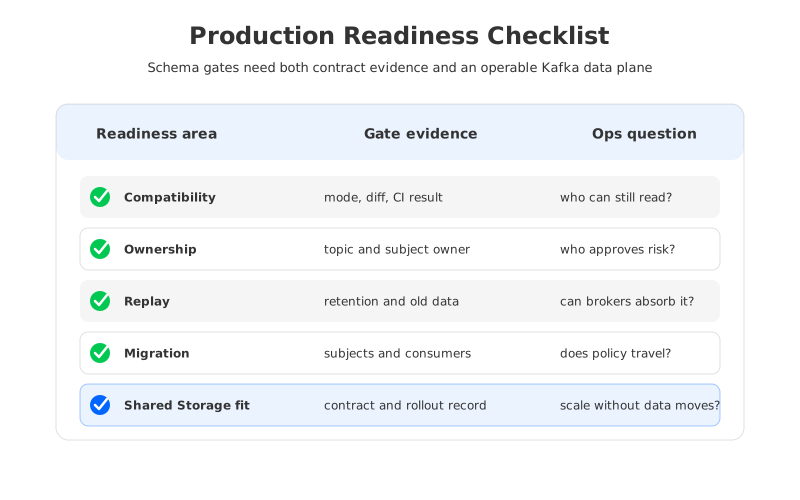
The simplest sustainable design is to treat the schema gate as a system of record for contract changes. A request should contain the schema diff, compatibility result, topic, subject, owner, consumer exposure, risk tier, approval result, rollout time, and rollback guidance. That record should be readable by humans and automation.
This design prevents two common failure modes. The first is "registry says yes, production says no," where a technically compatible schema still breaks a known consumer. The second is "approval says yes, nobody can prove why," where a risky exception is approved in chat and forgotten until an audit. A system-of-record gate makes both cases visible.
There is a useful test for readiness: pick one critical topic and simulate a breaking change. Can the platform show which policy rejects it, which consumers would have been exposed, who would have approved an exception, how rollback would work, and whether the underlying Kafka infrastructure can absorb replay or validation load? If the answer requires three dashboards, two Slack threads, and one person who remembers the migration, the gate is still too informal.
Kafka schema compatibility is not a paperwork exercise. It is a production safety mechanism for systems where old data, new code, and many consumers meet in the same log. Start by making the gate explicit. Then test whether the infrastructure behind it lets you recover, replay, migrate, and scale without turning every schema change into an incident review. If your team wants to evaluate that operating model on Kafka-compatible Shared Storage architecture, start an AutoMQ BYOC review.
9References
- Apache Kafka Documentation
- Apache Kafka Documentation: Message delivery semantics
- Apache Kafka Documentation: Kafka Connect
- Confluent Schema Registry: Schema evolution and compatibility
- AutoMQ Architecture Overview
- AutoMQ Compatibility with Apache Kafka
- AutoMQ Stateless Broker
- AutoMQ Eliminate Inter-Zone Traffic
10FAQ
10.1What are schema compatibility gates in Kafka?
Schema compatibility gates are automated or semi-automated checks that evaluate a proposed event schema change before it is registered or deployed to production. They usually combine Schema Registry compatibility checks, CI tests, ownership metadata, approval rules, and rollout controls.
10.2Are schema compatibility gates the same as Schema Registry?
No. Schema Registry stores schemas and enforces compatibility rules for subjects. A production gate uses those registry checks, but it also considers topic ownership, consumer exposure, connector impact, migration state, replay risk, and rollback evidence.
10.3Which compatibility mode should a Kafka topic use?
The right mode depends on release order and data usage. Backward compatibility is common when newer consumers must read older records. Forward compatibility matters when older consumers may read newer records. Full compatibility is stricter and is useful for widely shared topics, but it may slow evolution if the domain changes frequently.
10.4Do schema gates prevent every production incident?
No. They reduce a specific class of contract incidents. They do not prove that every consumer business rule is correct, and they do not replace integration tests, observability, rollback plans, or incident response. They make bad schema changes harder to ship unnoticed.
10.5How does AutoMQ relate to schema compatibility?
AutoMQ does not replace schema governance tools. It provides a Kafka-compatible streaming infrastructure with Shared Storage architecture and stateless brokers. That can make replay, migration, scaling, and multi-AZ operations easier to evaluate around a schema governance workflow.


