
Table of Contents
Table of Contents
A Kafka migration rarely fails because one broker cannot accept produce requests. It fails when the surrounding contracts move out of order. The Schema Registry is one of those contracts: small enough to be treated as a dependency, central enough to stop a payment pipeline, analytics feed, or fraud model when it returns the wrong schema ID.
That is why teams search for schema registry cutover kafka after the migration has become real. The cluster endpoint is changing, application owners are asking whether they must redeploy, security teams want to know where schema metadata will live, and SREs are trying to keep rollback possible after the first producer writes to the new platform.
The practical mistake is to treat Schema Registry as a sidecar to the Kafka cutover. Kafka clients read and write records; serializers and deserializers call the registry to resolve schema IDs, register versions, and enforce compatibility rules. If those paths are not planned together, the migration can look healthy at the broker layer while consumers fail at runtime.
1Why teams search for schema registry cutover kafka
Most Kafka migrations start with infrastructure pressure: hardware refresh, rising cloud cost, cross-AZ traffic, end-of-life operations, or a move from self-managed clusters to a Kafka-compatible managed architecture. The first plan usually focuses on topics, partitions, ACLs, bootstrap servers, consumer offsets, and replay strategy. Those are the visible pieces of the platform.
Schema Registry enters the plan when the migration touches typed data contracts. Avro, Protobuf, and JSON Schema serializers commonly embed a schema ID in the record payload and use the registry API to map that ID back to a schema definition. The registry is not merely a catalog. It is a runtime dependency for applications that use schema-aware serialization.
The cutover question usually appears in four forms:
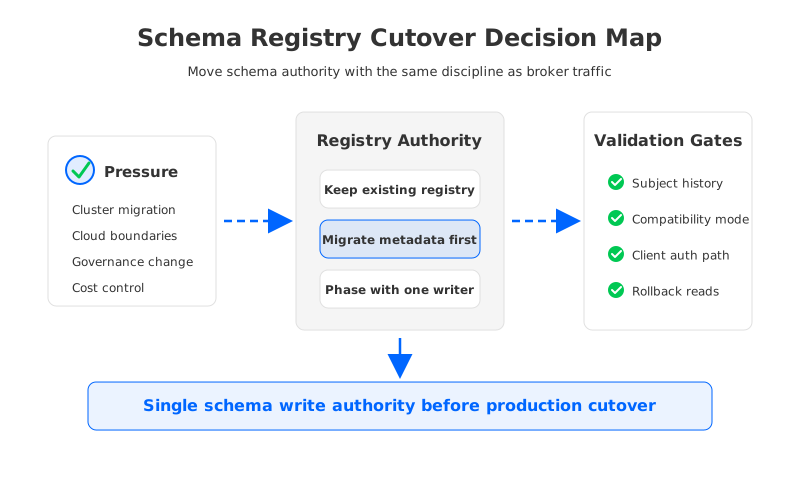
- Should the new streaming platform reuse the existing registry, run a new registry, or migrate schema metadata into a new registry?
- Can producer and consumer teams move independently, or must all schema-aware clients switch endpoints together?
- How should compatibility modes, subject naming strategies, and access control be verified before production traffic moves?
- What rollback path remains if some clients have already registered new schema versions after the cutover?
The answer depends less on the brand of Kafka-compatible infrastructure and more on the operational boundary being moved. A cluster-only migration can sometimes leave the registry in place. A platform migration that changes security, cloud account ownership, network topology, or governance model needs a registry plan that is as explicit as the broker plan.
2The production constraint behind the problem
Schema Registry cutover is difficult because schemas are shared state with application-level meaning. A topic can be replicated and replayed; a schema subject has a history of versions, compatibility decisions, and IDs that client libraries assume are stable within their serialization format. If you duplicate that state without controlling write ownership, two registries can diverge silently.
That divergence is more dangerous than an obvious outage. A failed registry call produces a visible error. A registry that accepts a schema under a different subject naming convention, a different compatibility mode, or a different identity boundary can create data that only part of the estate can read. By the time consumers report deserialization errors, the bad records may already be durable in the new cluster.
The production constraint is not "copy the schemas." It is "move the authority for schema evolution without breaking record compatibility." That requires the migration team to reason about three planes:
| Plane | What changes during cutover | Failure mode if ignored |
|---|---|---|
| Data plane | Producers and consumers move to a new Kafka endpoint. | Records arrive on the new cluster but clients still resolve schemas from an unreachable or inconsistent registry. |
| Contract plane | Subject history, schema IDs, compatibility modes, and serializers remain consistent. | Applications deserialize older records but fail on newly registered versions. |
| Control plane | Ownership, access policy, network routing, observability, and rollback ownership are clear. | Teams cannot tell whether a failure belongs to the app, registry, network, or platform. |
This is why registry cutover cannot be delegated entirely to application teams. Application owners understand their schemas, but platform teams own the shared runtime path. If each team chooses its own registry endpoint and timing, the organization loses the one property that a registry is meant to provide: a consistent contract boundary for event data.
3Three architecture options for registry cutover
The first decision is architectural. A few viable patterns exist, and each one optimizes for a different risk profile.
The simplest pattern is to keep the existing Schema Registry while moving Kafka traffic to the new cluster. This works when the registry is reachable from the new client environment, schema ownership is stable, and the serialization format continues to use the same IDs and subject history. It minimizes metadata movement, but it can leave an old operational dependency in the middle of a new platform.
The second pattern is to migrate registry metadata into a new registry before application cutover. This creates a cleaner platform boundary when the new environment has different network, security, or ownership requirements. It also raises the bar for validation: the team must verify subject names, versions, compatibility settings, and ID behavior before producers register new schemas.
The third pattern is a phased dual-registry model. It sounds flexible, but it is the easiest to get wrong. Dual reads may be acceptable for controlled validation, yet dual writes to independent registries can create split-brain schema evolution. If phasing is necessary, define a single write authority at every point in time.
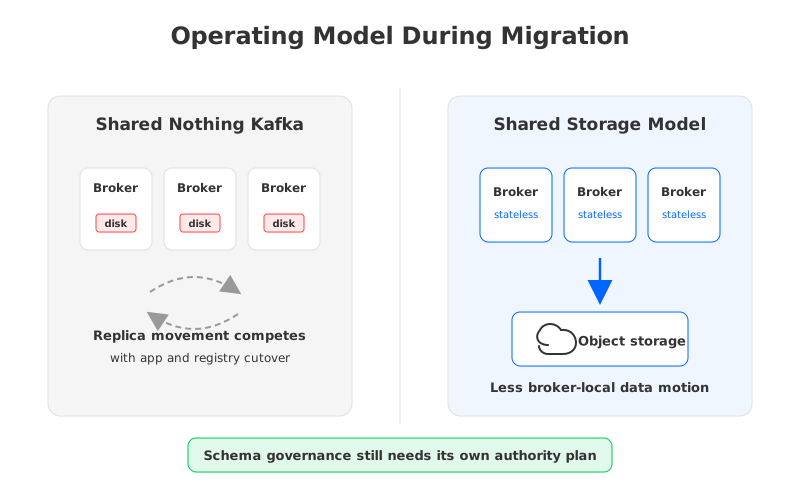
The broker architecture behind the migration matters because it changes how much work competes with the registry cutover. Traditional shared-nothing Kafka binds serving and durable storage to broker-local disks. When teams migrate large datasets, they must plan replica movement, local disk capacity, broker replacement, and cross-AZ replication at the same time as client and registry changes.
Shared storage architectures change that operating model. Instead of treating each broker as the long-term home of a local data replica, compute nodes can be made more stateless while durable data is stored in object storage and a write-ahead log protects the hot write path. This does not remove the registry plan, but it reduces the storage movement competing for the same cutover window.
4A cutover checklist for platform teams
A useful schema registry cutover checklist should be written around authority, not tasks. "Export schemas" and "change endpoint" are tasks. The deeper question is who can create the next version of a contract while traffic is moving. Once that is clear, the plan becomes testable.
Start with inventory. List every schema-aware producer and consumer, registry endpoint, subject naming strategy, and compatibility mode. Include batch jobs, connectors, stream processors, and operational tools, not only online services. Many incidents come from a low-traffic producer that wakes up during the migration and registers a schema against the wrong authority.
Then test compatibility under production-like paths. A registry that is reachable from a laptop may not be reachable from a private subnet, container runtime, VPC peering path, or cross-account environment. Security validation should include TLS, authentication, authorization, service identity mapping, and audit logging. Network validation should include private connectivity and DNS behavior, especially when client libraries cache registry URLs or egress is restricted.
The readiness checklist should make these decisions explicit:
- Write authority: Which registry accepts new schema registrations before, during, and after cutover? If the answer changes, define the exact gate.
- Read authority: Which registry resolves IDs for old records, new records, and replayed records? Replays are where hidden assumptions often surface.
- Compatibility policy: Are compatibility modes identical across subjects, and are exceptions documented with owners?
- Subject naming: Are topic-name, record-name, and custom subject naming strategies preserved across services and connectors?
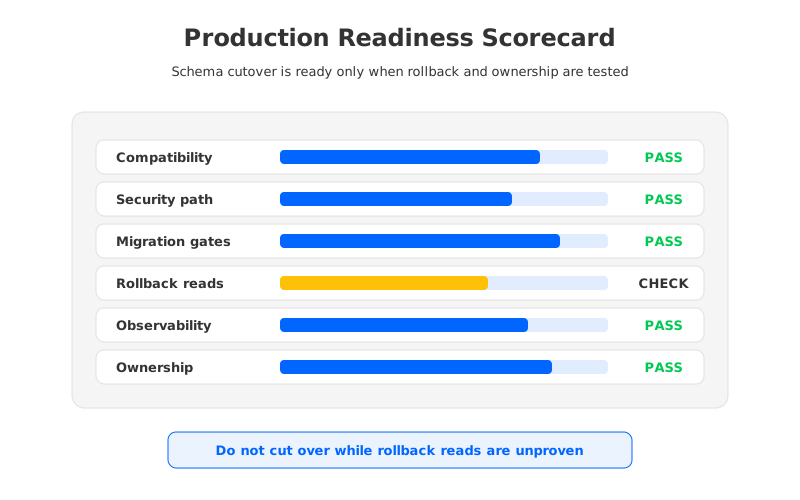
- Rollback boundary: If producers write new schemas after cutover, can the old platform read those records during rollback?
- Observability: Can the team separate broker errors, registry errors, serializer errors, and network errors in logs and metrics?
Many plans say "we can roll back by changing bootstrap servers." That is true only when the record stream and the contract stream remain compatible in both directions. If a producer registers a new schema version in the new registry and writes records that old consumers cannot resolve, the rollback path has already narrowed.
5Migration sequence that keeps rollback possible
The safest sequence is boring on purpose. First, freeze risky schema evolution or require explicit approval for new versions during the migration window. Second, copy or verify registry metadata according to the chosen architecture. Third, run compatibility tests with real serializers and deserializers. Fourth, move a bounded set of producers and consumers while monitoring both broker and registry paths. Fifth, reopen schema evolution after rollback criteria are updated.
Data and contracts age differently. A Kafka topic can hold records from months ago, and a consumer may deserialize those records after the application has already been redeployed. The registry plan must validate old schema IDs and old subject versions, not only the latest version of each schema.
For migrations that include Kafka Connect, stream processing, or CDC, the checklist needs one more layer. Connectors may generate schemas automatically, and stream processors may materialize state based on serialized records. Moving the registry without testing those components can create a false sense of readiness: core services pass, while downstream jobs fail on schemas registered by infrastructure rather than an application team.
The cutover runbook should include concrete stop conditions: registry 4xx or 5xx errors over threshold, unknown schema ID errors, new subject creation outside the approved list, or consumer lag rising together with deserialization errors. The exact thresholds depend on the environment, but the rule is universal: schema failures should be visible as schema failures, not buried under generic application exceptions.
6How AutoMQ changes the operating model
After the registry plan is clear, the next question is whether the streaming platform itself makes the cutover easier or harder to operate. Cloud-native Kafka architecture becomes relevant here. A platform migration is not only about API compatibility; it is also about how much state the team must move, rebalance, and protect during the change.
AutoMQ is a Kafka-compatible cloud-native streaming system that separates compute from storage while preserving Kafka protocol compatibility. Its architecture uses object storage as the durable storage layer and stateless brokers for serving traffic. In migration planning, that distinction matters because broker replacement, capacity scaling, and fault recovery are less tied to moving large local disks between machines.
That does not make Schema Registry disappear. AutoMQ does not remove the need to govern schemas, validate compatibility, or plan registry authority. The benefit is operational focus: when the broker layer is less dominated by local storage movement, platform teams can spend the migration window on client compatibility, governance, access control, and rollback behavior instead of simultaneous data rebalancing work.
Cost and network topology also belong in the decision. Traditional Kafka replication can amplify cross-AZ data movement because replicas are maintained at the broker layer. In cloud environments, cross-AZ traffic can become a recurring cost and migration constraint. AutoMQ's shared-storage model and zero cross-AZ traffic design are relevant for teams that want a Kafka-compatible platform with a different cost and failure-domain profile.
The right evaluation is not "does this platform have a registry feature?" The better question is whether the platform lets your team draw clean boundaries:
| Boundary | What the team should verify | Why it matters |
|---|---|---|
| Kafka compatibility | Client protocol, topic behavior, offsets, consumer groups, and tooling. | Registry cutover should not be mixed with avoidable client rewrites. |
| Storage operations | Broker replacement, scaling, recovery, and data movement. | A smaller storage migration burden leaves more room for contract validation. |
| Network control | Private routing, cross-AZ behavior, and cloud account boundaries. | Registry and client paths must stay reachable during phased moves. |
| Governance | Schema authority, ACLs, audit logs, and ownership. | The registry is a production control point, not a convenience service. |
| Rollback | Old and new platforms can read the records they may receive. | Rollback is a compatibility property, not a button. |
If this framework points toward AutoMQ for the streaming layer, keep the registry work explicit. Pair the AutoMQ migration plan with a registry authority plan, a serializer test suite, and a rollback table for every critical producer and consumer group. That combination turns a platform migration from a weekend endpoint change into a controlled production transition.
For teams evaluating a Kafka-compatible migration, the most useful next step is to map one real application flow end to end: producer, schema subject, registry endpoint, topic, consumer group, replay path, and rollback path. AutoMQ's architecture overview shows how shared storage and stateless brokers change the infrastructure side of that map: review the AutoMQ technical architecture.
7References
- Apache Kafka documentation
- Confluent Schema Registry documentation
- Confluent Schema Registry schema evolution and compatibility
- Confluent Schema Registry migration documentation
- AutoMQ technical architecture overview
- AWS PrivateLink documentation
8FAQ
8.1Can Kafka migration use the same Schema Registry?
Yes, when the existing registry remains reachable, secure, and authoritative for all schema-aware clients after the Kafka endpoint changes. This is often the lowest-risk option for a cluster-only migration. It is weaker when the migration also changes cloud accounts, network boundaries, security ownership, or governance.
8.2Should schemas be migrated before or after Kafka traffic moves?
Schema metadata should be verified before production traffic moves. If the target architecture uses a new registry, copy and validate subjects, versions, compatibility modes, and access policy before producers can register new schemas. Traffic cutover should happen only after real serializers and deserializers have passed read and write tests against the planned registry path.
8.3What is the biggest rollback risk in schema registry cutover?
The biggest risk is new schema evolution after cutover. If a producer writes records with a schema that only the new registry or new consumers understand, changing Kafka bootstrap servers back to the old cluster may not restore service. Rollback planning must include schema ID resolution and compatibility, not only broker connectivity.
8.4Does AutoMQ replace Schema Registry?
No. AutoMQ addresses the Kafka-compatible streaming infrastructure layer through a shared-storage architecture and stateless brokers. Schema Registry remains a contract governance component that should be planned, secured, monitored, and tested as part of the migration.
8.5How should teams test a schema registry cutover?
Use real client libraries and production-like network paths. Test old record reads, new writes, schema registration, compatibility rejection, connector behavior, stream processing jobs, authentication, authorization, DNS, and rollback. API-only tests do not prove that applications can serialize and deserialize records safely during migration.


