
Table of Contents
Table of Contents
Teams usually search for schema registry operating model kafka after the registry has already become important enough to hurt. A producer team wants to move faster. A consumer team wants guarantees before it builds against a topic. The governance team wants audit evidence. The platform team wants one place to enforce compatibility without turning every schema update into a ticket queue. Kafka is still doing its job; the weak link is the operating model around the schemas.
A schema registry is not only a service endpoint for Avro, Protobuf, or JSON Schema definitions. In a mature streaming platform, it becomes a control point for contracts: which changes are allowed, who owns exceptions, how consumers discover versions, how bad changes are rolled back, and how teams prove that a topic met its interface. That control point sits above Kafka, but retention, replay, migration, network placement, and broker recovery affect how confidently a team can enforce contract rules.
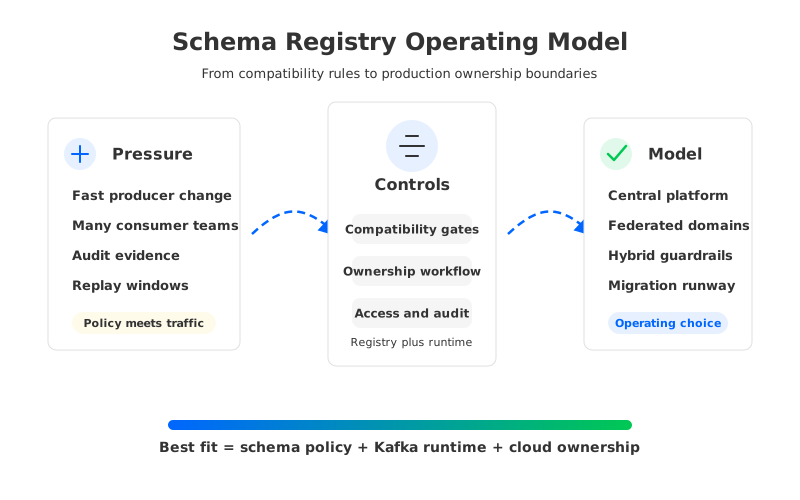
The practical question is not "which registry should we install?" It is "which operating model lets many teams change event schemas safely while the Kafka-compatible platform remains cost-effective, observable, and recoverable?" That needs a wider frame: ownership boundaries, enforcement paths, migration design, and the streaming substrate.
1Why teams search for schema registry operating model kafka
The search intent is rarely basic schema education. Platform owners usually need to standardize a shared registry across domains, move from ad hoc producer-side validation to governed compatibility rules, or prepare a Kafka migration without breaking consumers that depend on existing subjects and versions.
That work creates an organizational problem before it creates a technical one. Producer teams know field meaning. Consumer teams know risk. Platform teams own Kafka clusters, ACLs, CI templates, runbooks, and observability. Governance teams own retention, access, audit, and data classification. A registry can store schema versions, but it cannot decide alone who may make a breaking change.
Three symptoms usually show that the registry operating model is immature:
- Compatibility is centralized, ownership is not. The platform can reject incompatible schemas, but it cannot tell whether a compatible field changed business meaning.
- Approval is manual because risk is invisible. Teams use tickets or meetings when they cannot see which consumers depend on a subject, which topics carry sensitive fields, or which rollback path exists.
- Recovery is treated as a Kafka problem after governance fails. A bad schema rollout becomes an offset reset, replay, quarantine, or downstream repair exercise, and the registry workflow did not rehearse any of it.
The operating model has to make these handoffs explicit. A strong registry program lets producers publish within rules, consumers understand change risk, and the platform team enforce shared policy without reviewing every domain decision.
2The governance pressure behind shared streaming platforms
Kafka makes data contracts feel deceptively easy because the interface is stable. Producers write records to topics. Consumers read records at offsets. Kafka Connect moves data between systems. Transactions, idempotent producers, consumer groups, and ACLs give the platform a rich set of production primitives. A schema registry adds structure to that interface, but once it becomes mandatory, it changes how the platform is operated.
Contract enforcement increases retained evidence. Teams keep old schema versions, raw topics, rejected records, compatibility exception logs, and replayable event history. It also increases coordination. A producer cannot change a key field without understanding consumer impact. A consumer cannot rely on a certified stream unless it trusts the compatibility rules and the recovery path. Auditors care that the organization can prove which version was active when a record entered the platform.
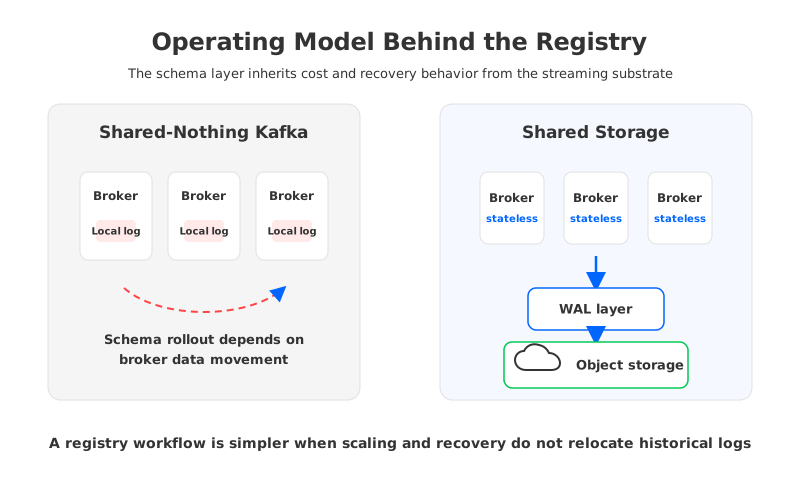
Traditional Kafka deployments add another layer. In the shared-nothing model, brokers own local log storage, and replication is handled by the Kafka cluster. That architecture is familiar and reliable, but it couples compute, storage, and recovery behavior. Longer retention for contract evidence means more broker-local capacity or tiered-storage planning. Replays and backfills can compete with live traffic. Partition movement and broker replacement can become part of the risk model for a registry change.
Tiered storage can improve the economics of historical retention by moving older log segments to remote storage. It is useful when retained bytes grow faster than live traffic. But it does not make brokers stateless, and it does not remove every operational constraint around hot data, leader placement, reassignment, or recovery. Schema registry operating models need to distinguish "where old data can live" from "how quickly the platform can absorb change, recover, and replay without creating another incident."
3Contracts, ownership, access, and audit trade-offs
A useful operating model separates registry responsibilities from platform responsibilities. The registry should manage schema versions, subject naming, compatibility modes, and metadata around evolution. The platform should manage topics, ACLs, quotas, retention, encryption, network boundaries, connectors, observability, and recovery. The data domain should own business meaning. Problems begin when one layer pretends to own all three.
The cleanest split is not always the most centralized one. A central platform team can run the registry, publish subject naming patterns, define baseline compatibility modes, and integrate checks into CI. Domain teams can own semantic review, consumer communication, and exception requests. Security teams can define which schemas imply sensitive data handling. SREs can define what happens when a rollout must be paused, replayed, or rolled back.
That produces three common operating models:
| Model | Works well when | Failure mode to watch |
|---|---|---|
| Central platform registry | Many teams need consistent compatibility and tooling | Platform becomes a bottleneck for domain meaning |
| Federated domain ownership | Domains understand consumers and semantics deeply | Compatibility policy drifts across teams |
| Hybrid guardrails | Platform sets rules while domains approve meaning | Requires clear escalation and audit trails |
Most production organizations end up with the hybrid model. The platform owns the registry service, default compatibility policy, subject naming rules, CI templates, and observability. Domains own semantic compatibility and consumer communication. Security and governance own classification and audit requirements. The model is successful when these responsibilities are boring enough to run repeatedly.
Access control is where the model becomes concrete. The registry may need its own authentication and authorization, but it also has to align with Kafka ACLs and topic ownership. A user who can register a schema for a subject should not automatically be able to produce to every topic. A user who can consume from a sensitive topic should not automatically be able to inspect every schema that reveals field-level meaning.
Audit closes the loop. A registry operating model should answer which schema version was used, who approved an exception, when compatibility rules changed, which producers were allowed to publish, which consumers were affected, and how rejected records were handled. Those answers should be available during an incident, not reconstructed from chat history.
4Evaluation checklist for platform teams
Platform teams should evaluate schema registry operating models through workflow and failure modes, not feature lists alone. The harder questions are about change velocity, ownership clarity, migration risk, and how the Kafka runtime behaves when governance creates extra storage or replay work.
Use this checklist before standardizing on a registry pattern:
- Subject strategy: Decide whether subjects map to topics, records, domains, or versions. The naming rule should make ownership and consumer discovery obvious.
- Compatibility policy: Define default modes, exception paths, and the difference between structural compatibility and semantic safety.
- CI and release integration: Validate schemas before deployment, not after a producer has started sending records.
- Consumer visibility: Make it clear which consumers depend on a subject, which versions they can read, and how long old versions must remain supported.
- Access and residency: Align registry permissions with Kafka ACLs, private networking, IAM, encryption, and audit boundaries.
- Replay and rollback: Test what happens when a schema is accepted but semantically wrong. Include offsets, retained records, downstream side effects, and quarantine topics.
- Cost model: Include retained evidence, replay traffic, connector load, observability volume, cross-zone network paths, and operator time.
The checklist exposes the architectural decision. If the registry program mainly standardizes schema evolution for stable topics, a conventional Kafka operating model may be enough. If it depends on long retention, replay, sensitive data boundaries, elasticity, and migrations, the streaming platform becomes part of governance design.
5How AutoMQ changes the operating model
Once the evaluation reaches retention, replay, scaling, and cloud ownership, AutoMQ becomes relevant as a Kafka-compatible streaming system built around shared storage and stateless brokers. A schema registry should not be replaced by the streaming platform. The point is narrower: a registry operating model becomes easier to run when durable stream data is not pinned to broker-local disks.
AutoMQ keeps Kafka protocol and ecosystem compatibility while moving stream durability into object storage through its shared-storage architecture. Brokers handle Kafka requests and cluster coordination, but historical log ownership is separated from the broker lifecycle. For schema registry operations, that changes the cost of longer rollback windows, repeatable replays, broker replacement, elastic capacity, and failure drills.
This matters during migration as much as during steady-state operation. A registry migration often has to preserve client behavior, subject naming expectations, serializer configuration, consumer offsets, connector behavior, and audit history. A Kafka-compatible platform reduces the application rewrite surface, while shared storage changes the recovery and scaling assumptions underneath those clients. Teams still need to test representative producers, consumers, connectors, and schema tooling.
Cloud boundaries are also part of the operating model. Regulated streams may require customer-controlled VPCs, private connectivity, object storage ownership, and audit access. AutoMQ's deployment patterns and zero cross-AZ traffic design are relevant because schema governance often expands the data that must be retained, replayed, and inspected.
Treat AutoMQ as one architecture category in the checklist. If broker-local storage is the main constraint on retention, replay, and elastic recovery, a shared-storage Kafka-compatible system deserves evaluation. If the main constraint is unclear domain ownership, fix the operating model first.
6Migration and readiness scorecard
Schema registry migration risk is easy to underestimate because the visible artifact is small: a schema file, a subject name, a serializer URL, or a compatibility mode. The production dependency is larger. Producers embed serializers, consumers cache schemas, connectors infer formats, and incident runbooks assume existing topics and offsets.
A readiness review should separate registry migration from platform migration. Registry migration asks whether subject names, versions, compatibility modes, authentication, and client configuration can move safely. Platform migration asks whether Kafka protocol behavior, consumer groups, transactions, connectors, security controls, observability, and rollback procedures remain acceptable. Combining both changes in one step may be necessary, but the risk should be explicit.
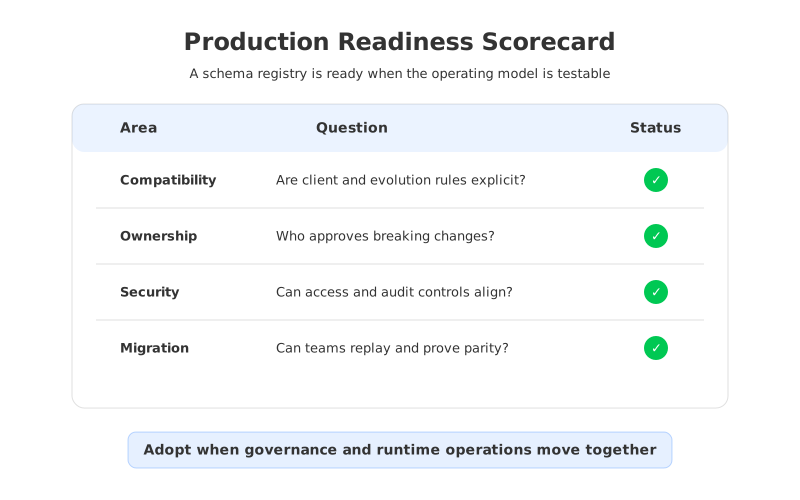
Use this scorecard before declaring the model ready:
| Readiness area | Pass condition |
|---|---|
| Compatibility | Representative clients can serialize, deserialize, evolve schemas, and fail safely under invalid changes |
| Ownership | Every subject has a domain owner, reviewer path, exception path, and consumer communication channel |
| Security | Registry access, Kafka ACLs, network boundaries, encryption, and audit trails are aligned |
| Operations | Rejected schemas, producer failures, consumer deserialization errors, and registry outages have runbooks |
| Migration | Mirroring, replay, rollback, and parity checks are tested before critical topics move |
| Cost | Retention, replay, observability, storage, and network effects are included in the model |
The scorecard is intentionally operational. A registry is ready when teams can change schemas without guessing who is affected, recover from wrong-but-compatible changes, and prove what happened later.
7Closing the loop
The original search for schema registry operating model kafka starts with a governance problem, but it should end with a production design. The registry defines what can change. The platform defines how safely the organization can absorb that change, recover from mistakes, and keep evidence.
If your registry roadmap is blocked by replay cost, broker-local retention planning, migration risk, or unclear cloud ownership boundaries, evaluate the operating model and streaming architecture together. AutoMQ's Kafka-compatible shared-storage design is a useful reference point: discuss an AutoMQ architecture path with your own topics, schemas, and rollback drills in mind.
8References
- Apache Kafka documentation: https://kafka.apache.org/documentation/
- Apache Kafka Connect documentation: https://kafka.apache.org/documentation/#connect
- Apache Kafka KIP-405 tiered storage proposal: https://cwiki.apache.org/confluence/display/KAFKA/KIP-405%3A%2BKafka%2BTiered%2BStorage
- Confluent Schema Registry schema evolution concepts: https://docs.confluent.io/platform/current/schema-registry/fundamentals/schema-evolution.html
- AWS Amazon S3 documentation: https://docs.aws.amazon.com/AmazonS3/latest/userguide/Welcome.html
- AWS PrivateLink documentation: https://docs.aws.amazon.com/vpc/latest/privatelink/what-is-privatelink.html
- AutoMQ overview: https://docs.automq.com/automq/overview/what-is-automq?utm_source=blog&utm_medium=reference&utm_campaign=aivk-0033
- AutoMQ shared storage architecture: https://docs.automq.com/automq/architecture/overview?utm_source=blog&utm_medium=reference&utm_campaign=aivk-0033
- AutoMQ Kafka compatibility: https://docs.automq.com/automq/architecture/technical-advantage/native-compatible-with-apache-kafka?utm_source=blog&utm_medium=reference&utm_campaign=aivk-0033
- AutoMQ zero cross-AZ traffic: https://docs.automq.com/automq-cloud/eliminate-inter-zone-traffics/overview?utm_source=blog&utm_medium=reference&utm_campaign=aivk-0033
9FAQ
9.1What is a schema registry operating model for Kafka?
A schema registry operating model defines how teams run schema governance in production. It covers subject naming, compatibility policy, ownership, approval paths, access control, audit evidence, CI integration, incident response, and how registry workflows interact with Kafka topics, consumers, connectors, and platform operations.
9.2Is a schema registry the same as a streaming data contract?
No. A schema registry stores and validates schema versions. A streaming data contract is the broader agreement around an event stream: field meaning, ownership, compatibility, privacy, observability, and recovery. The registry is usually one of the most important enforcement points for that contract.
9.3Which team should own schema compatibility rules?
The platform team should usually own default compatibility policy and tooling, while domain teams own semantic review and consumer communication. Security and governance teams should own classification and audit requirements. A hybrid model works best when escalation paths and exceptions are visible.
9.4How does Kafka architecture affect schema registry operations?
Registry operations create platform work: retained history, replay, connector validation, consumer recovery, and audit evidence. In broker-local storage models, some of that work can translate into disk planning, broker recovery, partition movement, or network load. Shared-storage Kafka-compatible architectures change those operational assumptions by separating durable log storage from broker lifecycles.
9.5Does AutoMQ replace a schema registry?
No. AutoMQ is a Kafka-compatible streaming platform, not a schema registry replacement. It can support the operating model around schema governance by changing how retention, replay, scaling, recovery, and cloud network boundaries are handled underneath Kafka-compatible workloads.


