
Table of Contents
Table of Contents
A schema registry outage is rarely the first thing users see. They see failed producers, deserialization errors, delayed analytics, broken CDC feeds, or a stream processing job that can no longer trust its inputs. By the time the registry appears in the incident channel, the real issue is usually larger than one service: teams changed a production data contract without a shared operating model.
That is why schema registry operations should not be treated as a sidecar to Kafka operations. The registry stores schemas, versions, subject names, compatibility rules, and client expectations, but the blast radius lives in producers, consumers, topics, offsets, and ownership boundaries. A healthy registry can still support an unhealthy operating model if teams bypass compatibility checks or lack a rollback path for messages already written to Kafka.
The useful question is not "which registry setting should we use?" The useful question is "who owns the contract, which compatibility rule protects it, and how do we recover when a bad schema reaches a topic?" Once schema registry operations are framed this way, they become part of platform architecture rather than middleware housekeeping.
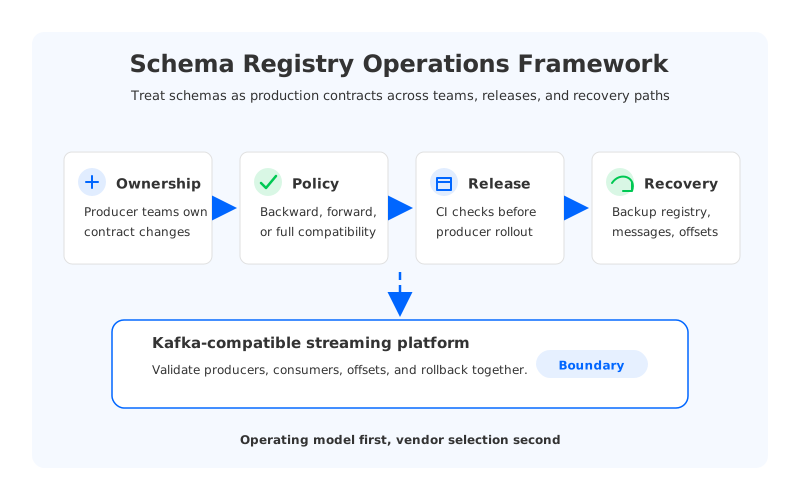
1Schema Registry Operations Start With Ownership
Most schema incidents are ownership incidents. A platform team may run the registry, but it does not understand every field in every business event. An application team may own the producer, but it may not know every downstream consumer. A data engineering team may depend on a contract created by another domain months earlier.
The cleanest operating model separates service ownership from contract ownership:
- Producer teams own the meaning of fields. They decide when a field is introduced, deprecated, renamed, or removed because they understand the source system and event semantics.
- Consumer teams own tolerance and upgrade windows. They decide how quickly applications can adopt a new version and whether older messages must remain readable.
- The platform team owns enforcement. It defines registry availability, authentication, authorization, subject naming standards, CI checks, backup, restore, and audit trails.
- Data governance owns cross-domain rules. It controls personally identifiable data, retention expectations, classification, and policy exceptions that go beyond one service.
This split matters because schema registries make it easy to confuse storage with authority. The registry can reject incompatible changes, but it cannot decide whether a new customer_status field has the same meaning in billing, support, and risk systems. That decision must live with named owners.
2Compatibility Is a Release Policy, Not a Checkbox
Compatibility modes are often discussed as if one mode should be selected once for the whole platform. Production teams usually need a more precise model. Backward compatibility protects upgraded consumers reading older data, forward compatibility protects older consumers reading data from upgraded producers, and full compatibility protects both directions at the cost of stricter evolution rules.
Avro, Protocol Buffers, and JSON Schema also carry different compatibility mechanics. Avro relies on writer and reader schema resolution, which makes defaults and field names especially important. Protocol Buffers has field numbers, reserved ranges, and wire compatibility rules that shape safe evolution. JSON Schema gives teams expressive validation, but operational discipline still decides whether new constraints break existing producers or consumers.
| Contract question | Operational implication | Failure mode when ignored |
|---|---|---|
| Can old consumers read new messages? | Choose forward or full compatibility for slow consumer upgrade windows. | A producer deploy breaks applications that are not ready to upgrade. |
| Can new consumers read old messages? | Require defaults and reader schema discipline for replay and backfill. | A recovery job fails when it reprocesses retained topic data. |
| Are subject names stable? | Standardize topic, record, and domain naming before teams scale usage. | Two teams accidentally share or fragment contract history. |
| Are schema changes reviewed in CI? | Enforce compatibility before code reaches production. | The registry becomes the first real test environment. |
Compatibility is not abstract correctness; it is a release promise between teams moving at different speeds. When a platform team says "all subjects use backward compatibility," it should also define who can approve an exception, how long old messages remain replayable, and which tests prove the contract still works.
3The Registry Is Only One Part of the Contract Path
A schema registry can reject bad schema registrations, but many production failures happen outside that narrow path. A producer can serialize with an older schema ID, publish to an unexpected topic, skip validation in a path that later becomes production, or reuse a field with a changed meaning.
Platform teams should map the entire contract path:
- The schema is reviewed and registered.
- Producer code references the intended subject and version.
- CI validates compatibility against the deployed registry state or a controlled snapshot.
- The producer deploy writes messages with observable schema IDs or metadata.
- Consumers validate decoding, business semantics, and fallback behavior.
- Replay and backfill jobs prove older retained data remains readable.
Each step needs a separate control. Registry policy protects step 1, build-time checks protect steps 2 and 3, runtime observability protects step 4, and consumer tests plus replay drills protect steps 5 and 6.
4Run the Registry Like a Production Control Plane
Schema registries sit in the control path of many streaming systems. A registry outage may not stop every application immediately because clients often cache schemas, but it can block deployments, new schema versions, cold starts, disaster recovery, and incident remediation. Operators should treat it as a control plane with explicit service objectives.
The baseline runbook should cover:
- Availability and latency. Track registration, lookup, compatibility check, and authentication latency separately. A slow registry can look like client instability.
- Authorization and audit. Require identity for schema writes. Keep an audit trail that links schema changes to repositories, pull requests, deployment events, and owners.
- Backup and restore. Back up registry state, configuration, subjects, versions, compatibility modes, and access rules. Test restore into an isolated environment.
- Cache expectations. Document how producers and consumers behave when registry lookups fail, especially during cold start or autoscaling events.
- Version lifecycle. Define deprecation windows, field removal rules, subject cleanup, and retention alignment with Kafka topics.
These controls reduce a subtle risk: recovery that restores the registry but not the contract. If Kafka topics retain messages written with schemas missing from the restored registry, replay becomes unreliable.
5Recovery Requires Registry State and Kafka Data
Schema recovery has two halves. The first half restores the registry: subjects, versions, compatibility rules, metadata, and access control. The second half proves that Kafka data can still be decoded, replayed, quarantined, or rolled back.
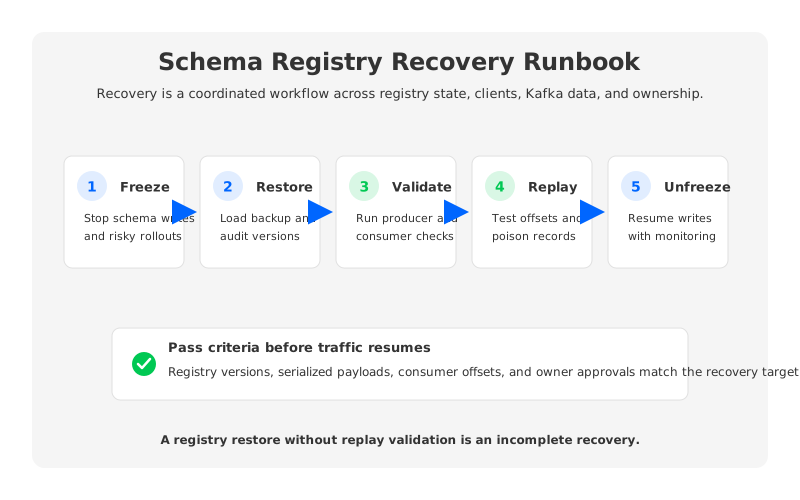
Consider a bad producer deployment that registers a compatible schema but changes the meaning of a field. The registry may be healthy and the compatibility rule may pass. Recovery still needs a coordinated workflow: stop the producer, identify affected schema versions and offsets, quarantine messages if needed, deploy a corrected producer, and replay consumers from a safe point.
A practical recovery runbook should answer four questions before the incident:
- What is the recovery target? Restore to a timestamp, a subject version, a deployment revision, or a known-good event sample.
- Which messages are affected? Correlate producer deployment time, schema version, topic, partition, and offset ranges.
- Which consumers need replay? Identify online services, stream processors, connectors, batch readers, and analytics jobs that may have consumed the affected messages.
- Who approves resume? Name the application owner, platform owner, and data owner who can unfreeze schema writes or restart producer traffic.
The same logic applies to registry infrastructure failures. A restored registry is not enough until producers can look up schemas, consumers can deserialize retained messages, replay jobs can read older offsets, and audit history matches the expected change window.
6Migration Expands the Validation Boundary
Schema registry operations become more complex during platform migration. Moving Kafka-compatible workloads changes where producers connect, where consumers read, how offsets are transferred or reset, how retained messages are replayed, and how schema IDs or subject histories are preserved.
Migration planning should treat the registry as part of the compatibility boundary:
- Export and import registry state with checksum validation. Do not rely on manual recreation for production subjects.
- Test old messages against restored or migrated registry state. This catches missing historical versions before the first backfill.
- Run dual-read or shadow-consumer validation for important topics. Serialization success is necessary, but semantic validation catches field meaning drift.
- Define rollback before cutover. A rollback plan must include registry writes, producer routing, consumer offsets, and topic data written during the migration window.
This is where streaming platform architecture matters. Traditional Kafka deployments tie broker identity, local storage, partition movement, and recovery work closely together. During migration or failover, schema registry validation is only one stream in a broader river of data movement and ownership decisions.
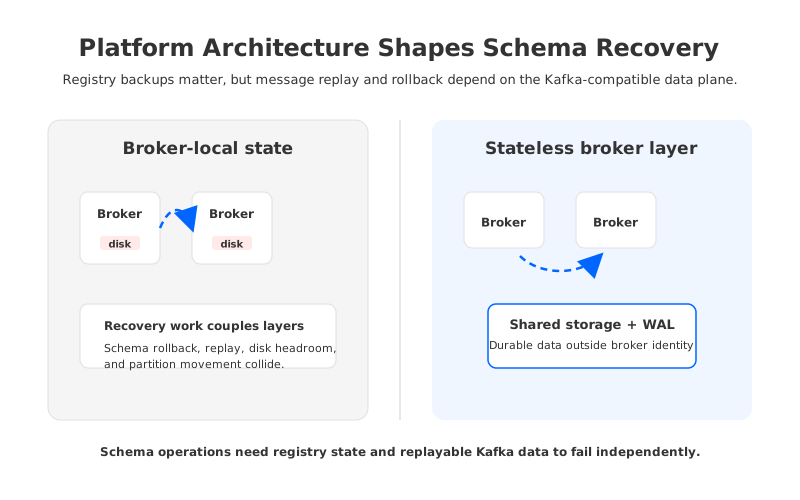
Shared-storage Kafka-compatible architectures change part of that operating model. Instead of treating durable log data as broker-local state, they separate broker compute from durable storage. For schema operations, that does not replace the registry, but it can narrow the migration and recovery problem: platform teams can focus more on contract state, client behavior, and replay validation, and less on emergency partition movement caused by broker-local storage.
AutoMQ fits this discussion as a Kafka-compatible shared-storage platform rather than a schema registry product. It preserves Kafka protocol compatibility while redesigning the broker storage model around stateless brokers and shared storage. In customer-controlled deployment models such as BYOC, that can be relevant for teams that want Kafka-compatible APIs, clearer data-plane boundaries, and less broker-local recovery work during platform changes.
7Evaluation Checklist for Platform Teams
The following checklist is useful when a team is evaluating schema registry operations for a growing Kafka-compatible platform:
| Area | Questions to ask | Evidence to collect |
|---|---|---|
| Ownership | Who approves a schema change, an exception, or a rollback? | Subject owner map, repository ownership, incident approvers. |
| Compatibility | Which rule applies by subject, domain, or lifecycle stage? | Registry configuration, CI policy, exception history. |
| Release workflow | Are schemas tested before producers deploy? | Pull request checks, contract tests, staging registry snapshots. |
| Runtime behavior | Can operators trace schema versions to messages and deployments? | Logs, metrics, schema IDs, deploy events, sample payloads. |
| Recovery | Can the team restore registry state and replay retained messages? | Backup drills, replay tests, quarantine procedure. |
| Migration | Are registry state, offsets, clients, and topic data validated together? | Cutover plan, rollback plan, shadow consumers. |
Schema registry operations often expose problems outside the registry. If every recovery drill is blocked by slow broker replacement, partition reassignment, or storage headroom, the registry is not the only system under evaluation. The data plane is part of the contract path because it decides whether old messages can be replayed under pressure.
8Decision Table: Tune, Govern, or Re-Architect
Not every schema problem calls for a platform redesign. Many teams can make large improvements by adding owners, CI checks, compatibility discipline, and restore drills. Architecture evaluation becomes more relevant when repeated incidents show that the platform cannot recover, replay, or migrate within the required window.
| Observed pattern | Improve registry operations | Revisit streaming architecture |
|---|---|---|
| A bad schema reached production through a manual path | Require CI registration checks and authenticated schema writes. | Redesign is premature; the control path is weak. |
| Registry restore succeeds but replay fails on retained data | Add historical schema backup and replay drills. | Revisit architecture if data retention, replay, or migration windows are structurally constrained. |
| Migration testing finds inconsistent subjects or schema IDs | Add export/import validation and shadow consumers. | Revisit architecture if rollback is dominated by broker-local data movement. |
| Broker failures repeatedly delay schema-related recovery | Keep registry runbooks, but inspect the data plane. | Evaluate shared-storage Kafka-compatible platforms such as AutoMQ. |
The durable lesson is simple: schema registry operations are contract operations. Treating them as a single service configuration leaves too much risk in the spaces between teams. Treating them as a production operating model gives platform teams a way to connect compatibility, ownership, release safety, recovery, and architecture decisions.
When you review your own streaming platform, start with one high-value topic and walk the entire path: schema change, producer deploy, consumer upgrade, retained-message replay, registry restore, and rollback. If the workflow is mostly blocked by missing ownership, fix governance. If it is mostly blocked by broker-local data movement and recovery mechanics, evaluate whether a Kafka-compatible shared-storage platform such as AutoMQ would reduce that operational load.
9References
- Apache Avro Specification - official specification for Avro schemas, schema resolution, and data encoding.
- Protocol Buffers: Updating Message Types - official guidance for evolving Protobuf message definitions.
- JSON Schema Documentation - official JSON Schema learning documentation for validation concepts.
- Apache Kafka Documentation - official Kafka documentation for operations, clients, topics, and configuration.
- AutoMQ Architecture Overview - official AutoMQ documentation for shared storage architecture.
- AutoMQ Compatibility with Apache Kafka - official AutoMQ documentation for Kafka API and ecosystem compatibility.
10FAQ
10.1What is schema registry operations?
Schema registry operations is the production discipline around schema ownership, compatibility rules, release checks, registry availability, backup, restore, and recovery. It covers the registry service, but it also includes producers, consumers, retained Kafka data, replay jobs, and governance.
10.2Which compatibility mode should a Kafka platform use?
There is no universal mode for every subject. Backward compatibility helps upgraded consumers read older data, forward compatibility helps older consumers read newer data, and full compatibility protects both directions. Platform teams should choose by subject lifecycle, consumer upgrade speed, replay requirements, and governance risk.
10.3How should teams recover from a bad schema?
Freeze risky schema writes, stop the offending producer, identify affected subjects and offset ranges, restore or register the corrected schema state, validate producer and consumer behavior, quarantine or replay affected messages, and resume only after owners approve the target state.
10.4Does a schema registry replace contract testing?
No. The registry enforces schema compatibility rules, but contract testing validates how code uses the schema. Teams still need producer tests, consumer tests, semantic checks, replay validation, and deployment gates.
10.5Where does AutoMQ fit in schema registry operations?
AutoMQ is not a schema registry. It is a Kafka-compatible shared-storage streaming platform. It becomes relevant when schema recovery, replay, migration, or rollback is constrained by broker-local storage, slow broker replacement, or data movement during platform changes.


