
Table of Contents
Table of Contents
A registry is supposed to make event changes safer. Then a team tries to rename a field, roll out a consumer, or move a Kafka workload and discovers that the registry has become part of the change itself. The schema file is portable, but the subject name, schema ID, serializer, compatibility setting, and registry endpoint have all become runtime assumptions.
That tension is the real schema registry problem. Governance protects a Kafka data contract only when the contract can be understood by every writer and reader that handles the record. The registry should enforce that contract, while the business code and the Kafka-compatible platform stay replaceable around it.
This article focuses on the mechanics that make Avro evolution safe: backward, forward, full, and none compatibility; Avro defaults and aliases; readers that span more than one writer version; and the binding points that turn a registry into a platform dependency.
1A registry governs a contract, but it does not own the record
With Avro, the writer schema describes how a producer encoded a record. The reader schema describes how a consumer wants to interpret it. The schema registry stores versions, checks proposed changes against a compatibility policy, and lets serializers and deserializers resolve a schema ID carried with the record.
That last detail matters. Kafka carries the record, but the registry is usually an application-level dependency beside Kafka. A producer can publish a valid Kafka record and still fail because it cannot register or resolve its Avro schema. A consumer can fetch the record successfully and still fail because its deserializer cannot reach the registry or because the subject points to an unexpected schema.
A Kafka data contract therefore has four parts:
- The Avro definition, including fields, types, defaults, aliases, and references.
- The writer and reader behavior that resolves those definitions.
- The subject, version, ID, and wire format used by the serializer.
- The policy and ownership rules that decide which changes are accepted.
Treating only the first item as “the schema” is how teams get a green pull request and a broken replay. Store all four as reviewable artifacts. A registry can validate structural compatibility, but it cannot decide whether a field called status still means the same thing after a product change.
2The four compatibility directions answer different questions
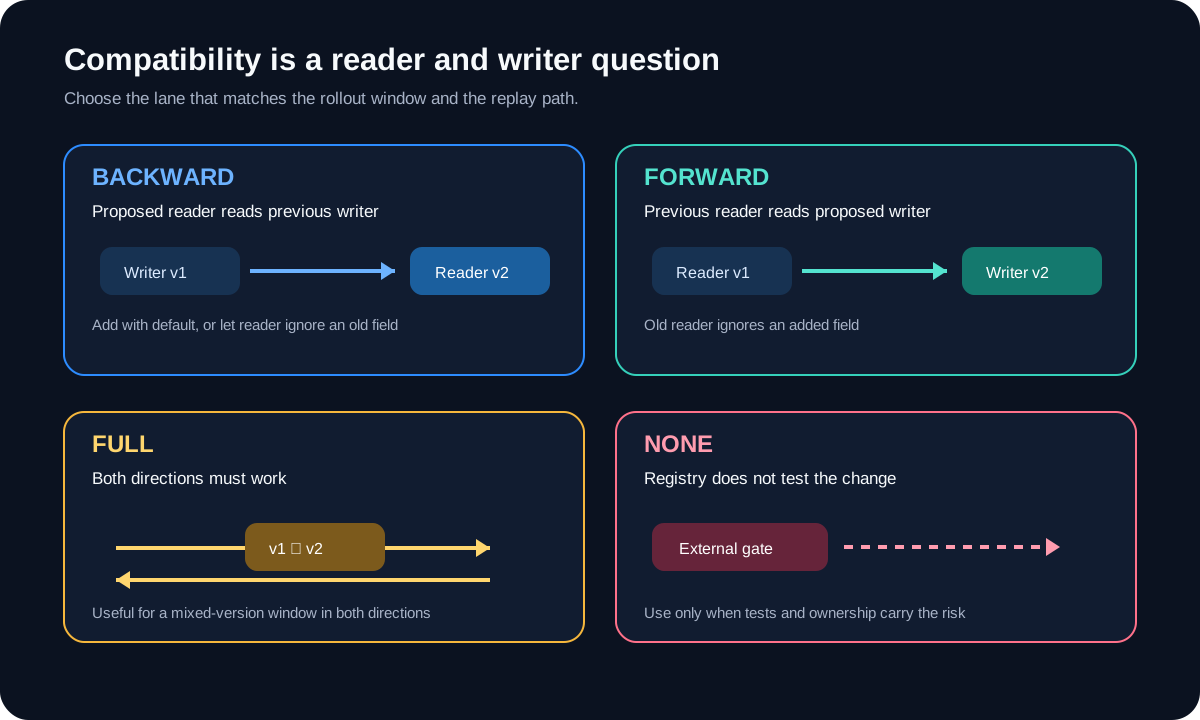
Compatibility is directional because a change has two sides: a schema that writes records and a schema that reads them. The mode should match the rollout order and the failure you are trying to prevent.
| Mode | Question it answers | Typical Avro change |
|---|---|---|
| Backward | Can a reader using the proposed schema read records written with the previous schema? | Add a field with a default, or remove a field that the reader no longer needs |
| Forward | Can a reader using the previous schema read records written with the proposed schema? | Add a field that old readers ignore, or remove a field when old readers have a default |
| Full | Can both old readers read proposed records and proposed readers read old records? | Changes that satisfy both directions, often an optional field with a stable default |
| None | Should the registry skip compatibility checks? | Deliberate exceptions where another gate owns the risk |
These definitions describe schema resolution, not deployment safety. Backward compatibility is often a good default when consumers are upgraded before producers. Forward compatibility fits a rollout where producers may write the proposed shape before every consumer is upgraded. Full compatibility supports a mixed-version window in both directions, but it narrows the set of legal changes. None does not make a change safe; it moves the decision to code review, contract tests, or an explicit migration.
Many registries also offer transitive variants that compare against more than the immediately previous version. That distinction matters when a consumer may replay records from an older retention window. A change that works against version 7 can still fail against version 2 if the registry checks only the latest version while the application must read the whole retained history.
Choose the policy from the read path: which writer and reader versions can coexist, and whether consumers replay retained history. Compatibility is a rollout contract, not a permanent topic label.
3Avro defaults fill missing data at read time
Defaults are the most useful Avro tool for adding a field without breaking an older record. Suppose version 1 contains customer_id and total. Version 2 adds currency with a default of "USD". When a version 2 reader reads a version 1 record, Avro supplies the default for the missing field.
The default does not rewrite old records. It does not cause a version 1 producer to start sending currency. It is a rule used during schema resolution when the writer lacks a field that the reader expects. That makes defaults a compatibility bridge, not a data backfill strategy.
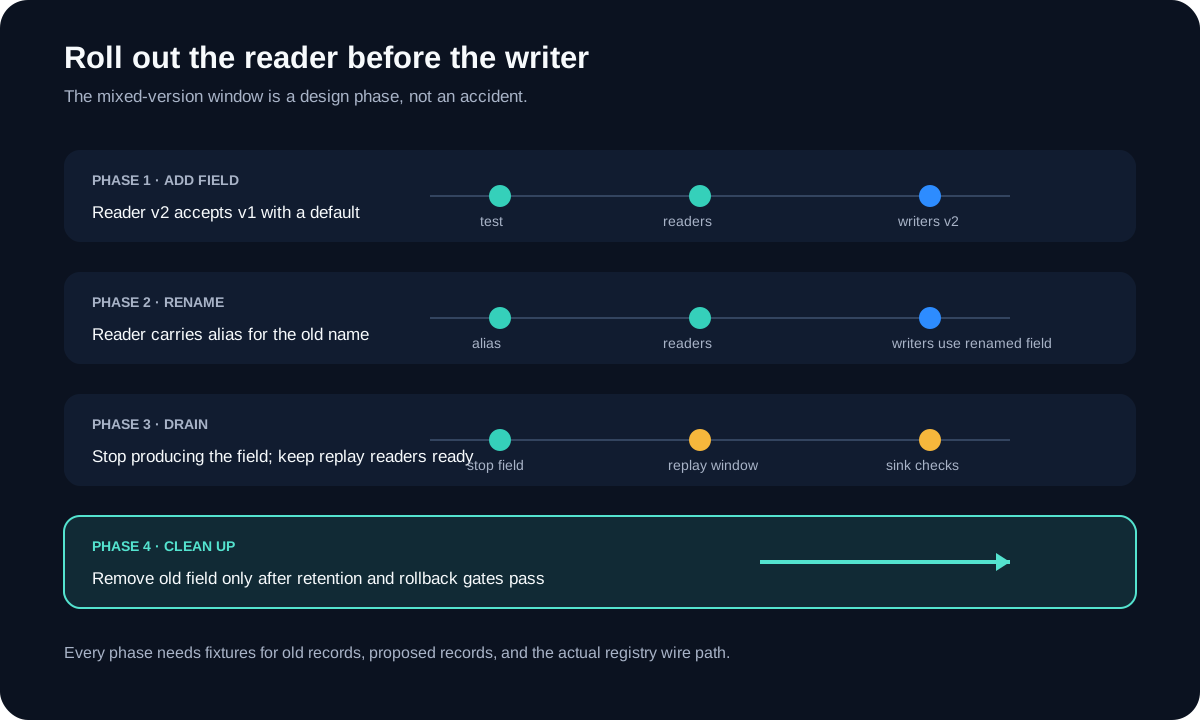
A safe add-field sequence is:
- Add the field with a default that is valid for its Avro type.
- Deploy readers that understand both the old record and the field's business meaning.
- Start producing the field once those readers are present.
- Decide separately whether historical records need an explicit backfill.
The order protects readers during the mixed window. It also forces a semantic question: is the default true for every historical record, or should consumers see “unknown”? A structurally valid default can still be a bad business default. If the old event did not contain the needed information, use an explicit nullable or union shape.
Field removal has the inverse shape. A reader can ignore a field that an older writer included, so removing a field from the reader schema can be backward compatible. That does not mean the field can disappear from producers immediately. Consumers, sinks, and replay tools may still depend on it. Compatibility protects decoding; ownership rules protect meaning.
4Aliases help with renames, within limits
Renaming a field is harder than adding one because the reader needs to connect two names that are semantically the same. Avro aliases let the reader schema name the field as it exists now while listing the previous name as an alias. During resolution, a record written with the old field name can be read through the renamed field.
Aliases do not rename data in Kafka. Older records still contain the old writer name, and producers using the previous schema still write that name. The alias only tells the reader how to resolve the old name. Keep the alias in later reader schemas for as long as the retained data and rollback plan require it.
A rename also needs a semantic review. If account_id becomes customer_id because the business meaning changed, an alias may hide a real contract break. Use a separate field or event version when the domain meaning changes, even if the two values happen to share a type. Avro can resolve names and types; it cannot judge whether an identifier now refers to a different entity.
Review three questions: is the meaning unchanged, can the proposed reader resolve every retained writer version, and will dashboards, sinks, and downstream code treat the field as the same business attribute? Only the first two are schema compatibility checks.
5Multi-version reads are the rollout mechanism
A deployment rarely flips every producer and consumer at the same instant. For a period, old and proposed records coexist. Multi-version reads make that period explicit: consumers use the writer schema ID found with each record and resolve it through a reader schema that knows how to handle the versions still in flight.
Align the compatibility direction with deployment order. For an additive change, upgrade readers with a default, then producers. For removal, stop producing the field and wait until the replay window and dependent readers no longer require it. For a rename, deploy readers with the alias before producers use the renamed field.
A single “schema compatible” result is not proof. Test these paths:
- Old reader with old record.
- Proposed reader with old record.
- Proposed reader with proposed record.
- Old reader with proposed record when forward compatibility is required.
- Replay or sink path across the retention window.
Fixtures should include omitted fields, nulls, defaults, aliases, and references. Parsing the latest schema file does not exercise registry identity, serializer configuration, or the wire envelope.
For a longer mixed window, let the consumer accept several writer versions while exposing one normalized internal model. Keep version handling at the boundary instead of spreading registry branches through business code.
6The binding points are where lock-in appears
Replaceability starts by naming the registry's binding points. The schema definition is usually the easiest artifact to move; operational assumptions around it are where migrations become expensive.
6.1Subject naming
A subject naming strategy maps a topic, record name, or custom rule to a registry namespace. The same Avro definition can fail when one client looks up orders-value and another expects a record-name subject. Version the rule and test it with the application serializer.
6.2Schema IDs and wire format
Serializers commonly place a registry-local ID beside the encoded payload. Exporting schema text without mapping IDs does not make existing bytes readable by a second registry. Preserve the source registry, translate IDs through a controlled bridge, or decode and re-encode records, then test historical and handoff records.
6.3Policy scope and references
A compatibility policy may apply globally, per subject, or through inheritance. Record the effective scope and whether checks are latest-only or transitive. Also export referenced Avro types as a dependency graph. A schema can pass source control and fail in production when a reference is missing or registered under another subject.
6.4Client, identity, and recovery behavior
Serializer libraries, registry URLs, authentication, TLS trust material, caches, retries, backups, and ID lookup during an outage all shape contract availability. The application experiences these platform controls as part of its data contract.
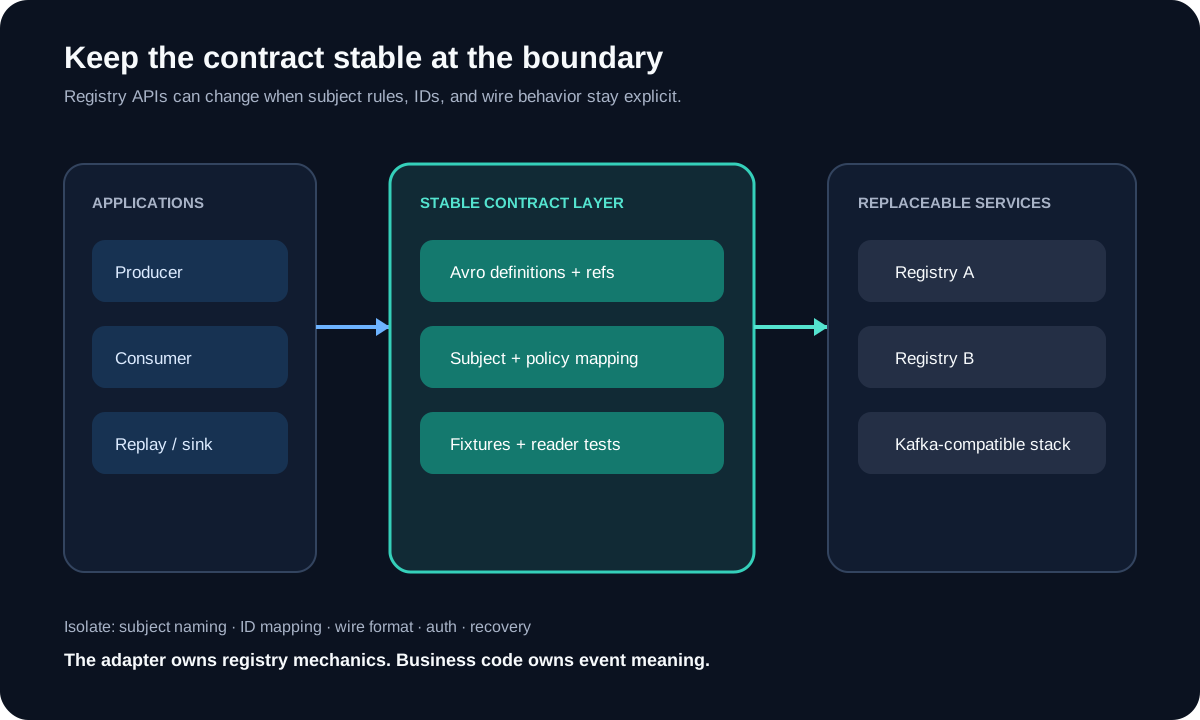
The practical pattern is to keep business code dependent on a small contract adapter. The adapter owns subject naming, registration, ID lookup, and error handling. Application code deals with typed events and explicit compatibility failures. This does not remove the serializer from the deployment, but it stops registry API details from spreading through every service.
7Keeping the registry replaceable on a Kafka-compatible stack
Portability starts before a migration is announced. Keep Avro definitions, references, compatibility policies, subject mappings, serializer versions, representative encoded records, and rollout tests in source control. Back up registry metadata in a form that can be reviewed and restored. Treat a schema ID as an identifier within a registry, not as a universal identity.
Then test two boundaries independently. First, run the contract suite against the registry implementation used in production. Second, run the Kafka client and serialization matrix against the target Kafka-compatible platform. The first proves schema governance. The second proves that producers, consumers, and records still move through the Kafka data plane. Neither test substitutes for the other.
This is where AutoMQ is a useful concrete example. AutoMQ uses Kafka protocol compatibility as the integration boundary, so a team can evaluate its existing Kafka clients and standard Apache Avro and schema registry setup against the platform. The registry remains a separate governance choice. The compatibility question is whether the Kafka data plane, serializer behavior, record history, and operational controls pass the workload's test matrix.
AutoMQ's Kafka compatibility documentation explains the Kafka client and ecosystem boundary, while its architecture overview describes the storage layer underneath it. Those facts support a narrow evaluation: keep the contract governance layer explicit, change the stream platform underneath, and verify the boundary with real Avro records.
A replaceability review should end with evidence rather than a vendor label. For one representative subject, prove that the team can export definitions and references, replay historical records, run a mixed-version reader, register the next version, and roll back the producer without losing the ability to decode existing data. If that exercise depends on undocumented registry behavior, the dependency is already part of the architecture.
8FAQ
8.1What is schema registry compatibility?
It is a rule for whether a proposed schema can resolve records written with another schema. Backward, forward, and full protect different reader and writer directions. None skips the registry check and requires a separate control.
8.2What does backward compatibility mean in Avro?
A proposed reader schema is backward compatible when it can read records written with the previous schema. Adding a field with a valid default is a common example because the reader can supply that value when the older record does not contain the field.
8.3Are Avro defaults written into old Kafka records?
No. An Avro default is applied during reader-side schema resolution. It does not rewrite retained Kafka records or make an older producer emit the field.
8.4Do Avro aliases make a field rename safe?
An alias can preserve name resolution when the business meaning stays the same. It does not rename historical bytes, update downstream semantics, or make a meaning change safe. Keep the alias while retained data and rollback paths still need it.
8.5Can a schema registry be replaced without changing Kafka applications?
Sometimes, but subject names, IDs, wire format, serializer settings, references, authentication, and historical records must be mapped and tested. Kafka protocol compatibility does not migrate registry identity.
8.6How does AutoMQ fit this design?
AutoMQ provides a Kafka-compatible data plane that can be evaluated with standard Kafka clients and an existing Avro and schema registry setup. Test serialization, schema lookup, retained records, security, and rollback on the workload.
For adjacent operating guidance, see production guardrails for schema registry runbooks and streaming data contracts for Kafka-compatible platforms.
If a schema change makes your team afraid to touch the platform underneath Kafka, start with one subject and its full reader and writer window. Export the contract, replay its records, test the four compatibility directions where they matter, and write down every registry binding. To run that boundary test on a Kafka-compatible cloud-native streaming platform, start an AutoMQ evaluation.


