
Table of Contents
Table of Contents
Teams search for schema test environment kafka after a test cluster stops being a sandbox. A producer changes an Avro or Protobuf schema, a downstream service fails in staging, and nobody can tell whether the break came from the schema registry, the Kafka client, the connector, or the environment itself. The problem looks like contract testing, but the failure path runs through infrastructure.
That is why a schema test environment should not be treated as a small Kafka cluster with sample topics. It is a controlled replica of the production contract surface: schema compatibility rules, topic configuration, ACLs, consumer group behavior, connector mappings, retention policy, and rollback paths. Drift makes tests weak.
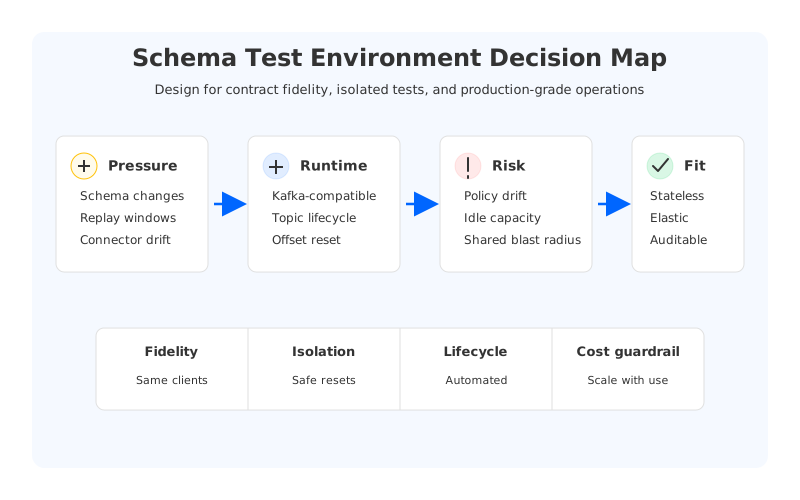
The useful question is not "How do we spin up Kafka for schema tests?" It is "Which production guarantees must be present before a schema test tells us anything?" The environment must be close enough to production to catch real breakage, but isolated enough for destructive tests, event replay, and migration validation.
1Why Schema Tests Expose Infrastructure Gaps
Schema governance sounds like an application concern. In practice, it crosses almost every boundary in an event-driven platform. A schema registry can reject an incompatible change, but it cannot prove that every consumer has upgraded. A unit test can serialize a payload, but it cannot prove that a connector preserves headers, timestamps, keys, tombstones, or transactional behavior. A staging topic can accept events, but it cannot prove that retention, compaction, and offset reset behavior match production.
Kafka-compatible systems make this more interesting because the client API is only one part of the contract. The behavior that matters to a schema change includes producer acknowledgments, partitioning strategy, consumer group rebalancing, idempotent writes, transactions, and offset commits. Those semantics are documented in Apache Kafka, but each team still has to test how they appear in its own deployment, client versions, security model, and operational tooling.
A useful schema test environment has four jobs:
- It validates wire-level compatibility before a schema reaches production topics. That includes serialization format, schema registry compatibility mode, key evolution, nullable fields, and delete events.
- It checks consumer readiness against realistic offsets and replay windows. A consumer that passes with one fresh event can still fail when it starts from a compacted topic or a retained backlog.
- It gives platform teams a place to test infrastructure changes. Broker upgrades, connector versions, ACL templates, and topic policy changes often affect schema workflows indirectly.
- It creates an audit trail. When a breaking schema is blocked, the team should know which rule, consumer, or replay scenario produced the failure.
The trap is to build this environment as an afterthought. Once event contracts become part of release gates, the test platform inherits production-like uptime expectations. Developers expect it to be available during CI runs, SREs expect it not to page them like production, and finance teams expect it not to consume production-style reserved capacity.
2The Production Constraint Behind the Test Cluster
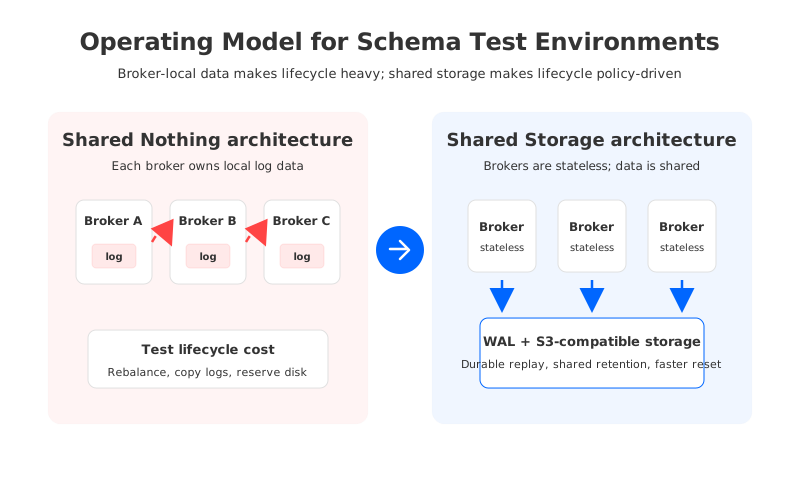
Traditional Kafka architecture ties partitions to broker-local storage. That model is battle-tested, but it gives test environments a hidden cost profile. If the test cluster needs realistic retention, it needs enough disk. If it needs realistic failover, it needs replication. If it needs frequent topic resets, replay data movement, or broker replacement, the storage layout becomes part of the test workflow.
For schema testing, this matters more than teams expect. A realistic environment often needs short-lived topics, replayable fixtures, multiple schema registry modes, branch-specific namespaces, and connector sandboxes. The data volume may be smaller than production, but the operational pattern is noisy: topics appear and disappear, consumers reset offsets, connectors are rebuilt, and producers run malformed payloads on purpose. Those behaviors make broker-local storage and manual capacity planning feel heavy.
There is also a governance problem. If each application team creates its own lightweight Kafka environment, the organization gets fast feedback but weak consistency. If the platform team centralizes everything into one shared staging cluster, it gets consistency but loses isolation. The schema test environment sits between those extremes, so it needs policy without becoming a ticket queue.
The architecture should be judged against the work it has to absorb:
| Requirement | Why it matters for schema tests | Failure mode when ignored |
|---|---|---|
| Kafka API compatibility | Existing producers, consumers, serializers, and tools should run without a rewrite. | Tests validate a different contract from production. |
| Isolated namespaces | Teams need branch, service, or domain-level test spaces. | One team's destructive test affects another team's CI run. |
| Fast topic and consumer reset | Schema evolution testing needs replay and rollback. | Developers avoid realistic replay because it is slow. |
| Low idle cost | Test environments spend much of their time below peak. | The platform team limits usage, and coverage drops. |
| Observable governance | Failed checks need traceable reasons. | Schema review becomes tribal knowledge. |
| Safe migration path | The test platform should not force a large client or tooling rewrite. | Adoption stalls before the first useful test. |
The table changes the buying criteria. A schema test platform is evaluated by how quickly it can create faithful environments, discard them, replay data, and keep governance consistent across teams.
3Architecture Options and Trade-Offs
The first option is a small self-managed Kafka cluster. It gives strong fidelity if production also runs Apache Kafka, but every lifecycle task remains with the platform team: patching, broker replacement, disk sizing, ACL templates, monitoring, connector management, and cost control.
The second option is a managed Kafka service. It reduces broker operations, but test environments can become expensive or slow to provision when teams need many isolated clusters or must mirror cloud network boundaries. Managed services also vary in lower-level broker settings, so the test contract may not match production if production uses a different deployment model.
The third option is one shared Kafka staging cluster with governance at the topic and schema layer. It is easy to start, but brittle when teams need branch-level isolation, destructive replay, or connector experiments. Shared clusters also accumulate stale topics and consumer groups until deletion becomes guesswork.
The fourth option is a Kafka-compatible platform with storage and compute separated. Brokers are easier to add, replace, or scale because persistent data is not anchored to local broker disks. This does not remove schema governance, but it lets the platform team think in terms of environment lifecycle and policy templates instead of disk placement and data rebalancing.
None of these options wins by default. A team testing one internal schema format may prefer a compact shared environment. A bank validating cross-domain event contracts may need isolation and audit evidence. A SaaS company with hundreds of microservices may care most about short-lived environments without production-style idle cost.
4A Practical Evaluation Checklist
Schema test environments fail when they are judged by the wrong checklist. "Can it run Kafka?" is too shallow. "Can it copy production?" is too expensive. The useful checklist sits in the middle, with enough fidelity to catch breakage and enough automation to keep developers moving.
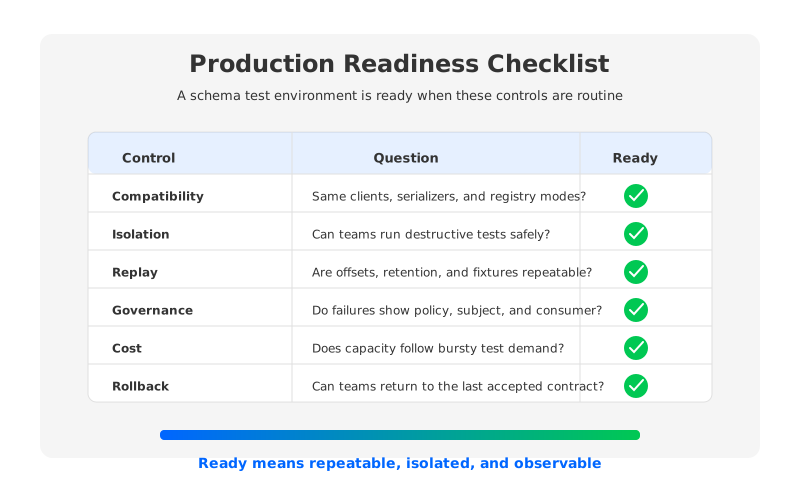
Start with compatibility. Use the same serializers, schema registry APIs, Kafka client versions, producer configurations, and consumer configurations that teams use in production. If production depends on idempotent producers or transactions, the test environment should include those paths. If production relies on Kafka Connect, test the connector behavior instead of only testing application code.
Then test the lifecycle. A schema test environment should support these actions without manual broker work:
- Create an isolated topic namespace for a service, branch, or release candidate.
- Register schemas under the same compatibility rules used in production.
- Produce valid and invalid events, including key changes, tombstones, and older versions.
- Replay retained events from known offsets and reset consumer groups.
- Run connector source or sink tests where schema shape affects downstream systems.
- Promote, reject, or roll back the schema with a record of the checks that ran.
Schema quality is not proven by a static schema diff. It is proven when producers, consumers, registry rules, offsets, and connectors behave together under a release workflow.
Cost should be evaluated as a lifecycle property, not only as a per-broker price. Test clusters are quiet at night, busy during CI windows, and noisy during release freezes. If the platform keeps peak broker and disk capacity online all the time, developers eventually get quotas that discourage testing. If compute and storage scale more independently, the platform team can offer richer coverage without turning every sandbox into a permanent cluster.
Governance should be visible. Developers need fast failure reasons, not a vague "schema incompatible" message buried in CI logs. Platform teams need policy drift reports, not a spreadsheet of topics. Security teams need ACL and data-boundary evidence. A good environment makes those signals routine.
5How AutoMQ Changes the Operating Model
At this point, the architecture requirement is clear: keep the Kafka contract, reduce the operational weight of broker-local storage, and make environments easier to create and retire. AutoMQ fits that category as a Kafka-compatible, Cloud-Native streaming platform built around a Shared Storage architecture. Its brokers are stateless because durable stream data lives in S3-compatible object storage, with WAL (Write-Ahead Log) storage handling low-latency persistence before upload.
For schema test environments, the important shift is not a single feature. It is the removal of broker-local data as the center of the operating model. When persistent data is not tied to broker disks, partition movement, broker replacement, and scaling are less dependent on copying large local log segments. That can make short-lived or frequently reset environments easier to operate, which is exactly the pattern schema testing creates.
This architecture also helps platform teams keep a cleaner boundary between policy and capacity. Schema compatibility rules, ACL templates, topic policies, and connector definitions remain platform concerns. Compute capacity can follow test demand, while object storage provides durable retention for replay and audit scenarios. AutoMQ's Kafka API compatibility matters because teams should not have to rewrite producers and consumers only to improve the test environment.
The same logic applies to network and deployment boundaries. In AutoMQ BYOC, resources run in the customer's own cloud account and VPC, which is useful when schema test data must stay inside an existing security boundary. For private deployment, AutoMQ Software targets customer-operated environments. The point is not that every schema test environment needs a commercial deployment. The point is that environment design should match data governance, not force governance to adapt to a generic sandbox.
There are still trade-offs to evaluate. A team should validate latency requirements, WAL storage choice, cloud object storage behavior, and operational integration before standardizing on any platform. The test environment may not need production throughput, but it does need representative failure behavior. Run the pilot with real serializers, real consumers, connector flows, and a few planned destructive tests.
6Migration and Rollback Considerations
If you already have a staging Kafka cluster, do not replace it in one step. Start by inventorying the contracts it already covers. List the producers, consumers, schema subjects, connector flows, ACL templates, topic settings, and CI jobs that depend on it. Then choose one domain where schema failures are common enough to prove value but bounded enough to control risk.
Run the new environment side by side. Mirror a small set of schemas and topics, replay known event fixtures, and compare test outcomes. The goal is not to prove that two clusters are identical. The goal is to prove that the new environment catches the same contract failures, provides better isolation, or reduces the operational work needed to run those tests.
Rollback should be designed before migration begins. Keep the old schema test path available until the new path has passed real release cycles. Preserve schema IDs and subject naming assumptions where clients depend on them. Document any intentional differences, such as shorter retention or stricter compatibility rules, so a failed test is not mistaken for a platform bug.
7Conclusion
The phrase schema test environment kafka sounds narrow, but it points to a bigger platform question. Event-driven teams are not only testing schemas. They are testing whether their streaming platform can make contracts repeatable, isolated, observable, and affordable enough to run before production.
If your Kafka test setup is starting to look like a second production cluster, use that as a signal. Revisit the architecture, not only the schema rules. A Kafka-compatible Shared Storage architecture such as AutoMQ can reduce the operational weight around short-lived environments, replay workflows, and capacity bursts while preserving the client contract teams already use. To evaluate it with your schema workflows, start an AutoMQ environment through the verified AutoMQ Cloud entry point and test it against real producers, consumers, and connector flows.
8References
- Apache Kafka documentation: https://kafka.apache.org/documentation/
- Apache Kafka producer configuration: https://kafka.apache.org/documentation/#producerconfigs
- Apache Kafka consumer configuration: https://kafka.apache.org/documentation/#consumerconfigs
- Apache Kafka Connect documentation: https://kafka.apache.org/documentation/#connect
- Confluent Schema Registry documentation: https://docs.confluent.io/platform/current/schema-registry/index.html
- AWS S3 User Guide: https://docs.aws.amazon.com/AmazonS3/latest/userguide/Welcome.html
- AutoMQ architecture overview: https://docs.automq.com/automq/architecture/overview?utm_source=blog&utm_medium=reference&utm_campaign=rpb-0136-schema-test-environments
- AutoMQ S3Stream overview: https://docs.automq.com/automq/architecture/s3stream-shared-streaming-storage/overview?utm_source=blog&utm_medium=reference&utm_campaign=rpb-0136-schema-test-environments
- AutoMQ WAL storage: https://docs.automq.com/automq/architecture/s3stream-shared-streaming-storage/wal-storage?utm_source=blog&utm_medium=reference&utm_campaign=rpb-0136-schema-test-environments
- AutoMQ migration guide: https://docs.automq.com/automq/migration/migrating-from-apache-kafka-to-automq?utm_source=blog&utm_medium=reference&utm_campaign=rpb-0136-schema-test-environments
9FAQ
9.1Is a schema test environment the same as a Kafka staging cluster?
No. A staging cluster is usually a shared pre-production runtime. A schema test environment is a controlled contract-testing surface for topics, schema rules, consumer groups, connector tests, replay data, CI automation, and audit evidence. It can run on staging, but it needs clearer isolation and lifecycle rules.
9.2Should every team get its own Kafka cluster for schema tests?
Not always. Separate clusters give strong isolation, but they can be expensive and harder to govern. Many teams do better with isolated namespaces, automated topic lifecycle, and shared policy templates.
9.3What should be included in the first pilot?
Pick one domain with real schema evolution pressure. Include at least one producer, two consumers, one schema subject, one replay fixture, and one connector or downstream sink if connectors are part of production. The pilot should prove that the environment catches real contract failures and gives clear failure reasons.
9.4Where does AutoMQ fit in this design?
AutoMQ fits at the streaming runtime layer. It keeps Kafka-compatible client behavior while using Shared Storage architecture and stateless brokers to reduce work around scaling, broker replacement, and data movement. Evaluate it when schema test environments need stronger lifecycle automation, lower idle cost, and production-like Kafka semantics.


