
Table of Contents
Table of Contents
Teams search for search indexing streams kafka when search has stopped being a batch export and has become part of the product's live behavior. Support tools need new orders to appear before the next conversation starts. Security teams need events to become searchable during active investigations. Marketplaces need catalog, inventory, pricing, and policy changes to reach discovery systems without forcing every source service to understand the search index.
Kafka-compatible streaming fits because it gives those changes a durable timeline. Producers publish events once, consumers build search documents independently, and platform teams can retain history for repair. The pressure begins when search is no longer one consumer. Relevance experiments, regional indexes, compliance filters, analytics copies, and emergency rebuilds all read the same streams, often with different latency and correctness requirements.
The production question is whether the streaming platform can absorb downstream backpressure, isolate replay jobs, preserve enough history, and keep operational evidence clear when indexing falls behind. Search freshness is visible to users, but the root cause of stale search usually lives several systems upstream.
1Why teams search for search indexing streams kafka
Most search indexing pipelines start with a sensible decoupling goal. Source systems publish changes into Kafka topics. A stream processor or connector shapes those changes into documents. A sink writes to Elasticsearch, OpenSearch, Solr, Vespa, or another search backend. Application teams avoid direct search writes inside the transaction path, and search teams gain one substrate for observing lag, retries, and replay.
That decoupling also creates a chain of independent failure domains. The source database may commit an update, the change capture system may emit an event, the broker may retain it, the indexing worker may enrich it, and the search backend may reject part of a bulk request. Each step can be correct by itself while the overall index becomes stale, incomplete, or inconsistent. The streaming layer becomes the audit trail for that chain, so its operational behavior matters as much as its API compatibility.
Search workloads are especially sensitive to three pressures:
- Backpressure from the search backend. Bulk indexing can slow down because of shard pressure, merge activity, mapping conflicts, throttling, or cluster maintenance. When that happens, the indexing workers need to slow down without losing offsets or blocking unrelated consumers.
- Replay after repair or reindexing. A bad transform, schema mismatch, or missed delete often requires replaying a known offset range. That replay should rebuild the index without starving live ingestion or consuming all broker headroom.
- Fanout across teams and indexes. One source stream may feed operational search, analytics search, machine learning features, and audit views. The platform must separate consumer progress, retention policy, and access control for those use cases.
The common mistake is to treat search indexing as a connector problem. A connector can report task status while retention is too short for rebuilds. A consumer can commit offsets while downstream bulk writes partially fail. A search cluster can return successful queries while the newest data waits behind a replay job.
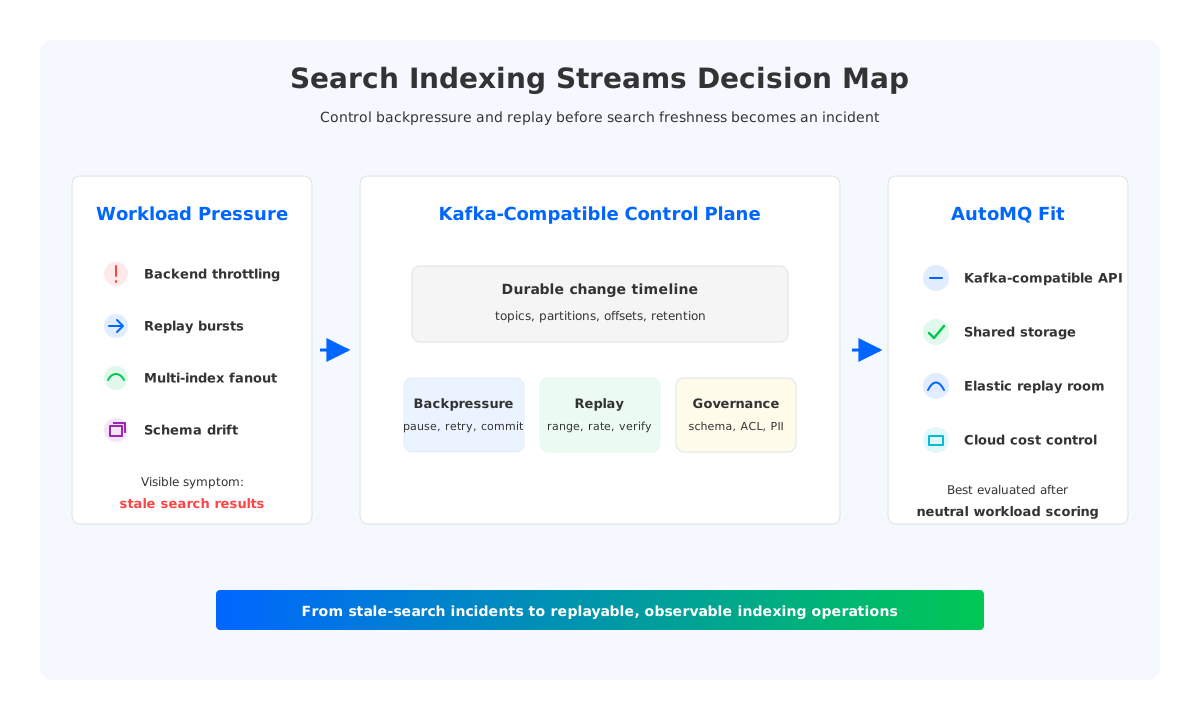
The first design move is to define what each layer owns. Source systems own authoritative state. Kafka-compatible streams own the change timeline, offsets, and replay boundary. Processing jobs own derived document logic. Search engines own query-serving indexes. Backpressure and replay become manageable when each handoff has a contract instead of being treated as a pipe.
2The production constraint behind the problem
Search indexing is uneven. Normal operation may look like a steady stream of small updates. During an incident, deployment, schema correction, or index rebuild, it can become a bursty read-heavy workload that consumes retained history at high speed. The same platform has to serve low-latency writes, steady consumers, and replay jobs that may read hours or days of history.
Traditional Kafka's shared-nothing architecture stores durable log data on broker-local disks. The model is proven and familiar, but it couples the compute node that serves clients with the storage that holds retained history. For search indexing, that coupling appears when teams increase retention for rebuilds and then run replay workloads that compete with live consumers for broker, disk, and network capacity.
Capacity planning becomes a multi-variable problem: producer writes, replica traffic, consumer fanout, retention, broker disk headroom, connector workers, and replay windows. A search team may see stale documents, while the SRE team sees partitions, offsets, disk utilization, throttled consumers, and cross-zone traffic. The business symptom is search freshness; the infrastructure symptom is a streaming platform doing both hot-path serving and history-heavy repair.
Backpressure makes the boundary visible. Apache Kafka consumers control fetch behavior and offset commits, while Kafka Connect provides a runtime for connector tasks and offsets. Those primitives do not decide whether an indexing worker should pause partitions, route rejected records to a dead-letter topic, retry a bulk request, or advance offsets after a partial failure. That policy has to be designed into the pipeline.
| Pressure point | What the platform must preserve | Failure mode when it is missing |
|---|---|---|
| Downstream throttling | Consumer position, uncommitted work, retry intent, and live-topic isolation | Indexing lag grows silently or workers commit offsets before documents are durable |
| Mapping or schema rejection | Original event, error reason, schema version, and repair path | Teams cannot replay a narrow range because failed records were only logged |
| Reindexing or backfill | Retained history, replay rate limits, and separation from live consumers | A repair job overwhelms brokers or makes current search stale |
| Multi-index fanout | Per-consumer offsets, access boundaries, and independent SLAs | One experimental index consumes capacity meant for production search |
| Broker maintenance | Predictable recovery without large unplanned data movement | Search freshness depends on cluster rebalancing and local disk recovery |
A search indexing architecture review should start with operating controls, not only arrows from sources to Kafka to search. The useful diagram says what happens when the search backend slows down, which offsets are safe to replay, who owns the transform version, and how the platform limits collateral damage.
3Architecture options and trade-offs
There are several valid ways to build search indexing streams, and the right choice depends on the consequences of stale or incorrect search. A small internal tool can use a direct consumer and a short retention window. A regulated audit-search platform may need longer retention, schema governance, dead-letter workflows, and isolated replay capacity. A marketplace index may care most about freshness, idempotent writes, and safe rollback after relevance changes.
The simplest architecture is a custom consumer that reads from Kafka and writes to a search backend. It gives application teams control over document IDs, batching, enrichment, and error handling. It also pushes offset policy, retry semantics, deployment, observability, and replay tooling onto that team. This works when the domain is narrow and the team owns the pipeline.
Kafka Connect reduces runtime work by standardizing connectors, tasks, workers, converters, and offset management. For many teams, this is the right baseline. The trade-off is that connector configuration does not remove the need for schema policy, dead-letter topics, worker scaling, secrets, network boundaries, and backfill plans. Connectors make the integration repeatable; they do not make the search index automatically correct.
Stream processing frameworks add another option. Flink, Spark Structured Streaming, Kafka Streams, or similar systems can enrich events, join streams, deduplicate updates, and emit indexing commands. This is powerful when search documents are derived from multiple sources, but it introduces state, checkpoints, code releases, and another set of failure modes. The stream processor becomes part of the correctness contract.
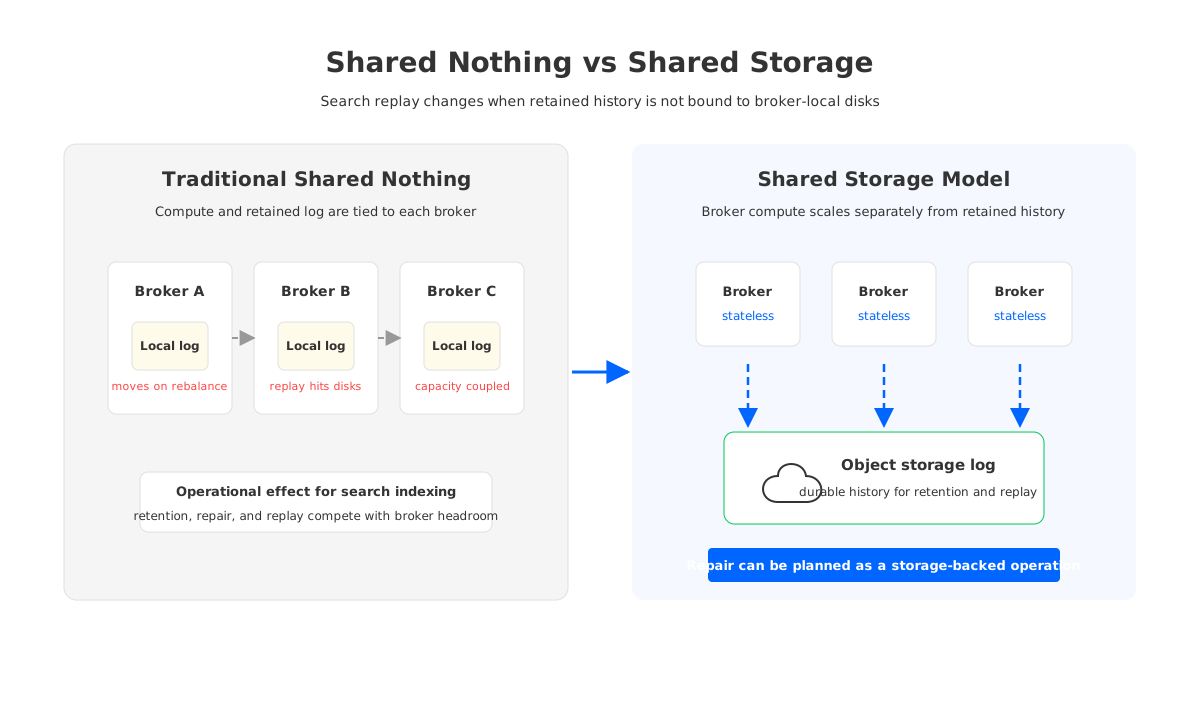
The streaming backbone sits underneath all three patterns. With a shared-nothing Kafka deployment, retained history and replay load are tied to broker-local capacity. Tiered storage can reduce pressure from older segments, but teams still need to know which reads hit broker disks, which reads hit remote storage, and how recovery behaves during maintenance. With shared storage, durable stream data lives outside the broker's local disk lifecycle, and broker compute can scale more independently from retained history.
That distinction matters because reindexing is not an edge case. Search teams rebuild indexes after mapping changes, relevance model changes, document-shaping bugs, analyzer changes, tenant moves, and incident repair. If every rebuild consumes the same broker headroom needed for live ingestion, repair becomes a risky event. A better operating model makes replay a planned workload with explicit rate limits, observability, and storage economics.
4Evaluation checklist for platform teams
The strongest platform reviews begin with a workload profile: event rate, record size, partitioning key, retention requirement, fanout count, expected replay frequency, downstream write limits, schema ownership, and rollback tolerance. Once those facts are visible, the trade-offs become less ideological.
Use this checklist before approving the architecture:
- Kafka compatibility. Existing producers, consumers, Kafka Connect workers, authentication settings, client libraries, and offset behavior should run without a rewrite.
- Backpressure contract. The indexing layer should define when it pauses, retries, dead-letters, commits offsets, or fails closed. Downstream throttling should slow the right consumers without blocking unrelated workloads.
- Replay boundary. The platform should retain enough history to rebuild an index and should make replay rate, offset range, and live-traffic impact observable. Repair should not depend on ad hoc logs from a failed worker.
- Cost model. Include broker compute, durable storage, replicated traffic, cross-zone data movement, connector workers, search bulk load, and replay windows. Search indexing cost is a system cost, not only a broker bill.
- Governance. Topic ownership, schema compatibility, PII handling, masking, dead-letter retention, and transform versioning should be assigned before search becomes a shared dependency.
- Migration and rollback. Dual-run, backfill, cutover, replay, and rollback should be tested with a real index before traffic moves.
- Observability. Lag, rejected records, bulk failure rate, replay throughput, index freshness, and broker health should be visible together. Separate dashboards for each component are not enough during an incident.
Elasticsearch and OpenSearch both document indexing performance and backpressure considerations because search clusters have their own resource limits. A streaming platform cannot make those limits disappear. It can make the response controlled: slow consumers deliberately, preserve replayable evidence, and prevent one index from turning into a platform-wide incident.
5How AutoMQ changes the operating model
Once the evaluation points to Kafka-compatible APIs, long retained history, replay-heavy operations, and cloud cost control, AutoMQ becomes relevant as a Kafka-compatible cloud-native streaming system built around shared storage. It keeps the Kafka protocol surface familiar while moving durable stream storage away from broker-local disks. Brokers operate more like stateless compute nodes, object storage holds stream data, and a write-ahead log layer supports writes.
For search indexing streams, the practical change is the separation of capacity questions. Retaining more change history for index rebuilds does not have to mean sizing every broker around local disk growth. Scaling broker compute for live ingestion and fanout can be considered separately from durable storage growth.
AutoMQ also fits the governance reality of enterprise platforms. It is Kafka-compatible, so teams can evaluate it with existing Kafka clients and tools rather than designing a new application API. Its shared-storage architecture is designed for cloud object storage, and its documentation describes deployment patterns such as AutoMQ BYOC and cloud traffic controls.
This does not remove the need for careful pipeline design. Document IDs still need deterministic rules. Partial bulk failures still need a policy. Transform code still needs versioning. Replays still need rate limits and validation. AutoMQ changes the infrastructure constraint beneath those choices by making retained history and replay less dependent on broker-local storage.
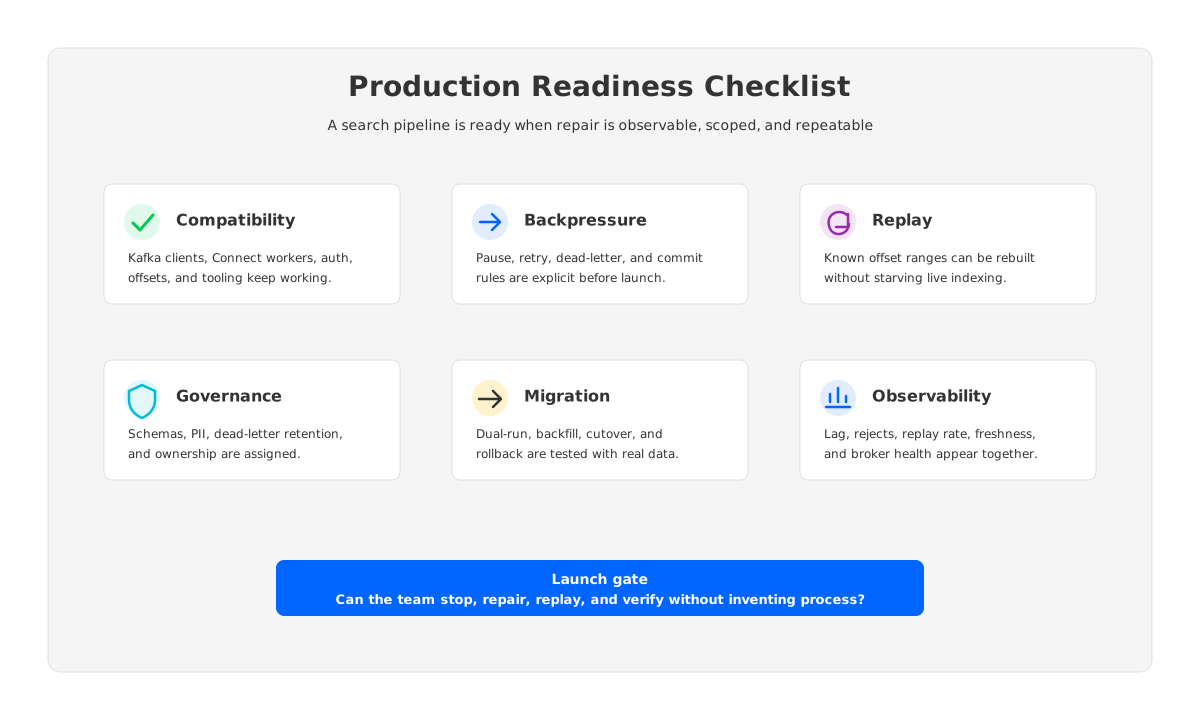
A useful proof of concept should avoid the easy demo. Do not only prove that a topic can reach a search index. Prove that a bad transform can be stopped, fixed, replayed from a known offset range, and validated while live changes continue. Prove that downstream throttling slows the intended consumers.
6Production readiness scorecard
The final readiness scorecard should make search freshness measurable and repair routine. Start with one non-critical index that behaves like a real workload. Publish CDC-style events, include deletes and schema changes, write through the chosen connector or consumer, and inject downstream failures. Learn how the system behaves when it is wrong, not only when it is empty and fast.
Score the platform on four questions that matter during incidents. First, can the team identify the last source event that reached the index? Second, can it isolate records that failed because of mapping or schema errors? Third, can it replay a narrow range without disrupting live indexing? Fourth, can it prove that the rebuilt index is equivalent enough to cut over? If the answer requires reading random worker logs, the pipeline is not yet production-ready.
The scorecard should also include team boundaries. Search indexing often crosses application owners, platform teams, data teams, and search teams. A written contract for ownership, retention, schema changes, and replay authority prevents incident response from turning into negotiation.
If your team is evaluating shared-storage Kafka for search indexing streams, use the AutoMQ architecture overview as a reference point for your own scorecard. The useful outcome is a clear decision about which pipelines can stay on the current backbone, which need stronger backpressure and replay controls, and which should move to an operating model built for retained history in the cloud.
7References
- Apache Kafka documentation: Consumer configs
- Apache Kafka documentation: Kafka Connect
- Apache Kafka documentation: Delivery semantics
- Apache Kafka documentation: KRaft
- OpenSearch documentation: Index backpressure
- Elasticsearch documentation: Tune for indexing speed
- AutoMQ documentation: Architecture overview
- AutoMQ documentation: S3Stream shared streaming storage
- AutoMQ documentation: WAL storage
- AutoMQ Cloud documentation: Eliminate inter-zone traffic
8FAQ
8.1Is Kafka required for search indexing streams?
No. A small application can write directly to a search engine, and some teams can use database-specific sync tools. Kafka-compatible streaming becomes valuable when many consumers share the same change events, replay matters, and indexing needs an operational boundary outside the transaction path.
8.2How should indexing workers handle backpressure?
They should slow down deliberately, preserve unprocessed work, and avoid committing offsets that imply documents are safely indexed when they are not. The exact policy depends on the failure: transient throttling may call for retry and pause, while invalid documents may need a dead-letter topic with enough context for repair.
8.3What is the safest way to replay search indexing streams?
Replay from a known offset range with a versioned transform, deterministic document IDs, rate limits, and validation against the target index. Avoid broad replays that run faster than the search backend can absorb or overwrite fresher documents without version checks.
8.4Where does AutoMQ fit in this architecture?
AutoMQ fits when the team wants Kafka-compatible APIs with a shared-storage operating model. That can help search indexing platforms retain more history, scale broker compute separately from durable storage, and treat replay-heavy repair as a planned cloud operation rather than a broker-local capacity emergency.


