
Table of Contents
Table of Contents
Teams usually search for secrets boundary design kafka after the first uncomfortable audit question, not before the first connector goes live. A JDBC source connector needs database credentials. A sink connector needs a warehouse token. Producers and consumers need Kafka credentials, TLS material, or cloud identity bindings. Each one looks reasonable in isolation, yet the platform team eventually has to explain who can see those secrets, who can rotate them, and how far a leaked connector credential can travel.
Kafka makes this problem more interesting because the platform is rarely a single application. It is a shared substrate for operational systems, analytics, machine learning features, fraud detection, and customer-facing event flows. Secrets boundary design is the discipline that keeps those flows from inheriting one large, implicit trust zone.
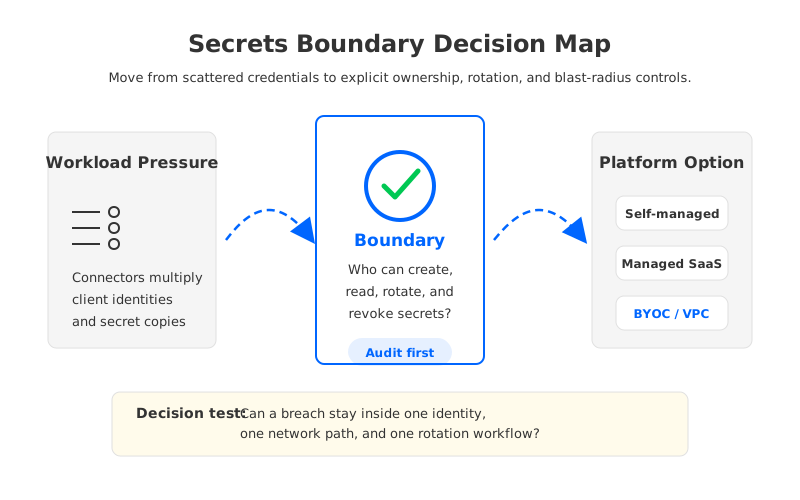
The hard part is not deciding that secrets should be stored in a secrets manager. The hard part is deciding where the boundary lives: inside a connector runtime, Kubernetes namespace, Kafka principal, VPC, managed service, or the customer's own cloud account. That boundary determines the blast radius of a credential leak and the operational cost of every rotation.
1Why teams search for secrets boundary design kafka
The search intent is usually practical. A team has moved beyond "how do I configure SSL?" and is trying to turn a collection of client settings into a governable system. Apache Kafka supports authentication, authorization, encryption, ACLs, and client-side configuration, but those primitives still need an ownership model. Kafka Connect supports externalized configuration through config providers, but it does not decide who should own the external secret store or how rotation should work across sources and sinks.
That ownership question becomes sharper when connector estates grow. The first few connectors are often operated by the data platform team. Later, application teams want self-service connectors, analytics teams want direct sink access, and security wants every credential mapped to an accountable owner. Without a boundary model, every new connector becomes a negotiation over who provisions, stores, reads, rotates, and audits the credential.
Three failure modes show up again and again:
- Secret sprawl across runtime layers. A password starts in a ticket, gets copied into a connector config, lands in a worker environment variable, appears in a backup, and later survives inside an old deployment manifest.
- Overbroad Kafka identities. A single connector principal can read or write more topics than its task requires, so a connector compromise becomes a data-plane compromise.
- Rotation without dependency mapping. Security asks for regular rotation, but nobody can predict which connector tasks, consumers, schema integrations, or downstream jobs will fail when a credential changes.
These are not signs that Kafka is insecure. They are signs that streaming has become central enough to need the same boundary design that teams already apply to databases, service meshes, and cloud IAM.
2The production constraint behind the problem
A Kafka secrets boundary has to satisfy two constraints that often pull in opposite directions. Security wants least privilege, fast revocation, short-lived credentials where possible, and a clear audit trail. Platform operations wants connector tasks to restart, consumer groups to keep offsets, producers to maintain availability, and migrations to avoid application rewrites. A boundary that is perfect on paper but breaks every rotation is not a production boundary.
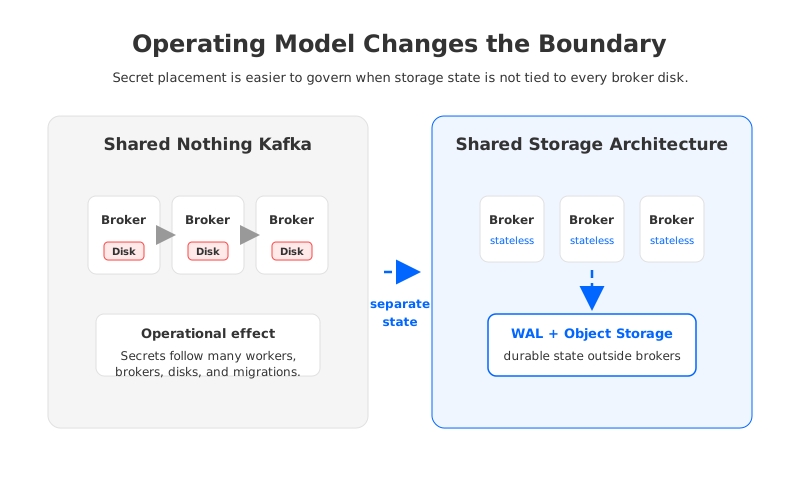
The traditional Kafka operating model adds another layer of friction. In a Shared Nothing architecture, brokers own local storage, partitions are placed on specific brokers, and operational events often involve data movement. That does not directly create application secrets, but it increases the number of stateful surfaces the platform team must protect, monitor, and reason about while clients and connectors continue to run.
Connectors amplify that complexity because they sit at the edge of two security domains. A source connector needs permission to read from an external system and write to Kafka. A sink connector needs permission to read from Kafka and write to an external system. The connector runtime therefore becomes a bridge between identity systems that may use different owners, rotation schedules, network paths, and audit mechanisms. Treating it as only a Kafka client misses the point.
The production question is narrower and more useful: can each connector or streaming client be tied to one accountable identity, one minimal set of Kafka ACLs, one external-system permission set, one network boundary, and one rotation workflow? If the answer is no, the architecture will force security exceptions into daily operations.
3Architecture options and trade-offs
There are several legitimate ways to draw the boundary. The right answer depends on the organization's cloud model, compliance posture, connector ownership model, and tolerance for operating Kafka internals. The wrong answer is treating the boundary as only a library setting.
| Boundary choice | What it protects well | Where it gets difficult |
|---|---|---|
| Application-owned secrets | Keeps each producer or consumer close to its own service owner. | Platform teams may lose visibility into inconsistent client settings and old credentials. |
| Connector-runtime secrets | Centralizes source and sink credentials around Kafka Connect workers. | A shared worker can become a high-value target unless tasks, namespaces, and principals are isolated. |
| Kafka principal per workload | Makes topic-level ACLs and audit trails easier to reason about. | Requires disciplined lifecycle management for many users, passwords, certificates, or tokens. |
| Kubernetes or cloud namespace boundary | Aligns secrets with deployment and network policy. | Does not automatically solve Kafka authorization or external-system permissions. |
| BYOC or customer VPC boundary | Keeps data-plane infrastructure and network control in the customer's account. | The team still needs a shared responsibility model for operations, upgrades, and support access. |
This table is deliberately not a product comparison. It is a way to prevent a common architectural mistake: moving the secret from one file to another and calling the design complete. A secret manager is a storage mechanism. A boundary is a control plane decision. It defines who can issue credentials, which runtime can read them, what the credential can do, and how the system behaves when the credential is revoked.
For Kafka-compatible infrastructure, compatibility also matters. If a platform changes the client protocol, ACL semantics, consumer group behavior, or connector configuration model, the security design becomes entangled with migration risk. Teams then have to validate security and application behavior at the same time. A cleaner path preserves Kafka client and protocol expectations while improving the operational model around storage, scaling, and deployment boundaries.
4Evaluation checklist for platform teams
Start with a threat model that is boring enough to run every quarter. Pick one representative source connector, one sink connector, one high-volume producer, and one regulated consumer. For each one, trace the credential from creation to rotation to revocation. The goal is not a perfect diagram. The goal is to find hidden copies and unclear owners before an incident or audit finds them for you.
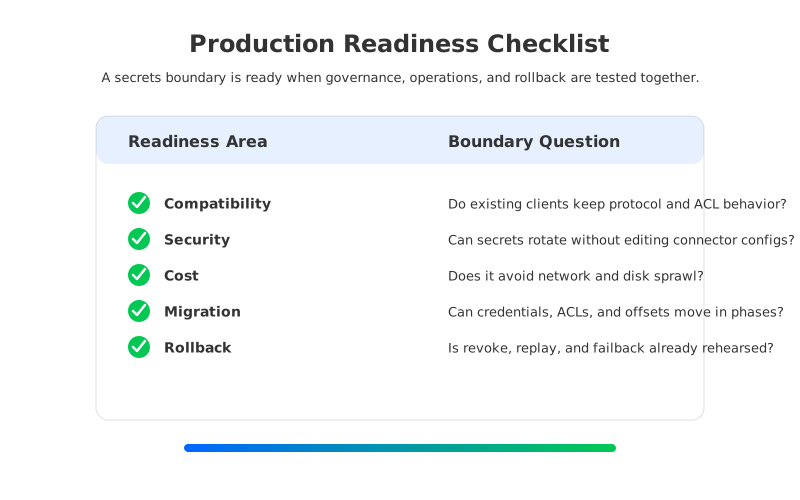
The checklist should cover both security and operations:
- Identity scope. Each workload should use its own Kafka principal and external-system credential. Shared accounts are convenient during pilots and expensive during investigations.
- Authorization scope. Kafka ACLs should match the connector's real topic and group needs. A sink connector that reads one topic family does not need cluster-wide read permissions.
- Runtime isolation. Connector workers should be isolated by sensitivity, tenant, or ownership where needed. A low-risk analytics sink and a payment-system source should not share a boundary because both use Kafka Connect.
- Rotation path. Rotation should be rehearsed without editing connector definitions by hand. Externalized config providers, Kubernetes Secrets, cloud secrets managers, and restart automation all help, but only if ownership is documented.
- Network path. The credential boundary should match the network boundary. A secret that can reach a database over broad peering has a different risk profile from one constrained by VPC, subnet, security group, or PrivateLink-style controls.
- Observability and rollback. Logs should show which principal accessed which topic, which connector task used which credential reference, and which operator changed it. A bad rotation also needs a tested fallback so consumers can resume from known offsets after a connector restart.
The most useful signal is often the weakest link between these items. A team may have excellent Kafka ACL hygiene but weak database credential rotation. Another may have strong cloud IAM but weak connector task isolation. Boundary design is cross-domain by nature, so the review has to cross team boundaries as well.
5How AutoMQ changes the operating model
Once the evaluation framework is clear, the streaming platform choice becomes easier to discuss. AutoMQ is a Kafka-compatible, cloud-native streaming system that keeps the Kafka API and ecosystem model while changing the storage architecture underneath. Instead of binding stream data to broker-local disks, AutoMQ uses a Shared Storage architecture with stateless brokers, a WAL layer for the durable write path, and object storage for durable stream data.
That architectural shift does not eliminate secrets design; no streaming platform can do that. It changes the operating model around it. When brokers are stateless, scaling and recovery no longer revolve around moving full local partition data between broker disks. For security and platform teams, that reduces the number of stateful broker surfaces included in operational runbooks.
AutoMQ's BYOC model is especially relevant to secrets boundaries. In a BYOC deployment, the streaming environment runs in the customer's cloud account and VPC, which helps teams keep network paths, infrastructure logs, cloud policies, and data-plane resources inside their own administrative boundary. AutoMQ documentation also describes Kafka Connect workers deployed in the user's VPC for BYOC, with connector access controlled through Kafka ACL users and related permissions.
The cost and governance discussion are connected. Traditional multi-AZ Kafka commonly creates cross-zone data movement through producer paths, broker replication, and consumer reads. AutoMQ's shared-storage architecture is designed to reduce or eliminate those inter-zone traffic paths in supported configurations by using S3-based storage and locality-aware routing. That is not a secrets feature, but fewer mandatory cross-zone paths mean fewer network-policy exceptions to explain.
Compatibility is the other reason AutoMQ can enter this conversation without forcing a rewrite. Existing Kafka producers, consumers, and Kafka Connect patterns are valuable precisely because teams have already built operational knowledge around them. A Kafka-compatible platform lets teams focus the migration plan on credentials, ACLs, network paths, observability, and rollback rather than changing application semantics at the same time.
For teams evaluating a move from self-managed Kafka or another managed Kafka-compatible service, the readiness question becomes concrete: can the target platform preserve client behavior while improving the deployment and storage boundary? If yes, inventory producers, consumers, connectors, Kafka principals, external credentials, and network paths first. Then validate protocol behavior, map ACLs, move connectors by sensitivity group, and rotate credentials after cutover. A migration is not validated when data flows once; it is validated when a credential rotates, a task restarts, and the audit trail is readable.
6Decision matrix: when the boundary is ready
A good secrets boundary is not the most restrictive design imaginable. It is the design that keeps risk local while allowing the platform to operate at production speed. Use this matrix to decide whether a Kafka-compatible streaming platform is ready for connector-heavy workloads.
| Test | Ready signal | Warning signal |
|---|---|---|
| Connector ownership | Every connector has a service owner and security owner. | Connectors are owned by "the platform" after creation. |
| Secret storage | Connector configs reference external secrets. | Literal passwords or tokens appear in connector payloads, manifests, or tickets. |
| Kafka authorization | Principals map to workload scope and topic scope. | One connector principal can read or write unrelated topics. |
| Network boundary | Runtime placement matches data sensitivity and external-system reachability. | A shared worker can reach systems across unrelated trust zones. |
| Rotation | Rotation is rehearsed and observable. | Rotation requires manual edits, tribal knowledge, or broad maintenance windows. |
| Migration | ACLs, offsets, and rollback are tested together. | Migration validates data copy but leaves credentials for later cleanup. |
This is where secrets boundary design becomes a buying criterion, not a security appendix. A platform that reduces broker-state operations, preserves Kafka compatibility, supports customer-controlled deployment boundaries, and makes connector runtime placement explicit gives security teams fewer exceptions to approve.
If you are evaluating Kafka-compatible streaming infrastructure and want to test this model against your own VPC, connector estate, and governance requirements, review AutoMQ's Kafka Connect and BYOC documentation or talk with the AutoMQ team through the verified contact page: Contact AutoMQ. The useful next step is a boundary review using your real connector identities, network paths, and rotation process.
7References
- Apache Kafka Documentation
- Apache Kafka Connect configuration providers
- Apache Kafka Security
- Kubernetes Secrets
- AWS Secrets Manager User Guide
- AutoMQ Kafka Connect Overview
- AutoMQ Manage Kafka ACLs
- AutoMQ Migration Overview
- AutoMQ Inter-Zone Traffic Overview
8FAQ
8.1What is secrets boundary design for Kafka?
It defines where Kafka client and connector credentials are created, stored, read, rotated, audited, and revoked. It connects Kafka ACLs, connector runtime isolation, external-system credentials, network placement, and operational ownership.
8.2Is storing connector passwords in a secrets manager enough?
No. A secrets manager protects secret values, but the boundary also includes who can reference the secret, what it can access, where the runtime runs, how rotation works, and how the team proves revocation.
8.3How should Kafka Connect secrets be handled?
Use externalized configuration where possible, keep literal passwords out of connector definitions, assign least-privilege Kafka principals, and isolate workers by sensitivity or ownership. Then test task restart and credential rotation.
8.4Does BYOC solve secrets governance automatically?
BYOC helps because the data plane, VPC controls, logs, and cloud resources can remain inside the customer's account boundary. It does not replace least-privilege Kafka ACLs, connector runtime isolation, external secret references, or rotation runbooks.
8.5Why does storage architecture matter for secrets boundaries?
Storage architecture affects operational surfaces around the streaming platform. Broker-local storage can make scaling, recovery, and replacement more stateful. Shared storage with stateless brokers reduces that coupling.
8.6Where should AutoMQ fit in an evaluation?
Evaluate the neutral requirements first: Kafka compatibility, ACL behavior, connector isolation, network placement, rotation, observability, migration, and rollback. AutoMQ becomes relevant if the team wants Kafka-compatible behavior with shared storage, stateless brokers, BYOC deployment boundaries, and reduced inter-zone data movement in supported configurations.


