
Table of Contents
Table of Contents
Teams search for secure multi tenant kafka when Kafka has become too useful to keep small. One team uses it for payments, another for product analytics, another for AI context, and a fourth for operational telemetry. The platform group is asked to provide a shared streaming backbone, but the security review asks a sharper question: can these tenants share infrastructure without sharing risk?
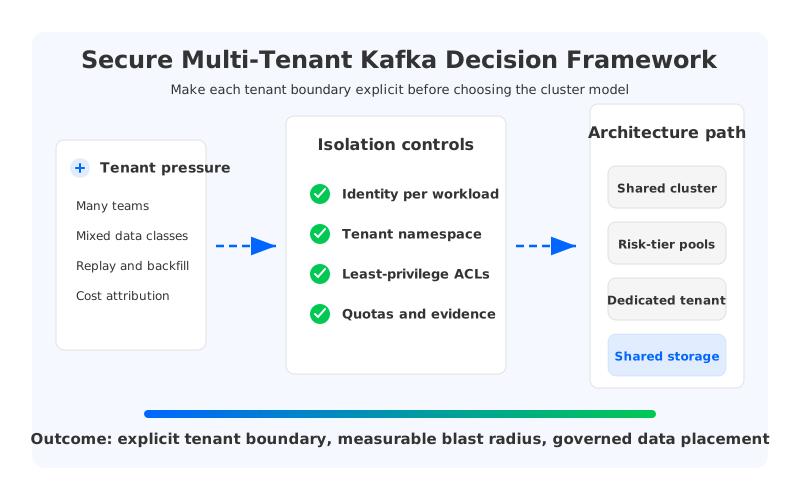
That question is not answered by saying "use ACLs" or "create one cluster per team." ACLs protect Kafka resources, but tenants also compete for network, broker CPU, disk, controller metadata, connector capacity, observability pipelines, and operational attention. Dedicated clusters reduce some shared risk, but they multiply upgrades, certificates, monitoring, idle capacity, and incident runbooks. Secure multi-tenancy sits between those extremes. It is the discipline of defining which boundaries must be hard, which can be logical, and which need measurable guardrails.
1Why secure multi tenant kafka matters now
Multi-tenant Kafka used to be an internal efficiency pattern: one shared cluster, many application teams, lower infrastructure waste. That framing is too narrow for platform teams now. Kafka is often the operational data plane for customer-facing products, fraud decisions, audit streams, ML features, customer profiles, and security events. A tenant boundary is therefore a data boundary, a reliability boundary, and a governance boundary at the same time.
The hardest part is that Kafka tenants are not always "customers" in the SaaS sense. A tenant may be a business unit, an application, a data domain, an environment, a geography, a connector fleet, or a regulated workload. Each tenant has a different appetite for blast radius:
- Security isolation asks whether one tenant can read, write, describe, alter, or infer data from another tenant.
- Performance isolation asks whether one tenant can cause latency, throttling, request queue growth, or controller pressure for another tenant.
- Operational isolation asks whether a tenant-specific change, upgrade, incident, or support action can be contained.
- Cost isolation asks whether spend can be attributed to the tenant that generated the load.
Those boundaries overlap, but they are not the same. A namespace can make topic ownership clear while doing little for request saturation. A quota can reduce noisy-neighbor impact while doing nothing for accidental ACL breadth. A network policy can prevent clients from reaching brokers while leaving connector workers with too much access. Secure design starts by naming the boundary, then choosing the mechanism.
2Isolation is a control stack, not a single feature
Apache Kafka gives operators important primitives: TLS for encrypted connections, SASL and mTLS patterns for authentication, ACLs for authorization, quotas for resource control, consumer groups for consumption coordination, and KRaft for metadata management without ZooKeeper. These primitives are necessary, but a secure platform is built from how they are combined.
A useful control stack has five layers. The first layer is identity: every producer, consumer, connector, admin job, and platform automation path needs an accountable principal. The second is namespace: topics, consumer groups, transactional IDs, schemas, and connectors need tenant-aware naming that can be mapped to policy. The third is authorization: permissions should grant specific operations against specific resources rather than broad cluster-level access. The fourth is resource governance: quotas, partition limits, retention policy, and request patterns need owner-level visibility. The fifth is operations: provisioning, secret rotation, emergency access, and audit evidence need repeatable workflows.
| Layer | Kafka mechanism | Secure multi-tenant question |
|---|---|---|
| Identity | SASL, mTLS, service accounts | Can each principal be tied to one workload, one owner, and one rotation policy? |
| Namespace | Topic and group naming, schema subjects | Can every resource be mapped to a tenant without reading tribal knowledge? |
| Authorization | ACLs and admin permissions | Can permissions be reviewed without wildcard access hiding in the corner? |
| Resource governance | Quotas, retention, partition policy | Can noisy-neighbor pressure be detected before it becomes a shared incident? |
| Operations | CI/CD, audit logs, break-glass access | Can tenant onboarding and incident actions be repeated without manual privilege drift? |
This stack also explains why "single cluster or many clusters" is an incomplete starting point. A shared cluster with disciplined identity, quotas, and automation may be safer than a sprawl of lightly governed dedicated clusters. A dedicated cluster may still be required for a regulated workload, but the reason should be explicit: data residency, support boundary, key ownership, latency SLO, or failure-domain separation.
3Where traditional Kafka gets stressed
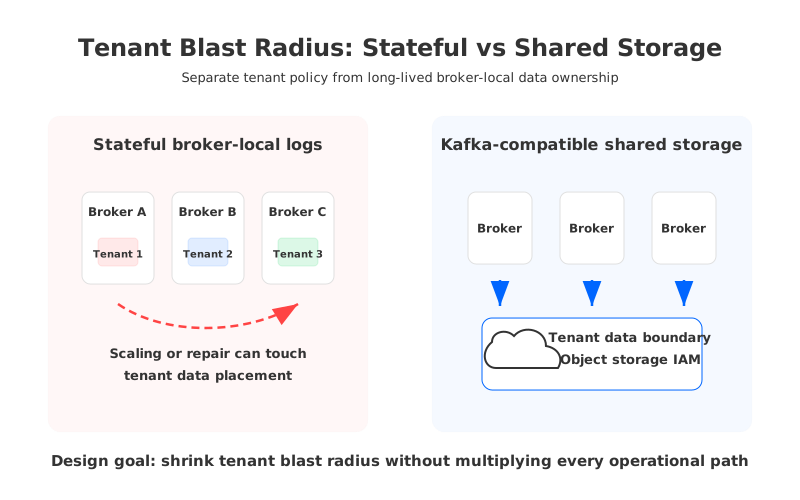
Traditional Kafka uses a shared-nothing architecture. Brokers own local log storage, partitions are assigned to brokers, and durability comes from replication across brokers. This model is mature and widely operated, but it makes multi-tenancy a capacity and storage placement problem as much as a security problem.
The first stress is resource coupling. A tenant does not consume "Kafka" in the abstract; it consumes broker network, request handler threads, page cache, disk bandwidth, partition metadata, controller activity, and replication capacity. Kafka quotas can limit producer and consumer byte rates or request rates, but platform teams still need to plan for partitions, retention, compaction, reassignments, and backfills. A tenant with a large replay or a poorly tuned producer can create pressure that looks like a platform incident.
The second stress is durable data ownership. With broker-local storage, each broker is both a compute endpoint and a storage owner. Replication is necessary for availability, but it also means durable copies sit across brokers and failure domains. When a tenant asks where its data lives, who can operate the nodes, how long retained records remain, and what happens during broker replacement, the answer involves both Kafka policy and infrastructure policy.
The third stress is scaling. If capacity expansion or tenant movement requires partition reassignment and data movement, teams often keep excess broker and disk capacity online. That buffer protects reliability, but it also increases the shared trusted surface: more long-lived nodes, more persistent volumes, more credentials, and more operational paths to review.
4Architecture patterns teams usually compare
A secure multi-tenant Kafka design usually lands in one of four patterns. None is universally correct. The right answer depends on tenant risk, operational maturity, workload shape, and the cost of isolation.
| Pattern | Strong fit | Main risk to test |
|---|---|---|
| Shared Kafka cluster | Many teams with moderate isolation needs and common platform standards | ACL drift, noisy-neighbor pressure, shared upgrades, broad admin access |
| Cluster-per-tenant | High-risk workloads, strict compliance, or strong performance isolation | Operational sprawl, idle capacity, inconsistent controls, slower patching |
| Pooled clusters by risk tier | Many tenants with different data classes or SLOs | Tier boundaries becoming vague, tenant migration friction, duplicated tooling |
| Kafka-compatible shared-storage platform | Elastic workloads, long retention, replay-heavy tenants, and strong storage governance | Object storage IAM, WAL choice, metadata scope, endpoint routing, telemetry policy |
The risk-tier pattern is often the most realistic for enterprises. Put low-risk internal telemetry in a shared pool, regulated data in a tighter pool, and exceptional workloads in dedicated environments. This keeps the architecture honest: isolation is expensive, so reserve the strongest isolation for tenants that can justify it. The platform team can still standardize identity, topic onboarding, quotas, observability, and audit across all tiers.
The shared-storage pattern changes a different part of the equation. Instead of treating every broker as a long-lived storage owner, it separates broker compute from durable stream storage. That does not eliminate tenant controls, but it can make the durable data boundary more explicit and reduce the amount of data movement tied to scaling or recovery. For platform teams, the question becomes: can storage governance, elasticity, and tenant blast-radius control be designed around cloud-native primitives rather than broker-local disks?
5A practical isolation model for platform teams
Start tenant design from a resource contract. Each tenant should know what it owns, what it can touch, what it can consume, and what evidence it receives. The contract does not need to be a legal document; it can be an internal platform spec backed by automation.
A strong contract usually contains these fields:
- Tenant identity. The business owner, technical owner, environment, data classification, and emergency contact.
- Kafka resource scope. Topic prefixes, consumer group prefixes, transactional ID scope, schema subject scope, and connector scope.
- Access model. Allowed operations, credential type, rotation cadence, approval path, and break-glass policy.
- Resource envelope. Throughput quota, partition budget, retention window, compaction policy, maximum message size, and backfill expectations.
- Observability evidence. Per-tenant throughput, errors, throttling, consumer lag, quota usage, topic growth, and audit events.
- Exit path. How the tenant can move to another tier, another cluster, or another platform without losing offsets, schemas, or governance history.
The exit path is often ignored, and that is where multi-tenancy becomes sticky. If a tenant outgrows the shared pool, the platform team needs a repeatable migration path: create target topics, mirror data, preserve or translate offsets, cut over clients, revoke old credentials, and keep audit evidence. Without that path, the shared cluster becomes a one-way door.
6Where AutoMQ changes the operating model
After the neutral evaluation is clear, AutoMQ becomes relevant as a Kafka-compatible, cloud-native streaming platform built around compute-storage separation. AutoMQ keeps the Kafka protocol surface familiar for producers, consumers, Kafka Connect, and Kafka ecosystem tooling, while S3Stream moves durable stream data into shared object storage. Brokers act more like stateless compute nodes, supported by WAL, cache, and metadata management rather than owning all long-term log data on local disks.
For secure multi-tenancy, that shift matters in three ways. First, durable data governance can align with customer-controlled object storage, cloud IAM, bucket policy, encryption, and audit controls. Second, broker replacement and elastic scaling can be less tied to tenant data movement, which reduces operational blast radius during capacity changes. Third, the platform can separate tenant access policy from infrastructure recovery paths more cleanly, because compute nodes do not need to be treated as the permanent home of tenant logs.
This does not make ACL design, quotas, network segmentation, or audit evidence optional. AutoMQ still needs the same platform discipline expected from any production Kafka-compatible system: accountable identities, least-privilege access, clear topic ownership, retention governance, key management, and incident workflows. The architectural difference is that a shared-storage foundation gives teams another lever for controlling where durable data lives and how compute capacity changes.
AutoMQ BYOC is especially relevant when the security requirement is not only "multi-tenant" but "customer-controlled." In a BYOC model, the data plane runs in the customer's cloud environment, helping teams align Kafka-compatible streaming with their VPC, storage, IAM, key, and audit boundaries. The review should still be concrete: which metadata is managed by the control plane, which permissions are granted to the operator, which telemetry is exported, and which tenant data never leaves the customer-controlled boundary?
7Decision checklist before production
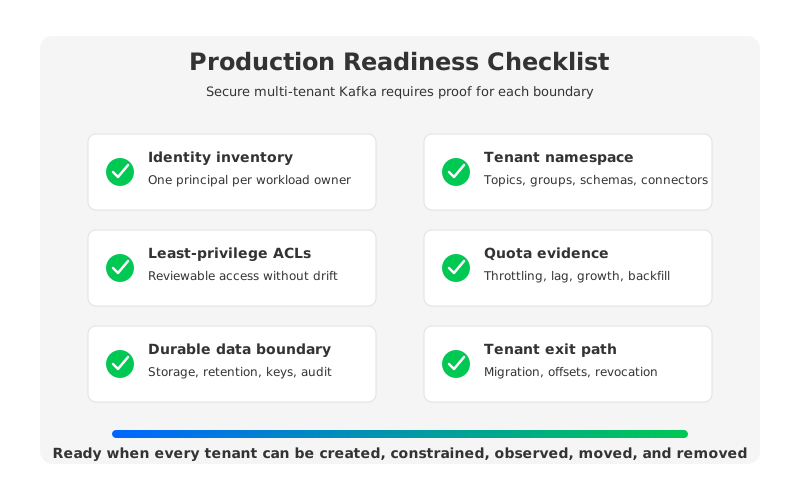
The production review should produce proof, not reassurance. A platform team should be able to show how a tenant is created, constrained, observed, moved, and removed. If those actions depend on manual ticket interpretation, the platform is still relying on human memory as a security control.
| Proof point | Evidence to collect |
|---|---|
| Tenant resources are discoverable | Owner, topic prefix, group prefix, schema scope, connector scope, and data class |
| Access is least-privilege | Principal inventory, ACL diff, admin role review, credential rotation record |
| Noisy-neighbor impact is bounded | Quota settings, throttling metrics, partition budget, backfill plan, tenant dashboards |
| Durable data has a boundary | Storage location, retention, backup path, encryption policy, key ownership, audit trail |
| Operations are repeatable | Provisioning workflow, CI/CD permissions, break-glass approval, rollback procedure |
| Tenant exit is possible | Migration plan, offset handling, schema compatibility, credential cutover, revocation evidence |
The most secure multi-tenant Kafka platform is not the one with the most clusters or the longest security checklist. It is the one where tenant boundaries are explicit enough to operate under pressure. When a tenant spikes traffic, leaks credentials, requests a data export, fails a compliance review, or needs to move to a dedicated tier, the platform should already know what to do.
If your team is evaluating secure multi-tenant Kafka, start with the tenant contract before choosing the cluster topology. Then compare the operating model of broker-local storage with a Kafka-compatible shared-storage architecture where durable stream data can be governed through customer-controlled object storage. To explore that option, review the AutoMQ architecture materials and test the model against your own IAM, network, retention, quota, and audit requirements.
8References
- Apache Kafka documentation: security
- Apache Kafka documentation: authorization and ACLs
- Apache Kafka documentation: quotas
- NIST Special Publication 800-207: Zero Trust Architecture
- AutoMQ documentation: compatibility with Apache Kafka
- AutoMQ documentation: difference with Apache Kafka
9FAQ
9.1Is secure multi-tenant Kafka only about ACLs?
No. ACLs are essential, but secure multi-tenancy also requires identity ownership, topic and group namespace policy, quotas, retention governance, network segmentation, audit evidence, operational workflows, and tenant migration paths.
9.2When should a tenant get a dedicated Kafka cluster?
A dedicated cluster is justified when the tenant requires strong data residency, independent upgrade timing, strict performance isolation, separate key ownership, or a narrow operational blast radius. The reason should be documented, because dedicated clusters also increase operational work.
9.3How do quotas help with multi-tenant Kafka security?
Quotas limit how much producer, consumer, or request capacity a tenant can consume. They do not protect confidentiality by themselves, but they reduce the chance that one tenant turns a shared cluster into a platform-wide incident.
9.4Does shared storage replace Kafka tenant controls?
No. Shared storage changes the compute and durable data ownership model, but teams still need Kafka authentication, authorization, network controls, quotas, retention policy, encryption, and audit workflows. It adds a storage governance lever; it does not remove platform governance.
9.5What should be tested before onboarding production tenants?
Test tenant provisioning, ACL enforcement, credential revocation, quota throttling, backfill behavior, connector access, object storage policy, broker replacement, audit completeness, and tenant exit. A platform is ready when those behaviors are repeatable under incident pressure.


