
Table of Contents
Table of Contents
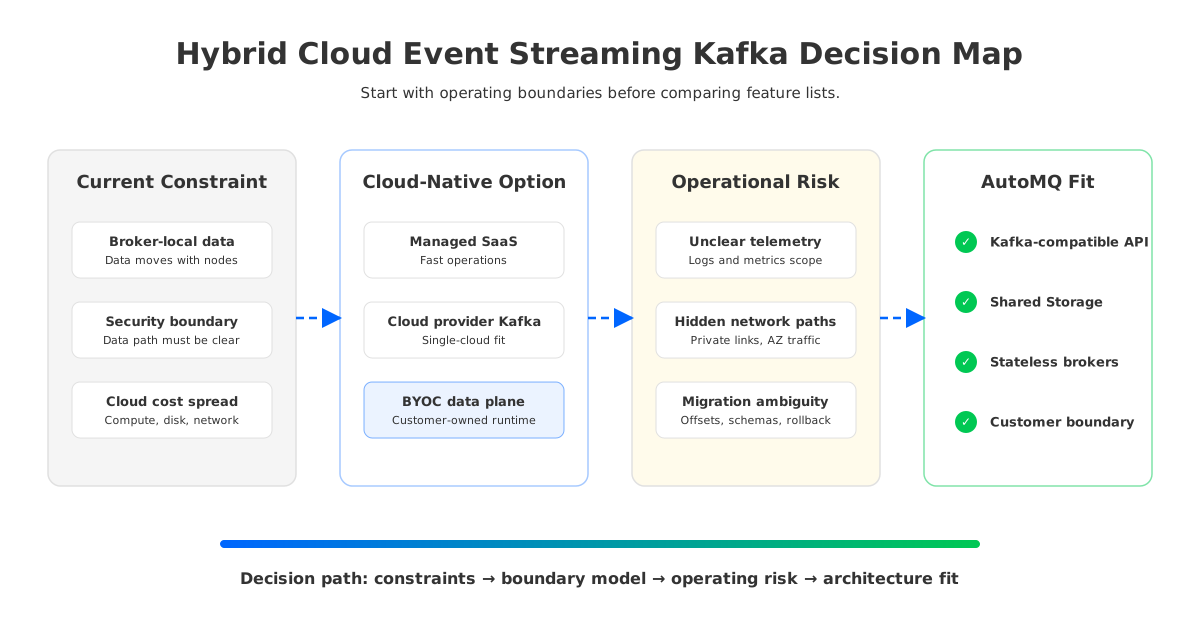
Teams search for hybrid cloud event streaming kafka when the Kafka decision has stopped being a pure platform-engineering question. The cluster still has to move records, preserve offsets, support Consumer groups, and integrate with Kafka Connect. But the meeting has changed: security wants to know where data and metadata live, procurement wants the cloud bill and vendor bill explained together, and architects want a deployment boundary that works across cloud, private network, and migration phases.
That is the hard part of hybrid cloud event streaming. The word "hybrid" can mean an on-premises Kafka estate connected to cloud analytics, a regulated application stack that keeps data inside a customer-owned VPC, or a multi-cloud architecture built to avoid dependence on one region or provider. Kafka can support these patterns at the protocol level, but production platforms are judged by identity, network reachability, storage ownership, audit evidence, operational responsibility, and rollback. A good evaluation starts by asking what boundary you are buying, not only which API the service exposes.
1Why teams search for hybrid cloud event streaming kafka
The search usually begins with one of three pressures. A platform team may need to connect an existing Kafka estate to cloud-native applications without rewriting clients. A security team may reject a fully hosted data path for regulated workloads, then ask whether a managed experience is still possible inside the customer's cloud account. A procurement team may discover that the Kafka line item is split across broker compute, disks, cross-Availability Zone traffic, private connectivity, storage, support, and engineering time.
These pressures are related because Kafka is not a stateless API gateway. A Kafka cluster is a durable log, a coordination system, a network endpoint, and a compatibility contract for applications that depend on Topic, Partition, Offset, Consumer group, and transaction behavior. If the platform crosses cloud and private boundaries, every layer becomes part of the review. The team cannot approve "Kafka in hybrid cloud" until it can explain where data is written, who can administer the runtime, which identities can reach it, how failover works, and how migration avoids changing offsets or breaking consumers.
Broad feature checklists flatten the decision into yes-or-no boxes while the real risk sits in the interaction between architecture and ownership. A Kafka-compatible platform can still create procurement friction if data storage, telemetry, support access, and network routing cross unclear boundaries. Another platform may pass review faster because it maps cleanly to existing cloud accounts, IAM, KMS, VPC flow logs, procurement terms, and incident response procedures.
2The production constraint behind the problem
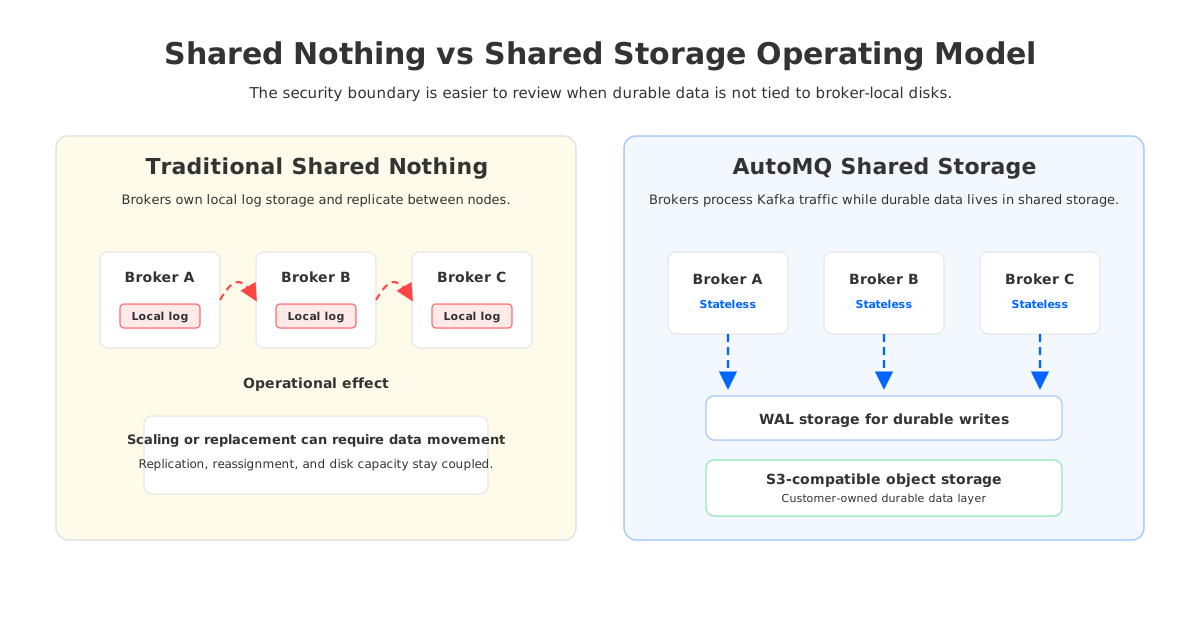
Traditional Kafka was designed around a Shared Nothing architecture. Each Broker owns local storage for its partitions, and Kafka uses replication between leader and follower replicas to protect availability. That model is practical and gives operators direct control over placement, retention, and failure domains.
The trade-off appears when that local-disk model is stretched across cloud and hybrid operating boundaries. Broker-local storage makes a compute node part of the durable data plane. When the team scales out, replaces nodes, rebalances partitions, or moves workloads closer to another application environment, data movement becomes part of the operation. In a multi-Availability Zone deployment, replication can also create network paths that finance teams notice later.
Hybrid cloud adds a second constraint: the data path must be explainable to people who do not operate Kafka every day. Security reviewers are usually asking whether event data leaves the approved account, whether encryption keys remain under customer control, whether support personnel can access runtime components, whether logs and metrics contain sensitive payloads, and whether a management credential can cross into the data plane. The architecture has to make those answers obvious enough to document.
Apache Kafka documentation is the right baseline for protocol behavior and client semantics: producers, consumers, topics, partitions, offsets, replication, and transactions. But a hybrid cloud procurement decision must add a deployment model on top. The review question becomes: which parts of the Kafka experience should remain stable, and which parts of the operating model can change?
3Architecture options and trade-offs
Most teams compare four operating models, even when the shortlist uses different names. Self-managed Kafka keeps maximum control but leaves the platform team responsible for upgrades, rebalancing, scaling, security hardening, and on-call work. Managed SaaS Kafka reduces operational load but places the service boundary outside the customer's runtime environment. Cloud-provider managed Kafka can simplify procurement inside one cloud. BYOC Kafka and customer-owned data plane models try to combine managed operations with customer-side infrastructure ownership.
The important distinction is not whether the product says "managed." It is where the control plane, data plane, storage, telemetry, and support path sit.
| Question | What a weak answer sounds like | What a strong answer should clarify |
|---|---|---|
| Data plane location | "It runs in the cloud." | The exact account, VPC/VNet, region, subnet, and runtime boundary for Brokers, storage, and network paths. |
| Storage ownership | "Data is encrypted." | Who owns the bucket, disk, key policy, retention policy, backup path, and deletion process. |
| Control plane scope | "The vendor manages it." | Which management actions are automated, which metadata is exchanged, and which actions need customer approval. |
| Network model | "Private connectivity is supported." | Client ingress, connector egress, admin access, endpoint policy, DNS, routing, and cross-zone or cross-region paths. |
| Exit path | "Kafka-compatible." | How topics, offsets, credentials, schemas, connectors, and rollback are handled during migration. |
This table is a procurement tool, not a vendor scorecard. A fully hosted service can fit when speed and operations matter more than customer-owned runtime boundaries. A self-managed deployment can fit when the organization has deep Kafka expertise and strict internal platform standards. A BYOC model is attractive when the business wants managed operations but needs the data plane to stay inside governed cloud accounts and networks.
The storage architecture underneath the platform changes the operating model as much as the deployment boundary does. In traditional Shared Nothing Kafka, data placement follows Brokers. In Tiered Storage, older data can move to object storage, but recent data and the active write path still depend on broker-local storage. In Shared Storage architecture, durable event data is placed in shared object storage, and Brokers become closer to replaceable compute.
4Evaluation checklist for platform teams
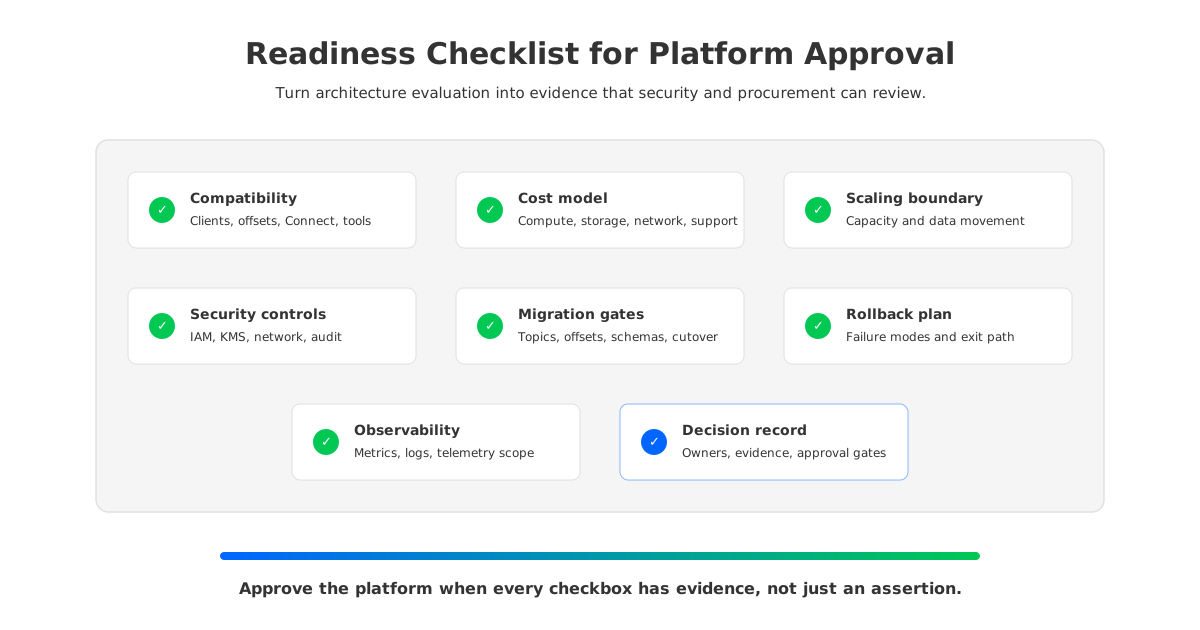
Security and procurement teams need questions that produce evidence. "Is it secure?" is too broad. "Can you provide the IAM policies, network paths, encryption boundaries, telemetry scope, and support access procedure for this deployment?" forces the platform owner and vendor to describe a system, not a promise.
Start with compatibility because migration risk often hides under architecture enthusiasm. Kafka-compatible streaming should preserve the client behavior your applications use: Producer and Consumer APIs, Consumer group coordination, offsets, idempotent and transactional producers where required, Kafka Connect integration, Schema Registry expectations, observability tooling, and operational scripts. Compatibility is a test plan tied to the applications that will be moved.
Then review cost as an operating model, not a single unit price. Hybrid streaming cost can include broker compute, disks, object storage, request charges, cross-Availability Zone traffic, private connectivity, load balancers, Kubernetes overhead, support, migration tooling, and engineering time. A platform that moves storage to object storage may reduce one category while adding another. Both effects should be visible before contract signature.
The remaining checks belong in a readiness scorecard:
- Boundary evidence. Document where event data, metadata, logs, metrics, control-plane state, and support access live. Treat "customer-owned data plane" as incomplete until each data class has a location and owner.
- Identity and encryption. Map runtime identities, admin identities, key ownership, secret storage, rotation, and emergency access. Security teams need to know whether management access can become data access.
- Network reachability. Draw client ingress, connector egress, admin access, observability export, object storage access, and migration replication. Include DNS and endpoint ownership, not only high-level VPC diagrams.
- Failure and rollback. Define what happens when a Broker fails, an Availability Zone is isolated, a region is unavailable, a migration lags, or the target platform fails acceptance tests. Procurement should ask for the rollback story before approving migration spend.
- Operational handoff. Decide which team owns upgrades, scaling, incident response, capacity planning, cloud quota requests, and audit evidence. A hybrid platform with an unclear handoff becomes expensive during incidents.
5How AutoMQ changes the operating model
After the neutral evaluation, the architectural requirement becomes sharper: keep Kafka semantics stable, move durable storage into a customer-controlled shared storage layer, and make Brokers easier to replace, scale, and rebalance. AutoMQ is a Kafka-compatible streaming platform built around that idea, replacing the broker-local storage layer with a Shared Storage architecture backed by S3-compatible object storage.
In AutoMQ, Brokers handle Kafka protocol processing, partition leadership, caching, and scheduling, while durable data is written through S3Stream to WAL storage and S3 storage. The data plane can be described as compute plus customer-owned storage, rather than a fleet of stateful nodes that each contain irreplaceable local log segments. Broker replacement and partition reassignment become metadata and ownership operations instead of long data-copy projects.
The deployment boundary matters as much as the storage design. AutoMQ BYOC is designed for public cloud environments where the control plane and data plane run in the customer's cloud account and VPC. AutoMQ Software is designed for private data centers and self-operated environments. Those models let platform teams discuss procurement in familiar terms: customer-owned cloud accounts, customer-owned storage, customer network controls, customer IAM, and scoped management components.
AutoMQ's Shared Storage architecture also changes cost and elasticity questions. Traditional Kafka capacity planning often couples compute, local storage, retention, and replication. A storage-compute separated design lets the team reason about compute capacity and durable storage capacity separately: compute scales with active workload, storage scales with retained data, and cross-zone data movement can be reduced by avoiding broker-to-broker replication of durable log data in the common write path.
Migration still deserves a sober plan. Kafka compatibility reduces application change, but it does not eliminate cutover work. Teams should inventory topics, partitions, ACLs, schemas, connector offsets, Consumer groups, observability dashboards, and rollback criteria. AutoMQ provides Kafka Linking for migration scenarios, including byte-level data synchronization and consumer progress synchronization in supported paths, but procurement should still ask for a workload-specific runbook.
6A procurement-ready decision frame
The strongest hybrid cloud event streaming decision survives three reviews at the same time. The platform review confirms Kafka semantics and operational behavior. The security review confirms boundaries, identities, encryption, telemetry, and support access. The procurement review confirms that cost, responsibility, renewal risk, and exit path are visible enough to manage.
Use this decision frame before the vendor demo turns into feature theater:
| Decision area | Approve when | Pause when |
|---|---|---|
| Kafka compatibility | Critical client behavior is tested with your applications and tools. | The answer stops at generic protocol compatibility. |
| Data boundary | Event data, metadata, logs, metrics, and control actions have documented owners. | The data plane location is described only in marketing terms. |
| Cloud cost | Compute, storage, network, private connectivity, and support costs are modeled together. | The quote excludes the cloud resources needed to run the system. |
| Operations | Upgrade, scaling, incident, backup, and rollback owners are named. | The managed-service boundary is vague during failure scenarios. |
| Migration | Topics, offsets, schemas, connectors, and rollback are covered in a test plan. | The migration plan only says "Kafka-compatible." |
The uncomfortable questions are useful. A platform that cannot answer them during procurement will not become clearer during an incident. A platform that can answer them with diagrams, policies, runbooks, and tested migration gates gives engineering and security teams a shared basis for approval.
Hybrid cloud event streaming is not won by stretching Kafka across every possible boundary. It is won by choosing the boundaries that make data ownership, operations, and cost easier to govern. If your next Kafka decision is really a security and procurement decision, evaluate the operating model before the feature list.
For teams that want Kafka compatibility with a customer-controlled cloud boundary, review AutoMQ BYOC against your own security checklist and migration plan. Start with the deployment boundary, then validate compatibility and cost under your workload: open AutoMQ Cloud.
7FAQ
7.1What does hybrid cloud event streaming Kafka mean?
It usually means a Kafka or Kafka-compatible streaming architecture that spans customer data centers, public cloud accounts, private networks, or multiple cloud environments. The key issue is where the data plane, control plane, storage, telemetry, and support paths live.
7.2Is BYOC Kafka more secure than managed SaaS Kafka?
Not automatically. BYOC Kafka can make data-plane ownership clearer because runtime resources can live inside the customer's cloud account or VPC, but security still depends on IAM, encryption, network design, telemetry scope, access, and incident procedures.
7.3What should procurement ask before approving a hybrid streaming platform?
Procurement should ask for a full cost model, deployment boundary, responsibility matrix, support access procedure, renewal and exit terms, and migration runbook. The quote should include vendor charges and cloud infrastructure costs.
7.4How is Shared Storage architecture different from Tiered Storage?
Tiered Storage keeps the active Kafka write path tied to broker-local storage while moving older data to object storage. Shared Storage architecture places durable data in shared object storage and treats Brokers more like stateless compute.
7.5Where does AutoMQ fit?
AutoMQ fits teams that want Kafka-compatible streaming with a Shared Storage architecture and customer-controlled deployment boundaries. AutoMQ BYOC targets public cloud accounts and VPCs, while AutoMQ Software targets private data center environments.


