
Table of Contents
Table of Contents
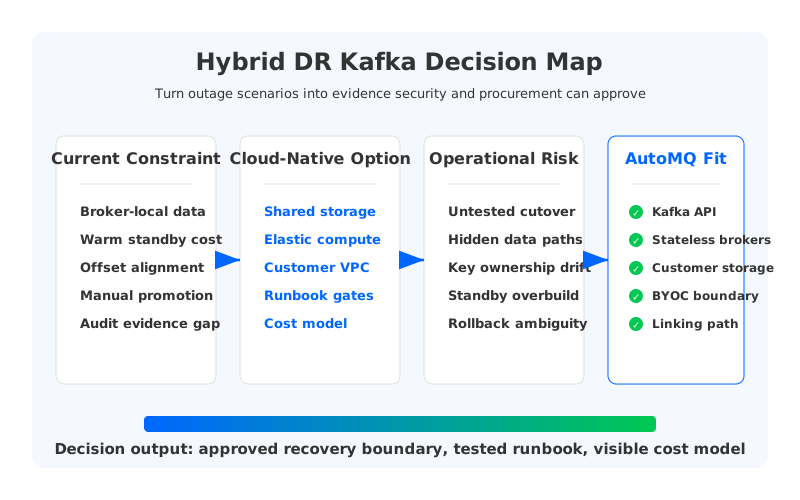
Teams search for hybrid disaster recovery kafka when the Kafka recovery plan has become too important to describe with a single secondary cluster. The platform still has to preserve topics, partitions, offsets, Consumer groups, transactions, and client behavior. But the approval meeting is asking a sharper question: if a region, cloud account, network segment, or platform release fails, can the business prove where event data lives, who can promote the recovery path, and how much capacity must be paid for before the incident happens?
That question sits between engineering, security, and procurement. Platform engineers care about replication lag, failover order, and whether consumers resume from the right offsets. Security teams care about key ownership, data movement, privileged access, audit trails, and whether telemetry contains sensitive payloads. Procurement cares about standby capacity, duplicate storage, private connectivity, cloud data transfer, support scope, and exit terms. A workable disaster recovery plan has to satisfy all three groups without turning Kafka into a bespoke one-off platform.
1Why teams search for hybrid disaster recovery kafka
The search usually begins after a team rejects two simple answers. A single Kafka cluster is not enough for applications where event loss or prolonged outage would stop revenue, risk operations, or audit workflows. A fully duplicated Kafka estate may pass a resilience review, but it can make procurement ask why the organization is paying for idle compute, replicated disks, cross-Availability Zone (AZ) traffic, and a migration toolchain that still needs manual cutover.
Hybrid disaster recovery makes the question harder because "hybrid" is not one architecture. It can mean an on-premises primary with a cloud recovery site, a public-cloud primary with a private recovery environment, two cloud regions under different compliance controls, or a Kafka-compatible target that runs in a customer-owned VPC (Virtual Private Cloud). Each design changes who owns the data plane, where durable records are stored, and which team can take action during an incident.
The mistake is treating disaster recovery as a replication feature. Kafka recovery is a chain of commitments: the write path must be durable, the recovery platform must understand Kafka semantics, cutover must preserve application progress, and rollback must be credible. If any link is vague, the plan may look complete in a diagram while remaining untestable during an outage.
2The production constraint behind the problem
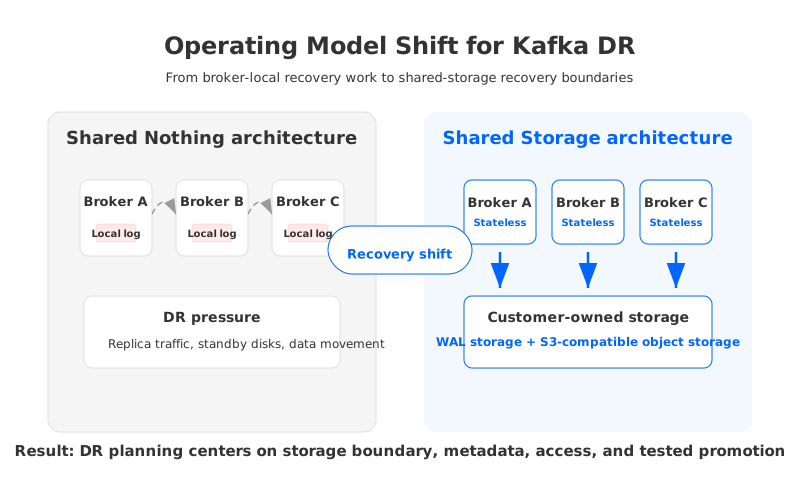
Traditional Kafka uses a Shared Nothing architecture. Each Broker owns local storage for the partitions assigned to it, and Kafka protects availability through leader and follower replicas. This model is mature and well understood, but it makes storage placement part of nearly every recovery decision. A Broker is not only compute; it is also a holder of durable log segments that must be replicated, rebuilt, moved, or restored.
That matters when the recovery target sits across a cloud or ownership boundary. If a team maintains a warm standby cluster, it has to decide how much compute and disk to reserve before failover. If it relies on replication into another environment, it has to monitor lag, credentials, topic configuration drift, and offset alignment. If it restores from backup, it has to prove that recovery time and recovery point objectives match the business system depending on the stream. None of those decisions is purely a Kafka setting.
The storage model also affects cost visibility. In broker-local designs, durability often means multiple copies of data across Brokers and zones. Scaling or rebalancing can add operational data movement on top of normal replication. In cloud deployments, that movement can appear across compute, block storage, object storage, private connectivity, and inter-zone or inter-region network lines. A recovery design that ignores those paths may pass a technical review and still fail a budget review.
Security adds another constraint: the recovery path must be authorized before the outage. During a regional incident, teams do not have time to negotiate emergency network routes, expand IAM permissions, approve a support access path, or explain why operational logs crossed an unapproved boundary. The disaster recovery architecture needs preapproved evidence.
3Architecture options and trade-offs
Most teams compare four patterns. Active-passive Kafka keeps a standby cluster ready for promotion, but capacity planning and offset alignment require discipline. Active-active Kafka can reduce recovery time for selected workloads, but conflict handling, client routing, and operational complexity increase quickly. Backup-and-restore reduces standby cost, but recovery time is often too slow for systems that depend on fresh streams. A Kafka-compatible customer-owned data plane tries to keep Kafka semantics stable while changing how storage, scaling, and ownership are handled.
The useful evaluation question is not "which pattern is resilient?" All four can be resilient under the right workload and operating model. The useful question is "which failure does this pattern make practical to test and clear to approve?"
| Evaluation area | What to verify | Why it matters in procurement |
|---|---|---|
| Compatibility | Producers, Consumers, offsets, transactions, Kafka Connect, ACLs, and observability tools behave as expected. | Application change is often the largest hidden migration cost. |
| Recovery boundary | The data plane, control actions, storage, keys, logs, and metrics have named owners. | Security approval depends on provable boundaries, not broad platform claims. |
| Standby economics | Compute, storage, network, private connectivity, request charges, and support are modeled together. | A DR design can be technically sound and commercially unsustainable. |
| Promotion process | DNS, client bootstrap, credentials, offset position, schema access, and rollback are rehearsed. | The first promotion should not happen during the first outage. |
| Evidence trail | Runbooks, access reviews, audit logs, and test reports exist before contract approval. | Procurement needs the operating burden priced before contract pressure appears. |
Tiered Storage deserves a specific note because it is often included in disaster recovery conversations. Apache Kafka's Tiered Storage moves older log data to remote storage, which can help retention economics and broker recovery for historical segments. It does not, by itself, turn Brokers into stateless compute or remove the need to reason about the active write path. For DR planning, the distinction between remote historical data and shared durable storage is important.
4Evaluation checklist for platform teams
Start with failure modes, not products. Write down the incidents the platform must survive: Broker failure, AZ isolation, region outage, cloud-account lockdown, object storage access failure, bad deployment, corrupted configuration, delayed replication, and operator error. Then ask which platform component becomes the recovery authority for each event. The answer should identify a system, an owner, and a test.
The checklist should force concrete evidence:
- Kafka semantic continuity. Validate Producer and Consumer APIs, Consumer group behavior, offset commits, idempotent or transactional producers where used, Kafka Connect integration, and admin tooling. Compatibility is a workload test, not a phrase.
- Data ownership and storage controls. Identify where records, topic metadata, offsets, schemas, logs, metrics, and backups live. Record the account, region, bucket, disk, database, encryption key, retention policy, and deletion path for each class of data.
- Network and access paths. Draw client ingress, connector egress, object storage access, control operations, support workflows, telemetry export, and migration replication. Include DNS, private endpoints, route tables, and firewall policies.
- Recovery operations. Rehearse promotion, client rerouting, consumer resumption, connector restart, schema availability, ACL validation, and rollback. A DR plan without a rollback stage is a cutover bet.
- Cost and capacity. Model standby compute, durable storage, replicated data, object requests, private connectivity, cross-zone or cross-region transfer, monitoring, support, and staff time. Use cloud-provider pricing pages as inputs and record the date of the estimate.
Recovery objectives should be assigned per workload, not per cluster. A fraud stream, an audit log, a recommendation feature pipeline, and a batch analytics feed may all use Kafka, but they do not have the same recovery tolerance. One workload may require near-continuous consumption with a narrow recovery point objective, while another can replay after the platform is stable. Treating the entire cluster as one DR tier usually leads to overbuilt standby capacity for low-priority topics and under-tested promotion for the topics that matter most.
Procurement can use those workload tiers to ask a better question: which parts of the recovery platform must be active, which parts can be warm, and which parts can be provisioned after promotion? This is where architecture affects commercial risk. A stateful design often pushes teams toward preprovisioned compute and storage because the recovery site has to be ready to hold durable data. A design with shared durable storage and replaceable compute can separate the cost of retained data from the cost of active serving capacity, but the team still has to test whether the target environment can scale within quota and policy limits during a failover exercise.
This checklist also helps separate architecture from contract language. A vendor may offer strong operational support, but the customer still needs to know which resources sit in its environment and which actions require vendor approval. A self-managed design may offer maximum control, but the organization still needs the people and rehearsal discipline to operate it during a regional failure.
5How AutoMQ changes the operating model
The evaluation above points to a specific architectural need: preserve Kafka behavior while reducing the amount of durable data tied to individual Brokers. AutoMQ is a Kafka-compatible streaming platform built around Shared Storage architecture. It keeps Kafka protocol semantics while moving durable data from broker-local disks into S3-compatible object storage through S3Stream, WAL (Write-Ahead Log) storage, and stateless brokers.
This changes the recovery conversation. AutoMQ Brokers handle Kafka protocol processing, partition leadership, caching, and scheduling, while durable data is placed in shared storage. When a Broker is replaced or partitions are reassigned, the operation is less about copying large local log datasets and more about ownership, metadata, and traffic movement. The recovery plan can focus on whether shared storage, WAL storage, metadata, and network access remain available under the chosen failure domain.
Deployment boundaries are part of the same story. AutoMQ BYOC is designed for public cloud deployments where the control plane and data plane run inside the customer's cloud account and VPC. AutoMQ Software is designed for private data center environments where the customer operates the deployment boundary directly. For security and procurement teams, that means the review can be framed around customer-owned accounts, customer storage, customer network controls, key ownership, scoped management access, and a defined support procedure.
AutoMQ's Shared Storage architecture also changes standby economics. Traditional Kafka capacity planning often couples compute, local storage, retention, and replication. With Separation of compute and storage, teams can reason about active compute, standby compute, durable storage, and retained history as separate cost drivers. That does not remove the need for a careful cost model, but it makes the model easier to explain than a design where every recovery target must behave like a full second stateful cluster.
Migration still needs a runbook. Kafka compatibility reduces application rewrite risk, but teams should inventory topics, partitions, ACLs, schemas, Connector configurations, Consumer groups, offset positions, dashboards, alerts, and rollback criteria. AutoMQ Kafka Linking can support migration scenarios with data synchronization and consumer progress synchronization in supported paths. Procurement should still ask for a workload-specific rehearsal plan before approving a production transition.
6A procurement-ready decision frame
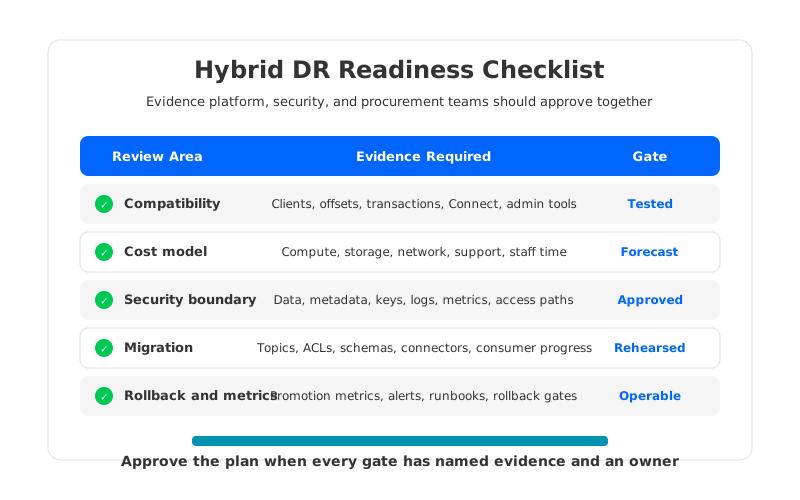
A good disaster recovery decision survives three reviews at once. Engineering can explain the failure modes and recovery sequence. Security can explain data boundaries, access paths, encryption, and audit evidence. Procurement can explain the bill, the responsibility split, and the exit path. When those three reviews share the same diagram, the Kafka DR plan becomes easier to approve and easier to test.
Use this frame before selecting a platform:
| Decision question | Strong signal | Pause signal |
|---|---|---|
| Can the platform preserve Kafka behavior? | Critical workloads pass client, offset, transaction, Connect, and admin tests. | Compatibility is described without a workload validation plan. |
| Can the recovery boundary be audited? | Data, metadata, keys, logs, metrics, and control actions have named owners. | The data plane location is abstract or undocumented. |
| Can the plan be rehearsed? | Promotion, rerouting, consumer resumption, and rollback are tested on a schedule. | The runbook depends on manual decisions that have not been approved. |
| Can the cost be forecast? | Standby compute, storage, network, connectivity, support, and staff time are modeled together. | The quote excludes cloud resources or migration work. |
Hybrid disaster recovery for Kafka is not a search for the largest secondary cluster. It is a search for a recovery boundary the business can approve before failure, test under realistic conditions, and afford through normal operations. If your next Kafka DR decision needs Kafka compatibility with a customer-controlled deployment boundary, evaluate AutoMQ BYOC against your own runbook and evidence checklist: open AutoMQ Cloud.
7FAQ
7.1What does hybrid disaster recovery Kafka mean?
It means a Kafka or Kafka-compatible recovery design that spans customer data centers, public cloud accounts, private networks, regions, or ownership boundaries. The key question is how event data, offsets, metadata, network access, and recovery authority move during a failure.
7.2Is active-active Kafka required for disaster recovery?
No. Active-active can reduce recovery time for selected workloads, but it also increases routing, conflict handling, and operational complexity. Many teams choose active-passive, warm standby, or shared-storage-based recovery depending on recovery objectives and application behavior.
7.3Does Kafka compatibility solve disaster recovery by itself?
No. Compatibility protects application behavior, but disaster recovery also depends on storage durability, network routing, access control, recovery runbooks, capacity planning, and tested rollback.
7.4Why does Shared Storage architecture matter for Kafka DR?
Shared Storage architecture separates durable data from broker-local disks. That makes Broker replacement, partition reassignment, and standby capacity planning less dependent on copying large local log datasets between compute nodes.
7.5Where does AutoMQ fit?
AutoMQ fits teams that want Kafka-compatible streaming, customer-controlled deployment boundaries, and a Shared Storage architecture. AutoMQ BYOC targets public cloud accounts and VPCs, while AutoMQ Software targets private data center environments.
8References
- Apache Kafka documentation
- Apache Kafka KIP-405: Kafka Tiered Storage
- Apache Kafka KIP-500: Replace ZooKeeper with a Self-Managed Metadata Quorum
- AutoMQ architecture overview
- AutoMQ compatibility with Apache Kafka
- AutoMQ S3Stream shared streaming storage
- AutoMQ Cloud overview
- AWS S3 pricing
- AWS PrivateLink documentation
- Google Cloud VPC Service Controls overview
- Azure Private Link overview


