
Table of Contents
Table of Contents
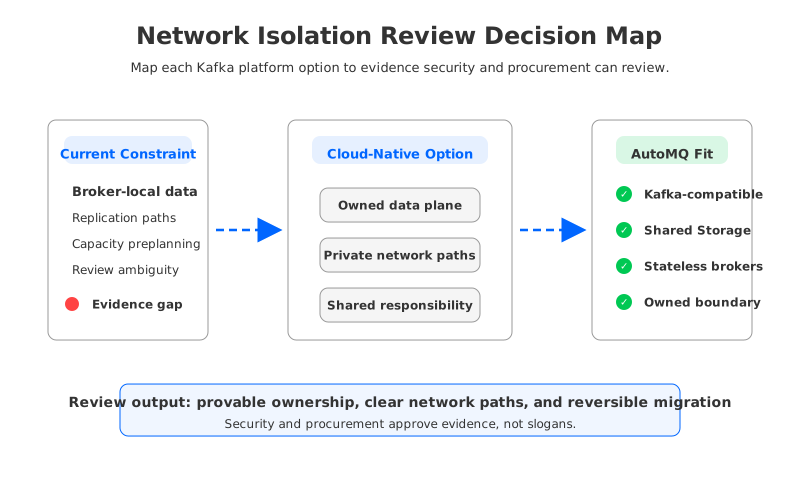
Teams search for network isolation review kafka when Kafka has moved from an engineering backlog item into a security and procurement review. The platform still has to behave like Kafka for Producers, Consumers, Consumer groups, offsets, transactions, Kafka Connect, and operational tooling. But the approval meeting is asking a different question: can the organization prove where the data plane runs, who controls the network boundary, which identities can administer it, and whether the commercial model matches the risk model?
That is why a network isolation review for Kafka should not start with a product feature list. It should start with an evidence map. Kafka is a durable log, a client compatibility contract, a network endpoint, and an operating responsibility. If any of those pieces cross an unclear account, VPC (Virtual Private Cloud), subnet, identity, support, or telemetry boundary, the review slows down even when the streaming API looks familiar.
1Why teams search for network isolation review kafka
The search often begins after a team has already agreed that event streaming is business critical. Payment authorization, clickstream analytics, inventory updates, AI feature pipelines, fraud detection, audit logs, and operational telemetry all benefit from Kafka-compatible streaming. The hard part is making that platform acceptable to people who are responsible for regulated data, vendor risk, cloud spend, and incident response.
A security team usually asks whether application data leaves the approved cloud account, whether encryption keys remain under customer control, whether administrative access can become data access, and whether logs or metrics carry sensitive payloads. Procurement asks a parallel set of questions: which cloud resources appear on the customer's bill, which vendor charges are usage based, which support obligations remain with the internal platform team, and how hard it is to exit the contract. Platform engineering sits between those groups and has to turn architecture into reviewable evidence.
This is where generic "Kafka-compatible" language is not enough. Compatibility tells you whether existing clients can keep using familiar APIs and semantics. It does not tell you whether the Brokers run in a customer-owned subnet, whether object storage is customer owned, whether the control plane has direct access to records, or whether a cross-zone replication path will surprise finance after production traffic grows. A network isolation review turns those concerns into a decision framework.
2The production constraint behind the problem
Traditional Apache Kafka uses a Shared Nothing architecture. Each Broker owns local storage for its partitions, and Kafka protects availability through replication between leader and follower replicas. This model is well understood, operationally mature, and documented across the Apache Kafka ecosystem. It also makes the Broker more than compute; the Broker becomes part of the durable storage boundary.
That storage boundary is what complicates isolation reviews. When data is tied to broker-local disks, many operations imply data movement: replacing nodes, rebalancing partitions, adding capacity, restoring after failure, and changing placement across Availability Zones (AZs). The security review then has to understand more than ingress and egress. It has to understand where durable records live during normal operation, where replicas move during maintenance, which network paths replication uses, and what happens when an operator or automation system triggers reassignment.
Cloud networking adds another layer. A private endpoint can keep client traffic off the public internet, but it does not automatically explain replication traffic, connector egress, object storage access, monitoring export, support access, or migration traffic. A VPC diagram that shows one arrow from applications to Kafka is usually too thin for production review. Security and procurement need a path-by-path inventory.
The review should separate Kafka semantics from the operating model. Kafka semantics include topics, partitions, offsets, Consumer groups, idempotent producers, transactions, and Connect integration. The operating model includes data-plane location, storage ownership, key ownership, control-plane scope, scaling behavior, failure recovery, network routing, observability, and commercial responsibility. A platform can preserve the first set while changing the second set, and that is where architectural evaluation becomes useful.
3Architecture options and trade-offs
Most enterprise evaluations compare four operating models, even when the shortlist uses different names. Self-managed Kafka gives maximum control but leaves the organization responsible for upgrades, partition balancing, scaling, security hardening, observability, and on-call work. Fully hosted streaming reduces operational load but places the service boundary outside the customer's runtime environment. Cloud-provider managed Kafka can simplify vendor approval inside one cloud. BYOC Kafka and customer-owned data plane models aim to combine managed operations with infrastructure that remains inside the customer's account or private environment.
The right question is not "which one is managed?" The right question is "which boundary does each model make provable?"
| Evaluation area | Self-managed Kafka | Hosted service | BYOC or customer-owned data plane |
|---|---|---|---|
| Data-plane boundary | Strong customer control, high operational burden | External service boundary, lower operations | Customer environment with managed lifecycle responsibilities |
| Network isolation | Fully designable by the customer | Depends on private connectivity model | Built around customer VPC, subnets, endpoints, and routing policies |
| Storage ownership | Customer controlled disks and backups | Service owned or abstracted | Customer-owned cloud storage or customer private storage |
| Scaling model | Engineering-driven capacity work | Service-driven scaling model | Managed scaling within customer-owned resource limits |
| Procurement question | Can the team operate it reliably? | Can the business accept the external data boundary? | Can the shared responsibility model be documented clearly? |
The storage architecture underneath these models matters because it determines how much operational activity touches durable data. In Shared Nothing Kafka, scaling and balancing are bound to broker-local data placement. Tiered Storage changes the retention economics for older segments by moving remote log data to object storage, but the active write path and recent data still depend on local storage. In Shared Storage architecture, durable event data lives in shared object storage, and Brokers act as replaceable compute for Kafka protocol handling, caching, and coordination.
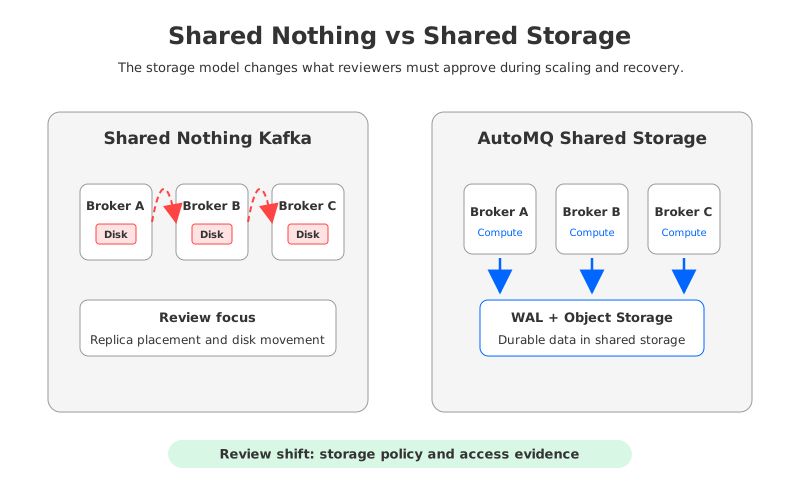
This distinction is not academic. In a network isolation review, a broker-local design forces reviewers to reason about replica placement, disk lifecycle, data copying during balancing, and inter-zone replication behavior. A Shared Storage architecture shifts the review toward bucket ownership, WAL (Write-Ahead Log) storage, object storage access policy, metadata control, and Broker replacement behavior. Both models still need careful security engineering, but they produce different evidence.
4Evaluation checklist for platform teams
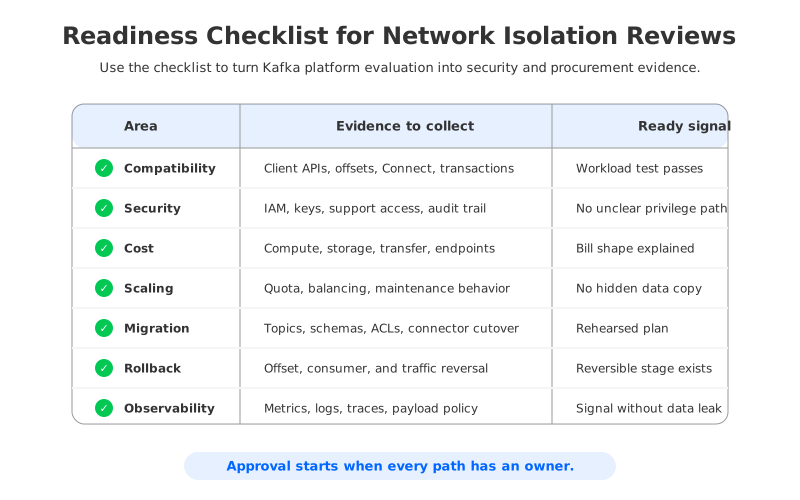
A useful review checklist should force specific answers. "Is the platform secure?" invites a yes. "List every path that can reach event data or operational metadata, then identify the owner, identity, encryption boundary, and audit trail for each path" creates evidence that security, procurement, and engineering can review together.
Start with compatibility, because migration risk often hides behind architecture enthusiasm. Kafka-compatible streaming should preserve the behavior your applications depend on: Producer and Consumer APIs, topic and partition semantics, offset commits, Consumer group coordination, idempotent and transactional producers where required, Kafka Connect integration, Schema Registry expectations, and observability tooling. Compatibility should be validated against the workloads being moved, not treated as a checkbox.
Then review cost as a system behavior. A Kafka bill can include broker compute, block storage, object storage, request charges, private connectivity, cross-AZ or cross-region data transfer, load balancers, Kubernetes overhead, support, migration tooling, and engineering time. A network-isolated platform may move spend from one category to another. That is acceptable when the trade-off is understood before approval; it becomes painful when finance discovers the shape of the bill after production traffic arrives.
Use these questions as the core of the review:
- Data and metadata location. Where do records, offsets, topic metadata, schemas, logs, metrics, backups, and audit events live? Identify the account, region, VPC, bucket, disk, database, or managed service for each class of data.
- Identity and key ownership. Which identities can administer the platform, access storage, rotate secrets, read metrics, manage connectors, and perform emergency actions? Separate management access from data access.
- Network reachability. Which paths exist for client ingress, connector egress, object storage access, telemetry export, support workflows, migration replication, DNS, and private endpoints? Draw them at subnet and endpoint level.
- Operational responsibility. Which team owns upgrades, scaling, incident response, cloud quota requests, access reviews, disaster recovery tests, and evidence collection? A managed platform still needs a clear shared responsibility model.
- Migration and rollback. How will topics, offsets, schemas, credentials, ACLs, connectors, observability, and consumer cutover be handled? What is the rollback path if acceptance tests fail?
These questions keep procurement from becoming a late-stage paperwork exercise. They also keep security from receiving a generic architecture diagram after the commercial decision has already been made.
5How AutoMQ changes the operating model
The evaluation above points to a specific architectural need: keep Kafka semantics stable while making the runtime boundary, storage ownership, and scaling behavior easier to reason about. AutoMQ is a Kafka-compatible streaming platform built around Shared Storage architecture. It keeps the Kafka protocol and client ecosystem while moving durable data from broker-local disks into shared object storage through S3Stream, WAL storage, and stateless brokers.
For network isolation reviews, the most important change is that AutoMQ Brokers do not own durable partition data on local disks. They handle Kafka protocol processing, leadership, caching, scheduling, and request routing, while durable data is placed in customer-controlled storage depending on the deployment model. That changes how reviewers look at replacement, scaling, balancing, and failure recovery. A Broker can be treated more like compute because the durable log is not trapped on that instance.
AutoMQ BYOC is designed for teams that want the control plane and data plane deployed inside their own cloud account and VPC. In that model, customer business data stays in the customer's environment, and the review can focus on the customer's cloud resources, network policies, IAM, storage, telemetry, and operating procedures. AutoMQ Software addresses private data center deployments where both control plane and data plane run in the customer's private environment. The product choice still requires a formal shared responsibility review, but the deployment boundary is easier to explain than a service that abstracts the data plane away from the customer.
The storage path also matters for cost and network review. AutoMQ's Shared Storage architecture uses object storage as the durable data layer and supports WAL storage options across product editions. AutoMQ's documentation describes how S3Stream writes through WAL storage for durability and then organizes data in S3 storage. This does not remove the need to design IAM, encryption, observability, and endpoint policies, but it reduces the amount of data movement associated with broker replacement and partition reassignment.
Self-Balancing and seconds-level partition reassignment build on the same idea. When data is already in shared storage, reassigning traffic and leadership does not require copying large partition datasets between Brokers. That gives platform teams a cleaner answer to a common procurement question: how much operational work is hidden behind scaling and maintenance? The answer is still workload dependent, but the architecture avoids making every capacity change a storage migration.
6Decision matrix for security and procurement
The final decision should map each requirement to evidence, not preference. A platform can be excellent for developer speed and still fail a regulated network isolation review. Another platform can provide strong customer control but require an operating team that the organization does not have. The decision matrix should make those trade-offs visible.
| Requirement | Evidence to request | Strong signal |
|---|---|---|
| Customer-owned data plane | Deployment diagram, cloud account boundary, storage ownership, and support access procedure | Records and operational runtime stay inside the approved customer environment. |
| Kafka compatibility | Client test plan, Connect validation, transaction and offset behavior, migration rehearsal | Existing applications move without client rewrites or semantic surprises. |
| Network isolation | Subnet-level paths, endpoint policies, DNS model, admin access, connector egress, and telemetry export | Every network path has an owner, purpose, and audit trail. |
| Cost governance | Resource list, storage model, data transfer paths, private connectivity, and scaling assumptions | The bill can be explained before production traffic grows. |
| Exit and rollback | Topic, offset, schema, ACL, connector, and consumer cutover plan | Migration has a reversible stage before final traffic shift. |
If the review began with network isolation review kafka, it should end with a packet-level and ownership-level understanding of the streaming platform. The useful outcome is not a perfect score across every category. It is a decision that security can defend, procurement can price, and platform engineering can operate.
For teams evaluating Kafka-compatible streaming inside customer-controlled environments, the next practical step is to compare your review evidence against a live deployment model. Explore AutoMQ BYOC and validate how the data-plane boundary, storage ownership, and operating model map to your security review.
7FAQ
7.1What does network isolation review kafka mean in practice?
It means evaluating Kafka-compatible streaming through the lens of data-plane location, private networking, identity, key ownership, support access, telemetry, migration traffic, and procurement responsibility. The review should cover more than client ingress.
7.2Is BYOC Kafka the same as self-managed Kafka?
No. Self-managed Kafka usually means the customer operates the entire platform. BYOC Kafka generally means the platform runs in the customer's cloud environment while lifecycle management is automated or supported through a vendor-defined shared responsibility model.
7.3Does Kafka compatibility prove network isolation?
No. Kafka compatibility addresses client APIs and semantics. Network isolation depends on deployment boundaries, storage ownership, routing, DNS, identity, telemetry, and support access.
7.4Why does Shared Storage architecture matter for security review?
Shared Storage architecture separates durable data from broker-local disks. Reviewers still need to inspect storage policy, encryption, IAM, and endpoints, but broker replacement and scaling become less tied to copying partition data between compute nodes.
8References
- Apache Kafka documentation
- KIP-405: Kafka Tiered Storage
- KIP-500: Replace ZooKeeper with a Self-Managed Metadata Quorum
- AWS PrivateLink documentation
- AWS data transfer documentation
- Google Cloud VPC Service Controls overview
- AutoMQ architecture overview
- AutoMQ compatibility with Apache Kafka
- AutoMQ Cloud overview
- AutoMQ S3Stream overview


