
Table of Contents
Table of Contents
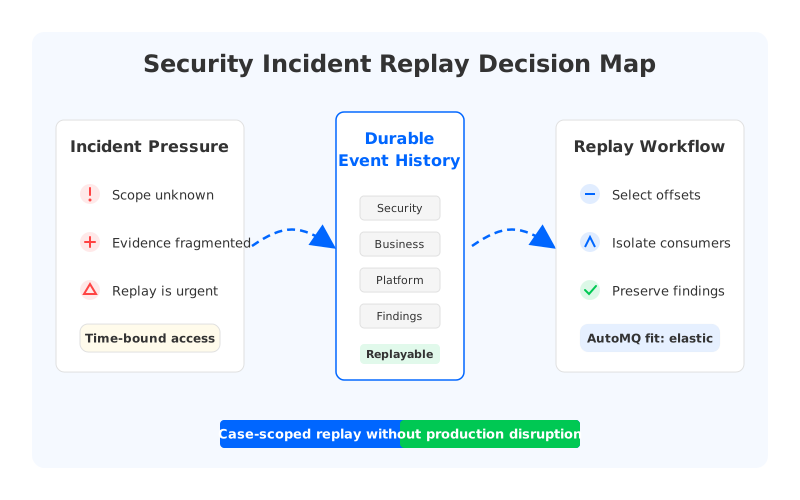
Teams usually search for security incident replay kafka after an incident exposes a gap between what the security team needs and what production systems kept. An account was abused, a privileged token moved through several services, an internal policy check behaved differently from expected, or a suspicious transaction touched multiple domains before anyone noticed. The question is no longer whether the alert fired; it is whether the organization can reconstruct what happened from durable event history without freezing production systems or depending on fragile log exports.
Kafka often sits close to this problem because it records business events, identity events, application decisions, CDC changes, and integration traffic in ordered streams. Consumer groups, offsets, retention, and replay make it possible to reprocess history for investigation and remediation. Those primitives are powerful, but they do not make incident replay automatic. A replayable event backbone has to be designed around retention economics, governance boundaries, schema discipline, operational isolation, and recovery workflows.
Security incident replay is therefore an architecture question before it is a tooling question. SIEM platforms, data lakes, and case management systems matter, but the streaming layer decides whether the raw sequence of events can be trusted, retained, and replayed under pressure. If the streaming platform cannot preserve enough history, isolate replay consumers, and scale without turning the cluster into a second incident, the investigation inherits the platform's limits.
1Why teams search for security incident replay kafka
The search usually begins with a practical failure mode. A security team has logs from several systems, but the records are incomplete, normalized too late, or detached from the business event that explains the impact. Application teams can show local traces, yet those traces do not cover downstream consumers, compensating actions, or external integrations. Data teams may have lake tables, but ingestion lag and schema drift make them poor tools for minute-by-minute reconstruction.
Kafka is attractive because it can preserve the operational event stream before it is transformed into downstream views. A payment authorization event, device login, policy decision, account change, entitlement update, fraud score, and data-access event can all be retained as independent streams with their own ordering and keys. During an investigation, the team can replay those streams into a clean environment, rebuild projections, compare derived state with production state, and test hypotheses without mutating live systems.
That replay path depends on design decisions made long before the incident. Retention must cover the investigation window, topics must carry correlation context, schemas must survive producer changes, and offsets must be managed so replay jobs do not interfere with production consumers. Access controls must let responders read the right event history without granting broad standing privilege. These are platform requirements, not after-the-fact tasks.
A durable incident replay model separates four event-history classes:
- Security telemetry events capture authentication, authorization, policy decisions, secrets activity, network controls, and administrative actions.
- Business-domain events record the user, account, order, device, session, or transaction state that determines impact.
- Infrastructure and platform events show deployments, configuration changes, broker health, connector errors, ACL changes, and network transitions.
- Derived investigation events preserve replay outputs, enrichment results, case annotations, and remediation decisions so the response itself is auditable.
Once those classes are explicit, the platform team can reason about retention, access, cost, and replay isolation. Without that separation, everything becomes "logs," and replay design becomes a scramble during the worst possible hour.
2The production constraint behind the problem
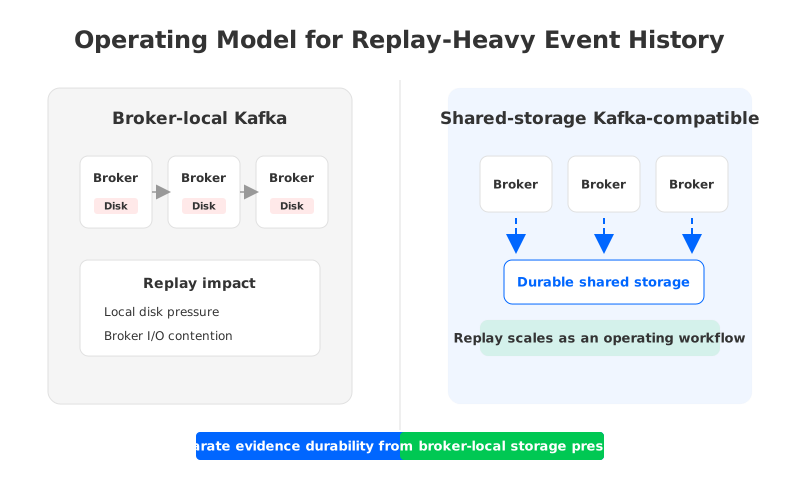
Traditional Kafka clusters bind compute and durable storage to stateful brokers. That shared-nothing model works well for many production workloads, but it creates a hard constraint for long-retention, replay-heavy incident workflows. Event history sits on broker-local disks, replicas move between brokers, and storage pressure becomes a cluster operation. When an investigation asks for a wide replay across high-retention topics, the platform must serve production traffic and forensic traffic from the same broker estate.
The tension shows up in several places. Long retention increases disk requirements on brokers, and large replay jobs compete with live consumers for broker I/O, network bandwidth, and fetch capacity. Increasing partitions to improve replay parallelism can create metadata and balancing overhead. Expanding the cluster may trigger data movement before the team can benefit from the added capacity.
Security teams often frame this as an evidence problem, while platform teams experience it as a capacity problem. Both views are correct. Evidence is valuable when it can be retrieved quickly, but retrieval is an operational workload. The platform has to absorb it without weakening the live system under investigation.
The harder constraint is governance. Incident replay often requires privileged read access across topics that ordinary application teams should never see together. A responder may need to correlate identity events, transaction events, connector events, and application state transitions. That access should be time-bounded, logged, and tied to a case. If the platform cannot express that boundary cleanly, teams choose between slow manual access requests and broad emergency privileges.
3Architecture options and trade-offs
There are several patterns for replayable security event histories. The right choice depends on the investigation window, event volume, regulatory requirements, and how much production isolation the organization needs.
| Pattern | What it gives teams | Main trade-off |
|---|---|---|
| Short Kafka retention plus SIEM export | Fast operational streams and centralized alerting | Raw event replay may be limited by export fidelity and retention windows |
| Kafka plus lake archive | Lower-cost historical storage and analytics tooling | Replay into Kafka semantics may require rehydration jobs, schema mapping, and delayed access |
| Long-retention Kafka topics | Direct replay through existing Kafka clients and consumer groups | Broker storage, capacity planning, and replay isolation become platform concerns |
| Shared-storage Kafka-compatible platform | Durable history backed by object storage with more elastic broker operations | Teams still need governance, schema discipline, and replay runbooks |
The table is not a ranking. Many enterprises use more than one pattern. SIEM tools are good at detection and case workflows. Lakes are good at historical analytics and broad joins. Kafka is good at preserving ordered streams and replaying them through the same application contracts used in production. The architecture breaks down when teams expect one layer to carry every responsibility.
A stronger model defines the replay path by use case. For containment, responders may replay a narrow set of identity or transaction topics into a temporary detector. For impact analysis, analysts may replay broader business-domain events into an isolated projection. For remediation validation, engineers may replay the event sequence that produced the fault and verify that a fix changes the outcome.
The most important design choice is whether replay workloads are isolated from live workloads. Isolation can come from separate consumer groups, quota policies, dedicated replay clusters, temporary compute, or a shared-storage architecture that reduces broker-local data movement. Replay is not background analytics when the organization is trying to answer whether customer data, money movement, or regulated activity was affected.
4Evaluation checklist for platform teams
A useful checklist starts with the incident lifecycle rather than the storage product. Walk through a real case: detection, scoping, access approval, event selection, replay environment creation, replay execution, evidence preservation, remediation, and post-incident review. Vague workflow steps reveal where platform design needs work.
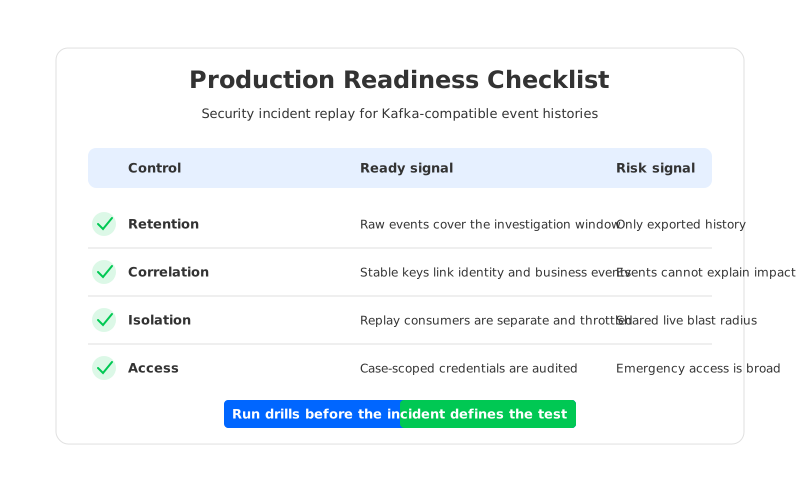
- Retention window: Does Kafka retain enough raw event history for the organization's investigation and compliance window, or is older evidence available through a verified archive and rehydration path?
- Correlation model: Do events carry stable identifiers such as account, session, tenant, device, transaction, trace, request, and policy decision IDs?
- Replay isolation: Can replay consumers run without disturbing production consumer groups, live broker capacity, or critical connector workloads?
- Access boundary: Can responders receive case-scoped read access across required topics, with audit logs and a clear revocation path?
- Schema reliability: Can the team replay old events after schema evolution, producer upgrades, connector changes, and field deprecations?
- Operational observability: Can platform teams see replay throughput, lag, broker pressure, object-storage access, errors, and cost signals during the response?
The checklist should be tested with drills, not debated in slide decks. A tabletop exercise can confirm approvals and ownership, but it will not reveal whether a replay job saturates fetch capacity or whether an old schema breaks enrichment. A production-like replay drill gives teams a more honest signal and a shared vocabulary: incident scope, event history, replay boundary, retention tier, and evidence chain.
5How AutoMQ changes the operating model
After the replay requirements are clear, the streaming architecture determines how much operational friction sits between a case and the evidence. Broker-local Kafka makes long retention and heavy replay a broker capacity problem because durable history lives with the compute nodes. The platform can still support incident replay, but it must reserve disk, rebalance carefully, and protect production traffic from forensic reads.
AutoMQ is a Kafka-compatible cloud-native streaming platform that separates broker compute from durable storage. The point is not that architecture replaces governance. It does not. The point is that shared storage changes the operating model for event history. Durable log data can be backed by object storage, while stateless brokers focus on serving traffic, making retention and broker elasticity easier to reason about than a model where every byte of history is tied to local disks.
This matters during incident response because replay is bursty. A cluster may run normally for weeks, then suddenly need to replay many hours or days of events for a narrow case. In a broker-local design, the team has to ask whether the same brokers that protect live traffic can absorb that read pattern. In a shared-storage design, replay becomes a compute and access problem on top of a durability layer, with less dependence on long broker-local storage operations.
AutoMQ also keeps the Kafka protocol surface central to the design. Existing Kafka clients, consumer groups, offsets, and ecosystem tools remain part of the operating model, which helps replay workflows depend on Kafka semantics. For customer-controlled or BYOC deployments, event history, networking, and object storage can stay within the customer's environment while platform operations follow defined access channels.
The decision is how the streaming backbone should preserve business and security events so the rest of the response stack can work. AutoMQ fits when teams want Kafka-compatible replay semantics, object-storage-backed durability, stateless broker operations, and deployment boundaries that align with enterprise governance.
6A practical replay runbook
A runbook makes the architecture testable. Start by choosing a case type, such as suspicious credential use, unauthorized data access, fraudulent transaction flow, or policy-engine regression. Identify the event classes needed to answer scope and impact, then define a replay environment isolated from production writes but close enough to reproduce consumer behavior, schema resolution, and downstream enrichment.
The runbook should treat offsets as evidence, not incidental state. Record the topic set, partition ranges, offset ranges, schema versions, replay code version, access approval, and output destination. If the replay produces derived findings, write those findings to a separate investigation topic or case store with immutable metadata. That turns the response into a repeatable process instead of a collection of one-off scripts.
Platform teams should also define replay guardrails. A replay job can be rate-limited, restricted to approved topics and offset ranges, run under a dedicated identity with time-bounded credentials, and publish metrics for throughput, lag, errors, and resource use. These controls let investigators move quickly without bypassing the platform.
Here is a compact scorecard for evaluating the platform before the next incident:
| Dimension | Healthy signal | Risk signal |
|---|---|---|
| Evidence durability | Raw events survive long enough for investigation and are tied to schemas | History exists only in transformed logs or short operational buffers |
| Replay semantics | Kafka consumers can rebuild state from known offsets and keys | Replays require custom exports with unclear ordering |
| Cost control | Retention and replay reads are visible to topic owners and platform teams | Long retention hides broker, network, or archive costs |
| Security boundary | Case-scoped access is auditable and revocable | Emergency access uses broad shared credentials |
| Elasticity | Replay capacity can scale without long broker data movement | Extra capacity arrives after storage rebalancing or manual cleanup |
| Recovery learning | Findings become durable investigation events and runbook improvements | Each incident produces scripts that cannot be repeated |
The value of this scorecard is not the score itself. It forces security, platform, and application teams to agree on what "replayable" means before pressure arrives. Kafka gives the event backbone a strong starting point; the production design decides whether that backbone becomes a reliable incident-response asset.
If security incident replay is becoming a platform requirement, evaluate the storage and operating model together. AutoMQ's Kafka-compatible shared-storage architecture is designed for teams that need durable event histories, customer-controlled deployment boundaries, and elastic operations. You can review the deployment model on the AutoMQ BYOC page and compare it against the replay checklist above.
7References
- Apache Kafka documentation: Consumers and consumer groups
- Apache Kafka documentation: Message delivery semantics
- Apache Kafka documentation: Security
- Apache Kafka documentation: Kafka Connect
- NIST Special Publication 800-92: Guide to Computer Security Log Management
- AWS documentation: Amazon S3 data protection and durability
- AutoMQ documentation: What is AutoMQ
- AutoMQ documentation: Compatibility with Apache Kafka
- AutoMQ documentation: Architecture overview
- AutoMQ documentation: Deployment overview
8FAQ
8.1Is Kafka enough for security incident replay?
Kafka is a strong event-history backbone when teams need ordered streams, consumer groups, offsets, and replay. It should be paired with SIEM, case management, identity controls, schema governance, and evidence-retention processes. The streaming layer preserves the sequence; the broader response stack turns that sequence into investigation and remediation.
8.2How long should incident replay topics retain data?
The retention window depends on detection latency, regulatory requirements, business risk, and archive strategy. Platform teams should define windows for hot replay, historical archive, and compliance retention, then test the full path from raw event to replay output before relying on it in an incident.
8.3How do replay jobs avoid disrupting production consumers?
Use separate consumer groups, dedicated identities, quotas, rate limits, and isolated replay environments. For high-volume cases, consider whether the platform architecture can add replay capacity without long broker-local data movement. Observability should show replay throughput, lag, errors, and resource pressure while the job runs.
8.4Where does shared storage help?
Shared storage helps when durable event history and broker compute need different scaling behavior. In a shared-storage Kafka-compatible architecture, long-retention history can be backed by object storage while brokers focus on serving traffic. That reduces the coupling between retention, replay bursts, broker replacement, and capacity expansion.


