
Table of Contents
Table of Contents
Teams search for security lake ingestion kafka when the first version of the pipeline has stopped being enough. Sources now include cloud activity, endpoint telemetry, identity events, DNS records, SaaS logs, vulnerability findings, application traces, and detection outputs. Each stream has a different shape, burst pattern, retention requirement, and owner.
Kafka is attractive in this role because it gives the security platform a durable event buffer. Producers can write continuously, downstream consumers can process at their own pace, and offsets give replay a concrete operating handle. The problem appears later, when the security lake becomes a production system rather than a landing zone. The platform team has to answer harder questions: where does the authoritative stream live, how much broker capacity must be reserved, who owns schema failures, how does a team replay a bad parser window, and what happens when a feed spikes during an incident?
The useful architecture review starts with the operating contract between security producers, Kafka-compatible streams, object storage, detection systems, and analysts. If that contract is vague, the lake will collect data but lose control.
1Why Teams Search For security lake ingestion kafka
Security ingestion has an uncomfortable combination of requirements. It must be fast enough for detection, durable enough for investigations, governed enough for audits, and flexible enough for source onboarding. A batch-only pipeline usually struggles with freshness and backpressure. A direct-to-lake pipeline can work for some sources, but it often pushes retry, ordering, parsing, and replay logic into each collector.
Kafka gives the ingestion layer a shared contract. A topic can represent a feed or normalized event class. A partition provides ordered processing within a key range. A Consumer group allows independent services to read without forcing a single downstream path. Offsets make replay explicit, which matters when a parser, enrichment rule, or detection model needs to be corrected.
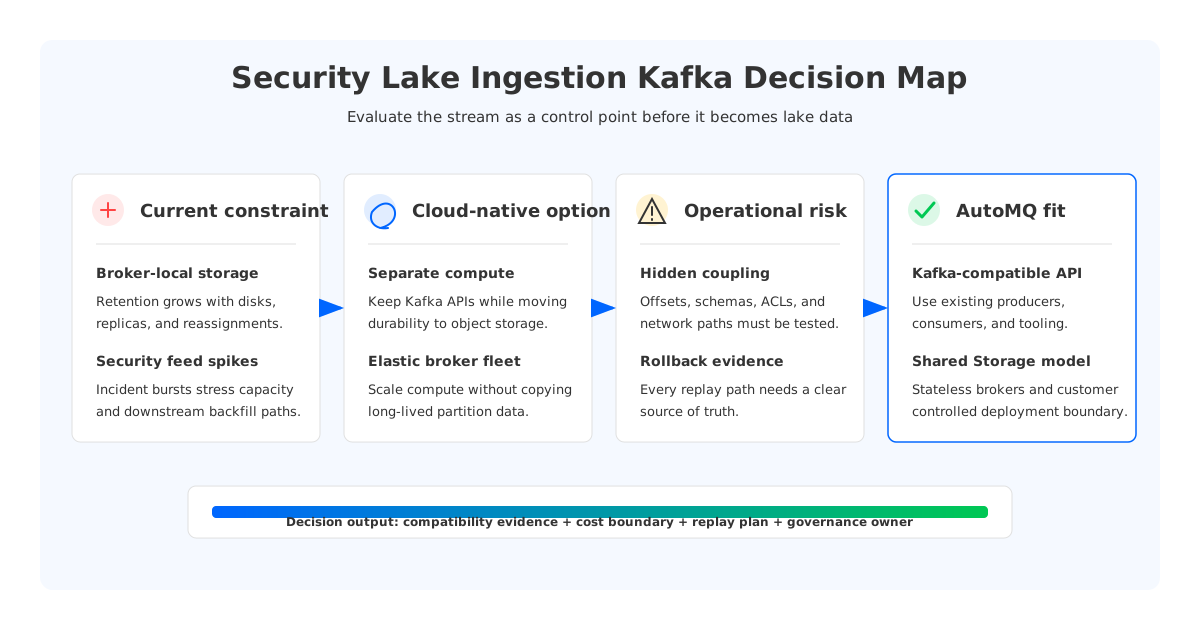
The search query usually hides a platform decision: should Kafka remain a short-lived buffer in front of the lake, or should it become the operational front door of the security data platform? The difference is large. A buffer can be sized for short outages. A front door has to survive incident bursts, schema mistakes, reprocessing jobs, multiple consumers, network controls, and long-lived retention policies.
That distinction changes the evaluation criteria. A working connector is useful, but it does not prove the architecture. The platform needs evidence across four contracts:
- Stream contract: Producers, consumers, offsets, keys, headers, ordering expectations, retry behavior, and backpressure behavior are understood before feeds are onboarded.
- Governance contract: Schema evolution, encryption, access control, audit logging, object ownership, and data residency are enforced at the ingestion boundary.
- Recovery contract: The team can replay a chosen time window, isolate bad records, and prove which records entered the lake.
- Operating contract: Capacity, broker replacement, traffic spikes, network routing, and lake write health can be observed and changed without turning every feed into a special case.
Kafka is a good foundation for these contracts, but the storage model underneath Kafka decides how costly those contracts become.
2The Production Constraint Behind The Problem
Traditional Kafka uses Shared Nothing architecture. Each broker owns local persistent storage, partitions are placed on brokers, and replicas are copied between brokers for durability and availability. This model also creates a tight link between ingestion growth and broker-local capacity.
Security lake ingestion amplifies that link. Feed volume is uneven. A cloud account onboarding project may double event volume in a week. A vulnerability scanner may create predictable bursts. A security incident may turn a quiet stream into a high-volume source at the exact time the team most needs reliable collection. Long retention adds another pressure point, because investigations and compliance reviews often need old events alongside fresh detection data.
When durable stream data is tied to broker disks, each change becomes a storage operation. More retention means more local storage or tiering decisions. More partitions mean more placement and balancing work. Broker replacement may require data movement. Cross-Availability Zone replication can turn availability design into a recurring network cost line.
Tiered Storage can reduce old data kept on broker-local disks, and it is worth evaluating for existing Kafka estates. It does not make brokers stateless. Recent data, leadership, local storage pressure, and operational reassignments still matter. For security lake ingestion, separate two questions: where should old analytical data live, and how should the streaming layer operate while data is still active, replayable, and governed?
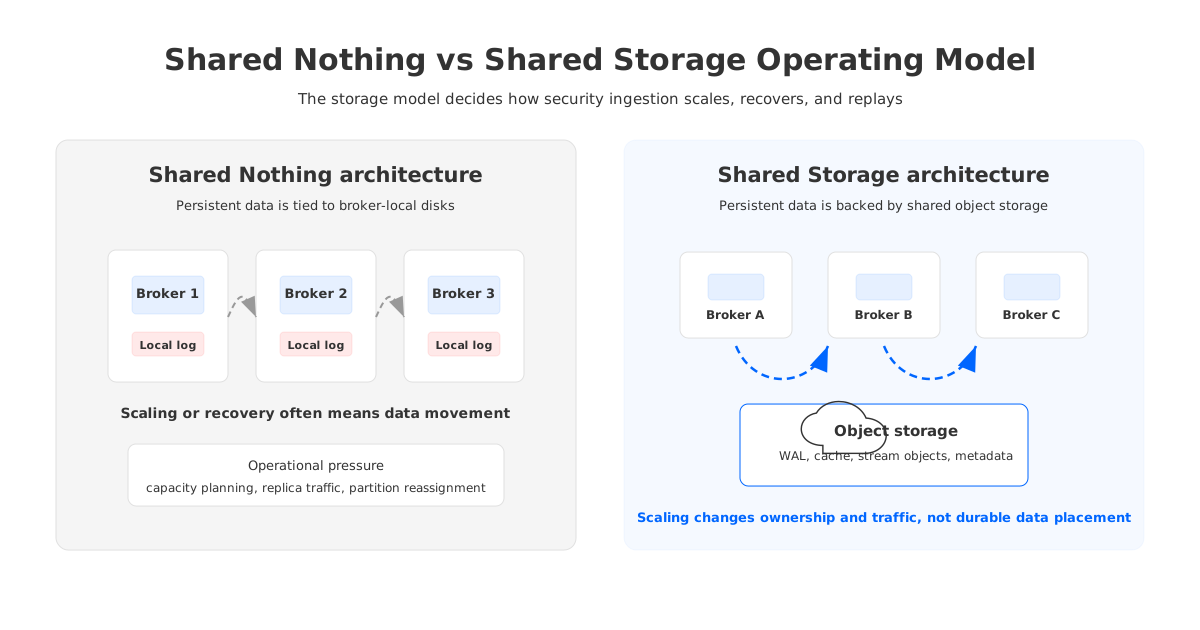
The constraint is not that Kafka cannot ingest security data. It can. The constraint is that broker-local persistence makes capacity, recovery, and scaling decisions follow the data. A security lake wants the opposite shape: durable data should have a stable home, while compute capacity changes with traffic and processing demand.
3Architecture Options And Trade-Offs
Most teams end up choosing among three practical patterns. None is universally correct. The right answer depends on feed volume, retention, regulatory boundary, team maturity, and how much operational change the organization can absorb.
| Architecture option | When it fits | Trade-off to verify |
|---|---|---|
| Existing Kafka plus lake writers | The current Kafka estate is healthy, retention is short, and the feed count is limited | Broker storage and reassignment work may grow as feeds and replay needs expand |
| Kafka plus processing layer | Enrichment, normalization, and routing are complex enough to need stream processors | Job ownership, error handling, and schema drift can become the main risk |
| Kafka-compatible shared storage | The platform needs Kafka semantics with more elastic compute and object-storage-backed durability | Compatibility, security controls, and migration behavior must be proven with the team's own feeds |
The evaluation should be neutral and specific. A team that already runs Kafka well may get the fastest path by tightening schemas, improving Connect or stream-processing operations, and keeping retention modest. A regulated security lake across many accounts may care more about customer-controlled storage, private networking, audit evidence, and repeatable replay. Frequent bursts put more weight on elastic broker capacity than on feature lists.
Cost evaluation should follow the same discipline. Avoid single-number comparisons unless the workload is defined. Security ingestion cost usually includes broker compute, local or block storage, object storage, cross-zone traffic, private connectivity, stream processing, catalog services, observability, and engineering time for backfills and recovery. A platform can look inexpensive in steady state and become costly during reprocessing if every replay competes with live ingestion.
Compatibility is also more than "the client connects." The proof should cover producer acknowledgments, idempotent producers when used, Consumer group behavior, offset commits, ACLs, authentication, serializers, schema registry integration, Kafka Connect behavior, transactions if needed, and operational tooling. Test any Kafka-compatible platform against the subset the security lake actually uses.
The sharpest architecture reviews ask what breaks when the pipeline is wrong. A malformed event should not disappear into task logs. A parser bug should not require a full lake rebuild. A table writer outage should not force producers to drop records. A feed owner should know whether they are responsible for schema fixes, dead-letter review, or replay approval.
4Evaluation Checklist For Platform Teams
A security lake ingestion review should produce test results, not a slide that says "Kafka-compatible." Use the checklist as a production gate. If an item has no owner, the system is not ready for broad feed onboarding.
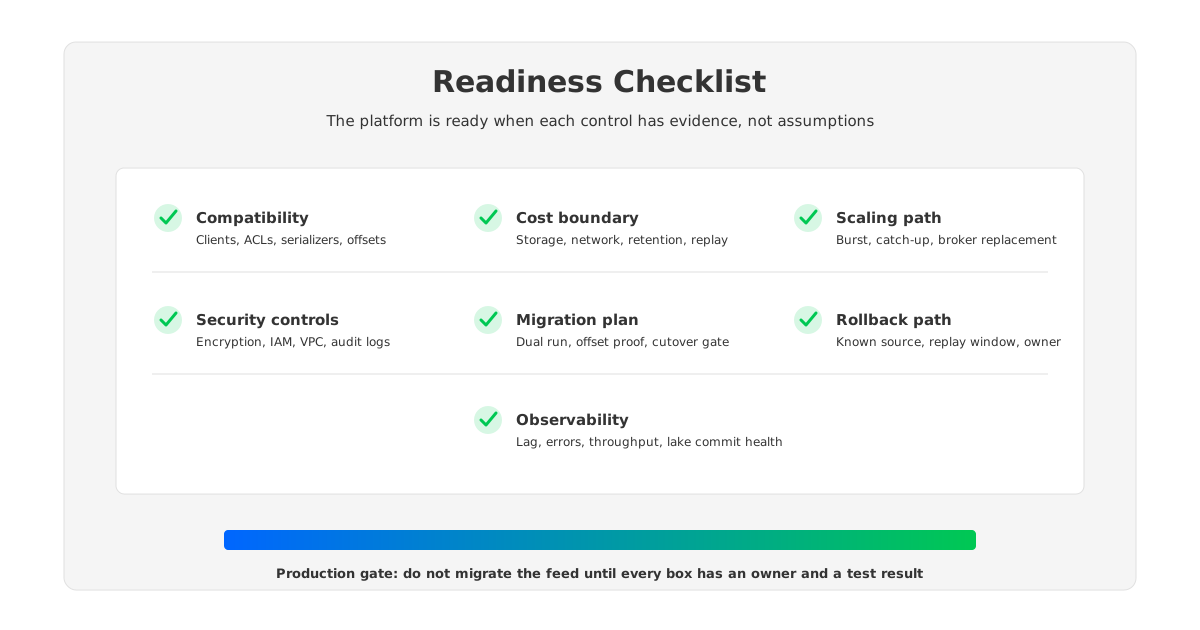
- Compatibility: Validate the real producers and consumers, not sample clients. Include the client versions, serializers, authentication method, ACL model, offset behavior, and any transaction or idempotency settings used by the feeds.
- Cost boundary: Map steady-state and replay cost separately. A replay window can stress broker fetch capacity, object-storage reads, lake writes, and downstream query engines in a pattern that normal dashboards do not show.
- Scaling path: Test burst ingestion, slow consumers, catch-up reads, broker replacement, and partition growth. The question is not whether the cluster can run when calm, but whether it changes shape under pressure.
- Security controls: Keep encryption, key ownership, identity policy, private routing, audit logs, and data residency in the design from the first feed. Retrofitting those controls after onboarding is slower and riskier.
- Migration plan: For existing Kafka estates, prove dual-run, topic mapping, consumer progress, producer cutover, and rollback before moving a critical feed.
- Rollback path: Define which system is authoritative during migration and during replay. If two systems can receive writes, the cutover plan needs a rule that prevents split evidence.
- Observability: Track producer errors, consumer lag, broker health, fetch latency, rejected records, dead-letter volume, lake commit health, and object-storage errors in one operating view.
This checklist is biased toward operational evidence. Security data is evidence, and ingestion must preserve that property when schemas change, feeds misbehave, and teams reconstruct what happened.
5How AutoMQ Changes The Operating Model
Once the neutral review points to a need for Kafka compatibility plus a different storage model, AutoMQ becomes relevant. AutoMQ is a Kafka-compatible, cloud-native streaming platform built around Shared Storage architecture. It keeps Kafka protocol semantics for clients and ecosystem tools while moving durable stream storage away from broker-local disks and into object storage through its storage layer.
The key change is the role of the broker. In AutoMQ, brokers handle Kafka-facing compute, request routing, cache, partition leadership, and coordination with the Controller. Durable data is backed by shared storage. WAL (Write-Ahead Log) storage provides the write path for durability and recovery, while object storage becomes the long-term foundation for stream data. Because brokers are stateless brokers rather than owners of long-lived local partition data, scaling and replacement become metadata, ownership, and traffic-routing operations instead of large data-copy projects.
For security lake ingestion, that changes several practical decisions. Retention can be designed around shared durability instead of broker disks. A broker failure does not have the same implication as losing a node that owns local persistent logs. Scaling compute for an incident burst becomes less entangled with durable data placement. Cross-AZ traffic can also be reduced through AutoMQ's architecture and routing design in supported deployment patterns.
AutoMQ BYOC is relevant when the security team needs cloud resources, data plane, and control plane components inside the customer's cloud account. That boundary is often important for security telemetry, because the organization may need to control VPC placement, object storage, IAM policy, encryption keys, and audit flows. AutoMQ Software addresses private data center deployments where the same Kafka-compatible operating model is needed outside public cloud.
Migration deserves the same evidence-first approach. AutoMQ's Kafka Linking is designed for moving Kafka workloads with topic data and Consumer group progress while reducing application change. For a security lake, still test real feed replay, malformed event paths, producer cutover, consumer catch-up, observability, rollback, and owner sign-off.
Some designs also need a path from streams to analytical tables. AutoMQ's Table Topic can be evaluated where teams want Kafka topic data written into Apache Iceberg tables with catalog, schema, partition, commit, and error-handling controls.
6A Practical Reference Architecture
A production reference architecture for security lake ingestion should be drawn from left to right. Start with event sources: cloud audit logs, identity systems, endpoint agents, network telemetry, application events, and findings. Place a normalization and validation layer before or at Kafka ingestion, depending on how much control exists over the source. Then place Kafka-compatible topics as the durable operational buffer, with explicit topic naming, schema policy, retention, error topics, and access boundaries.
Downstream from the streams, separate real-time and lake paths. Detection and alerting consumers may read fresh events directly from Kafka-compatible topics. Enrichment and table writers may produce normalized tables in object storage. Incident response and compliance query engines should read from the lake. Observability should span Kafka client metrics, broker metrics, Consumer group lag, rejected records, table commit health, object-storage errors, and catalog failures.
The design should name ownership boundaries. Platform engineering owns the streaming platform and capacity model. Security engineering owns detection logic, parser correctness, and triage workflows. Data platform teams may own table layout, catalog policy, and query performance. Cloud infrastructure owns network routing, IAM, and encryption policy.
The final reference point is the replay path. Pick one feed, one incident window, and one parser bug. Can the team identify the topic, partition, offset range, schema version, table commit, dead-letter records, and owner who approves the replay? If the answer is yes, Kafka is acting as a controlled ingestion layer. If the answer is no, the lake may be collecting events without preserving the chain of evidence.
7FAQ
7.1Is Kafka a security lake?
No. Kafka is the streaming and replay layer. A security lake also needs object storage, table layout, metadata, query engines, access policy, retention controls, and auditability. Kafka is often the front door because it gives producers and consumers a durable event contract before data becomes analytical lake data.
7.2When should a team use Kafka for security lake ingestion?
Use Kafka when sources are continuous, bursty, or consumed by multiple downstream systems. It is especially useful when replay, backpressure, Consumer group isolation, and offset-based recovery matter.
7.3Does Kafka compatibility remove migration risk?
No. Kafka compatibility reduces application rewrite risk, but production migration still needs proof. Test clients, ACLs, serializers, offsets, Consumer groups, error paths, observability, dual-run behavior, and rollback with real security feeds.
7.4How does AutoMQ fit a security lake ingestion architecture?
AutoMQ fits when a team wants Kafka-compatible streams with Shared Storage architecture, stateless brokers, object-storage-backed durability, and customer-controlled deployment boundaries through AutoMQ BYOC or AutoMQ Software. It should be evaluated with the same checklist as any production platform.
7.5What is the first design artifact to create?
Draw one sensitive feed end to end: source, topic, schema, offset, consumer, lake output, object-storage policy, catalog, query engine, dead-letter path, replay path, and owner.
If your team is evaluating security lake ingestion with Kafka-compatible streams, start with the checklist above and test one real feed. When broker-local storage or replay work becomes the limiting factor, review AutoMQ's cloud-native Kafka architecture against the same evidence.
8References
- Apache Kafka documentation
- Apache Kafka Connect documentation
- Apache Kafka KRaft documentation
- Apache Kafka Tiered Storage documentation
- AWS Security Lake documentation
- AWS PrivateLink documentation
- AutoMQ architecture overview
- AutoMQ compatibility with Apache Kafka
- AutoMQ WAL storage documentation
- AutoMQ zero cross-AZ traffic documentation
- AutoMQ Table Topic documentation
- AutoMQ Kafka Linking documentation


