
Table of Contents
Table of Contents
Teams usually search for security posture drift kafka after the cluster has already become important enough to make everyone nervous. Producers keep writing, consumers keep catching up, and the business treats the stream as shared infrastructure for payments, telemetry, fraud detection, customer events, or lake ingestion. The uncomfortable part is that the cluster's security posture no longer matches the diagram that passed review years ago.
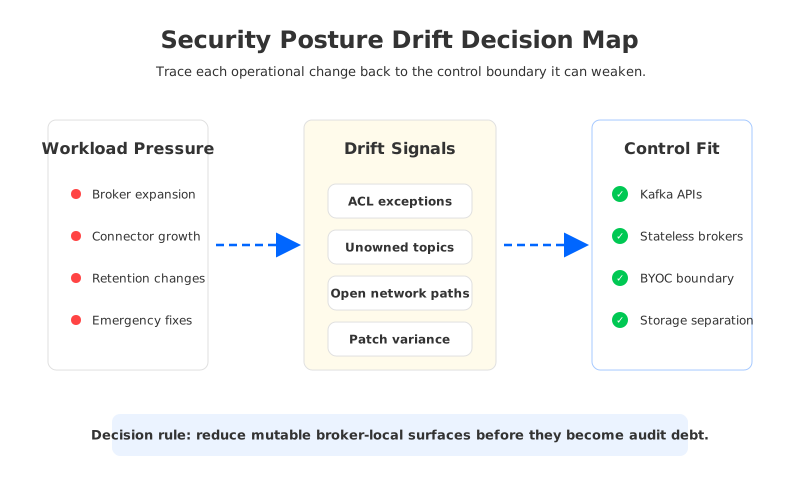
That mismatch rarely comes from one reckless change. It grows from normal production work: a temporary ACL added during an incident, a network rule opened for a connector, a broker replacement with a slightly different image, or an emergency topic created outside the usual request path. Each change is defensible in isolation. Together, they move identity, encryption, network access, topic ownership, audit evidence, and operational responsibility away from the architecture that security and compliance teams think they are governing.
Kafka makes this more than a generic infrastructure drift problem because the cluster is both a data plane and a coordination fabric. It carries sensitive records, stores offsets, enforces access control, hosts connectors, and participates in consumer group coordination. A misaligned control on a streaming platform can affect every system that reads from or writes to the stream.
1Why teams search for security posture drift kafka
The search phrase usually hides a bigger question: "How do we keep a long-running Kafka environment governable while it keeps changing?" Security posture drift is not only about whether TLS is enabled or whether a particular ACL exists. The real test is whether the platform can absorb growth, failure, migration, and new governance requirements without forcing teams to keep making local exceptions.
The triggers are familiar. A regulated workload moves onto a cluster originally built for internal telemetry. A data lake project adds sink connectors and wider network reach. A merger brings new identity domains and retention policies. A platform team consolidates Kafka clusters, then discovers different topic conventions, client settings, and firewall assumptions.
The drift often shows up as audit friction before it shows up as an outage. Security asks which service owns a topic and receives several plausible answers. Compliance asks whether a stream containing personal data is restricted to the right region, but the answer depends on both Kafka configuration and cloud network paths. A platform team can explain each layer, yet no one can prove the whole posture quickly.
That is why the phrase belongs in architecture review, not only in a security checklist. Kafka's official documentation covers producers, consumers, offsets, transactions, Connect, KRaft, and tiered storage in detail, but posture drift appears when those mechanics are operated across many teams and many years. The harder question is whether the cluster's architecture keeps the number of changing security surfaces small enough for humans to govern.
2The production constraint behind the problem
Traditional Kafka was designed around a shared-nothing architecture. Brokers own local persistent data. Replication, leader placement, partition reassignment, disk capacity, and broker recovery all revolve around data that lives on specific machines or volumes. That model is understandable and battle-tested.
The same model creates a long-term governance constraint in the cloud. When storage is tied to brokers, ordinary operational changes touch persistent state. Scaling out can require partition movement. Rebalancing changes which brokers hold which data. Expanding retention changes disk pressure and recovery exposure. Replacing brokers can involve local storage lifecycle, replica catch-up, and network movement.
This is where drift becomes structural. A platform team can automate many actions, but the security review still has to reason about a large mutable surface:
- Broker-local disks or volumes that carry durable stream data and must be encrypted, monitored, resized, and retired.
- Inter-broker replication paths that move data across racks, zones, or subnets and therefore affect network policy and cloud transfer cost.
- Topic and ACL policies that evolve under pressure from application teams, connector teams, and incident response.
- Connector runtimes that often need access to both Kafka and external systems, widening the blast radius of identity and network mistakes.
- Client configuration variance, where small differences in authentication, timeout, retry, and idempotence settings can produce different behavior under failure.
Security teams think in control boundaries. Platform teams think in operational procedures. Kafka posture drift happens when those two views are not mapped to each other. The platform procedure says "add brokers and rebalance." The control view asks which data moved, which network paths carried it, and whether the new state still matches the workload's classification.
Cloud infrastructure adds another layer because security and cost boundaries share the same topology. Cross-zone replication, private connectivity, object storage policies, key management, and region selection are governance decisions as well as infrastructure decisions. AWS documents a shared responsibility model, S3 encryption controls, and PrivateLink networking as separate service concerns. In a streaming platform, those concerns meet inside the same runbook.
3Architecture options and trade-offs
A useful evaluation starts with the drift surface. Count the places where routine operations can change the security posture, then ask whether the architecture reduces or multiplies those places. The answer will differ by workload, but the framework stays consistent.
| Architecture choice | What it improves | Where drift can still appear |
|---|---|---|
| Self-managed Kafka on local disks | Maximum control over version, topology, and operational policy | Broker-local storage, manual partition movement, cluster-specific procedures, inconsistent client and ACL conventions |
| Managed Kafka with broker-attached storage | Less infrastructure maintenance and better service integration | Capacity planning, storage expansion, network paths, connector boundaries, and provider-specific control mapping |
| Kafka with tiered storage | Lower pressure on local disks for older data | Hot data and operational recovery still depend on broker-local state and local-log procedures |
| Shared storage with stateless brokers | Fewer broker-local persistent surfaces and simpler compute scaling | Requires careful WAL, object storage, identity, encryption, and deployment-boundary review |
Tiered storage deserves special attention because it is easy to confuse with a fully shared-storage operating model. It can move older segments to remote storage, which is valuable for retention and cost. But brokers still manage local hot data and still participate in the operational lifecycle around local logs. The drift surface is reduced for long-retention data, not eliminated for the hot path.
Shared storage changes the question. If durable stream data is no longer bound to a specific broker's local disk, then broker replacement, compute scaling, and many recovery paths stop being storage migration events. The security review can focus on shared durable layers, identity boundaries, encryption policies, and network topology.
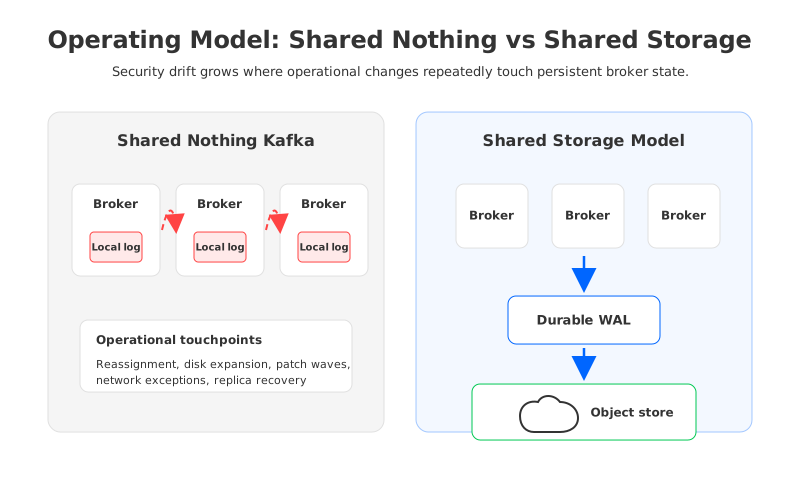
The trade-off is that shared storage must prove its write path. Kafka workloads expect low-latency acknowledgments, ordered logs, consumer offset behavior, and predictable recovery. A serious review should ask how the system acknowledges writes, how unflushed data is protected, how brokers recover ownership, and how object storage policies map to the customer's cloud controls.
4Evaluation checklist for platform teams
The cleanest way to review posture drift is to score architecture and operations together. A cluster that looks secure on paper but requires constant exception handling will drift. A cluster that is easy to operate but vague about identity, encryption, and data boundaries will also drift.
Start with compatibility because migration risk can become security risk. Kafka clients rely on protocol behavior, consumer group coordination, offset commits, transactions, idempotent producers, and ecosystem tooling. If a platform claims Kafka compatibility, validate the parts your applications actually use. The official Kafka documentation is a good baseline for the semantics teams should preserve during evaluation.
Then evaluate control ownership. Every topic should have an application owner, data classification, retention policy, access policy, and review cadence. That becomes technical as soon as a connector needs credentials to an external system or a consumer group belongs to another team. The platform should make it easier to preserve that ownership map, not harder.
A practical checklist should cover these areas:
- Compatibility: client APIs, consumer groups, offsets, transactions, Kafka Connect, monitoring tools, and migration tooling.
- Cost boundary: storage, broker capacity, cross-zone traffic, private networking, and retention growth.
- Security controls: TLS, authentication, ACLs, SSO or identity-provider integration, encryption at rest, key ownership, and audit trails.
- Deployment boundary: whether the data plane runs in the customer's account, VPC, region, and cloud resource policy perimeter.
- Elasticity: whether scaling compute requires data movement, manual reassignment, or long periods of mixed operational state.
- Recovery: broker failure, zone failure, rollback, topic restoration, and evidence that recovery does not widen access.
- Observability: metrics, logs, alerts, ownership metadata, configuration drift detection, and review artifacts.
The order matters less than completeness. A financial services platform may start with identity and auditability, while a data platform team may start with retention and connector boundaries. The point is to make each operational action answerable in security language: what changed, who owns it, what data could move, what evidence proves the new state, and how quickly can the team roll back?
5How AutoMQ changes the operating model
Once the review reaches architecture-level controls, AutoMQ fits into a specific category: a Kafka-compatible cloud-native streaming system that separates broker compute from durable storage. It keeps Kafka protocol compatibility as the application-facing contract, while the storage architecture moves away from broker-local persistent logs toward shared storage backed by object storage and a WAL layer.
That distinction matters because it reduces the number of routine operations that touch broker-local durable state. Brokers can be treated more like stateless compute nodes. Durable stream data is protected by the WAL and object storage path rather than by each broker's local disk lifecycle. Scaling compute, replacing brokers, and recovering from broker failure become less entangled with moving persistent log data.
AutoMQ's documentation describes this as a shared storage architecture, and its Kafka compatibility documentation outlines the goal of preserving the Kafka protocol and ecosystem contract. For security and governance teams, the operating-model implication is more important than the product label: a smaller set of durable storage boundaries to review, including the WAL layer, object storage, cloud identity, encryption, network paths, and deployment boundary.
The BYOC model is relevant because posture drift is often about who controls the environment. In a customer-controlled cloud account and VPC, the security team can map streaming infrastructure to existing cloud controls: IAM, VPC policy, private connectivity, key management, logging, and region restrictions.
AutoMQ's zero cross-AZ traffic design is another example of architecture affecting governance. Cross-zone traffic is usually discussed as a cost topic, but it is also a topology topic. A design that reduces unnecessary inter-zone data movement can make both cost review and network review simpler.
This does not remove the need for security engineering. Teams still need topic ownership, ACL policy, identity-provider integration, encryption posture, connector access, incident runbooks, and audit evidence. Shared storage changes the default workload of that governance process: fewer broker-local storage exceptions, fewer data-movement procedures during scaling, and a clearer mapping between streaming durability and cloud storage controls.
6Migration and readiness scorecard
The safest migration plan treats posture as something to preserve, not something to rediscover after cutover. Before moving workloads, export the current reality: topic inventory, ACLs, principals, consumer groups, retention settings, connector dependencies, network rules, dashboards, alerts, and runbooks.
From there, split readiness into semantic, control, and rollback gates. Semantic readiness means clients, offsets, transactions, and tooling behave as expected. Control readiness means identity, encryption, network boundaries, and audit evidence are defined before production traffic moves. Rollback readiness means teams can return traffic without losing track of offsets, topic policy, or access boundaries.
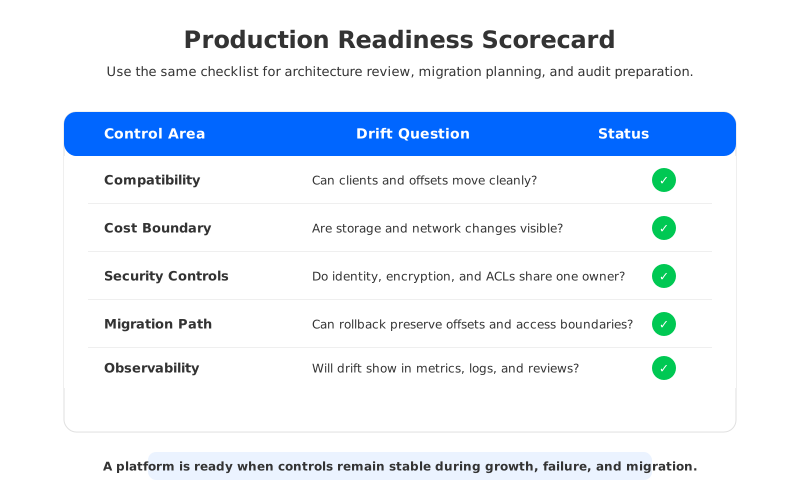
Use this scorecard as an architecture review artifact rather than a one-time checklist.
| Readiness area | Pass condition | Drift warning |
|---|---|---|
| Topic inventory | Every topic has owner, classification, and retention | Topics exist without owner or data class |
| Access control | ACLs or equivalent permissions map to current service identities | Temporary principals remain after incidents |
| Network boundary | Producers, consumers, connectors, and storage paths are documented | Connector exceptions bypass normal review |
| Storage model | Durable path, WAL, object storage, and key policy are understood | Broker-local storage requires case-by-case review |
| Scaling procedure | Compute scaling does not require uncontrolled data movement | Reassignment changes security evidence |
| Observability | Metrics and logs expose posture-relevant drift signals | Review depends on tribal knowledge |
| Rollback | Cutover preserves offsets, access policy, and audit trail | Rollback focuses only on traffic |
The most important row is often observability. A posture that cannot be observed cannot be governed. Metrics and logs should not only answer whether Kafka is healthy; they should help answer whether the platform is still inside the intended control boundary.
Security posture drift in Kafka is a sign that the platform's architecture and the organization's governance model have fallen out of sync. Long-running clusters will keep changing. The practical goal is to make the safe path the normal path. If broker-local storage, manual reassignment, and ad hoc network exceptions are driving too much drift, it is worth evaluating a Kafka-compatible shared storage model. AutoMQ's architecture overview is a useful next step for teams that want to compare this operating model against their current Kafka environment: review the AutoMQ architecture documentation.
7References
- Apache Kafka Documentation
- AutoMQ Kafka Compatibility
- AutoMQ Architecture Overview
- AutoMQ BYOC Environment Documentation
- AutoMQ Zero Inter-Zone Traffic Overview
- AWS Shared Responsibility Model
- Amazon S3 Encryption Documentation
- AWS PrivateLink Documentation
8FAQ
8.1What is security posture drift in Kafka?
Security posture drift in Kafka is the gap between the cluster's intended control model and its actual production state. It can involve ACLs, identities, topic ownership, connector access, network rules, encryption settings, retention policies, observability, or operational procedures.
8.2Why is Kafka especially exposed to posture drift?
Kafka sits between many systems. Because it stores data, coordinates consumers, enforces access, and moves records across network boundaries, small operational exceptions can accumulate into a broad governance problem.
8.3Does managed Kafka eliminate security posture drift?
Managed Kafka can reduce infrastructure maintenance, but it does not automatically eliminate drift. Teams still need to govern topics, identities, clients, connectors, data classification, retention, network access, and audit evidence.
8.4How does shared storage reduce posture drift risk?
Shared storage reduces the amount of durable state tied to individual brokers. That can make broker replacement, compute scaling, and recovery less dependent on moving local log data.
8.5Where should a platform team start?
Start with an inventory of topics, owners, data classifications, ACLs, principals, consumer groups, connectors, retention settings, network paths, storage controls, and runbooks. Then review which normal operations can change those controls.


