
Table of Contents
Table of Contents
Kafka on GKE and managed Kafka on Google Cloud can expose the same producer, consumer, topic, partition, and offset model. They do not expose the same operating job. With self-managed Kafka, your team owns the broker state, storage topology, upgrades, and recovery evidence. With a managed service, the provider takes over part of that work, while your team still owns the workload contract and the decisions around compatibility, networking, retention, and cost. The useful comparison is therefore an operations scorecard, not a feature checklist.
A team choosing between the two should be able to answer one question before it approves a design: when a broker, zone, disk, client, or release causes trouble, who has the next action and what evidence proves the system can recover? This article uses that question to compare self-managed Kafka on GKE with Google Cloud Managed Service for Apache Kafka, then adds a third architecture only when the storage boundary itself is the source of the problem.
1Start with the responsibility boundary
A GKE cluster gives a platform team a managed Kubernetes control plane, node-pool primitives, scheduling rules, and integrations with Google Cloud. It does not operate Kafka's distributed log for you. A self-managed deployment still needs a Kafka operator or an equivalent runbook for broker identities, PersistentVolumeClaims, partition placement, replication, quotas, listeners, security, and upgrades. The Kubernetes layer can reschedule a pod; it cannot decide whether a partition should move, whether a replica is caught up, or whether a client can safely resume.
Managed Kafka reverses that boundary. The provider runs the service infrastructure and exposes a Kafka cluster through a documented control surface. Google Cloud's Managed Service for Apache Kafka overview describes the service lifecycle and Kafka-facing model. Your platform team still has to provision clients, define topic and retention policies, place applications and connectors, monitor consumer behavior, and test the failure modes that matter to the business. “Managed” changes the owner of a set of tasks; it does not remove the tasks from the system.
That difference is often missed in a happy-path test. A producer can write records to both platforms, and a consumer can read them back. The scorecard has to follow the system into the less convenient moments.
2What self-managed Kafka on GKE really adds
The usual GKE pattern combines a regional or multi-zone cluster, a Kafka StatefulSet, one PersistentVolumeClaim per broker, and topology rules. This gives broker identities and log directories a stable home, but it also ties a broker to a storage attachment. Google documents PersistentVolumes in GKE and regional cluster placement; Kafka adds its own rules on top.
When a node is drained, the platform team has to reason about two systems at once. Kubernetes must find a schedulable replacement with the right topology, volume, and capacity. Kafka must preserve leadership, replication, and client connectivity while it catches up. If a broker is replaced without its original data, the cluster may need replica recovery or partition reassignment. Apache Kafka's replication guidance and cluster expansion procedure describe the Kafka side of those operations, but the GKE team still has to connect them to node pools, volumes, and maintenance windows.
That coupling creates three review questions:
- Where does durable data live? A larger disk can solve capacity pressure while leaving throughput, attachment, snapshot, and zone constraints unresolved.
- What moves during a change? Adding a broker is a Kubernetes action first, but it becomes a Kafka data movement operation when partitions and replicas are reassigned.
- Who is on call? The owner must be able to correlate Kubernetes events, volume status, Kafka controller state, client errors, and network telemetry during the same incident.
GKE is a strong fit when that control is a requirement and the organization is ready to operate Kafka as a stateful distributed system. It becomes a poor fit when the team wants Kubernetes-level control without accepting Kafka-level data movement.
3What managed Kafka changes, and what it does not
A managed Kafka service can remove a large portion of broker lifecycle work: infrastructure provisioning, service-side maintenance, and the mechanics of keeping the service available are handled within the provider's product boundary. That can make an upgrade or a broker incident less dependent on a custom StatefulSet runbook. It also changes what you can inspect. The service exposes supported configuration and telemetry, while some infrastructure decisions remain behind the service boundary.
That is a trade, not a defect. If the team values delegated operations, a managed service may be the cleaner choice. If the team needs a specific storage class, plugin, scheduling rule, or placement policy, the same boundary can become a constraint. The evaluation should record the exact control you need, the control the service exposes, and the fallback when the control is unavailable.
The cost model deserves the same treatment. Self-managed Kafka on GKE combines cluster capacity, persistent storage, network transfer, observability, backups, and engineering time. Managed Kafka uses provider billing dimensions that package infrastructure differently. Google publishes a Managed Kafka pricing page; use it with GKE pricing and the relevant storage and network meters. A service line item is not total cost.
A managed service also does not decide whether your consumers can tolerate a longer catch-up, whether a connector can replay safely, or whether a region-level recovery test meets your business objective. Those are workload obligations. Your scorecard should keep them visible.
4An operations scorecard for the decision
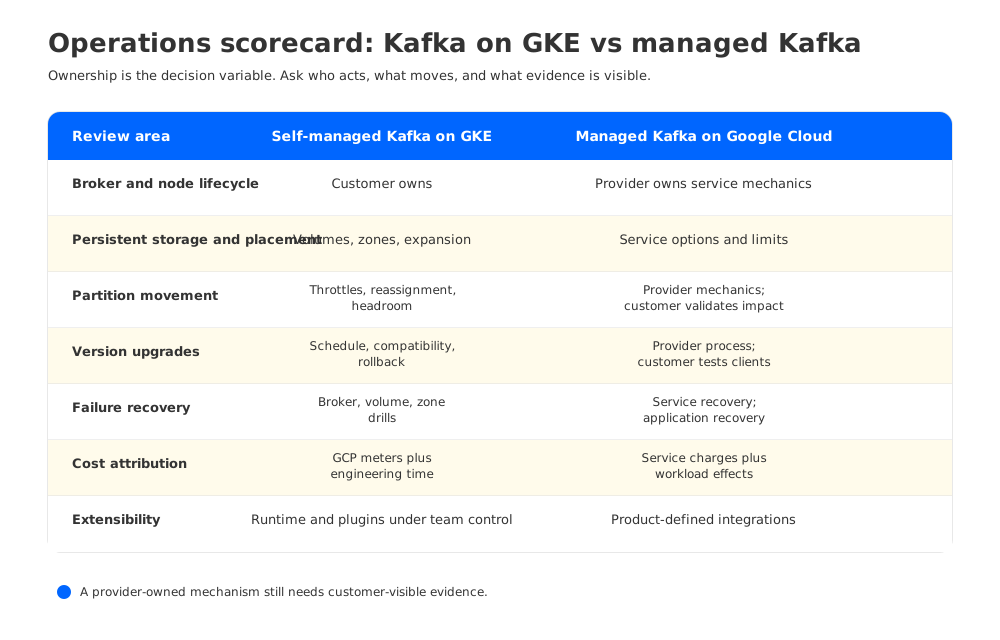
The matrix below uses ownership language rather than a numeric score. A “provider” entry means the service boundary owns the mechanism; it does not promise a particular SLO. A “customer” entry means the platform team must design, test, and operate the path.
| Review area | Self-managed Kafka on GKE | Managed Kafka on Google Cloud | Evidence to request |
|---|---|---|---|
| Broker and node lifecycle | Customer | Provider within service boundary | Maintenance and replacement runbook |
| Persistent storage and placement | Customer chooses volumes, topology, and expansion path | Service-defined options and limits | Storage classes, attachment behavior, and limits |
| Partition movement | Customer plans throttles, reassignment, and headroom | Provider manages service mechanics; customer validates impact | Rebalance test with client error and lag data |
| Version upgrades | Customer schedules, validates, and rolls back | Provider controls service process; customer validates compatibility | Supported versions, maintenance process, rollback or recovery path |
| Failure recovery | Customer owns broker, volume, and zone drills | Provider owns service recovery; customer owns application recovery | Restore, replay, offset, and failover evidence |
| Cost attribution | Many separate GCP meters plus labor | Service charges plus workload-side network and storage effects | A workload ledger with the same traffic and retention assumptions |
| Extensibility | Broad control over plugins and runtime | Product-defined integrations and configuration | Required connectors, APIs, and unsupported settings |
The row that usually decides the outcome is partition movement. If a scaling event or replacement requires moving a large retained log between broker-local disks, the operation can consume capacity and attention even when the steady-state cluster is healthy. If the workload cannot tolerate that operational pattern, the team should question the storage architecture rather than keep tuning the same StatefulSet.
5Compare the data paths, not the product names
A self-managed GKE topology usually places producer and consumer traffic on a Kafka broker, with durable log segments on broker-attached volumes and replica traffic between brokers. A managed service hides the broker and volume topology, but clients still traverse a network boundary and records still incur storage, retention, and read costs. The right drawing has the same arrows in both designs: writes, replication or durable storage, consumer reads, connector traffic, and recovery traffic.
The operational consequence is different. In the GKE design, changing the broker set can change the location of retained bytes. In the managed design, changing the service may change what is observable or configurable. Neither drawing proves a lower bill or a faster recovery. Each one tells you which measurements to collect.
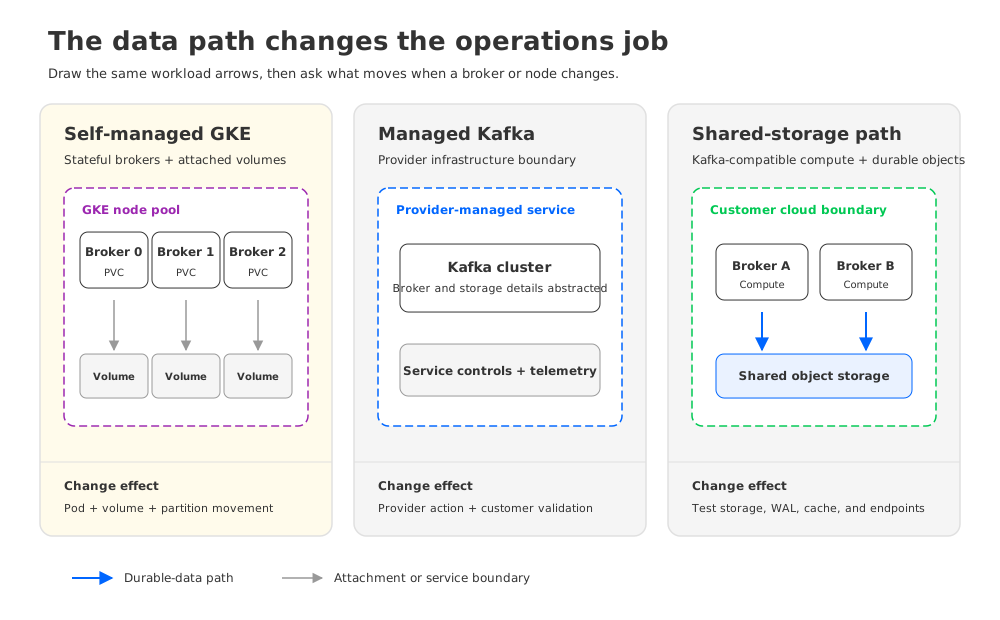
A useful exercise is to annotate the topology with four timestamps: detection, decision, data movement, and client recovery. Run it during a node drain or controlled broker replacement. If a timestamp has no owner or customer-visible evidence, the design needs a closer review.
6When the storage boundary becomes the real choice
Some teams reach the managed-versus-GKE decision because they want Kafka compatibility, but the repeated incident is about broker-local storage: replica movement during scaling, disk expansion during retention growth, or recovery that depends on a particular volume returning to a particular zone. In that case, changing who runs the broker may leave the expensive coupling intact.
That is the point where a Kafka-compatible shared-storage architecture is worth testing. AutoMQ is a Kafka-compatible cloud-native streaming platform that separates the Kafka-serving role from durable stream storage. Its architecture overview describes brokers, metadata, WAL storage, caching, and object storage as distinct parts of the data path. Its stateless broker documentation explains the boundary to verify in a proof of concept.
This does not turn every GKE workload into a fit. Object storage, WAL choice, caching, client behavior, and network endpoints still need workload-specific tests. The potential change is narrower: broker replacement or compute scaling need not treat every retained partition as permanently attached to one broker. AutoMQ's Google Cloud GKE deployment guide is the place to verify current prerequisites.
7Turn the scorecard into a proof
The decision is ready when every row has evidence. A short proof can use one representative topic and one consumer group, provided it includes the events that expose ownership boundaries:
- Baseline the workload. Record producer rate, consumer rate, partition count, retention policy, replica policy, client versions, and connector behavior. Keep the same workload assumptions across candidates.
- Exercise change. Add capacity, drain a node, replace a broker, and roll a version in a controlled environment. Capture lag, client errors, leadership changes, recovery bytes, and elapsed time.
- Exercise failure. Test a volume-attachment failure for GKE or the service's documented failure and escalation path for managed Kafka. Verify what the application sees and which operator receives the next action.
- Reconcile cost. Map compute, storage, network transfer, observability, and labor to the same retention and traffic model. Label every estimate with its source and date.
- Write the exit condition. State the evidence that would make the team reject each option. A decision that only lists reasons to proceed is a procurement preference, not an operational review.
This process also exposes when Pub/Sub belongs in the comparison. If the application can adopt Pub/Sub's API and delivery model, it may avoid Kafka-specific operations entirely. If existing clients, Kafka Connect, Streams, or offset semantics are part of the contract, keep the Kafka-compatible options in the same proof rather than treating a protocol rewrite as a free alternative.
8Choose the boundary you can operate
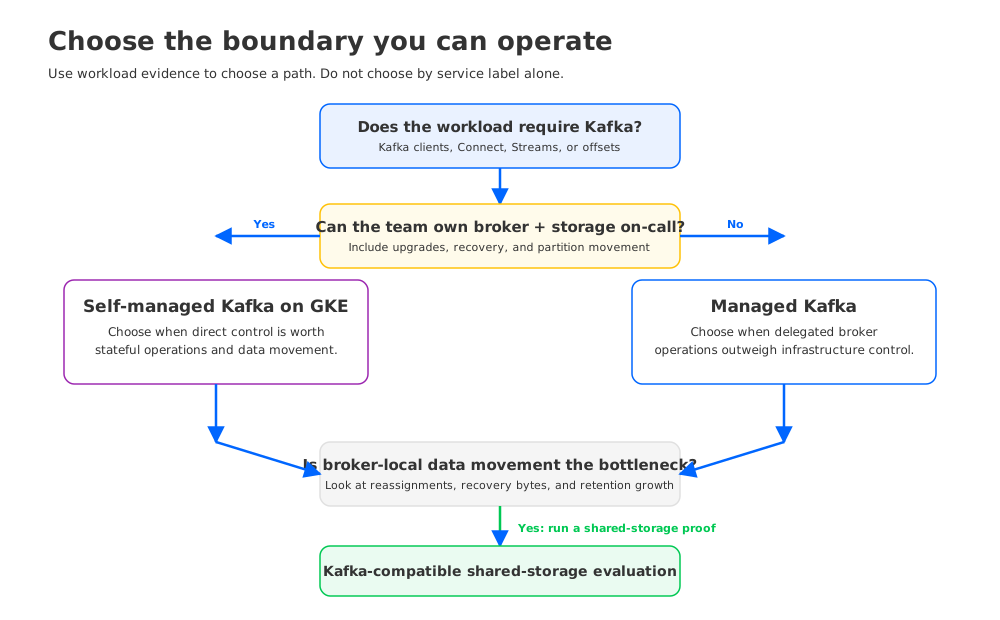
Self-managed Kafka on GKE is a reasonable choice when Kubernetes control, custom runtime behavior, and direct storage ownership justify the work of running a stateful log. Managed Kafka is a reasonable choice when delegated broker operations matter more than infrastructure-level control. A shared-storage Kafka-compatible design belongs in the test when broker-local data movement is the recurring constraint and Kafka compatibility still matters.
Return to the opening question: when the next broker, zone, disk, client, or release causes trouble, who owns the next action? Put that answer beside the evidence from your drain, recovery, upgrade, and cost tests. If the answer points to Kafka-compatible shared storage on GKE, review AutoMQ deployment options with the same scorecard before you commit to another stateful cluster.


