
Table of Contents
Table of Contents
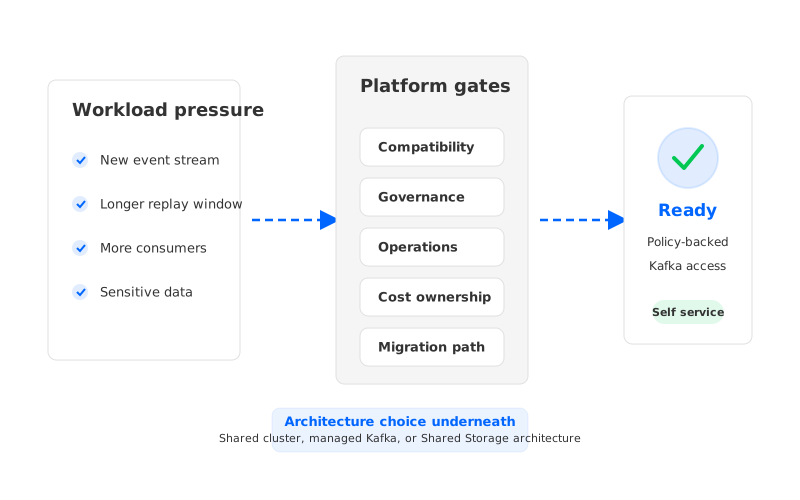
Most application teams do not ask for Kafka because they want another infrastructure dependency. They ask because a product workflow needs events, a data team needs a reliable feed, or an integration has outgrown batch jobs. The request sounds small at first: create a topic, issue credentials, connect a service, and let the team ship. In production, self service kafka onboarding becomes a platform boundary problem, because every additional producer and Consumer brings questions about ownership, retention, schema, access, cost, observability, and rollback.
The useful goal is not to let every team create anything they want. That produces a fast demo and a slow incident. A serious self-service model gives application teams a clear path to production while keeping the platform team in control of the constraints that make Kafka safe to share.
1Why Teams Search for Self Service Kafka Onboarding
The search usually starts after Kafka becomes popular inside the company. One successful platform team proves that event-driven integration works, then the next five teams want their own topics. A fraud service wants payment events. A search team wants catalog updates. A data science team wants clickstream data with longer retention. Each request is reasonable by itself, but the manual intake process starts to collapse under repetition.
Manual onboarding often hides three kinds of work. The first is Kafka work: topics, partitions, retention, ACLs, Consumer groups, quotas, and compatibility with existing clients. The second is organizational work: naming conventions, service ownership, approval paths, incident routing, and chargeback. The third is cloud infrastructure work: capacity, networking, encryption, private connectivity, monitoring, and data residency. A ticket form that asks only for topic name and retention skips most of the decision.
Good self service narrows the choices before the request reaches production. Application teams should not need to understand every broker setting, but they should understand the contract they are choosing. A platform can expose opinionated service classes such as low-retention operational events, long-retention audit streams, CDC feeds, or high-throughput analytics topics. Each class maps to a tested policy instead of a fresh architecture debate.
That distinction matters because Kafka is shared state. A bad HTTP service can usually fail inside its own blast radius. A badly designed Kafka onboarding flow can create hot partitions, unbounded retention, unauthorized data access, or Consumer lag that affects multiple teams at once. Self service is valuable only when it converts platform knowledge into guardrails.
2The Production Constraint Behind the Problem
Traditional Kafka was built around a Shared Nothing architecture. Each Broker owns local log data, and replication keeps copies of partitions on other Brokers for durability and availability. This model is familiar and battle-tested, but it makes onboarding operationally heavier than the API suggests. Every topic consumes broker-local storage, partition leadership, replication bandwidth, controller metadata, monitoring cardinality, and future rebalancing work.
That coupling shows up during the moments application teams care about most. If a workload grows faster than expected, the platform team may need to add Brokers, move partitions, expand disks, or revisit retention. If a team asks for longer replay windows, the retained data has to live somewhere. If multiple teams onboard high-volume producers in the same quarter, the cluster needs enough headroom before the traffic arrives, not after it surprises the on-call engineer.
The cloud changes the cost and elasticity profile of these choices. Broker-attached storage is also a placement and movement problem. Multi-AZ Kafka deployments often replicate data across zones to keep partitions available, and cloud providers meter network, storage, private connectivity, and object storage differently. Even when the monthly bill is not the first concern, the cost model affects governance because someone has to decide which application team is allowed to create which kind of stream.
Kafka Connect and stream processing add another layer. A connector is not only a piece of configuration. It needs credentials, source ownership, sink ownership, offset handling, retry policy, schema behavior, and an incident owner. A self-service portal that provisions a connector without asking who owns the downstream data contract is automation in the narrowest sense. It saves a ticket and creates a future ambiguity.
The platform problem is therefore not "how do we create topics faster?" The better question is "how do we make the safe path faster than the unsafe path?" Once the question is framed that way, onboarding architecture becomes easier to evaluate.
3Architecture Options and Trade-Offs
There are several ways to build a self-service Kafka experience, and none of them is universally right. The right design depends on team maturity, compliance requirements, workload shape, and how much Kafka operating responsibility the platform team wants to keep.
| Option | Where It Fits | Main Trade-Off |
|---|---|---|
| Shared central Kafka cluster | Teams need a common event backbone with consistent policies | Strong governance, but capacity and noisy-neighbor control need discipline |
| Per-domain Kafka clusters | Business domains need isolation and independent lifecycle control | Clear blast radius, but more clusters to operate and standardize |
| Managed Kafka service | Platform team wants less broker lifecycle work | Faster operations, but platform boundaries, cost visibility, and feature behavior still need review |
| Kafka-compatible Shared Storage architecture | Storage growth, elasticity, and data movement are limiting onboarding speed | Changes the storage model, so teams must validate latency, compatibility, and migration behavior |
The first two options are mostly organizational choices. A central cluster makes policy enforcement easier because every team passes through the same control plane. Per-domain clusters reduce blast radius and can match ownership boundaries, but they often recreate duplicated platform work. Managed Kafka can remove patching and broker lifecycle tasks, but it does not remove the need for application contracts, topic governance, and cost attribution.
Shared Storage architecture changes a deeper assumption. Instead of treating each Broker as the durable owner of local log data, durable stream data is placed in shared object storage, and Brokers act more like compute, cache, and protocol-serving nodes. A WAL (Write-Ahead Log) layer handles the low-latency write path before data is organized in object storage. The practical effect is that capacity changes and Broker replacement are less dominated by moving retained partition data.
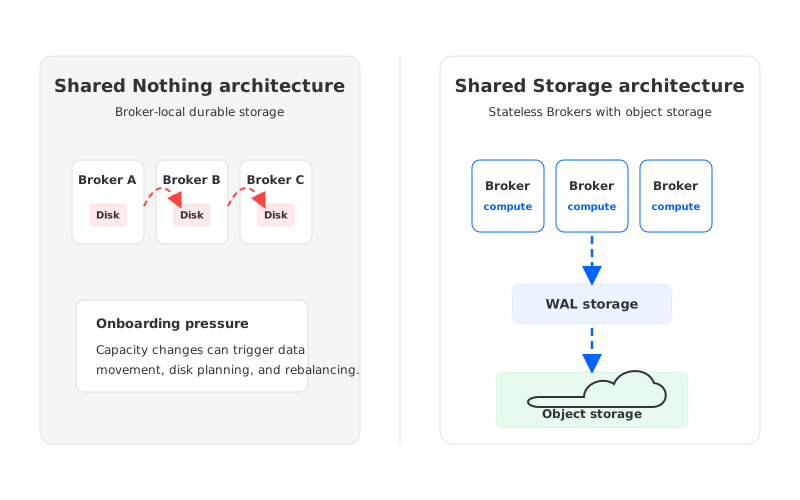
This does not make governance optional. It changes what governance can focus on. If the storage layer is less tied to individual Brokers, the platform team can spend more of its policy budget on compatibility, data contracts, security, migration, and cost visibility instead of treating every onboarding request as a possible disk and rebalance event. The architecture removes one class of friction, but the platform still needs a strong intake model.
4Evaluation Checklist for Platform Teams
A useful self-service onboarding checklist should separate application-level intent from platform-level enforcement. If those two are mixed together, the form becomes either too simple to be safe or too detailed for application teams to use. The platform team should ask for the few facts that define risk, then map those facts into tested policies.
The application-facing request should capture workload intent:
- Event contract. What is the record key, value format, schema ownership model, and compatibility policy? If the team cannot describe the contract, creating the topic is premature.
- Traffic shape. What are expected write rate, read fanout, burst pattern, and retention window? Estimates can be rough during design, but the platform needs enough information to select a service class.
- Ownership. Who owns producers, Consumers, schema changes, access approvals, and incident response? Shared topics without clear ownership become political infrastructure.
- Recovery behavior. What happens during replay, Consumer reset, connector failure, or rollback? Kafka makes replay possible, but the business process decides whether replay is safe.
- Data boundary. Does the stream include regulated, personal, financial, security, or customer-sensitive data? This drives network, encryption, access, retention, and audit decisions.
The platform-facing policy should convert those answers into controls. Topic naming and tags make ownership visible. ACL templates prevent one-off permission drift. Quotas protect shared clusters from accidental overload. Retention classes prevent long-lived data from appearing by default. Observability templates define the dashboards and alerts each onboarded workload receives. Migration templates define how a workload moves between development, staging, and production without inventing the process again.
There is a trap here: teams often automate the low-friction parts first. Topic creation is straightforward to automate. Credential issuance is straightforward to automate. The hard parts are compatibility testing, failure drills, cost attribution, and decommissioning. A platform that creates resources quickly but never deletes unused topics is still accumulating operational debt.
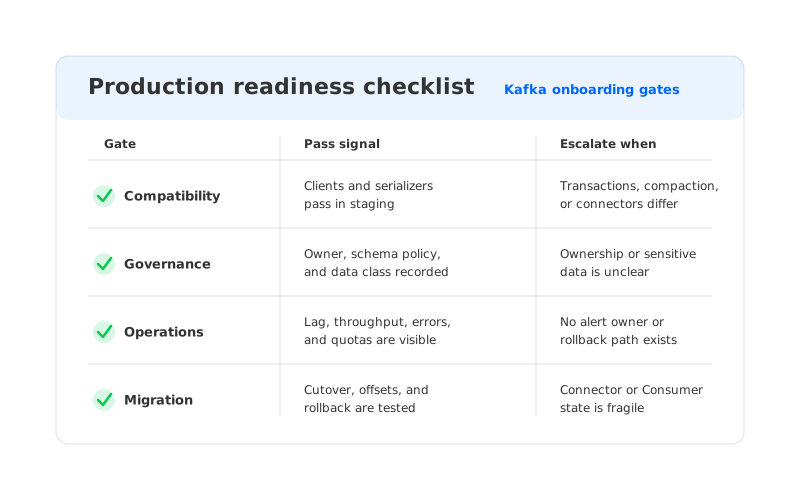
The checklist should also include a readiness score before production access is granted. A simple scoring model works well because it forces the discussion into visible trade-offs:
| Gate | Pass Signal | Escalate When |
|---|---|---|
| Compatibility | Existing Kafka clients, serializers, and Consumer behavior pass in staging | Client versions, transactions, compaction, or connector behavior differ from production |
| Governance | Owner, schema policy, ACL template, and data class are recorded | Topic ownership or data sensitivity is unclear |
| Operations | Lag, throughput, error, and quota dashboards exist before launch | No alert owner or no rollback path |
| Cost | Retention, fanout, and environment class map to a cost owner | Long retention or high fanout has no budget owner |
| Migration | Cutover, offset handling, and rollback are tested | Workload depends on fragile connector or Consumer state |
This kind of scorecard is not bureaucracy. It is a compression of incidents the platform team has already seen. The application team gets a repeatable path, and the platform team gets a defensible reason to say yes, no, or not yet.
5How AutoMQ Changes the Operating Model
Once the evaluation framework points to storage coupling, elastic capacity, and customer-controlled deployment boundaries as the limiting factors, AutoMQ becomes relevant as a Kafka-compatible, cloud-native streaming platform based on Shared Storage architecture. AutoMQ preserves the Kafka protocol and ecosystem surface while replacing broker-local persistent storage with S3Stream, where data is persisted through WAL storage and S3-compatible object storage.
For self-service onboarding, the important change is not that application teams learn a different event model. They should not have to. Producers, Consumers, Kafka Connect jobs, schema tooling, and operational scripts should be evaluated against Kafka-compatible behavior. The platform team, meanwhile, gets a different substrate for capacity and recovery planning: AutoMQ Brokers are stateless, durable data is object-storage-backed, and compute can be scaled with less dependence on broker-local retained data.
That difference affects the onboarding workflow in four practical places. First, service classes can be built around workload contracts rather than disk placement. Second, retention-heavy teams can be reviewed against object-storage-backed durability rather than a per-Broker storage expansion plan. Third, platform engineers can use Self-Balancing and shared storage behavior to reduce the amount of manual partition movement that follows growth. Fourth, customer-controlled deployment models such as AutoMQ BYOC and AutoMQ Software let security teams inspect where the control plane, data plane, credentials, telemetry, and object storage live.
AutoMQ does not remove the need for Kafka discipline. Application teams still need schemas, ownership, access control, Consumer lag alerts, connector runbooks, and rollback plans. The value is that the platform can make self service less dependent on slow storage operations and more dependent on policies that can be encoded into AutoMQ Console, Terraform workflows, API-driven provisioning, monitoring templates, and migration playbooks.
Kafka Linking also matters when self service is introduced into an existing estate. Many companies do not start with a clean platform. They already have clusters, topics, offsets, connectors, and Consumers in motion. A migration-aware onboarding program should support gradual movement: replicate topics, validate Consumer group progress, test cutover behavior, and keep rollback visible until the workload is stable.
6A Practical Rollout Model
Start with a developer tier, but do not confuse it with production. A developer tier should make experimentation quick: constrained retention, limited throughput, clear naming, default dashboards, and automatic cleanup. Its purpose is to help teams learn the contract without turning every experiment into a long-lived platform liability.
Production tiers need fewer choices, not more. Three or four well-designed classes are usually easier to operate than a free-form menu of partitions, retention, and quotas. For example, one class might handle short-retention service events, another might handle regulated audit events, and another might handle high-throughput analytics feeds. The exact classes depend on the business, but the principle is stable: each class should encode known capacity, security, observability, and cost behavior.
The rollout should also include decommissioning from day one. Self service creates resources quickly, so it must retire them with equal discipline. Ownership tags, last-write timestamps, Consumer activity, cost allocation, and approval workflows should feed a cleanup process. Otherwise the platform team will eventually spend more time auditing old streams than onboarding new ones.
The final sign of a mature onboarding model is boring repetition. A team requests a stream, selects a service class, attaches a schema and owner, validates in staging, receives production access, and enters the same observability and cost model as everyone else. The process should feel predictable because the hard decisions were made in the platform design, not rediscovered in every ticket.
If your platform team is building this kind of self-service path and wants to test Kafka-compatible Shared Storage architecture inside your own deployment boundary, start with the AutoMQ BYOC evaluation path and evaluate one real onboarding workflow before rolling it out across teams.
7References
- Apache Kafka documentation: consumer configuration
- Apache Kafka documentation: Kafka Connect
- Apache Kafka KIP-405: Kafka Tiered Storage
- AWS PrivateLink pricing
- Amazon S3 pricing
- AutoMQ overview
- AutoMQ Shared Storage architecture
8FAQ
8.1What is self service kafka onboarding?
Self service kafka onboarding is a platform workflow that lets application teams request and use Kafka resources through predefined policies. It usually covers topics, credentials, ACLs, retention, schema ownership, observability, cost ownership, and production readiness gates.
8.2Should application teams create Kafka topics directly?
They can, but direct creation should happen through guardrails. A platform should expose approved service classes, naming rules, access templates, retention policies, and dashboards so application teams move quickly without bypassing governance.
8.3Is Tiered Storage the same as Shared Storage architecture?
No. Tiered Storage offloads older log segments to remote storage while the active Kafka log remains tied to broker-local storage. Shared Storage architecture makes shared object storage the durable backing store and makes Brokers less dependent on local persistent data.
8.4Where does AutoMQ fit in a self-service Kafka platform?
AutoMQ fits when the platform team wants Kafka-compatible APIs, object-storage-backed durability, stateless Brokers, and customer-controlled deployment boundaries. It should be evaluated after the team defines compatibility, governance, latency, migration, and rollback requirements.


