
Table of Contents
Table of Contents
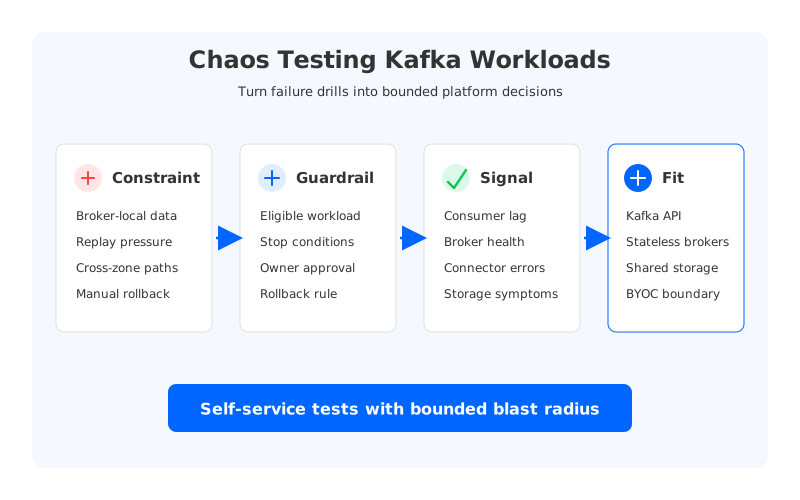
Teams search for chaos testing kafka workloads when ordinary staging tests stop answering the real question: will this streaming platform keep a business workflow alive when something ugly happens? A broker disappears during a deploy. A consumer falls hours behind. A connector retries into a downstream limit. A network path between Availability Zones becomes noisy. Apache Kafka does not fail as a single component in those moments; it fails as a chain of producers, brokers, topics, partitions, offsets, Consumer groups, connectors, dashboards, and humans making decisions under time pressure.
The self-service part matters because platform teams cannot personally supervise every failure drill. If every application team has to open a ticket before pausing a consumer, injecting lag, or rehearsing a broker replacement, chaos testing becomes an annual theater exercise instead of an operating habit. The better pattern is to define safe experiments, guardrails, rollback rules, and ownership boundaries so teams can run repeatable drills without turning production into a guessing game.
The core argument is simple: chaos testing Kafka workloads is not a list of failure types. It is a platform design problem. The architecture has to make failures observable, bounded, reversible, and affordable enough to practice.
1Why teams search for chaos testing kafka workloads
The search usually begins after a near miss. A team discovers that the consumer can recover from a restart, but nobody knows how long replay takes when the topic has a large retention window. A broker replacement works on a quiet cluster, but partition reassignment creates enough data movement to delay other maintenance. A connector can be paused and resumed, but the downstream system sees duplicates because the replay boundary was never documented. These are not exotic failures. They are the ordinary edges of durable streaming systems.
Kafka is attractive because it remembers. Producers can write events once, downstream systems can process at their own speed, and consumers can use offsets to resume. That same durability changes the shape of chaos testing. When an HTTP request fails, the failed request may disappear after a timeout. When a Kafka workload fails, the system may preserve the record, the offset gap, the retry loop, the dead-letter topic, and the lag graph. The platform has to turn that memory into a recovery path.
A useful self-service program starts with a narrow set of experiments that application teams can understand:
- Consumer interruption: Stop a consumer instance, create controlled lag, restart it, and verify catch-up behavior, duplicate handling, and alert routing.
- Producer failure: Block a producer, slow it down, or force retries, then confirm idempotent producer settings, backpressure behavior, and error budgets.
- Broker loss: Remove broker capacity in a controlled window and observe leadership changes, client retries, partition availability, and operational ownership.
- Connector degradation: Pause a Kafka Connect task, limit a sink, or force transient errors, then verify retry policy, dead-letter routing, and downstream consistency.
- Network impairment: Add latency or packet loss on a test path and observe producer acknowledgments, fetch latency, Consumer lag, and cross-zone routing behavior.
These experiments should be boring before they become broad. If a team cannot explain what a safe consumer interruption means for one topic, it is not ready to run region-level drills across shared streaming infrastructure.
2The production constraint behind the problem
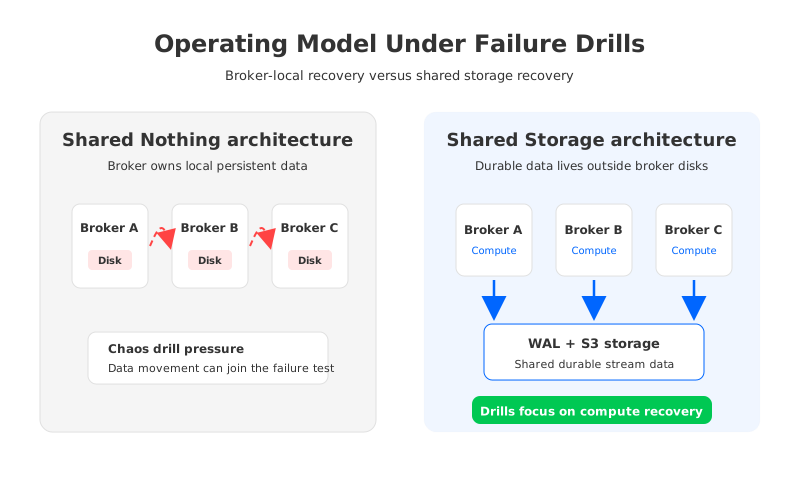
Traditional Kafka uses Shared Nothing architecture. Each broker owns local persistent storage, and partitions are replicated across brokers for availability. This design is proven, widely understood, and operationally transparent to many experienced Kafka teams. It also makes several failure drills depend on broker-local data placement: partition reassignment, broker replacement, catch-up reads, storage headroom, and multi-zone replication traffic.
That coupling shows up in chaos testing as hidden blast radius. A broker-loss drill is not only a broker-loss drill; it can become a data movement drill, a disk utilization drill, a leader election drill, a client retry drill, and a cross-Availability Zone traffic drill at the same time. A consumer lag drill is not only a consumer problem; it can put pressure on fetch capacity, page cache, broker disks, and downstream writes. The platform team may intend to test one failure mode, while the architecture quietly exercises three more.
This is why "run chaos experiments" is weak advice by itself. The real production constraint is the difference between failure injection and failure containment. Injecting a fault is easy. Containing the operational side effects requires clear limits: which topics can be used, how much lag is allowed, what metrics stop the test, who can roll back, and whether the storage layer can absorb replay without becoming the incident.
Tiered Storage can help with historical data economics by moving older segments to remote storage while brokers keep serving active data from local storage. It is a valid option for many Apache Kafka deployments, especially when retention pressure is the dominant issue. It does not make active brokers stateless, and it does not remove the need to test partition leadership, local storage pressure, Consumer group recovery, and rollback behavior.
The platform question is therefore sharper than "Can Kafka survive this failure?" A better question is: can teams rehearse this failure repeatedly without creating a second operational problem?
3Architecture options and trade-offs
Most teams evaluating chaos testing Kafka workloads have three architecture paths. They can harden their existing Kafka platform, add a controlled testing layer around it, or evaluate a Kafka-compatible platform whose storage model changes the recovery profile. None of these choices removes the need for disciplined tests, but each places the complexity in a different part of the system.
| Option | What it improves | What still needs proof |
|---|---|---|
| Harden existing Kafka | Uses familiar tools, broker metrics, client behavior, and operational runbooks | Broker-local storage headroom, reassignment duration, replay cost, and cross-zone traffic during drills |
| Add a self-service testing layer | Gives teams safer templates for lag, restarts, connector pauses, and network tests | Whether guardrails are enforced across teams, topics, clusters, and rollback paths |
| Adopt Kafka-compatible shared storage | Keeps Kafka-facing APIs while changing how broker compute and durable storage interact | Client compatibility, security boundary, migration path, observability, and test ownership |
The first path is often the fastest. A team can define test topics, cap experiment duration, standardize alerts, and document stop conditions without changing platforms. This is a strong starting point when the current cluster has enough capacity and the main problem is process discipline. It becomes weaker when the drills repeatedly collide with broker storage limits or data movement windows.
The second path treats chaos testing as an internal product. Platform teams expose approved experiments through templates, CI jobs, workflow forms, or an internal portal. Application teams choose a workload, a failure type, a time window, and a rollback rule. The platform enforces limits around topics, quotas, Consumer groups, namespaces, and environments. This model scales well when the organization has many teams, but it only works when the underlying platform metrics are good enough to stop a test before it becomes an incident.
The third path is architectural. If the most painful drills involve broker replacement, partition movement, multi-zone traffic, and long replay windows, the team should evaluate whether broker-local storage is the constraint. A Kafka-compatible shared storage design changes that conversation because durable data is no longer tied to a specific broker disk in the same way. The test still has to validate client behavior, offset handling, and downstream correctness, but the platform has a different recovery surface.
4Evaluation checklist for platform teams
A self-service chaos program should be judged by the quality of its guardrails, not the drama of its failures. The goal is not to break Kafka in creative ways. The goal is to let teams discover weak assumptions while the platform still has a clear path back to a known-good state.
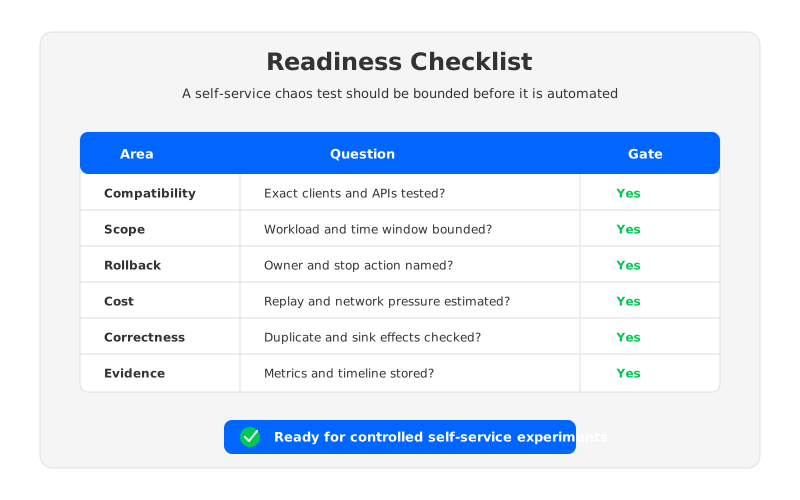
Use this checklist before allowing broad self-service access:
- Compatibility surface: Verify producer, consumer, Admin API, Kafka Connect, transaction, idempotent producer, security, and observability behavior with the exact client versions used in production.
- Experiment scope: Define which clusters, topics, Consumer groups, connectors, namespaces, and time windows are eligible for each experiment type.
- Stop conditions: Set objective limits for Consumer lag, error rate, broker health, connector failures, storage errors, network symptoms, and downstream backpressure.
- Rollback authority: Name the person or automation that can stop the test, restore capacity, resume consumers, restart connectors, or block further experiments.
- Cost boundary: Estimate the extra compute, storage reads, network paths, and downstream writes caused by replay and catch-up behavior. Avoid exact cost claims unless they are calculated from current cloud pricing and workload assumptions.
- Data correctness: Decide how duplicates, out-of-order effects, dead-letter records, sink retries, and partial table writes are detected and repaired.
- Audit and learning loop: Store the experiment plan, approvals, metrics, timeline, findings, and follow-up tasks in a place that future teams can reuse.
The checklist separates platform safety from application correctness. A broker may recover cleanly while a downstream table still receives duplicate writes. A consumer may catch up while its business logic silently skips a poison record. Kafka availability is necessary, but it is not the whole test.
5How AutoMQ changes the operating model
After the neutral evaluation points to a need for Kafka compatibility plus a different recovery profile, AutoMQ becomes relevant. AutoMQ is a Kafka-compatible, cloud-native streaming platform built on Shared Storage architecture. It keeps Kafka protocol behavior for clients and ecosystem tools while redesigning the storage layer so durable stream data is backed by S3-compatible object storage instead of broker-local disks.
That storage change matters for chaos testing because many drills are really tests of operational coupling. AutoMQ Brokers handle Kafka-facing compute, partition leadership, request processing, caching, and coordination. Durable data is handled through S3Stream, WAL (Write-Ahead Log) storage, and S3 storage. With stateless brokers, replacing or scaling broker compute is less tied to moving partition data. A broker-loss drill can focus more directly on leadership, client retry, cache warmup, and platform automation rather than turning into a large data relocation exercise.
Self-Balancing and Self-healing also change the self-service boundary. A platform team can design tests around the assumption that the system has built-in mechanisms for traffic balancing and abnormal node isolation, while still requiring explicit stop conditions and observability. This does not remove the need for engineering judgment. It changes which failure modes are reasonable for application teams to rehearse without waiting for a specialist to supervise every step.
AutoMQ BYOC is relevant when governance and cloud ownership are part of the test plan. In AutoMQ BYOC, the control plane and data plane run inside the customer's cloud account and Virtual Private Cloud (VPC). That boundary matters for teams whose chaos testing has to respect IAM policy, private networking, object storage ownership, audit logs, and compliance rules. AutoMQ Software serves private data center deployments where the same Kafka-compatible operating model is needed outside public cloud.
Migration testing is another place where the architecture shows up. A chaos program should not treat migration as a one-time cutover event. It should test dual-run behavior, offset continuity, rollback authority, connector recovery, and client compatibility before the final move. AutoMQ Kafka Linking is designed to support migration by synchronizing Kafka data and Consumer group progress while preserving Kafka-facing behavior for applications. The self-service pattern stays the same: define the safe experiment, limit the blast radius, and prove the rollback path.
6A self-service pattern that survives production
Build the platform around four layers: catalog, guardrail, executor, and evidence. The catalog describes approved experiments in language application teams understand: "pause one consumer," "restart one broker," "limit one sink," or "create bounded lag." The guardrail layer checks whether the selected workload is eligible, whether the time window is allowed, and whether required metrics are present. The executor performs the change through automation rather than manual shell sessions. The evidence layer records the plan, metrics, timeline, and decision points.
This pattern keeps responsibility clear. Application teams own business correctness: duplicates, replay safety, downstream impact, and user-visible behavior. Platform teams own the shared substrate: quotas, cluster health, broker replacement, network policy, and observability. Security teams own boundaries: IAM, audit trails, secrets, and environment access. SREs own the incident threshold: when a test stops being a test.
The model is strongest when experiments are small but frequent. Run a consumer interruption against one non-critical topic before you test a shared service. Run connector degradation in staging before you touch production. Test broker replacement during a maintenance window before you claim recovery confidence. The practice should create muscle memory without normalizing uncontrolled risk.
7FAQ
7.1What is the safest first chaos test for a Kafka workload?
A bounded consumer interruption is usually the safest starting point. Stop one consumer instance or pause one Consumer group in a controlled environment, create a known amount of lag, restart it, and verify catch-up time, duplicate handling, alerts, and downstream correctness.
7.2Should chaos testing run directly in production?
Production testing can be valuable, but it should come after staging drills prove the experiment, metrics, stop conditions, and rollback path. Start with low-risk workloads, small time windows, explicit approvals, and automated evidence collection.
7.3How is chaos testing Kafka different from testing stateless services?
Kafka is durable infrastructure. A failure can leave behind records, offsets, lag, retries, dead-letter entries, and downstream side effects. The test must verify recovery of state and data correctness, not only process restart behavior.
7.4Does Kafka compatibility remove the need for chaos testing?
No. Kafka compatibility reduces application rewrite risk when evaluating a Kafka-compatible platform, but teams still need to test client behavior, Consumer group recovery, connector handling, security policy, observability, and rollback authority.
7.5Where does AutoMQ fit in chaos testing Kafka workloads?
AutoMQ fits when the test program is constrained by broker-local storage, partition movement, replay pressure, cross-Availability Zone traffic, or migration complexity. It keeps Kafka-compatible behavior while Shared Storage architecture and stateless brokers change the operational profile underneath Kafka.
8References
- Apache Kafka documentation
- Apache Kafka consumer configuration
- Apache Kafka transactions
- Apache Kafka Connect
- Apache Kafka KRaft
- Apache Kafka Tiered Storage
- AutoMQ architecture overview
- AutoMQ Apache Kafka compatibility
- AutoMQ WAL storage
- AutoMQ zero cross-AZ traffic
- AutoMQ Continuous Self-Balancing
- AutoMQ migration overview
- Explore AutoMQ for cloud-native Kafka


