
Table of Contents
Table of Contents
Someone usually searches for consumer lag diagnostics kafka after a dashboard has already turned red. The application team sees a growing backlog. The platform team sees normal broker CPU. The downstream service owner says nothing changed. Everybody is technically looking at the same Kafka system, but each team owns a different slice of evidence, and the incident keeps moving between queues.
That is why consumer lag diagnostics is not a single command. It is a platform pattern. Kafka gives you the primitives: Topic, Partition, Offset, Consumer group, broker request metrics, and tooling such as kafka-consumer-groups. Production teams still need a shared way to decide whether lag is caused by consumer code, broker fetch pressure, storage path behavior, downstream IO, or a capacity event. The useful question is not "Which metric is lag?" It is "Who can prove where the delay entered the path?"
1Why teams search for consumer lag diagnostics kafka
Consumer lag is the distance between where a Partition has been produced to and where a Consumer group has committed progress. The Apache Kafka documentation describes consumers as clients that read records from topics and consumer groups as the mechanism that lets multiple consumers divide work across partitions. That model is powerful because it lets an application scale horizontally, but it also means lag can come from several places that look similar in a high-level chart.
A lag spike can be application-local: a slow deserializer, a database sink under load, a thread pool that stopped polling, or a deployment that changed batch size. It can be broker-facing: fetch latency, network saturation, request queue time, remote reads, or partition leadership churn. It can also be operational: a rebalance, broker replacement, retention-heavy replay, or a capacity increase that triggers local data movement. Teams get into trouble when they treat all of those paths as one generic "Kafka is slow" problem.
The first self-service pattern is to separate symptoms by ownership before debating architecture:
- Application evidence: consumer poll rate, processing time, commit cadence, downstream latency, and error rate. This tells you whether the group is falling behind after records have reached the client.
- Broker evidence: fetch request latency, request queue behavior, network throughput, partition leadership events, and storage pressure. This tells you whether the platform is delaying delivery before the application can process records.
- Workload evidence: produced bytes, partition skew, replay volume, retention window, and fan-out. This tells you whether the lag event is caused by normal demand that the platform design failed to absorb.
- Operational evidence: rebalance events, broker replacement, scaling actions, maintenance windows, and configuration changes. This tells you whether platform change itself introduced the backlog.
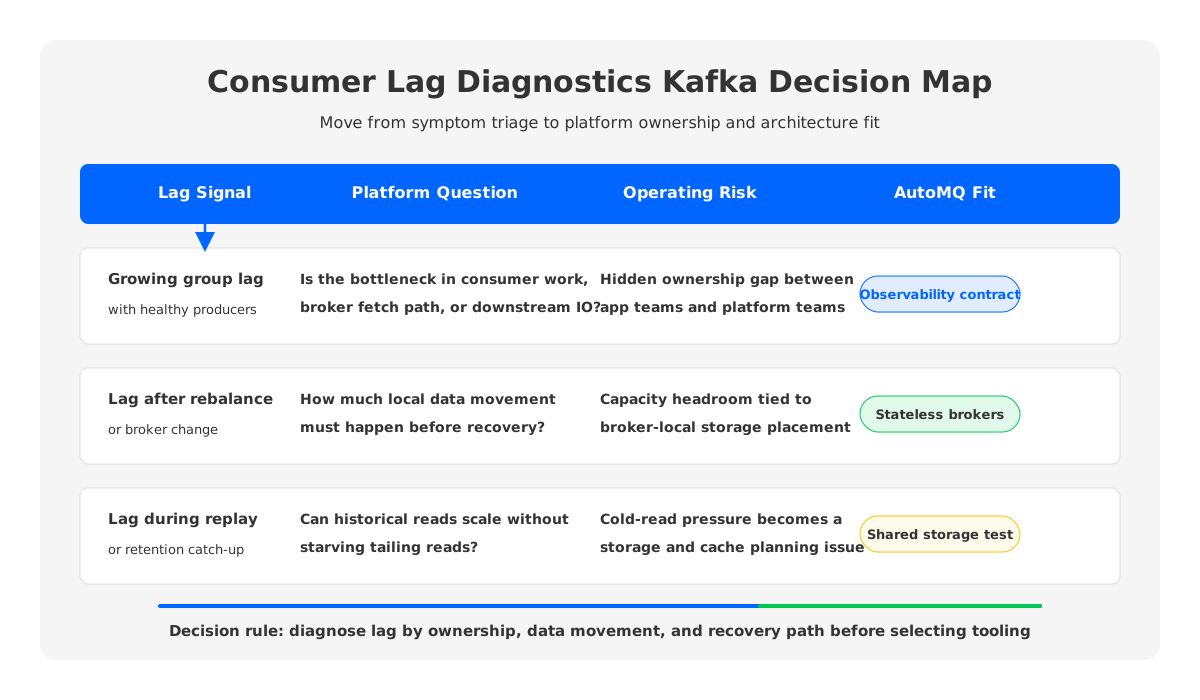
That split does not solve the incident by itself. It prevents the most common failure mode: every team adds a tool, nobody changes the diagnostic contract, and the next lag spike starts from zero again.
2The production constraint behind the problem
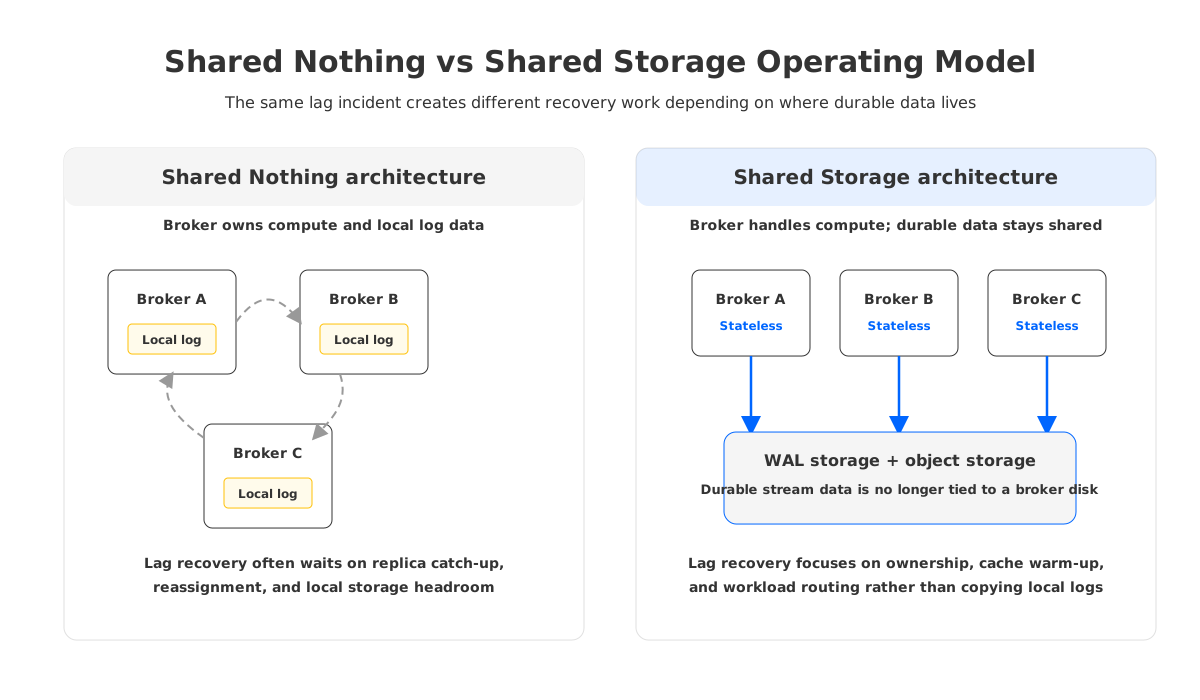
Traditional Kafka runs on a Shared Nothing architecture. Each broker owns local log data, and partitions are replicated across brokers for durability and availability. This design made sense in data center environments where local disks and broker-to-broker replication were the natural building blocks. In cloud environments, the same design turns several operational events into storage placement events.
When a broker fails, the cluster cares about which replicas were on that broker. When a workload outgrows capacity, the cluster cares not only about adding compute but also about where partition data needs to move. When a replay-heavy consumer creates cold-read pressure, the cluster cares whether local disk, remote storage, page cache, and broker fetch paths can serve historical data without harming tailing reads. Consumer lag becomes visible at the application edge, but the root cause may be a broker-local storage constraint.
This is where self-service diagnostics has to go deeper than "check lag, then scale consumers." Scaling consumers helps when the bottleneck is application processing and there are enough partitions to distribute. It does not fix a broker fetch path that is saturated, a downstream sink that is slow, or a platform that is busy moving data after a capacity change. A mature runbook forces the team to ask which queue is growing and why that queue exists.
| Diagnostic question | If the answer points to the app | If the answer points to the platform |
|---|---|---|
| Are consumers polling but not committing? | Inspect processing time, retries, and sink latency. | Check fetch wait time and broker-side throttling before changing application code. |
| Did lag grow after a rebalance? | Review group membership, assignment strategy, and deployment cadence. | Inspect broker changes, partition movement, and leadership churn. |
| Is lag tied to replay or long retention? | Validate batch size, parallelism, and downstream write limits. | Inspect storage path, cache behavior, and cold-read throughput. |
| Does adding consumers reduce lag? | Continue application scaling and partition planning. | Avoid masking a broker, storage, or network bottleneck with more clients. |
The table is deliberately plain. The goal is not to produce a perfect taxonomy; the goal is to stop treating lag as a single metric owned by a single team.
3Architecture options and trade-offs
Platform teams usually have four options once lag diagnostics shows recurring platform pressure. They can tune the existing Kafka cluster, add observability and runbooks, adopt Tiered Storage where it fits, or evaluate a Kafka-compatible platform with a different storage model. Each option is valid in the right context, and each option fails when it is used to solve the wrong layer of the problem.
Tuning is the fastest starting point. Consumer configuration, fetch sizes, partition counts, group assignment strategy, quota policy, and downstream batching all matter. The Apache Kafka documentation is still the first place to review client behavior, consumer group semantics, transactions, KRaft operations, and Tiered Storage configuration. The limitation is that tuning does not change the operating model. If the incident pattern is dominated by broker-local data movement, local storage headroom, or repeated capacity planning, better parameters may reduce pain without changing the cause.
Tiered Storage can help long-retention workloads by moving older log segments to remote storage while keeping the Kafka broker model intact. That is useful when historical data growth is the main pressure and the team can validate remote-read behavior for replay workloads. It is not the same as making brokers stateless. The broker still has an operating role around local storage, segment lifecycle, leadership, and fetch behavior, so teams should test replay, failure recovery, and consumer lag together rather than assuming that remote storage removes storage-driven operations.
The more structural option is Shared Storage architecture, where durable stream data lives in shared object storage and brokers are closer to stateless compute nodes. That changes the question during a lag incident. Instead of asking how much local log data must be copied before the cluster settles, the platform asks how ownership, metadata, cache warm-up, and routing should change so consumers can catch up. This does not remove the need for measurement. It changes which measurement matters.
4Evaluation checklist for platform teams
A self-service platform should let application teams answer the first layer of lag questions without opening a platform ticket, and it should let platform teams prove when the issue has crossed into broker, storage, or network territory. That requires a checklist that covers the whole operating model, not a dashboard that shows one more lag line.
Use this framework before adding another tool or changing platforms:
- Compatibility: Can existing Kafka clients, serializers, transactions, Kafka Connect jobs, monitoring tools, and admin scripts keep their expected contract? A platform change that breaks the application surface turns lag diagnostics into migration work.
- Cost shape: Which meters grow during replay, fan-out, retention, and broker recovery? Include compute, storage, network, private connectivity, observability, and operational headroom.
- Elasticity: Can the platform add or remove capacity without a long period of broker-local data movement? If scaling creates a second incident, the platform is not self-service.
- Governance: Who owns topic creation, Consumer group visibility, ACLs, audit events, Terraform changes, and production runbooks? Lag diagnostics fails when permissions and evidence live in different teams.
- Recovery: What happens when a broker, zone, downstream sink, or consumer deployment fails? The answer should include rollback, not only steady-state success.
- Migration risk: Can offsets, topic configuration, and cutover timing be rehearsed with a non-critical workload before production traffic moves?
- Observability: Can the same incident view show consumer lag, application processing time, broker fetch behavior, storage path metrics, cache behavior, and operational events?
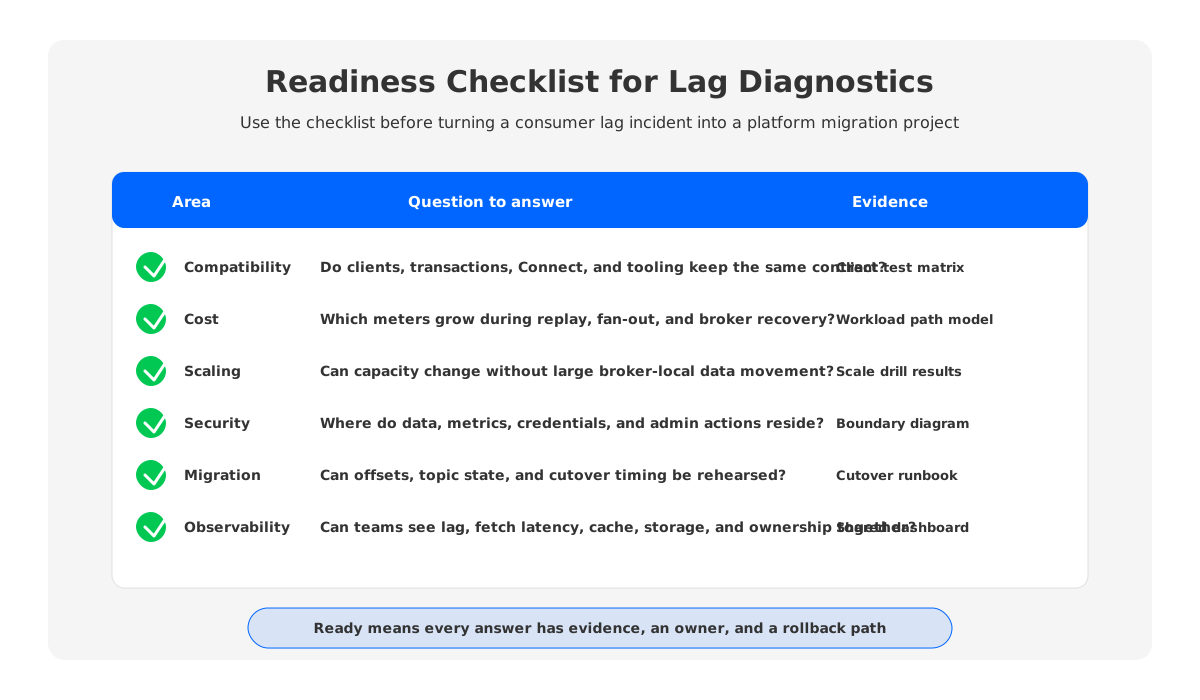
The checklist gives platform teams a better procurement question. Instead of asking whether a product "has consumer lag monitoring," ask whether the platform can reduce the number of teams required to diagnose lag accurately.
5How AutoMQ changes the operating model
After that neutral evaluation, AutoMQ becomes relevant for teams whose lag incidents are tied to cloud operations rather than consumer code alone. AutoMQ is a Kafka-compatible cloud-native streaming platform that uses Shared Storage architecture. It keeps the Kafka protocol and application surface while moving durable stream storage away from broker-local disks and into object storage through S3Stream, WAL storage, and S3 storage.
The diagnostic impact is practical. AutoMQ Brokers are stateless brokers, so broker replacement and scaling are less coupled to copying local log data between machines. Self-Balancing can redistribute traffic as the cluster changes, while Self-healing can isolate unhealthy nodes before they turn into prolonged application incidents. For replay and catch-up scenarios, the platform can reason about Tailing Read, Catch-up Read, data caching, and object storage pressure as first-class parts of the storage path rather than treating historical reads as an afterthought.
AutoMQ Console and Terraform support also matter for self-service. Lag diagnostics is not only a metrics problem; it is a workflow problem. Application teams need visibility into their Consumer groups and topics. Platform teams need controlled ways to change capacity, quotas, access, and deployment state. Security reviewers need to understand where customer data, metrics, credentials, and admin actions reside. AutoMQ BYOC keeps the control plane and data plane in the customer's cloud environment, which gives teams a customer-controlled boundary to evaluate alongside the technical architecture.
Migration is where the checklist becomes concrete. AutoMQ Open Source users can evaluate compatibility with representative workloads and standard Kafka migration approaches. AutoMQ commercial editions provide Kafka Linking for migration scenarios where offset consistency, traffic cutover, and Consumer group progress need careful handling. The right proof of concept is not a polished demo. It is a lag-heavy workload with a known downstream bottleneck, a replay window, a broker replacement drill, and a rollback plan.
6A self-service diagnostic runbook
A useful runbook is short enough to use during an incident and specific enough to prevent guesswork. Start with the Consumer group and identify whether lag is growing across all partitions or concentrated in a few. A skewed pattern points toward partition ownership, key distribution, or a slow shard of downstream work. A broad pattern points toward application capacity, broker path pressure, or a platform-wide event.
Then compare event age with consumer processing time. If records arrive at the client but processing time grows, keep the investigation with the application and downstream system. If client-side processing looks healthy while fetch latency or broker request pressure rises, move the investigation to the platform. If the timing matches a rebalance, deployment, broker replacement, or scaling action, treat the operational event as part of the root cause instead of a coincidence.
Finally, record the evidence in a form that can survive the incident. The artifact can be a dashboard snapshot, command output, runbook note, or ticket template. What matters is that the next team can see why the decision was made. Self-service does not mean every application team debugs Kafka internals. It means they can reach the right boundary with evidence.
7FAQ
7.1What is consumer lag in Kafka?
Consumer lag is the gap between the latest produced offset in a Partition and the offset a Consumer group has processed or committed. It is useful because it shows backlog, but it does not explain the cause by itself.
7.2Is consumer lag always an application problem?
No. Lag can come from slow consumer processing, downstream services, broker fetch pressure, partition skew, rebalances, replay workloads, storage path behavior, or platform operations. The diagnostic process should separate these paths before changing code or adding capacity.
7.3Should teams scale consumers first?
Scale consumers when the application is the bottleneck, the topic has enough partitions, and downstream systems can absorb more work. Scaling consumers is less useful when lag comes from broker, storage, network, or rebalance behavior.
7.4How does Shared Storage architecture help consumer lag diagnostics?
Shared Storage architecture reduces the coupling between broker compute nodes and durable local log data. During capacity changes or broker replacement, the diagnostic focus can shift from copying local data to ownership, cache, routing, and workload behavior.
7.5Where should AutoMQ fit in a lag diagnostics evaluation?
Evaluate AutoMQ after the team has identified that recurring lag incidents are tied to cloud operations, broker-local storage constraints, scaling friction, or recovery behavior. Start with compatibility and workload evidence before comparing product features.
If your consumer lag review keeps returning to the same broker-local storage, replay, and scaling questions, bring the checklist above into a real workload assessment. Start with the AutoMQ technical evaluation path, or test the open project from GitHub with the Kafka clients and incident patterns you already operate.


