
Table of Contents
Table of Contents
Teams usually search for self service quota request kafka after the informal path has already failed. A product team asks for higher producer throughput. A data science team wants replay capacity for a feature pipeline. A support tool needs a temporary consumer burst during an incident review. The platform team can approve each request manually, but every approval carries an uncomfortable question: will this quota change fit the brokers that exist today?
That question is not really about a number in a form. It is about whether the platform can turn business demand into a governed streaming allocation without making an SRE mentally simulate broker disk, partition placement, replication load, cross-zone traffic, lag recovery, and rollback. Kafka has quota mechanisms; the hard part is connecting those logical limits to the physical capacity model underneath them.
1Why teams search for self service quota request kafka
Self-service starts as a developer experience project. The platform team wants fewer tickets. Application teams want faster access. Finance wants clearer chargeback. Security wants a traceable approval path. None of those goals are controversial, but quota requests become sensitive because streaming workloads do not behave like many other internal platform resources.
A service quota for CPU or memory usually maps to a container, namespace, or instance class. A Kafka quota maps to a live traffic path. Producer byte rate, consumer byte rate, request percentage, connection count, retention, partition count, and topic configuration all affect a shared broker pool. A small-looking approval can change write amplification, catch-up reads, controller activity, and storage pressure if the workload lands on a busy part of the cluster.
This is why the first self-service portal often disappoints both sides. Developers see a form that still takes days to approve. SREs see a form that hides the context they need. The useful goal is not "approve everything automatically." The useful goal is to make each request class predictable enough that routine changes can be approved by policy, while risky changes are routed to humans with the right evidence.
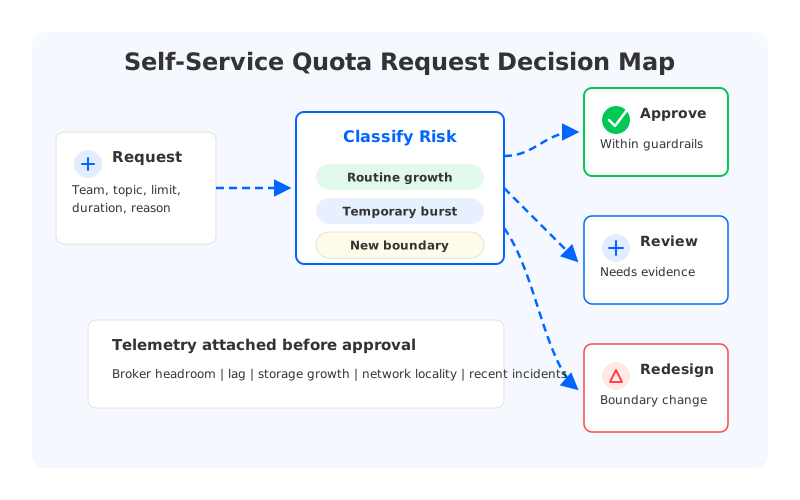
The platform should classify requests by their operational blast radius:
- Routine growth: A team needs a modest producer or consumer limit increase for an existing topic family with stable traffic and known ownership.
- Burst tolerance: A team needs temporary replay or catch-up capacity, often tied to incident response, model refresh, backfill, or event reprocessing.
- New workload class: A team introduces a topic or client pattern with different retention, fanout, partition count, or SLO expectations.
- Boundary change: A tenant, product line, or regulated workload needs a stronger isolation model than the shared quota pool can provide.
Only the first class should feel like a simple form submission. The others need review because the quota number is a symptom, not the decision.
2The production constraint behind the problem
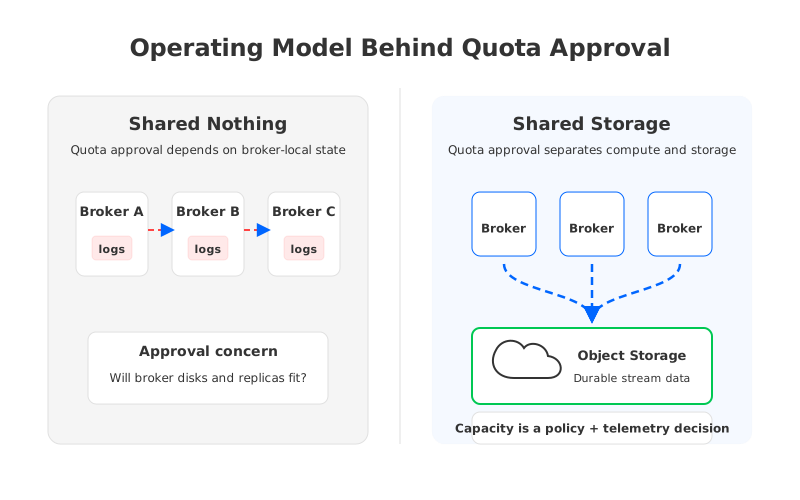
Traditional Kafka runs a shared-nothing storage model: brokers own local log segments, partitions are assigned to brokers, and replication copies data between broker nodes. This model is mature, but it makes capacity approval local. A quota request is not only "how many bytes per second can this client send?" It is also "which brokers will absorb the leaders, followers, replicas, retention, recovery, and reads?"
That broker-local coupling is where guesswork enters the process. If the request is approved too loosely, one tenant can create a noisy-neighbor problem. If the request is denied too conservatively, the platform becomes a bottleneck. If the team creates a dedicated cluster for every uncertain workload, governance improves at the cost of cluster sprawl and underused capacity.
The most painful cases are the ones that look temporary. A consumer replay may last only a few hours, but it can turn cold data into hot broker IO and expose weak alerting. A producer burst may be related to a launch window, but it can force partition reassignment if leaders are already uneven.
| Request dimension | What the form asks | What operations must know |
|---|---|---|
| Producer quota | Desired write throughput | Leader placement, replication factor, WAL or disk pressure, peak window |
| Consumer quota | Desired read throughput | Fanout, catch-up behavior, zone locality, downstream retry pattern |
| Partition count | Number of partitions | Controller load, leader distribution, future expansion path |
| Retention | Hours or days | Physical storage growth, compaction needs, recovery window |
| Isolation | Team, tenant, or app boundary | ACLs, chargeback tags, incident blast radius, rollback path |
The table is deliberately split between request language and operating language. Self-service systems fail when they store the first column and ignore the second. A quota approval workflow needs to translate developer intent into broker impact before it can be trusted.
3Architecture options and trade-offs
There are three common ways to make Kafka quota requests more self-service.
The first option is a shared Kafka cluster with strong policies. This keeps infrastructure efficient and gives platform teams one place to enforce naming, ACLs, quotas, schemas, metrics, and topic lifecycle. The downside is that every request still competes for the same physical broker pool, so the approval process must understand placement and headroom.
The second option is cluster or pool segmentation. A platform might create separate clusters for high-volume services, regulated workloads, experimental teams, or cost centers. This gives clearer boundaries, but it also creates more clusters to patch, monitor, secure, and rebalance.
The third option is a cloud-native Kafka-compatible architecture that reduces the amount of broker-local state involved in scaling decisions. If brokers are less tied to durable local data, a quota request can be evaluated more like a compute and policy decision and less like a storage migration decision.
This distinction matters because quota requests are often requests for elasticity in disguise. Developers care whether the platform can absorb a launch, replay, connector burst, or analytics read without a week of manual coordination. Platform teams care because someone still owns reliability, cost, and incident response.
A fair architecture review should compare at least these dimensions:
- Compatibility: Kafka client behavior, Admin APIs, ACLs, quotas, consumer groups, transactions, connectors, and monitoring should be validated against real workloads.
- Elasticity: The platform should show how request approval maps to capacity addition, reduction, and rollback.
- Cost visibility: The request path should expose storage, compute, network, replay, and idle-capacity implications before approval.
- Governance: Each quota should carry owner, environment, topic class, data sensitivity, expiration, and change history.
- Failure recovery: The same workflow that approves a quota should know what happens when a broker, disk, Availability Zone, or client deployment fails.
- Migration risk: A platform that requires broad client changes will slow adoption, even if the quota workflow looks elegant.
Self-service quota management is not a UI problem first. It is an operating model problem that needs a UI, APIs, automation, and an architecture that can support repeated change.
4Evaluation checklist for platform teams
Before building the portal, define what a quota request must prove. The strongest forms are not longer forms; they ask the few fields needed to choose the right policy. "50 MiB/s for checkout-events, production, two-week launch window, owned by payments-platform, with consumer catch-up expected overnight" is more useful than "50 MiB/s producer quota."
Start with request classes. Routine changes can be policy-driven. Burst requests can be time-limited. New workload classes can require a readiness review. Boundary changes can require an architecture decision record. This prevents the portal from treating every request as equally risky.
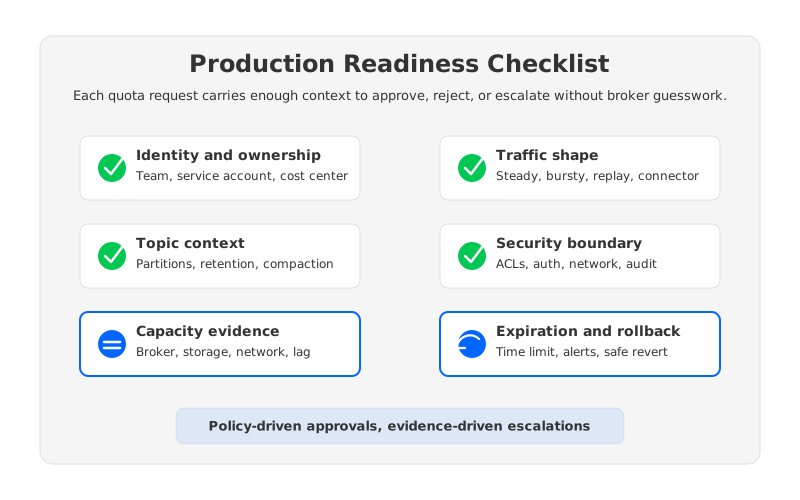
A practical checklist should include:
- Identity and ownership: Which service account, team, cost center, and on-call rotation owns the traffic?
- Traffic shape: Is the request steady, bursty, replay-heavy, connector-driven, or tied to a launch window?
- Topic context: Which topics, partitions, retention policy, compaction settings, and replication requirements are affected?
- Consumer behavior: Will the quota enable live reads only, or should the platform expect catch-up and backfill?
- Security boundary: Which ACLs, authentication mechanism, network path, and audit trail apply?
- Expiration and rollback: Does the increase expire automatically, and what happens if clients fail after the limit changes?
- Capacity evidence: Which broker, storage, network, and lag metrics prove the request can be approved safely?
The last item separates a useful self-service system from a ticket form with better styling. If the platform cannot show capacity evidence, the approver still has to guess. If the evidence is stale, the workflow creates false confidence.
Rejected requests need a useful answer. "Denied" is not enough. The workflow should say whether the request failed because of missing owner metadata, insufficient cluster headroom, unsafe replay behavior, weak isolation, cost policy, or migration risk.
5How AutoMQ changes the operating model
If the operational pain comes from broker-local storage and data movement, then a different Kafka-compatible storage architecture changes the approval conversation. AutoMQ is a cloud-native streaming system that keeps Kafka protocol compatibility while using a shared-storage architecture backed by object storage. Brokers can be treated as a more stateless compute layer, while durable stream data is persisted outside broker-local disks.
That design does not make quotas disappear. Kafka-compatible platforms still need client limits, ACLs, topic controls, observability, and approval policy. The change is that quota approval no longer has to be dominated by the fear that capacity changes will trigger large broker-local data movement. When compute and storage scale more independently, a platform team can evaluate more requests through policy and telemetry.
For self-service quota requests, this has practical effects. Temporary burst capacity becomes easier to reason about because the compute layer can be adjusted without treating every capacity change as a storage relocation project. Retention and replay discussions can be separated from broker disk sizing more cleanly. Cloud cost analysis also becomes more transparent because object storage, compute, and network behavior can be modeled separately.
AutoMQ also matters for deployment boundaries. In customer-controlled deployments such as BYOC, the data plane can stay inside the customer's cloud environment, which is relevant when quota workflows include security, compliance, network, and audit requirements. A self-service workflow for regulated teams should not only ask "how much throughput?" It should also know where the data plane runs, who can access it, and what telemetry leaves the environment.
Zero cross-AZ traffic is another useful operating-model example. In traditional Kafka, replication and client placement can create cross-zone traffic that platform teams must account for when approving heavy producers or consumers. AutoMQ documents a deployment approach intended to eliminate inter-zone traffic through broker and client configuration. For quota approvals, this turns a vague cost concern into a policy question: are clients and brokers configured in a way that keeps traffic local?
A platform that wants self-service quota requests needs Kafka compatibility, governance, clear cost attribution, safe elasticity, and deployment boundaries that match its risk model. AutoMQ fits that category when the team wants a Kafka-compatible API with shared storage, stateless broker operations, object-storage-backed durability, and cloud deployment control.
6A self-service workflow that survives production
The workflow should be boring enough that developers trust it and explicit enough that SREs trust it. A good request starts with identity, workload class, topic scope, target limits, expected duration, and rollback behavior. The platform then enriches that request with live telemetry: throughput, consumer lag, broker headroom, topic placement, storage growth, network locality, and recent incidents.
Once the request is enriched, automation can choose a path. Routine increases within guardrails are approved automatically. Temporary bursts are approved with expiration and alerts. Requests that exceed headroom are returned with a lower limit, a scheduled window, a different topic class, or a dedicated boundary.
This model also improves migration planning. Teams moving from a traditional Kafka cluster to a Kafka-compatible cloud-native platform should inventory quotas, topics, ACLs, service accounts, consumer groups, connector dependencies, client versions, and observability alerts. Quota policy is part of migration state.
Keep the workflow declarative. Store quota intent in code or a platform API, not only in a ticket comment. Attach metadata for owner, environment, duration, justification, topic class, and approval path. Emit events when quotas change. Self-service is not the absence of control; it is control that runs at the speed of the teams using the platform.
7Closing the loop
The original search query sounds narrow, but the production problem is broad. A Kafka self-service quota request is where developer experience, SRE capacity planning, FinOps, security, and architecture meet. If the platform treats the request as a number, every approval depends on broker guesswork. If it treats the request as an operating contract, most routine changes can become predictable.
The path forward is to separate intent from impact. Let developers state what they need in terms they understand. Let the platform translate that intent into compatibility, cost, capacity, governance, and recovery checks.
If you are evaluating whether a Kafka-compatible shared-storage architecture can simplify your quota and capacity workflows, review the AutoMQ architecture documentation here: AutoMQ architecture overview. Use it as a starting point for mapping your current quota approval path to a more policy-driven operating model.
8References
- Apache Kafka documentation
- Apache Kafka design notes on quotas
- Apache Kafka operations documentation
- AutoMQ architecture overview
- AutoMQ compatibility with Apache Kafka
- AutoMQ documentation on eliminating inter-zone traffic
- AutoMQ Cloud BYOC environment documentation
9FAQ
9.1What is a self-service quota request in Kafka?
A self-service quota request is a governed workflow that lets application teams request producer, consumer, connection, partition, retention, or workload limits without opening an unstructured operations ticket. The workflow should still enforce ownership, security, cost, capacity, expiration, and rollback policy.
9.2Are Kafka quotas enough to build a self-service platform?
Kafka quotas are necessary, but they are not the whole platform. A production workflow also needs request classification, topic metadata, ACL review, live capacity evidence, observability, cost attribution, and a clear escalation path when a request changes the risk profile of the cluster.
9.3Why does broker architecture affect quota approvals?
In a shared-nothing Kafka model, brokers own local log data. Higher throughput, retention, replay, or partition count can affect broker disk, replication, leader placement, and recovery behavior. Shared-storage Kafka-compatible architectures reduce the amount of durable state tied to individual brokers, which can make capacity changes easier to reason about.
9.4Should every quota request be automatically approved?
No. Routine requests inside known guardrails can be automated. Burst requests may need expiration and alerts. New workload classes and stronger isolation boundaries should go through human review with enough telemetry attached to make the decision fast and defensible.
9.5How should platform teams start?
Start by inventorying the current request path. Record what developers ask for, what SREs actually check, how often requests are rejected, and which checks require manual broker reasoning. Then convert the repeatable parts into policy, attach live metrics, and reserve human review for requests that change architecture risk.


