
Table of Contents
Table of Contents
Teams search for serverless Kafka because they want fewer capacity meetings, less broker sizing work, and an event streaming platform that can expand and contract with demand while keeping the Kafka API. The word "serverless" carries that promise. It suggests that developers can produce and consume events without caring which broker owns which partition, how much disk is attached, or whether a traffic spike will trigger a long rebalance.
That promise is useful, but easy to blur. A Kafka service can be managed without being deeply elastic. A pricing page can be usage-oriented while the architecture still has hard capacity ceilings. A control plane can hide broker operations while the data plane still depends on broker-local storage and partition movement. For architects and platform teams, the question is what has become serverless: billing, operations, scaling behavior, or the underlying architecture.
1Serverless Kafka Is More Than a Managed UI
Managed Kafka removed a lot of operational burden from self-managed clusters. It reduced the work required to provision brokers, patch software, replace failed nodes, monitor health, and expose endpoints. That is valuable. But "managed" and "serverless" answer different questions.
Managed Kafka asks: who runs the cluster? Serverless Kafka asks a harder question: how much of the cluster's capacity model disappears from the user's operating model? A managed service can still require users to choose broker sizes, storage limits, partition counts, throughput units, or cluster classes. A serverless experience should reduce how often teams need to pre-plan those dimensions and how much risk is created when demand changes.
Four meanings often get compressed into the same phrase:
- Managed Kafka: the provider operates infrastructure, patching, health, and service lifecycle.
- Serverless billing: the bill is tied more directly to throughput, storage, or requests than to fixed broker capacity.
- Serverless operations: users do less broker sizing, capacity forecasting, and maintenance work.
- Serverless architecture: the data plane can scale compute and storage with less coupling to broker-local state.
AWS describes MSK Serverless as a cluster type that runs Apache Kafka without users managing or scaling cluster capacity, automatically provisions and scales capacity, manages topic partitions, and uses throughput-based pricing. That is a strong operational and billing signal. Confluent Cloud's official cluster-type documentation uses cluster classes and elastic capacity units to describe different elasticity and capacity models. Those details matter because they show that "serverless" is not one universal implementation. It is a product and architecture spectrum.
For platform leaders, the evaluation starts by separating experience from mechanism. A product may deliver a serverless user experience through a control plane, multi-tenant service, quotas, or an architecture that decouples durable data from compute. Each path changes limits, isolation, migration, procurement, and workload fit.
2The Four Dimensions of Serverless Kafka
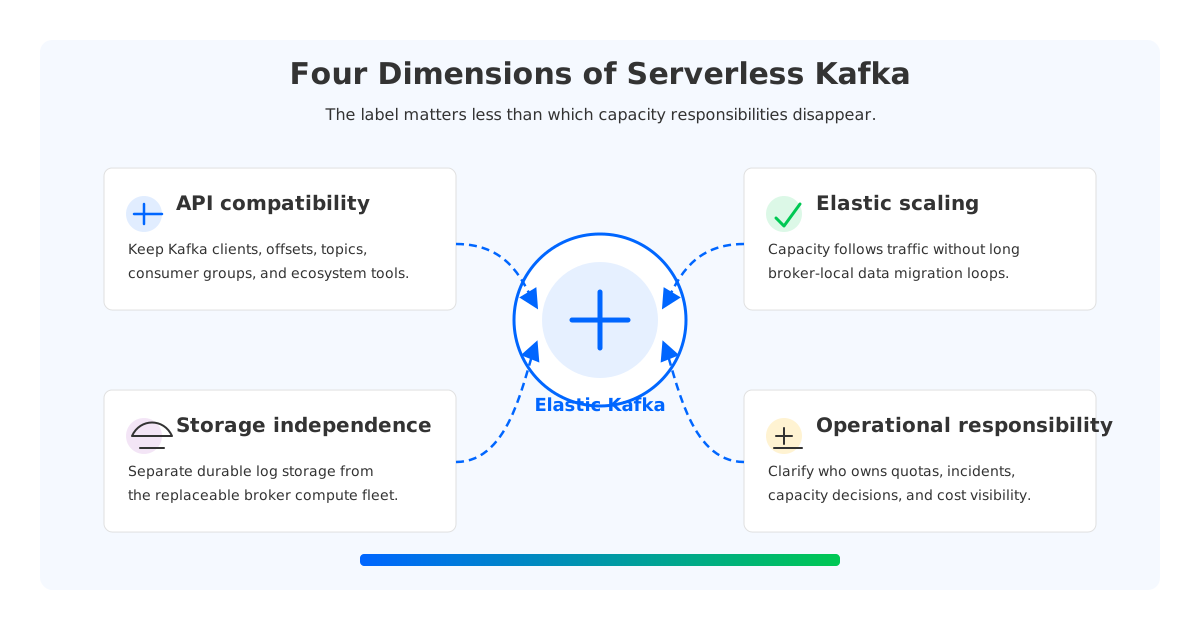
A useful serverless Kafka evaluation has four dimensions: API compatibility, elastic scaling, storage independence, and operational responsibility. Missing one does not automatically make a service bad, but it changes what "serverless" means for the buyer.
2.1API Compatibility
For most Kafka users, serverless Kafka is not a request to abandon Kafka. It is a request to keep Kafka clients, topics, partitions, offsets, consumer groups, Kafka Connect, and Kafka Streams relevant while removing capacity friction. That is why API compatibility is the first dimension.
If a service requires a different event API, it may still be a good streaming system, but it is no longer a clean Kafka serverless path. Existing producers, consumers, observability tools, schema practices, and platform abstractions may need migration work.
Compatibility should be checked at the behavior level, not only the connection-string level: client versions, admin operations, consumer groups, and ecosystem tools all matter.
2.2Elastic Scaling
Elastic Kafka means capacity can follow demand without turning every change into a storage migration project. That includes scale-out when producers or consumers generate more traffic, and scale-in when demand falls. A system that scales out but cannot safely scale in will still encourage over-provisioning.
Elasticity is not one metric. It includes throughput headroom, partition placement, leader movement, storage growth, retention changes, and failure recovery. In traditional Kafka, these interact because brokers usually carry both compute and durable log storage.
Good serverless Kafka designs make the control loop shorter. Capacity should become useful quickly, without turning normal workload variation into long reassignment and data-copy workflows.
2.3Storage Independence
Storage independence is the architectural dimension that is easiest to miss. Kafka stores data in partition logs, and in traditional deployments those logs live on broker-local disks or attached volumes. That makes the broker a compute node and a data location at the same time.
When compute and storage are coupled, retention and throughput forecasting get tangled. Longer retention can require larger disks even if compute demand is unchanged. Higher throughput can require more brokers even if storage is sufficient. Scaling down can require data evacuation before nodes disappear.
Storage-compute separation changes that equation. Durable data lives in shared storage such as object storage, while brokers focus on protocol processing, caching, request routing, and leadership. It changes what must move when the fleet changes.
2.4Operational Responsibility
The final dimension is responsibility. Who decides capacity? Who handles hot partitions? Who applies patches? Who owns quotas, limits, upgrades, incident response, and cost visibility? Serverless Kafka should reduce operational responsibility for the application and platform teams, but the reduction can happen in different places.
A fully hosted serverless service may absorb most operational duties into the provider. A BYOC or self-managed architecture may keep infrastructure in the customer's account while reducing data-plane coupling. The right choice depends on what must be elastic and what must stay under direct control.
3Why Traditional Kafka Makes Serverless Hard
Apache Kafka's core model is partitioned and replicated. Topics are split into partitions, partitions have leaders and replicas, and brokers serve client requests based on partition leadership. This gives Kafka parallelism, ordering within a partition, and fault tolerance. It is also why Kafka does not scale like a stateless web service.
When a stateless service scales out, added instances can receive traffic through a load balancer. When Kafka scales out, added brokers do not automatically own the busiest partitions. The platform has to move leadership, place replicas, preserve availability rules, and avoid overloading the cluster while redistribution is happening.
Broker-local storage adds the heaviest constraint. If durable partition data is stored on the broker, scaling is not only a compute event. It can become a data movement event. Added brokers need replicas to catch up; removed brokers need data evacuated; rebalance throttles must protect production traffic.
That coupling creates several serverless blockers:
- Capacity becomes sticky. A broker with important local data cannot be treated as disposable compute.
- Scale-out has a delay. Added brokers may not help until leaders and replicas are moved.
- Scale-in has risk. Removing brokers can require careful evacuation and availability checks.
- Retention changes affect compute shape. Longer retention can drive disk sizing even when CPU demand is stable.
- Hot partitions remain application-shaped. More brokers do not fix a key distribution problem by themselves.
These are not flaws in Kafka's original design. They are consequences of using a stateful distributed log architecture in environments where users expect cloud-native elasticity. Traditional Kafka can be automated and operated well, but the serverless promise is constrained when state and compute live in the same place.
4Managed Kafka, Serverless Kafka, and Stateless Architecture
The word "serverless" is sometimes used as a buying shortcut: fewer knobs, no broker fleet, pay for what is used. That shortcut is helpful for early filtering, but it can hide important architecture differences.
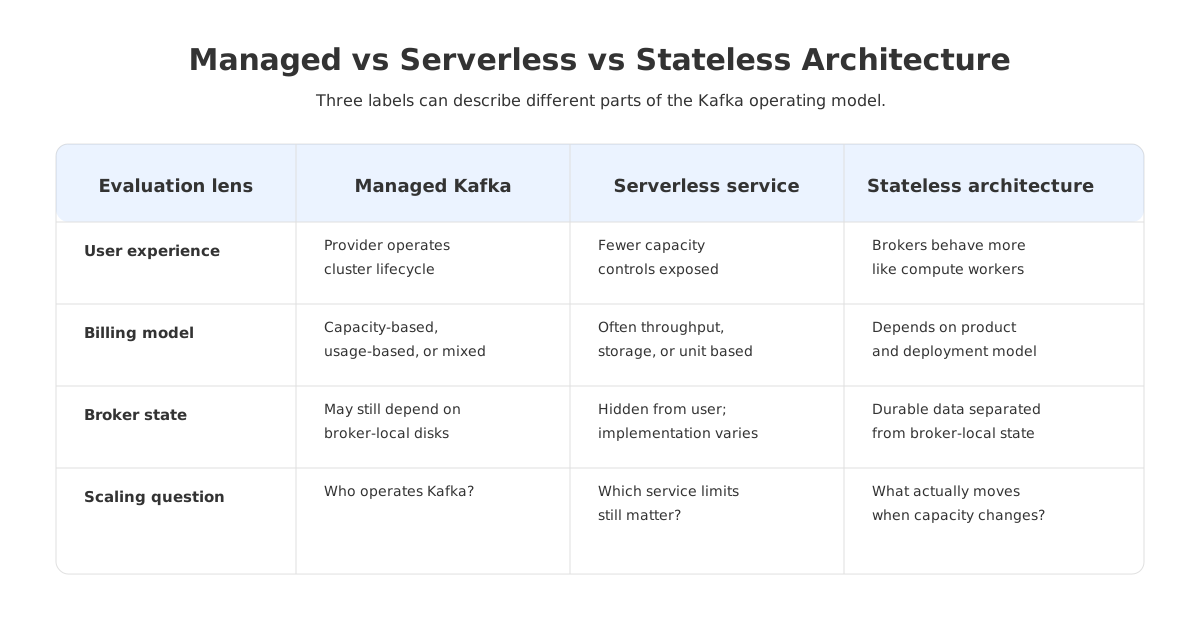
| Evaluation lens | Managed Kafka | Serverless Kafka service | Stateless shared-storage Kafka architecture |
|---|---|---|---|
| User experience | Provider operates the cluster | User sees fewer capacity controls | Operators can treat brokers more like compute workers |
| Billing model | Often capacity-based, usage-based, or a mix | Often throughput, storage, request, or unit based | Depends on product and deployment model |
| Broker state | May still be tied to broker-local disks | Hidden from the user, implementation varies | Durable data is separated from broker-local storage |
| Scaling behavior | Automated but may require sizing choices | Capacity can scale within service quotas | Scaling can move toward metadata, ownership, and traffic scheduling |
| Best question to ask | "Who operates Kafka?" | "Which limits still matter?" | "What actually moves when capacity changes?" |
This distinction is especially important for teams comparing hosted services with BYOC or private-cloud options. A hosted serverless Kafka service may provide the least operational work for application teams. A stateless architecture may provide a stronger foundation for elasticity while preserving more control over environment, network, data location, and procurement model.
A strong evaluation combines product experience with architecture due diligence: partition count, hot partitions, retention growth, burst throughput, consumer lag, scale-in, network isolation, and quota changes.
5How AutoMQ Supports a Serverless-Like Kafka Architecture
If the root limitation is the coupling between brokers and durable log storage, the architecture-level response is storage-compute separation. That is where AutoMQ naturally enters the discussion: it is a Kafka-compatible streaming platform that uses object-storage-backed shared storage and stateless brokers to reduce the data-plane constraints behind elastic Kafka.
AutoMQ does not need to be described as a generic usage-based serverless service for this point to matter. The precise claim is architectural. AutoMQ keeps Kafka protocol compatibility while moving durable data away from broker-local disks and into shared object storage. Brokers focus on protocol handling, caching, traffic serving, and partition ownership. Public AutoMQ documentation describes shared storage, stateless brokers, self-balancing, and fast partition reassignment.
That changes the scaling conversation. When a broker is no longer the primary durable data location, adding or replacing brokers can depend less on copying large local logs. Capacity work can focus on compute demand, cache behavior, network path, object storage performance, and workload SLOs.
This is why stateless Kafka and serverless Kafka often belong in the same architectural conversation. Serverless is the desired operating experience; stateless brokers and shared storage are one credible foundation for getting closer to that experience while retaining Kafka compatibility.
6Serverless Kafka Evaluation Checklist
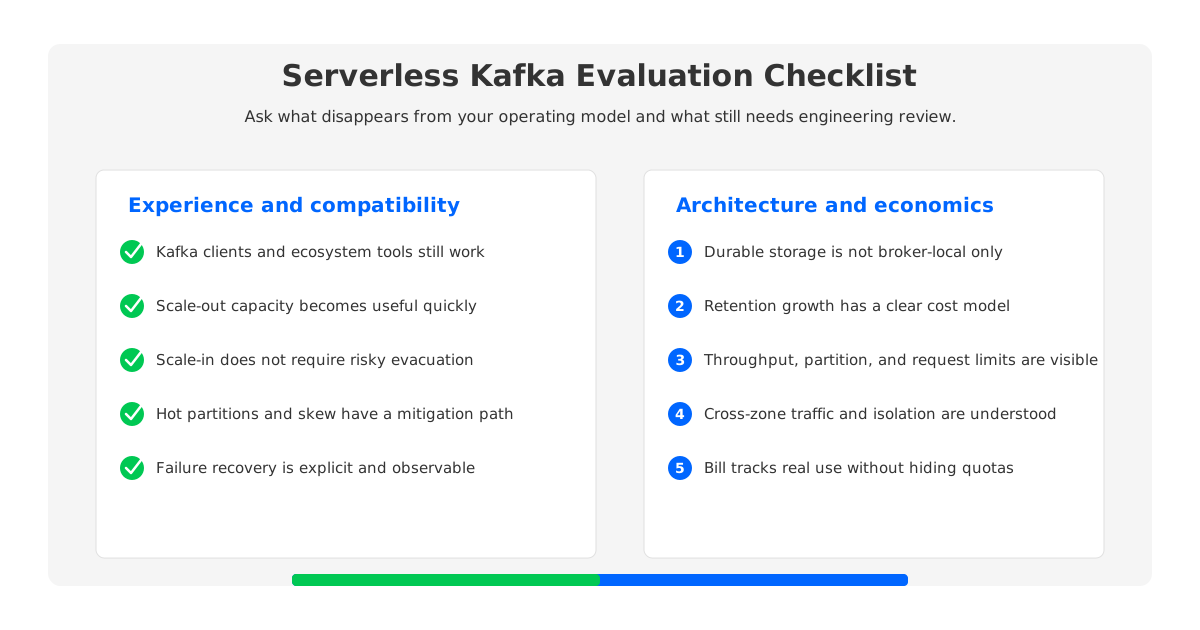
Before adopting any kafka serverless option, treat the vendor label as the beginning of the review. Understand which responsibilities disappear, which limits remain, and which constraints are still yours.
A practical checklist includes:
- Kafka compatibility: client versions, admin APIs, consumer groups, Kafka Connect, Kafka Streams, ACLs, and observability tooling.
- Elastic scale-out: how capacity is added, how quickly it becomes useful, and what happens to partition leadership.
- Elastic scale-in: whether capacity can shrink safely or whether the service encourages permanent headroom.
- Storage model: whether durable data is broker-local, tiered to remote storage, or stored in shared primary storage.
- Retention behavior: how longer retention changes cost, storage limits, and broker capacity.
- Hot partition handling: whether the platform can identify and mitigate skew or only add aggregate capacity.
- Quota and limit transparency: partition limits, throughput limits, connection limits, regional availability, and request limits.
- Cost visibility: how throughput, storage, retention, cross-zone traffic, and operations appear in the bill.
- Isolation and data control: tenancy model, network boundaries, BYOC options, and customer-owned infrastructure requirements.
- Failure recovery: what happens when brokers fail, zones degrade, or object storage paths experience pressure.
The key question is simple: when demand changes, what has to move? If the answer is mostly compute, ownership, and routing, the architecture is closer to elastic Kafka. If the answer is large amounts of durable broker-local data, the experience may be managed without being fully serverless in the architectural sense.
7What to Choose
For developer teams with variable traffic and minimal infrastructure ownership requirements, a hosted serverless Kafka service may be the right default. It can reduce provisioning work, simplify early adoption, and align cost with active usage patterns better than a fixed broker fleet.
For platform teams with strict data-location requirements, BYOC preferences, high retention needs, or direct cloud control requirements, the better question may be whether the Kafka architecture is stateless enough to support serverless-like operations.
For procurement and CTO-level evaluation, avoid asking only "Is it serverless?" Ask what kind of serverless it is. Serverless billing can improve financial alignment. Serverless operations can reduce team load. Serverless architecture can reduce the state that blocks elasticity.
Kafka earned its place as a durable, compatible, high-throughput streaming backbone. Serverless Kafka should mean making capacity less sticky, scaling less tied to data movement, and operations less dependent on permanent over-provisioning.
8References
- Amazon MSK: What is MSK Serverless?
- Confluent Cloud cluster types
- Apache Kafka documentation: concepts and terms
- AutoMQ documentation: architecture overview
9FAQ
9.1What is serverless Kafka?
Serverless Kafka is a Kafka-compatible streaming experience where users manage less capacity and operations work than in a traditional broker-based cluster. Depending on the service, it may include automatic capacity scaling, throughput-based billing, managed operations, or an architecture that separates compute from durable storage.
9.2Is serverless Kafka the same as managed Kafka?
No. Managed Kafka means a provider operates Kafka infrastructure for you. Serverless Kafka should go further by reducing capacity forecasting, scaling work, and fixed infrastructure decisions. Some managed Kafka services are not fully serverless, and some serverless experiences still have quotas and architectural limits.
9.3Why is traditional Kafka hard to make serverless?
Traditional Kafka brokers usually own both compute and durable partition data on local or attached storage. When the cluster scales, Kafka often needs partition leadership changes, replica placement changes, and data movement. That makes elasticity more complex than adding stateless compute instances.
9.4What does stateless Kafka have to do with serverless Kafka?
Stateless Kafka separates durable data from broker-local storage so brokers can behave more like replaceable compute nodes. This can make scaling, replacement, and rebalancing less dependent on moving large local logs, which supports a serverless-like operating model.
9.5Is AutoMQ a serverless Kafka service?
AutoMQ is best described here as a Kafka-compatible, shared-storage architecture with stateless brokers. That architecture can support serverless-like elasticity by reducing broker-local state. Do not assume a usage-based serverless billing model unless the specific AutoMQ product and contract state it.


