
Table of Contents
Table of Contents
A platform team usually starts searching for serverless kafka cost boundaries after the first bill review that does not match the architecture diagram. The Kafka cluster may be stable. Producers may be healthy. Consumer lag may be under control. Yet the invoice shows storage growing faster than traffic, cross-zone transfer that nobody budgeted for, connector infrastructure owned by a different team, and enough idle capacity to make FinOps ask whether "serverless" actually changed the cost model or only moved the line items.
That question is fair. Kafka became the default event backbone because it gave engineering teams a durable, high-throughput log with clear client semantics. The hard part is that Kafka's operational model was shaped around broker-local storage, partition leadership, replication, and capacity planning. In a cloud environment, those technical choices become financial boundaries. The team paying for compute is not always the team generating retention. The team owning network architecture is not always the team operating consumers. The team signing the platform contract is not always the team handling partition reassignment during an incident.
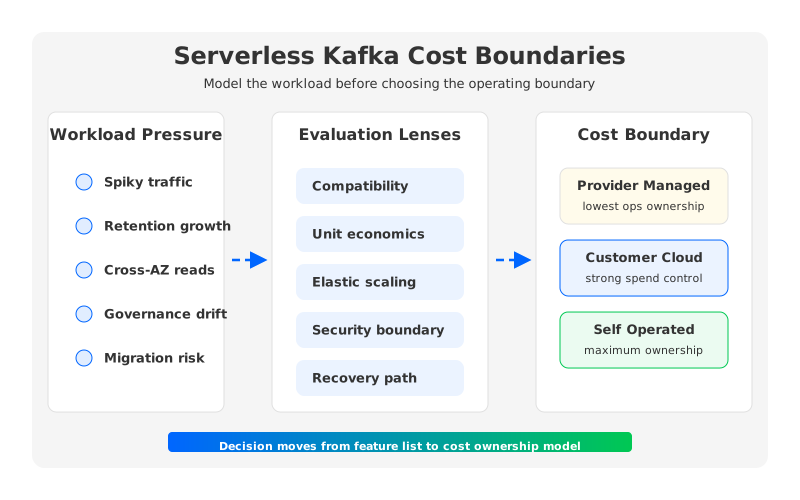
Serverless Kafka should therefore be evaluated less like a feature bundle and more like an ownership model. The useful question is not "Does this platform remove brokers from my screen?" The useful question is "Which cost and operational responsibilities remain with my team, which move to the provider, and which become cloud infrastructure charges that still appear in my account?"
1Why Teams Search For Serverless Kafka Cost Boundaries
The search phrase sounds financial, but the pain is usually operational. A team wants Kafka-compatible streaming without the weekly cycle of disk expansion, partition balancing, broker replacement, and emergency quota negotiation. At the same time, the team cannot let a managed service become an unbounded expense. A streaming platform that scales without a model is not elasticity. It is an open-ended commitment with a nicer console.
Three groups tend to enter the discussion with different definitions of success:
- Platform engineering wants fewer broker-level operations, predictable failure recovery, and compatibility with the Kafka ecosystem already in production.
- FinOps wants every major cost driver tied to a workload variable: ingress, egress, retained bytes, partition count, replication, connector tasks, private networking, and support.
- Security and governance teams want clear deployment boundaries, identity control, encryption, auditability, and region or account ownership.
These goals are not in conflict, but they do require a shared model. Apache Kafka documentation defines the semantics that many teams depend on, including producer and consumer behavior, consumer groups, transactions, Kafka Connect, and KRaft metadata management. Any Kafka-compatible alternative has to respect those expectations before cost optimization is worth discussing. A lower monthly bill does not help if client behavior changes, offsets become hard to reason about, or migration requires rewriting every integration.
The boundary exercise starts by separating two ideas that are often merged in sales conversations. One idea is operational abstraction: the provider reduces the day-to-day work of running brokers. The other is economic abstraction: the pricing model tracks the way your workload consumes resources. A service can improve the first while making the second harder to forecast.
2The Cloud Cost Drivers Behind The Workload
Kafka cost is not a single number. It is a chain of resource commitments created by durability, throughput, retention, isolation, and recovery requirements. Traditional clusters make those commitments explicit through broker instances, disks, replication factor, and network placement. Serverless or managed platforms may hide the physical layout, but the underlying physics still exist. Bytes are written, stored, copied, fetched, monitored, and sometimes moved during recovery or scaling.
The practical model starts with workload shape. Sustained write throughput determines the minimum ingest capacity. Retention determines how much durable storage accumulates. Read fan-out determines how many times the same records are fetched by independent consumers. Peak-to-average ratio determines whether provisioned capacity sits idle between bursts. Connector workloads add their own tasks, retries, transforms, and downstream backpressure. Governance adds private connectivity, audit logs, encryption, and environment isolation.
| Boundary | What To Model | Why It Changes The Bill |
|---|---|---|
| Compute | Broker capacity, proxy capacity, connector workers, controllers | Reserved capacity can be idle during low traffic and insufficient during peaks. |
| Storage | Retained bytes, replica policy, tiering, compaction, snapshots | Durable log storage grows with retention even when current traffic is flat. |
| Network | Cross-AZ replication, consumer reads, private links, internet egress | Cloud data transfer can be charged separately from compute and storage. |
| Operations | Rebalancing, upgrades, observability, incident recovery | Human and automation cost increases when state must move between brokers. |
| Governance | Account boundary, encryption, IAM, audit, compliance evidence | Security controls can introduce dedicated resources or connectivity charges. |
This table is intentionally independent of any single product. It gives platform teams a way to compare self-operated Kafka, a managed Kafka service, a serverless Kafka-compatible service, and a cloud-native architecture with shared storage. If a provider cannot map pricing and responsibilities into these categories, procurement will struggle to predict the cost boundary.
Network deserves special attention because it is easy to miss in architecture reviews. In a multi-AZ Kafka deployment, replication and consumer locality affect whether data crosses zone boundaries. Cloud providers publish separate pricing pages for storage, compute, and data transfer, which is the first clue that these resources should not be blended into one "Kafka cost." A design that reduces broker work but increases cross-zone reads may move cost rather than remove it.
3Storage, Network, And Compute Trade-Offs
The most important architectural question is where durable state lives. In traditional Kafka, partitions are stored on broker-local disks. Replication across brokers gives durability and availability. This design is coherent and battle-tested, but it also means brokers are not interchangeable units of compute. They carry data. When you replace a broker, expand a cluster, or rebalance hot partitions, the system has to reason about where data lives and how much of it must move.
That broker-local model turns storage decisions into compute decisions. A broker sized for disk retention may have more CPU than the workload needs. A broker sized for peak ingress may have more disk than the workload needs. A retention increase can force a storage expansion even when current traffic has not changed. A hot partition can require reassignment that competes with production traffic. The cluster can be healthy and still be economically awkward because compute and storage are purchased as a coupled unit.
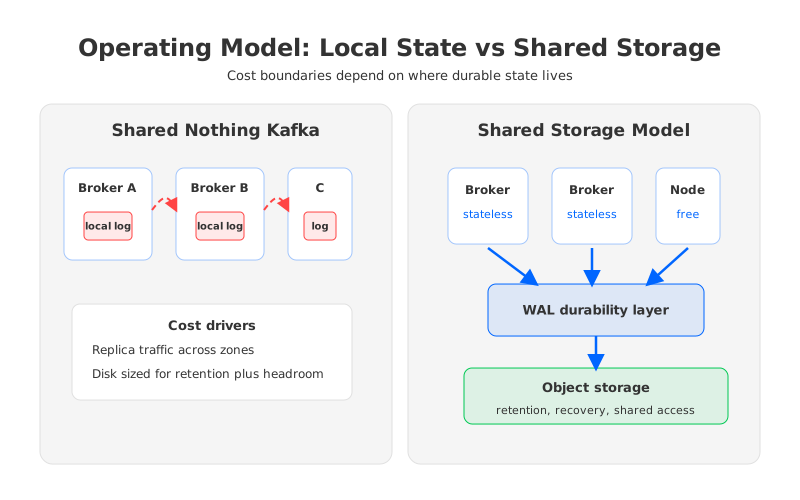
Tiered storage changes part of this equation by offloading older segments to object storage. It can reduce pressure on local disks for historical data, and Apache Kafka includes tiered storage documentation for this direction. But tiering is not the same as making brokers stateless. Hot data, leadership, local log management, and reassignment behavior still matter. For cost-boundary modeling, the distinction is important: tiering can reduce retained-data pressure, while a shared storage architecture changes the operational assumption that each broker owns durable partition data.
This is where serverless claims need careful inspection. A serverless interface can hide cluster sizing from the user while still relying on capacity pools, local state, or network replication behind the scenes. That may be acceptable. The point is not that every platform must use the same architecture. The point is that buyers should know which workload variables create marginal cost. Ask what happens when retained data doubles, when read fan-out triples, when one AZ becomes unavailable, when connector lag spikes, and when a producer burst exceeds the usual daily pattern.
A useful evaluation also separates storage cost from recovery cost. Object storage can be attractive for retained data because it is elastic and billed by usage, but streaming systems still need low-latency write durability and predictable read behavior. The write-ahead log, cache strategy, metadata path, and failure recovery process matter. A platform that stores data economically but recovers slowly may be a poor fit for sensitive workloads.
4Evaluation Checklist For FinOps And Platform Teams
The best cost review is not a spreadsheet created after vendor selection. It is a design gate before selection. The team should define workload assumptions, run a proof of concept against representative traffic, and require each option to explain its responsibility boundary in the same language.
Use these questions as the first pass:
- Compatibility: Which Kafka protocol version, client libraries, consumer group behaviors, offsets, transactions, ACLs, and Kafka Connect integrations are supported? Which features are documented as limitations?
- Cost shape: Which dimensions are metered directly, which are bundled, and which appear as cloud-provider charges outside the platform invoice?
- Elasticity: What actually scales when traffic changes: brokers, partitions, storage, connector workers, network paths, or an abstract capacity unit?
- Data movement: When scaling, recovering, or rebalancing, does the platform move full partition data, metadata, or neither?
- Governance: Where do data, credentials, logs, metrics, and operational access live? Can the platform fit the organization's account, VPC, region, and audit boundaries?
- Migration: Can the team preserve producer behavior, consumer progress, topic configuration, and rollback options during cutover?
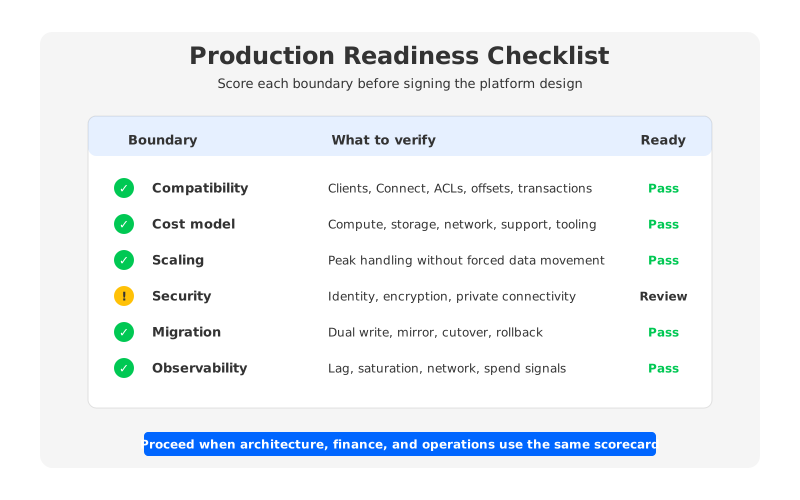
The checklist should end with a decision matrix, not a yes-or-no vote. A startup running moderate traffic with a small platform team may choose maximum operational abstraction even if some unit costs are higher. A regulated enterprise may prefer a customer-controlled deployment boundary. A data platform with extreme retention growth may care most about storage economics and independent scaling.
| Decision Area | Good Signal | Risk Signal |
|---|---|---|
| Workload fit | Pricing tracks ingress, reads, retention, and peaks in a way the team can forecast. | Pricing hides the resource that grows fastest in your workload. |
| Operational fit | Scaling and recovery do not require large manual data movement windows. | Routine changes depend on partition reassignment or broker-local capacity reshuffling. |
| Governance fit | Data ownership, access, and audit boundaries match existing cloud controls. | Provider access, network paths, or region constraints require exceptions. |
| Migration fit | Existing Kafka clients and ecosystem tools can move with limited change. | Migration requires application rewrites or ambiguous offset handling. |
The matrix is also a negotiation tool. "What is included?" becomes "Which workload variable is included, and what happens when it doubles?" That is the difference between buying a service and understanding a platform.
5How AutoMQ Changes The Operating Model
Once the evaluation framework is clear, AutoMQ fits into a specific architectural category: a Kafka-compatible, cloud-native streaming platform built around Shared Storage rather than broker-local durable logs. AutoMQ keeps compatibility with Apache Kafka protocols and semantics while changing the storage layer beneath the broker. In practical terms, the design goal is to make brokers closer to stateless compute and place durable stream data in object storage with a WAL layer for write durability.
That architecture changes the cost-boundary conversation in three ways. First, storage can scale independently from compute because retained data is not tied to the disk attached to a broker. Second, broker replacement and scaling do not need to be dominated by moving full partition data between local disks. Third, cross-AZ traffic can be reduced through an architecture that avoids traditional broker-to-broker replica traffic and supports zone-aware access patterns. AutoMQ documents this as a Shared Storage architecture and also provides guidance for eliminating inter-zone traffic.
The product point should not be overstated. A shared storage architecture does not remove the need for workload testing, client validation, observability, or migration planning. It changes which assumptions you test. Instead of asking how much broker-local disk to reserve for retention, you ask how object storage, WAL, cache, and compute capacity behave under ingest, read fan-out, and recovery scenarios.
For teams that want customer-controlled boundaries, AutoMQ's deployment model is relevant. AutoMQ provides BYOC and software deployment paths, which can keep infrastructure in the customer's cloud or Kubernetes environment while still targeting Kafka compatibility and cloud-native elasticity.
The natural next step is a workload-specific model, not a generic promise. List your top topics by write rate, retention, read fan-out, and compliance boundary. Map each one to compute, storage, network, and operations. Then test the two or three cost drivers that dominate your bill. If Shared Storage looks aligned with those drivers, evaluate AutoMQ's architecture and deployment options against your own traffic profile: Start an AutoMQ trial.
6References
- Apache Kafka Documentation
- Apache Kafka KRaft documentation
- Apache Kafka Tiered Storage documentation
- Apache Kafka Connect documentation
- AutoMQ Architecture Overview
- AutoMQ Compatibility with Apache Kafka
- AutoMQ WAL Storage
- AutoMQ Inter-Zone Traffic Overview
- AWS S3 Pricing
- AWS EC2 On-Demand Pricing
- Google Cloud Storage Pricing
- Azure Blob Storage Pricing
7FAQ
7.1Is serverless Kafka always lower cost than self-managed Kafka?
No. It depends on workload shape, retention, read fan-out, network locality, operational staffing, and governance requirements. Serverless can reduce operational work, but platform teams still need to model the resource dimensions that drive marginal cost.
7.2What is the biggest hidden cost in Kafka-compatible cloud platforms?
Network transfer is often the least visible cost because it can appear outside the streaming platform invoice. Cross-AZ replication, remote consumers, private connectivity, and connector paths should be reviewed separately from compute and storage.
7.3How is Shared Storage different from Tiered Storage?
Tiered Storage offloads older log segments from broker-local disks to remote storage. Shared Storage makes object storage part of the primary stream storage architecture, reducing the dependence on broker-local durable state. The operational difference shows up during scaling, recovery, and retention growth.
7.4What should be tested before migrating to a Kafka-compatible alternative?
Test client compatibility, consumer group behavior, offset handling, ACLs, transactions if used, connector behavior, monitoring, failure recovery, and rollback. Cost tests should use representative traffic rather than synthetic ingress alone.
7.5Where does AutoMQ fit in a serverless Kafka cost evaluation?
AutoMQ is relevant when the evaluation favors Kafka compatibility, independent compute and storage scaling, object-storage-backed durability, reduced cross-AZ traffic, and customer-controlled deployment boundaries. It should still be validated against the team's actual workload and governance requirements.


